
You are currently browsing the category archive for the ‘Politics’ category.
In Canada’s high-trust society, the rule of law cannot endure selective enforcement. When certain groups are shielded from consequences while others face harsh penalties for identical actions, the principle of equality before the law collapses. What emerges instead is favoritism by creed or identity—a betrayal that fragments unity and breeds resentment.
Uneven Standards in Practice
Toronto street prayers (August 2024). Hundreds of worshippers staged outdoor prayers at a busy downtown intersection, apparently without permits, halting traffic. Police did not intervene and later described the disruption as lawful. Few doubt how a Christian congregation attempting the same would have been treated: injunctions would be swift, fines inevitable. The point is not hostility toward prayer, but the evident double standard.[1]
Reckless firearm discharge in Muskoka (August 2025). Videos surfaced of men firing rifles and pistols from a snowmobile bridge near MacTier. Ontario Provincial Police confirmed an investigation, warning that careless use of firearms can bring Criminal Code charges. Yet similar celebratory gunfire at cultural festivals, whether at South Asian weddings or Indigenous gatherings, often receives muted responses or “contextual” exemptions. Danger is danger, regardless of tradition.[2]
Pro-Palestinian marches in Toronto (2024–2025). Demonstrations repeatedly blocked major roads, including rallies where smoke bombs were deployed from overpasses. Despite millions spent on policing, arrests remained rare—only 24 across hundreds of events by March 2024. Contrast this restraint with the 2022 Freedom Convoy in Ottawa, where the Emergencies Act was invoked, bank accounts were frozen, and police forcibly dismantled encampments. The contrast is glaring: enforcement appears to hinge less on infractions than on identity and political alignment.[3][4]
Mill’s Warning on Law and Liberty
John Stuart Mill, in On Liberty (1859), emphasized that genuine freedom depends on impartiality of the law. If rules are applied based on popularity or group identity, he argued, society replaces principle with prejudice, inviting arbitrary power. Selective enforcement, Mill warned, is a subtle but corrosive path to tyranny—not only by the state but by favored factions within society.[5]
Restoring Trust
A society built on trust cannot thrive under inconsistent law enforcement. The law must apply equally, regardless of race, religion, or political leaning. To preserve legitimacy, policing standards should be codified and subject to independent oversight. Discretion is unavoidable, but unreviewed discretion becomes favoritism. Equality before the law is not optional—it is the bedrock of Canadian unity. Without it, trust will wither, and division will prevail.

References
- “Toronto residents upset after Hamas supporters blockade busy intersection.” Juno News, Mar 21, 2025. Link
- “Gun video sparks OPP investigation.” MuskokaRadio.com, Aug 28, 2025. Link
“UPDATE: Bracebridge OPP investigating social media videos depicting unlawful firearm use.” MyMuskokaNow, Aug 28, 2025. Link
“OPP seek public help in identifying men firing guns off bridge in Mactier.” Barrie360.com, Aug 30, 2025. Link - “Police arrest two at pro-Palestinian rally that delayed Trudeau event in Toronto.” CityNews, Mar 15, 2024. Link
“Palestine solidarity protesters attacked by police in Toronto.” People’s Dispatch, Apr 3, 2024. Link
“Violent Crackdown at Land Day March.” The Grind Magazine, Mar 31, 2024. Link - “Canada convoy protest.” Wikipedia, accessed Sept 2025. Link
“TD Bank freezes accounts that received money for Canada protests.” Reuters, Feb 12, 2022. Link - Mill, J.S. On Liberty. London: John W. Parker and Son, 1859.
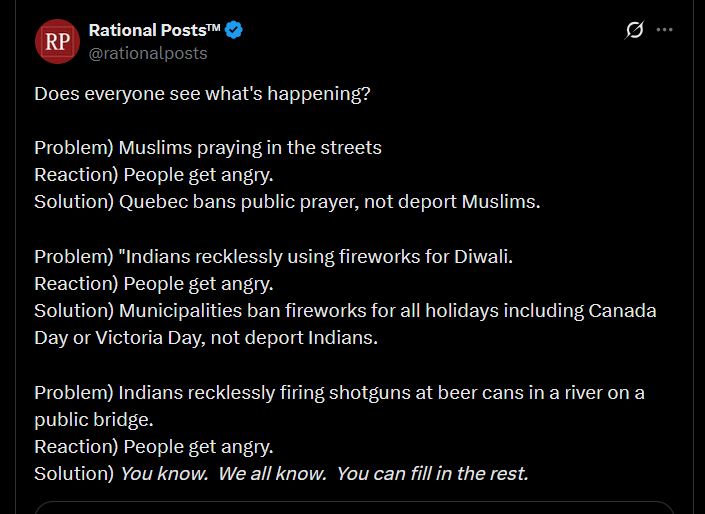
The solution to thwart this insidious strategy of systematically stripping Canadians of their rights lies in enforcing the law with unyielding equality, blind to race or religion, a principle that stands as the bedrock of a just society. The Rational Posts narrative reveals a troubling trend: public outrage over Muslims praying in streets or Indians celebrating Diwali with fireworks, and now shotguns on a bridge, triggers blanket bans, from Quebec’s prohibition on public prayer to municipal fireworks restrictions, effectively punishing entire communities rather than addressing specific transgressions. This corrosive approach, echoing the divisive echoes of Jim Crow or apartheid, corrodes multicultural unity and foments resentment, as social cohesion studies irrefutably demonstrate. Instead, precise legislation targeting reckless acts, such as discharging firearms irresponsibly, must replace these broad edicts, ensuring accountability without stifling cultural expression. Fair laws unite: bans divide. Let us, with urgent resolve, choose the former and reclaim a Canada where justice, not prejudice, prevails.
Picture a library, its shelves stripped of Orwell and Atwood, replaced by outrage: this is the activist’s trap. Critical social constructivism—commonly branded as “woke ideology”—does not depend on truth-seeking but on the imposition of narrative, luring well-meaning observers into excusing captured institutions as merely inept (Kincheloe, 2005). To extend such charity is to enable agendas that corrode trust in public institutions and divide communities.
The Edmonton Public School Board’s (EPSB) recent book removal controversy exemplifies this dynamic. In late August 2025, a leaked list of more than 200 titles slated for removal from K–12 school libraries ignited national outrage. The list included canonical works such as Margaret Atwood’s The Handmaid’s Tale and Aldous Huxley’s Brave New World. Media coverage swiftly framed the list as a right-wing purge: a literary witch-hunt torching academic freedom and signaling Alberta’s dystopian slide.
Yet this spectacle obscures the actual policy. In July 2025, Education Minister Demetrios Nicolaides issued a directive requiring school boards to remove sexually explicit materials by October 1, 2025, to ensure age-appropriate resources in K–12 libraries (Alberta Ministry of Education, 2025). The directive does not ban classics nor prohibit parents from providing controversial works privately. Its scope is limited: public schools, funded by taxpayers, must not circulate sexually explicit material to children.
Seen in this light, the EPSB’s list appears less a bureaucratic stumble than a narrative maneuver. By placing revered classics alongside contested titles such as Maia Kobabe’s Gender Queer—which contains explicit illustrations of sexual acts—and Jonathan Evison’s Lawn Boy, which describes sexual encounters between minors, the Board ensured the reaction would focus on “censorship” rather than explicit content. The outrage generated by the supposed “banning” of Atwood and Huxley distracts from the substantive question: whether K–12 libraries should carry graphic sexual material at all.
To be fair, some argue this was an honest misstep. Officials under pressure may have over-applied vague guidelines, fearing punishment if they erred on the side of permissiveness. From this perspective, the inflated list reflects incompetence, not ideology. This interpretation has surface plausibility—and acknowledging it is crucial. Yet it falters when weighed against the broader intellectual context.
The precise inclusion of classics alongside sexually explicit texts mirrors the rhetorical tactics of queer pedagogy, which openly embraces provocation as a teaching tool. In their influential article Drag Pedagogy: The Playful Practice of Queer Imagination in Early Childhood, Harper Keenan and Lil Miss Hot Mess (2021) describe initiatives such as Drag Queen Story Hour as “strategic defiance” designed to “disrupt normative understandings of childhood” (p. 433). Drawing on José Esteban Muñoz’s Cruising Utopia (2009), they frame queerness as a “future-oriented ideality” (p. 1), using performance and play to challenge authority, destabilize binary categories, and cultivate “embodied kinship” rather than passive empathy (Keenan & Lil Miss Hot Mess, 2021, pp. 434–436).
This framework is not hypothetical. It explicitly advocates the use of aesthetics, provocation, and imaginative unruliness to reshape children’s perceptions. In their words, “Drag pedagogy embraces an unruly vision of childhood as a site of potentiality” (p. 437). Texts like Gender Queer or Lawn Boy, with their focus on sexual exploration and destabilization of normative boundaries, can be read as curricular extensions of this agenda. Their presence in K–12 libraries is not incidental but reflects a coherent intellectual project to prioritize queer cultural forms over developmental appropriateness.
From this perspective, the EPSB’s list functions as a narrative cudgel. By spotlighting Orwell and Atwood, defenders can recast the government’s directive as authoritarian censorship while obscuring the ideological drive to embed queer pedagogy in public institutions. The effect is the same whether activists deliberately curated the list or whether bureaucrats, steeped in activist frameworks, reproduced them unconsciously: outrage is amplified, and the debate is reframed on activist terms.
This is the trap of charitable interpretation. To dismiss the list as simple incompetence is to ignore its functional alignment with queer pedagogy’s playbook: provoke, inflate, and obscure. Even if intent cannot be definitively proven, the effect is unmistakable—a shift of public discourse away from the legitimate question of protecting children’s developmental environments and toward a defensive posture about “book banning.”
The consequences are corrosive. Communities fracture, as defenders of childhood innocence are painted as censors, and activists wield “inclusivity” as a battering ram against parental concerns. Public trust in schools erodes further. And children—the supposed beneficiaries—are caught in the crossfire of ideological contestation.
Children deserve age-appropriate materials in their school libraries—full stop. No law prevents parents from accessing contested works privately, but schools should not be battlegrounds for ideological conquest. The EPSB controversy demonstrates how critical social constructivism (woke) thrives not on truth but on narrative imposition. To resist this, we must reject the activist trap of charitable interpretation and confront directly how such narratives are engineered. Only by doing so can we restore unity, rebuild trust, and protect the integrity of public education.

“Queer is by definition whatever is at odds with the normal, the legitimate, the dominant. There is nothing in particular to which it necessarily refers. It is an identity without an essence.”
(Halperin, 1995, p. 62)
References
-
Alberta Ministry of Education. (2025). Ministerial Order No. 2025-07: Age-Appropriate Resources in School Libraries. Edmonton, AB: Government of Alberta. Retrieved from https://www.alberta.ca/ministerial-orders
-
Keenan, H. B., & Lil Miss Hot Mess. (2021). Drag pedagogy: The playful practice of queer imagination in early childhood. Curriculum Inquiry, 51(5), 433–452. https://doi.org/10.1080/03626784.2020.1864621
-
Kincheloe, J. L. (2005). Critical constructivism. New York: Peter Lang.
-
Muñoz, J. E. (2009). Cruising utopia: The then and there of queer futurity. New York: NYU Press.
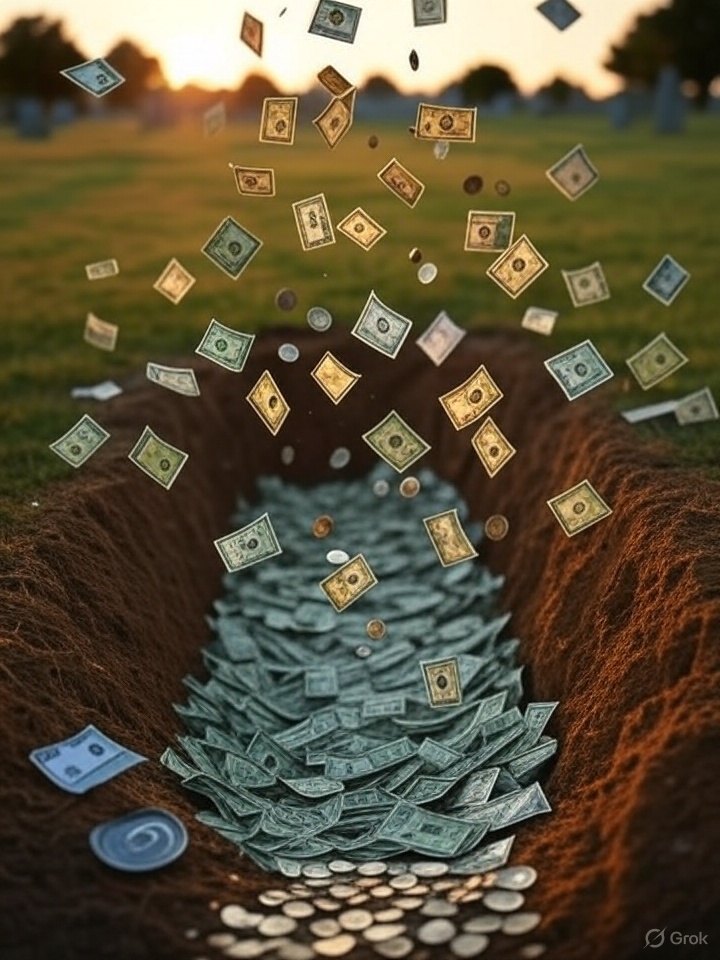
The latest claim of “unmarked graves” at St. Joseph’s Mission Residential School in British Columbia exposes a familiar pattern: sweeping headlines, scant evidence. On August 14, 2025, the Williams Lake First Nation announced ground-penetrating radar (GPR) detected 16 “anomalies.” Global News and others framed them as “potential burial sites.” Yet no remains have been confirmed, substituting implication for proof.
Canadians know this script. In 2021, Kamloops’ claim of 215 “graves” became Canada’s “news story of the year,” sparking global outrage and $12 million in federal funding. Four years on, no bodies surfaced—GPR anomalies aligned with tree roots or septic tiles. Still, the unverified narrative lingers as proof of mass graves.
Geophysicists note GPR cannot distinguish human remains from soil disruptions—a fact buried in coverage. Yet sensational claims yield dividends: $8 million in reconciliation grants since 2021, media clout, and moral authority, all absent hard evidence. The Williams Lake announcement follows suit, with no excavation planned, only “consultation.”
None of this negates the residential school era’s tragedies—deaths from disease or neglect were documented. But inflating anomalies into “graves” distorts history, manipulates grief, and diverts resources from urgent Indigenous needs. Worse, a proposed federal bill to criminalize “denialism” would shield such claims from scrutiny, turning skepticism into heresy.
Truth demands excavation, not headlines. Until anomalies are verified, Canadians are asked to mistake speculation for fact. That is not reconciliation—it is a grave error, fracturing trust in a nation desperate for unity.
Sources Referenced
- Global News, “Williams Lake First Nation Finds 16 Potential Burial Sites,” August 14, 2025
- Fraser Institute, “No Evidence of ‘Mass Graves’ in Residential Schools,” February 12, 2024
- National Post, “Kamloops Graves Remain Unproven,” April 6, 2025
- Struggles-Activist.com, “Three Years Later, Canadian ‘Mass Graves’ Claims Remain Unproven,” January 7, 2025
- Aggregated X posts, August 2025
Canada’s tariff wars reveal a glaring double standard: confrontation with Communist China draws muted shrugs, while disputes with the United States ignite fiery “elbow up” rhetoric and national outrage. When China slapped a 75.8% tariff on Canadian canola in August 2025—retaliation for Ottawa’s 100% tariff on Chinese electric vehicles and 25% on steel and aluminum announced earlier that spring—Manitoba farmers were left reeling. Nearly half of their canola exports go to China, and industry estimates project multi-billion-dollar losses. Yet Canada’s political class and major media outlets framed Beijing’s move as a mere “tit-for-tat” trade dispute, urging patience and diplomacy. Outside the mainstream, social media filled with posts lamenting the devastation in farm country.
Contrast this with the uproar over U.S. tariffs. In March 2025, President Donald Trump imposed 25% duties on Canadian goods (excluding energy), escalating them to 35% by August. Ottawa erupted. Prime Minister Mark Carney thundered about the need for a unified “North American market,” while pundits and media outlets blasted “unjustified” American aggression. Canadians were rallied with slogans of defiance and “elbow up” resolve. Yet under CUSMA, more than 85% of Canada–U.S. trade remains tariff-free, meaning the outrage over Washington’s measures dwarfed the reaction to China’s far heavier blow to canola.
The contrast betrays selective indignation. China, an authoritarian regime, cripples a vital Canadian industry yet escapes national fury. The United States, a democratic ally, delivers a lesser economic hit and is vilified. Such narrative hypocrisy undermines both unity and credibility, sacrificing farmers’ livelihoods for geopolitical posturing. If Canada roars at Washington but bows to Beijing, it sends a dangerous message: principle is negotiable, and farmers are expendable.

Sources:
-
Statistics Canada, 2023 Trade Data
-
CBC News, “China’s Tariffs on Canadian Canola,” Aug. 13, 2025
-
Fraser Institute, “Trump’s Trade War Update,” Aug. 12, 2025
-
Globe and Mail, “Over 85% of Canada–U.S. Trade Remains Tariff-Free under CUSMA,” Aug. 2025
-
Aggregated X posts, Aug. 2025
Amy Hamm, a British Columbia nurse, faces a $93,811 fine from the B.C. College of Nurses and Midwives (BCCNM) for a thought-crime: stating that humans are biologically sexed and gender identity cannot override this reality. Her off-duty remarks defending women’s sex-based rights, like female-only spaces, were ruled “discriminatory and derogatory” by a disciplinary panel. The decision, released March 13, 2025, followed over 20 days of hearings triggered by activist complaints—not patients—over her support for J.K. Rowling and posts declaring “there are only two sexes.”
Hamm’s ordeal mirrors a Maoist-style struggle session, a public shaming meant to crush dissent. The BCCNM’s 115-page ruling, backed by ideologically aligned “experts,” condemned her for challenging gender identity dogma, equating her advocacy with “erasing” trans existence. No evidence of patient harm surfaced. Yet Hamm—fired without severance by Vancouver Coastal Health—faced harassment, death threats, and accusations of professional misconduct for her views.
This is no anomaly but a trend: regulators weaponize “professional standards” to silence dissent on gender ideology, as seen in the Ontario College of Psychologists’ pursuit of Jordan Peterson for his social media critiques of progressive orthodoxy. Canada’s Charter protects free expression, but bodies like the BCCNM act as enforcers of dogma. Hamm’s appeal to the B.C. Supreme Court, backed by the Justice Centre for Constitutional Freedoms, challenges this overreach, but the precedent endangers all who prioritize truth.
Canada’s buckling healthcare system squanders resources on ideological witch hunts while patients languish. Hamm’s near-$100,000 fine for speaking truth signals a nation veering from reason into authoritarian zeal, where dissent becomes heresy and free inquiry burns.

Sources Referenced
- B.C. College of Nurses and Midwives, Discipline Committee Decision, March 13, 2025
- Justice Centre for Constitutional Freedoms, Press Releases, March–April 2025
- National Post, Opinion, April 6, 2025
- Aggregated X posts, August 2025
Canada’s policing landscape reveals a troubling inconsistency, a corrosive double standard that erodes public trust: assaults on Jewish citizens often draw sluggish responses, while those on Muslims prompt swift condemnation and action. Consider the Montreal debacle—a Jewish father beaten in Dickie Moore Park before his terrified children, his kippah tossed into a splash pad like discarded refuse. Police took nearly an hour to arrive, allowing the assailant to vanish, and only arrested him days later amid public furor spurred by community outcry on social media.
Contrast this with Ottawa’s swift response to an unprovoked attack on a young Muslim woman aboard public transit, punched and bombarded with Islamophobic slurs as passengers watched in stunned silence. Authorities immediately labeled it hate-motivated and launched an investigation, reflecting a government commitment to combatting hate crimes. No delay, no limbo—just urgency, as if the system awakens only for select victims.
This disparity is not aberration but pattern. Statistics Canada reports Jews—under 1% of the population—endured over 900 hate crimes in 2023, roughly 70% of religion-based incidents, while Muslim-targeted crimes, numbering around 200, saw faster police action. Yet responses to antisemitic violence often lag, fostering a climate where aggressors act with impunity. Muslims face brutal attacks too, but policing pivots faster, bolstered by vocal leadership. Both communities deserve equal protection; only one consistently receives it.
The irony stings in a nation priding itself on equity: one community’s cries echo unanswered, another’s summon swift shields. Such two-tiered enforcement is not oversight—it is antithetical to justice. If Canada fails to apply equal urgency to all victims, it risks fracturing society into a hierarchy of suffering, dividing rather than uniting against bigotry’s tide.

Sources Referenced
- Statistics Canada, 2023 Hate Crime Report
- CTV News, Montreal, July 2023: Dickie Moore Park assault coverage
- CBC News, Ottawa, June 2023: Transit attack reports
- X posts aggregated from community reports, July 2023











 bleatmop
 Mystro
 The Arbourist


 Dead Wild Roses
Your opinions…