
You are currently browsing the category archive for the ‘Politics’ category.
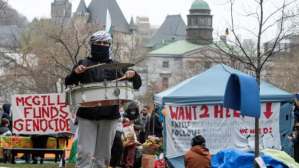 The protests at McGill University in April 2025 and the Trucker Convoy of 2022, while distinct in their scale, context, and authority, offer a compelling lens through which to examine accountability and lawbreaking in Canada. The McGill protests, driven by anti-Israel activists, involved physically blocking lecture halls and disrupting classes, as reported by B’nai Brith Canada, thereby denying students their right to education. In contrast, the Trucker Convoy, a nationwide movement against COVID-19 mandates, paralyzed critical infrastructure like the Ambassador Bridge, causing billions in economic losses and prompting the federal government to invoke the Emergencies Act. The scale of the Trucker Convoy’s impact was far greater, affecting national and international trade, while McGill’s disruptions were localized to a university campus. Additionally, the authority responding differed—McGill’s administration, a private institution, managed the campus protests, whereas the federal government, with its broader legal powers, tackled the Trucker Convoy. These differences in scope and jurisdiction naturally shaped the responses, but they also highlight a shared challenge: ensuring accountability when laws or rules are broken.
Acknowledging the protesters’ perspectives strengthens the case for consistent accountability. At McGill, the activists likely saw their actions as a moral imperative, aiming to pressure the university into divesting from companies linked to Israel’s actions in Gaza, which they framed as complicity in genocide. Similarly, the Trucker Convoy participants believed they were defending personal freedoms against government overreach, with some public support reflecting sympathy for their cause, as noted in historical polling data. Both groups may argue that their lawbreaking was justified by higher ethical goals—whether social justice or individual rights. However, this justification does not negate the harm caused: McGill students were intimidated and denied education, while the Trucker Convoy’s blockades disrupted livelihoods and public safety, with reports of harassment like defecating on lawns, as documented in news coverage from the time. The principle of free expression, a cornerstone of Canadian democracy, does not extend to actions that violate others’ rights or break laws, whether on a university campus or a national border. Recognizing the protesters’ motivations does not absolve them of responsibility; rather, it underscores the need for equitable enforcement to maintain social order and trust in institutions.
 The disparity in official responses to these events reveals a troubling inconsistency in addressing lawbreaking in Canada, fueling perceptions of a two-tier justice system. The Trucker Convoy faced severe consequences—hundreds of arrests, vehicle seizures, and frozen bank accounts under the Emergencies Act, as reported by Globalnews.ca—reflecting the government’s prioritization of economic and public safety. In contrast, McGill’s response was tepid, with the university implementing ID-based access controls only after days of disruption, and no immediate legal consequences like arrests or suspensions for the protesters, despite calls from advocacy groups for decisive action. While the federal government’s authority and the national stakes justified a stronger response to the Trucker Convoy, McGill’s leniency raises questions about institutional accountability on Canadian campuses. This inconsistency—where one group faces significant repercussions while another does not—erodes public confidence in the rule of law, suggesting that the consequences of lawbreaking may depend on the cause, context, or authority involved. Canada must strive for a balanced approach, ensuring that all acts of lawbreaking, regardless of scale or motivation, are met with fair and proportionate accountability to uphold the principles of justice and equality that define the nation.
Sunday DWR Religious Disservice: Radical Islamic Protests Clash with Canadian Values
The recent demonstrations at McGill University in April 2025, where anti-Israel protesters blocked lecture halls and disrupted classes, starkly illustrate the incompatibility of radical Islamic protests with Canadian values. As reported by B’nai Brith Canada, masked activists, some wearing keffiyehs, physically prevented students from accessing education, chanting slogans like “McGill, McGill you can’t hide, you’re complicit in genocide.” While the protests were framed as a call for divestment from companies linked to Israel, their tactics—intimidation and coercion—echo a broader pattern of radical Islamic activism that prioritizes ideological confrontation over dialogue. In Canada, a nation built on mutual respect and the rule of law, such actions undermine the principles of peaceful coexistence and individual rights that define our culture.
 These protests not only disrupted academic life but also created an environment of fear, particularly for Jewish students, who felt targeted by what advocacy groups described as antisemitic behavior. The McGill demonstrations reflect a worldview that rejects Canada’s commitment to pluralism and freedom of expression, instead embracing a form of radicalism that seeks to impose its agenda through force. Historical insights, such as those from McGill’s Institute of Islamic Studies, highlight that radical Islam often merges religious ideology with political and social demands, as noted in a House of Commons report on the “clash of civilizations” thesis. This fusion can lead to a confrontational stance that clashes with Canadian culture, which values negotiation and inclusivity over exclusionary tactics that silence others.
For the faithful, this serves as a reminder that true spirituality fosters harmony, not division. The McGill protests, with their roots in radical Islamic ideology, stand in stark contrast to Canada’s cultural ethos of tolerance and respect for all. As a nation, we must uphold our values by ensuring that protests, even those driven by deeply held beliefs, do not cross into intimidation or lawbreaking. The path to peace lies in dialogue and understanding, not in actions that alienate and divide—principles that should resonate with any community of faith seeking to live out its convictions in a diverse society.
The recent protests at McGill University, where anti-Israel activists physically blocked access to lecture halls and disrupted classes, represent a troubling departure from the principles of free speech and Canadian values. On April 2, 2025, as reported by B’nai Brith Canada, masked protesters in the Bronfman Building prevented students from attending classes, with chants of “McGill, McGill you can’t hide, you’re complicit in genocide” echoing through the campus. While protest is a protected right, these actions crossed into intimidation and coercion, as students were denied their fundamental right to education. Free speech in Canada is about expressing ideas without fear of retribution, not about obstructing others’ rights or creating a hostile environment. Such behavior is distinctly un-Canadian, as it undermines the nation’s commitment to mutual respect, dialogue, and the rule of law—values that have long defined Canadian society.
McGill University’s response to these protests highlights a glaring abdication of responsibility. Despite the disruptions, which forced some classes online and led to acts of vandalism, the university’s initial reaction was tepid, only implementing ID-based access controls on April 4, 2025, after days of chaos. Advocacy groups like the Canadian Friends of Simon Wiesenthal Center and concerned individuals have called for decisive action, pointing to the hostile environment created for Jewish students and the broader student body. McGill’s failure to swiftly address the physical blockades and ensure safe access to education sends a dangerous message: that the university prioritizes appeasing disruptive activists over protecting the rights of all students. This inaction not only erodes trust in the institution but also sets a precedent for tolerating intimidation under the guise of activism, further emboldening such behavior on Canadian campuses.
The protests at McGill reveal a deeper issue: a two-tier system of justice that is profoundly divisive for Canadian society. While the protesters faced little immediate consequence for their actions, students attempting to attend classes were left to fend for themselves, as seen in videos where individuals were physically blocked from entering lecture halls. This disparity in treatment—where one group’s “right” to protest is elevated above others’ rights to safety and education—creates a fractured campus environment. Jewish students, in particular, have reported feeling unsafe, with advocacy groups framing the protests as antisemitic. Meanwhile, some individuals with differing views supported the protesters, accusing Israel and its supporters of enabling genocide. This polarization reflects a broader societal trend where identity-based grievances are weaponized, pitting groups against each other rather than fostering unity, a core Canadian ideal.
My blog post *The Oblivious Irony of Canada’s Progressive Left* provides a stark illustration of this trend, noting, “The progressive left’s obsession with identity politics has created a hierarchy of victimhood, where certain groups are given carte blanche to act with impunity, while others are silenced or vilified.” This observation captures the essence of the McGill protests, where the activists’ cause—framed as a fight against oppression—seemingly justified their coercive tactics, while the rights of other students were dismissed. Identity politics, as I argue, has become a divisive force in Canada, eroding the shared values of fairness and equality that once united the nation. The McGill protests are a microcosm of this larger societal shift, where the pursuit of “justice” for one group comes at the expense of others, deepening divisions and resentment.
In conclusion, the actions at McGill University are not a legitimate exercise of free speech but a violation of the principles that define Canada as a nation. By allowing protesters to intimidate and obstruct, McGill has failed its students, particularly those who felt targeted or unsafe, and has contributed to a two-tier system of justice that undermines Canadian unity. The divisive impact of identity politics, as highlighted in previously, underscores the urgent need for a return to shared values—respect, dialogue, and equal treatment under the law. Canadian society cannot thrive when one group’s rights are prioritized over another’s, and institutions like McGill must take responsibility to ensure that campuses remain spaces for learning, not coercion. Only by upholding these principles can Canada reclaim its identity as a nation of fairness and inclusion for all.

 Herbert Marcuse’s 1965 essay *Repressive Tolerance* argues that tolerance in liberal societies isn’t neutral—it props up power while smothering real dissent. He saw it as a rigged game: the system tolerates ideas that fit its frame and represses those that don’t. Marcuse’s fix? “Liberating tolerance”—coddling radical change, even lawbreaking, if it’s “progressive,” while crushing “regressive” resistance. Fast-forward to today: police and courts often give left-leaning lawbreakers a pass when their cause aligns with elite vibes, but hammer right-leaning groups like Canada’s Trucker Convoy. Let’s break this down with real cases through Marcuse’s eyes.
Marcuse’s Core Idea
Marcuse claimed tolerance in capitalist democracies—like free speech or legal fairness—shields the status quo. It’s not about justice; it’s about control. He pushed for intolerance toward oppressive ideas (think war or exploitation) and leniency for acts challenging them, even if illegal. The hitch: who picks the winners? Today’s justice system seems to—favoring leftist breaches while pummeling right-wing ones. Two real examples show it plain.
The Left’s Light Touch
Look at the 2020 Portland protests after George Floyd’s death. Night after night, activists clashed with police, torched a federal courthouse, and smashed storefronts. Over 1,000 arrests happened across months, per Portland Police data, but Multnomah County DA Mike Schmidt dropped charges for most non-violent cases—hundreds walked free. Rioting and property damage? Illegal, sure. But Schmidt called it “proportional” to focus on “serious” crimes, nodding to the protests’ racial justice aim.
Marcuse might nod too. He’d see this as “liberating”—lawbreaking to dismantle systemic racism, a cause he’d back. The state’s leniency fits his playbook: tolerate disruption if it’s “just.” But context matters. Media framed it as moral outrage, and cultural elites cheered. Tolerance here wasn’t blind—it leaned on a narrative Portland’s leaders could stomach.
The Trucker Convoy: Heavy Hand
Now flip to Canada’s 2022 Trucker Convoy. Truckers rolled into Ottawa, protesting vaccine mandates. They parked rigs, honked horns, and gridlocked downtown—illegal blockades, no question. No firebombs, though; it was loud, not violent. Ottawa’s response? A state of emergency. Police arrested 191 people, per the Ottawa Police Service, and the feds invoked the Emergencies Act—first time since 1988. Bank accounts got frozen, crowdfunding cash was seized, and leaders like Tamara Lich faced charges carrying up to 10 years. Courts still grind on some as of 2025.
Marcuse might call this “regressive”—truckers resisting public health for personal freedom, not his revolutionary vibe. His theory would greenlight repression here. But step back: these were blue-collar workers, not suits, pushing against centralized control. The state didn’t just enforce law—it flexed hard, with banks and media tagging them “extremists.” Tolerance? Out the window when the script flipped.
Side by Side
Portland versus Ottawa lays it bare. In Portland, sustained lawbreaking—arson, vandalism—drew arrests, but prosecutors waved off most penalties. The cause? Racial justice, a darling of progressive elites. The truckers broke laws too—blockades, noise—but got hit with emergency powers, asset freezes, and jail time. Their cause? Individual liberty, a sore spot for the same elites. Both disrupted public order. One got a shrug; the other got shackles.
Marcuse’s lens tracks this. He’d argue Portland’s activists deserved slack—their fight aligned with his anti-oppression stance. The truckers? Too “backward” to tolerate. Yet the truckers’ working-class roots and anti-mandate gripes echo his underdog ideal more than Portland’s curated chaos. The difference? Cultural clout. Left-leaning causes get a halo; right-leaning ones get a boot.
Steel-Manning the Divide
To be fair, the state’s not a monolith. Portland’s leniency could reflect local politics—progressive DAs like Schmidt prioritize “equity” over punishment. Ottawa’s crackdown? Public safety after weeks of gridlock, not just ideology. Law’s messy, not a conspiracy. Still, the gap’s real. A 2021 DOJ report showed 93% of Portland riot cases got dismissed or deferred; contrast that with the Convoy’s 70+ convictions by 2023, per Canadian court records. Police logged 1,000+ hours on Portland protests with kid gloves; Ottawa saw 2,000+ officers deployed in days, batons out. Numbers don’t lie—tolerance tilts.
Marcuse didn’t see this coming. He figured the repressed were leftists battling a right-wing Goliath. Now? Power’s cultural, not just economic, and it leans left—media, tech, academia. The truckers, not the rioters, look more like his outcasts. Yet “repressive tolerance” still flows his way—toward causes that sound noble, not ones that clash with the zeitgeist.
The Takeaway
Marcuse’s *Repressive Tolerance* nails today’s double standard. Portland’s rioters broke laws and walked; Ottawa’s truckers did the same and sank. It’s not random—tolerance tracks power’s favorites. Marcuse wanted it for revolution, but it’s become a perk for the loudest voices. Scroll X, pick a protest, and test it: who gets the pass? The answer’s in the outcomes, not the excuses.”
Credit to Grok AI, for the legwork with regards to statistics and editing for clarity.
In recent years, Toronto, Canada, has witnessed a disturbing trend where adherents of the Islamic faith have organized large, unauthorized gatherings—such as the Eid al-Adha prayers in July 2023 near Nathan Phillips Square—that spill onto public streets, shutting them down without permits or regard for the broader community. These events, where hundreds gather and block traffic for hours, are often cloaked as religious expression, but they flout the basic expectation that all Canadians, regardless of faith, must adhere to the same rules governing public spaces. This isn’t just a minor inconvenience; it’s a direct challenge to the Canadian value of order and fairness, where no group gets a free pass to disrupt the lives of others under the guise of cultural practice.
The glaring absence of robust policing and arrests during these incidents is nothing short of a betrayal of Canada’s commitment to the rule of law. Toronto police, present at events like the 2023 Eid gathering, have chosen to stand by and redirect traffic rather than enforce bylaws that would see any other unpermitted group—be it protesters or revelers—swiftly fined or dispersed. This cowardice in the face of religious optics sends a dangerous message: that some communities can act with impunity, while others are held to account. Canadian values demand equality before the law, not selective enforcement that bends to avoid offending specific groups. When police fail to act decisively, they undermine the very principles of justice and accountability that have long defined this nation.
This growing pattern of leniency threatens to unravel the fabric of Canadian society, where respect for shared rules has been a cornerstone of our strength. If authorities continue to prioritize appeasement over impartial governance, they invite chaos—emboldening any group, religious or otherwise, to trample on public order without consequence. Canada’s pride in multiculturalism cannot come at the cost of surrendering our streets to lawlessness. The rule of law isn’t negotiable; it’s the bedrock of our freedom and security. Toronto must reclaim its resolve, enforce its regulations without hesitation, and send a clear signal that Canadian values—order, equality, and accountability—will not be compromised, no matter who tests them. Anything less is a surrender of what makes this country worth defending.

In the mid-2010s, prominent voices on Canada’s progressive left, including those aligned with Prime Minister Justin Trudeau’s vision, leaned heavily into the idea of Canada as a “post-national state.” Trudeau himself famously told *The New York Times* in 2015 that “there is no core identity, no mainstream in Canada,” framing the country as a mosaic of identities unbound by traditional nationalism. This rhetoric dovetailed with a broader movement to reckon with Canada’s colonial past, exemplified by the Truth and Reconciliation Commission’s 2015 report, which labeled the residential school system a “cultural genocide.” Activists and academics pushed to dismantle symbols of national pride, arguing they propped up a settler-colonial legacy. Flags flew at half-mast for 161 days in 2021—over five months—following the alleged “discovery” of unmarked graves at former residential school sites, a gesture that underscored a narrative of shame rather than unity. Patriotism, in this view, was suspect, a relic of a Canada that needed deconstructing.
Fast forward to 2025, and the same progressive cohort now clutches the maple leaf with newfound zeal, spurred by fears of American annexation—whether economic, cultural, or political. The phrase “elbows up, just say no” has surfaced in leftist circles online, a gritty call to resist U.S. influence amid trade disputes and border security debates. This nationalist hyperbole marks a stark pivot from the earlier disdain for Canada-as-nation. Where once the Canadian identity was a punching bag—think of the 2020 toppling of Sir John A. Macdonald’s statue in Montreal by activists decrying his role in Indigenous oppression—now it’s a shield against the Stars and Stripes. The irony is palpable: a movement that spent years driving the notion of “Canadian-ness” into the ground suddenly hoists it aloft when sovereignty feels threatened.
So where was this patriotism when Canada’s symbols and history were being systematically dismantled? The progressive left’s about-face reveals a selective nationalism, dormant when reckoning with internal flaws but roused when an external foil like the United States looms large. The 2021 half-mast marathon, meant to signal humility, left little room for pride in the nation’s resilience or achievements. Yet today, as trade tensions flare—U.S. tariffs on Canadian lumber hit 17.99% in 2024, per the U.S. Department of Commerce—the same voices rally to “protect our way of life.” It’s a jarring contrast: a Canada once deemed unworthy of celebration is now a hill to die on, exposing the fluidity of ideology when convenience calls. The lesson? National identity, it seems, is only as disposable as the threat du jour allows.

Policing in Canada has historically been grounded in the principle of equality under the law, where all individuals, regardless of identity, are subject to the same legal standards and enforcement practices. However, recent shifts in policy, training, and public discourse suggest that Canadian policing is increasingly adopting a model that applies different standards based on identity categories such as race, ethnicity, gender, and socioeconomic status. This evolution is driven by a combination of social justice movements, government directives, and institutional reforms aimed at addressing systemic inequalities. While intended to rectify historical disparities, this approach raises questions about consistency and impartiality in law enforcement.
One clear indicator of this shift is the implementation of race-based data collection by police services across Canada. Initiated in response to allegations of racial profiling, agencies like the Toronto Police Service and the Ontario Provincial Police began collecting and analyzing data on the race of individuals stopped, questioned, or arrested, starting with pilot projects around 2019 and expanding since then. The stated goal is to identify and address “disproportionate” enforcement patterns, particularly against Black, Indigenous, and other racialized groups. While this data has confirmed higher rates of police interaction for certain communities—such as a 2020 Toronto report showing Black individuals were 2.2 times more likely to be involved in use-of-force incidents—it has also led to tailored policing strategies that adjust scrutiny or leniency based on racial identity rather than uniform application of the law.
Training and policy changes further illustrate this trend toward differential standards. Following high-profile incidents like the 2020 death of Regis Korchinski-Paquet and subsequent Black Lives Matter protests, Canadian police forces have overhauled training to emphasize “de-escalation” and “cultural competency,” often with specific focus on interactions with Indigenous and racialized populations. For instance, the RCMP introduced mandatory “bias-free policing” modules by 2022, which instruct officers to consider historical trauma and systemic factors when engaging with certain groups. While these measures aim to reduce harm, they implicitly encourage officers to alter their approach—sometimes reducing enforcement rigor—based on an individual’s perceived identity, diverging from a strictly neutral standard.
Legal and governmental frameworks also support this shift. In 2023, Bill C-92, an Act respecting First Nations, Inuit, and Métis children, youth, and families, effectively granted Indigenous communities greater autonomy over child welfare, including policing-related interventions, creating a parallel system distinct from mainstream enforcement. Similarly, hate crime laws and sentencing guidelines increasingly factor in identity-based considerations, with offenders targeting “vulnerable” groups facing harsher penalties, while enforcement in marginalized communities is often softened to avoid perceptions of over-policing. This dual-track approach—tougher on some, lighter on others—reflects a deliberate move away from universal standards toward identity-specific policing practices.
Finally, public and institutional pressure continues to reinforce this trajectory. Advocacy groups, such as the Canadian Association of Black Lawyers and Indigenous rights organizations, have successfully lobbied for policies that treat identity as a mitigating factor in policing. Reports like the 2021 Missing and Murdered Indigenous Women and Girls Inquiry explicitly called for reduced police intervention in Indigenous communities, alongside increased accountability for officers dealing with these populations. Meanwhile, urban police forces face scrutiny for “over-policing” racialized neighborhoods, prompting initiatives like Toronto’s 2024 “Community Crisis Support Service,” which diverts mental health calls involving racialized individuals away from police entirely. These developments signal a broader trend: policing in Canada is increasingly calibrated to identity, balancing equity goals against the traditional ethos of equal enforcement. Whether this enhances justice or undermines fairness remains a point of contention.











 bleatmop
 Mystro
 The Arbourist


 Dead Wild Roses
Your opinions…