
You are currently browsing the category archive for the ‘Politics’ category.
When the extremes meet, the center collapses. (TL;DR)
When the Horseshoe Hangs from the Scales explains why the far left and far right increasingly resemble each other—not in ideas, but in methods. Drawing on the metaphors of the scale and the horseshoe, this essay argues that both totalitarian idealism and populist reaction stem from the same metaphysical error: the rejection of objective reality. Only realism—humility before truth—can keep Western society from closing into a circle of coercion.
Political language often obscures more than it reveals. The familiar left–right spectrum suggests linear opposition—progressives facing conservatives across a straight divide. Yet history and experience show something stranger: as ideologies radicalize, their behavior begins to mirror one another. The further the extremes move from reality, the closer they become in method, rhetoric, and moral psychology.
In The Scales of Society (published yesterday), realism anchored the crossbar, and idealism dragged the pans downward into totalitarianism. The horseshoe adds a complementary image. Viewed from above, the scale’s pans curve toward each other like the ends of a bent spectrum. The metaphysical collapse becomes social convergence. Both metaphors describe a single process: when realism breaks, the poles of idealism meet in coercive symmetry.
The Geometry of Political Collapse
The horseshoe theory proposes that the political spectrum bends upon itself, bringing the far left and far right into proximity. Communism and fascism, though ideologically opposed, resemble one another in practice: one abolishes private property, the other subordinates it to the state; both demand absolute obedience. Each claims to redeem humanity through purity—of class or of nation—and each regards dissent as treason.
The scale explains why this happens: both extremes spring from idealism detached from reality. The horseshoe shows how it manifests: through behavioral and institutional mimicry. One describes the metaphysical axis, the other the social. Together they form a complete model of ideological deformation. The vertical collapse of realism generates the horizontal convergence of fanaticism.
From Difference to Sameness
Political polarization masquerades as difference, but when stripped of surface content, the ends often converge in identical impulses:
- Moral totalism. Each side claims moral monopoly—an absolute vision of justice or order that sanctifies any means.
- Friend–enemy logic. Politics becomes warfare. Dialogue is betrayal; neutrality, complicity.
- Collectivist ethics. The individual dissolves into the movement, valuable only as a vehicle for ideological ends.
- Epistemic closure. Truth is no longer discovered but declared; narrative replaces verification.
Arendt observed that totalitarian movements, regardless of ideology, replace empirical reality with “a fictitious world” sustained by propaganda. Popper saw the same pattern: the closed society begins when ideas become sacred and unfalsifiable. Whether draped in red flags or eagles, the architecture is the same.
What begins as opposition ends as resemblance. The revolutionary who abolishes hierarchy and the reactionary who enforces it both deny human limitation. Each demands transformation rather than reform, purity rather than compromise. The further they stray from realism, the more they mirror one another’s methods—purges, censorship, mythmaking, and ritual denunciation.
Convergence in the Contemporary West
The horseshoe is no relic of the twentieth century; its shape defines the present. In the West, the rhetoric of liberation and the rhetoric of restoration increasingly share an authoritarian grammar.
Cultural absolutism. On the progressive extreme, morality is redefined as the enforcement of inclusivity. Dissenting speech becomes “harm,” and linguistic deviation, “violence.” On the reactionary extreme, purity is national or moral rather than social, but the logic is the same: deviation equals corruption. Each side builds orthodoxy around identity.
Information control. The progressive insists on regulating “disinformation,” policing language for moral safety. The populist right responds with its own echo chambers, treating factual correction as conspiracy. Both distrust open discourse, substituting propaganda for persuasion. Truth is no longer common ground but a weapon.
Purity politics. Cancel culture and culture-war purges are functional twins. One excommunicates for heresy against equality, the other for heresy against tradition. Each side frames punishment as virtue, enforcing conformity by shame or exclusion. In both cases, moral capital accrues not from good deeds but from the public destruction of sinners.
The psychological mechanism is identical: belonging through denunciation. The horseshoe’s curve tightens as participants draw moral comfort from collective outrage. When opposing extremisms adopt the same tactics, the distance between them is illusion.
The Horseshoe Meets the Scale
The two metaphors illuminate one another. The scale shows the metaphysical error: idealism’s detachment from realism. The horseshoe shows the social consequence: the return of opposites through behavioral convergence. The result is not diversity of belief but monoculture of method.
Imagine the scales viewed from above: the crossbar of realism forms the straight backbone, but as the pans descend into idealism, they bend toward one another, forming the curve of the horseshoe. The more society abandons truth, the closer its extremes approach in both temperament and technique.
When realism—objective verification, moral humility, and factual accountability—fails, politics becomes a contest of myths. The question is no longer “what is true?” but “whose truth will rule?” In that struggle, the difference between revolutionary and reactionary becomes decorative. Both invoke moral crisis to justify compulsion; both see coercion as salvation.
Why the Center Cannot Hold Without Realism
Critics often lament the “vanishing center,” as if centrism itself could rescue political sanity. But moderation is not a position; it is a discipline—an adherence to external reality over internal fervor. The true counterweight to the horseshoe’s closure is not neutrality but realism.
Realism anchors discourse in verifiable truth: data, evidence, experience, and the acknowledgment of limits. It permits disagreement without dehumanization because it recognizes a shared world beyond ideology. Realism turns enemies into interlocutors by subjecting both to the same facts.
Idealism, by contrast, makes conflict existential. When truth depends on belief, contradiction becomes evil. The desire to perfect the world leads to the compulsion to perfect others, and the moral imagination becomes the tool of tyranny. Only realism—accepting that the world corrects us—keeps the curve of politics open rather than collapsing into a circle of extremism.
The Moral Psychology of the Horseshoe
The convergence of extremes is not merely institutional; it is psychological. Both sides attract personalities drawn to certainty, purity, and moral theater.
The late political theorist Eric Voegelin described this as “gnostic revolt”—the refusal to accept human limitation and the longing to recreate the world in one’s own image. Arendt called it “world alienation.” Each formulation captures the same impulse: the substitution of idea for reality. The horseshoe is the social geometry of that spiritual rebellion.
When entire populations internalize this mindset, societies lose the ability to distinguish moral conviction from metaphysical arrogance. Activists and autocrats alike begin to speak in the same register—of awakening, purity, and necessary sacrifice. The vocabulary of utopia is universal; only its symbols differ.
The Path Back to Reality
Escaping the horseshoe requires reattaching it to the scales—recovering realism as the crossbar that holds political difference in balance. This means restoring institutions that mediate between belief and fact: open science, free inquiry, due process, and honest journalism. It means accepting that error, not heresy, is the normal state of human reason.
Humility, not ideology, is the civic virtue realism demands. The realist admits uncertainty, revises judgment, and learns from failure. Such modesty is not weakness but strength—the discipline that prevents conviction from hardening into cruelty.
Conclusion: The Shape of Sanity
The geometry of political life reflects our metaphysics. When truth stands above us, the scales stay level and the horseshoe remains open. When truth becomes a tool of power, the scales tilt, and the horseshoe closes into a circle—opposites united in coercion.
The West’s present turbulence is not a clash of left and right but a crisis of realism. Both sides, in their extremes, are tempted by the same illusion: that belief can replace being, that will can dictate truth.
If freedom is to endure, it will not be because one ideology triumphs but because reality reasserts itself—quietly, stubbornly, as the only ground capable of bearing the weight of difference.

References
- Arendt, Hannah. The Origins of Totalitarianism. New York: Harcourt Brace, 1951.
- Burke, Edmund. Reflections on the Revolution in France. London: J. Dodsley, 1790.
- Haidt, Jonathan. The Righteous Mind: Why Good People Are Divided by Politics and Religion. New York: Vintage, 2012.
- Lukianoff, Greg & Haidt, Jonathan. The Coddling of the American Mind. New York: Penguin, 2018.
- Popper, Karl. The Open Society and Its Enemies. London: Routledge, 1945.
- Voegelin, Eric. The New Science of Politics. Chicago: University of Chicago Press, 1952.
- Ortega y Gasset, José. The Revolt of the Masses. New York: W.W. Norton, 1932.
Why do societies slide toward tyranny when they pursue utopia? (TL;DR)
The Scales of Society argues that the real divide in politics isn’t left versus right, but realism versus idealism. When truth yields to belief, coercion follows. From communism and fascism to modern moral crusades, history warns that abandoning objective reality tips civilization toward totalitarianism. The balance must be restored—anchored in realism, humility, and truth.
In the landscape of political philosophy, metaphors serve as intellectual scaffolding—structures that help us grasp dynamics too intricate for direct depiction. The familiar political compass, with its left–right and liberty–authority axes, sketches ideological positions but fails to reveal the deeper fracture driving modern polarization. A more illuminating image is that of a balance scale. Its crossbar represents philosophical realism—the recognition of an objective reality—while the suspended pans embody the idealist extremes of communism and fascism. This model captures not just polarization but the gravitational descent into totalitarianism that occurs when societies abandon reality for utopia.
The Core Divide: Realism vs. Idealism
Realism begins with the premise that reality exists independently of human will or perception. The wall remains whether one believes in it or not, and collision has consequences indifferent to ideology. This external order imposes limits: progress requires trade-offs, and perfection is impossible. The realist accepts these constraints, submitting theories to verification through evidence, reason, law, and experience. Responsibility and competence—not vision or zeal—earn authority.
Idealism inverts this relationship. It treats reality as a projection of consciousness, imperfect but malleable. If perception shapes the world, then changing minds can remake existence. Truth becomes what society collectively affirms. This impulse, when politicized, leads toward social constructivism and, inevitably, coercion: those who refuse to affirm the “truth” must be re-educated or silenced. A contemporary example can be seen in gender ideology, where subjective identity claims are enforced as social fact through compelled speech and institutional conformity. The point is not about gender per se but about the pattern: belief overriding biology through social pressure rather than persuasion.
The Platonic ideal—perfect, transcendent, and abstract—becomes the new absolute. The imperfect, tangible world must be reshaped until it conforms. Once utopia is imagined as possible, coercion becomes inevitable, for someone must ensure that all comply with the ideal.
The Scale and Its Balance
The realist crossbar allows for movement and balance. One may lean left toward egalitarianism, right toward hierarchy and tradition, or find equilibrium between the two. Disputes are adjudicated by verifiable standards: evidence, empirical data, or, for the religious, revelation interpreted through disciplined exegesis. Justice is blind, authority is earned, and failure prompts responsibility rather than revolution.
From that crossbar hang the chains leading to the pans—communism on the left, fascism on the right. Each represents idealism in a different costume. Descent is gradual, a shimmy downward from realism into partial idealism, then freefall into extremism. The pans have no centers: in a world of pure ideals, moderation cannot hold.
Communism imagines a belief-driven utopia—re-educate humanity into “species-being” beyond property or conflict, and paradise will emerge. Fascism demands obedience to a mythic hierarchy—sacrifice self for the community’s glory, and unity will prevail. Both subjugate reality to ideology: when facts resist, facts are crushed. From the perspective of either pan, the realist crossbar appears as the enemy’s support beam. Each seeks to destroy it, believing that only by breaking the balance can truth be realized.
Polarization and the Descent
As tension mounts, the scale begins to swing. Idealists radicalize when realism resists persuasion—utopia seems attainable but for “obstructionist” constraints. In frustration, anti-fascism justifies communism; anti-communism, fascism. The center thins as factions define themselves by opposition rather than truth. The political becomes existential: the other side must be destroyed, not debated. The mechanisms of verification—law, science, journalism, reasoned discourse—collapse under pressure. Force replaces evidence; propaganda replaces persuasion.
History confirms the pattern. The twentieth century saw communism outlast fascism, not because it was less violent but because it sold coercion through promises of emancipation. Fascism, with its naked appeal to dominance, exhausted itself; communism cloaked tyranny in moral idealism. Both ended in mass graves.
Left and Right: The Limits of Tolerance
The realism–idealism axis cuts deeper than the traditional left–right divide. The left tends toward anti-traditionalism and radical egalitarianism, seeking liberation through the dissolution of hierarchy and norm. The right inclines toward tradition and hierarchy, valuing stability and inherited order. Each contains wisdom and danger.
Tradition carries epistemological weight: customs that survive generations have proven utility—Chesterton’s fence stands until one understands why it was built. Yet tradition can ossify, defending arbitrariness or prejudice. Egalitarianism corrects injustice but becomes destructive when it denies the functional necessity of hierarchy. Even lobsters, as Jordan Peterson once observed, form dominance orders; structure is not oppression but biology. When hierarchy is treated as sin and equality as salvation, society drifts from realism into moral mythology.
The Peril of Idealism
Idealism’s danger is not merely its optimism but its refusal to recognize limits. When imagination detaches from reality, coercion rushes in to bridge the gap. The ideal cannot fail; only people can. Those who resist must be “re-educated” or “deprogrammed.” What begins as moral vision ends as total control.
The cure is humility—a willingness to let facts instruct rather than ideology dictate. Repentance, in the philosophical sense, means returning from illusion to reality, subordinating theory to evidence and loving wisdom without claiming omniscience. Realism requires courage: to see, to accept, and to act within the bounds of what is possible.
Lessons from the Twentieth Century and Beyond
The horrors of the last century—gulags, purges, and genocides—were not aberrations but logical conclusions of idealism unmoored from realism. Communism and fascism both promised transcendence from the human condition; both delivered degradation. Today, similar impulses reappear in moralized movements on left and right that treat disagreement as heresy and consciousness as the final battleground. These are not new phenomena but recycled idealisms—different symbols, same metaphysics.
In an era of manufactured crises and moral crusades, the scales remind us: cling to the crossbar. Only realism—anchored in evidence, bounded by humility, and guided by verifiable truth—permits tolerance, adaptation, and progress. When the crossbar breaks, society plunges into the abyss, and one pan’s triumph becomes delusion for all.

References
- Arendt, Hannah. The Origins of Totalitarianism. New York: Harcourt Brace, 1951.
- Burke, Edmund. Reflections on the Revolution in France. London: J. Dodsley, 1790.
- Chesterton, G.K. The Thing: Why I Am a Catholic. London: Sheed & Ward, 1929.
- Lewis, C.S. The Abolition of Man. London: Oxford University Press, 1943.
- Lindsay, James. Left and Right with Society in the Balance. New Discourses Lecture, 2025.
- Peterson, Jordan B. 12 Rules for Life: An Antidote to Chaos. Toronto: Random House, 2018.
- Popper, Karl. The Open Society and Its Enemies. London: Routledge, 1945.
- Voegelin, Eric. The New Science of Politics. Chicago: University of Chicago Press, 1952.
(TL;DR) Eric Voegelin’s The New Science of Politics remains one of the clearest guides to our modern disorder. It teaches that when politics cuts itself off from transcendent truth, ideology fills the void—and history descends into Gnostic fantasy. Voegelin’s remedy is not new revolution but ancient remembrance: the recovery of the soul’s openness to reality.
Eric Voegelin (1901–1985) was an Austrian-American political philosopher who sought to diagnose the spiritual derangements of modernity. In his 1952 classic The New Science of Politics—first delivered as the Walgreen Lectures at the University of Chicago—Voegelin proposed that politics cannot be understood as a merely empirical or procedural science. Power, institutions, and law arise from a deeper spiritual ground: humanity’s participation in transcendent order. When societies lose awareness of that participation, they fall into ideological dreams that promise salvation through human effort alone. The book is therefore both a critique of modernity and a call to recover the classical and Christian understanding of political reality (Voegelin 1952, 1–26).
1. The Loss of Representational Truth
Every stable society, Voegelin argued, “represents” its members within a larger order of being. In ancient civilizations and medieval Christendom, political authority symbolized this participation through myth, ritual, and law that acknowledged a reality beyond human control. The ruler was not a god but a mediator between the temporal and the eternal.
Beginning in the twelfth century, however, the monk Joachim of Fiore reimagined history as a self-unfolding divine drama in which humanity itself would bring about the final age of perfection. With this shift, Western consciousness began to “immanentize the eschaton”—to relocate ultimate meaning inside history rather than in its transcendent source. Out of this inversion grew the modern ideologies of progress (Comte, Hegel), revolution (Marx), and race (National Socialism), each promising earthly redemption through planning and will (Voegelin 1952, 107–132).
For Voegelin, the loss of representational truth meant that governments no longer reflected humanity’s place in divine order but instead projected utopian images of what they wished reality to be. Politics ceased to be the articulation of truth and became the engineering of salvation.
2. Gnosticism as the Modern Disease
Voegelin identified the inner structure of these movements as Gnostic. Ancient Gnostics sought hidden knowledge that would liberate the soul from an evil world; their modern successors, he said, sought knowledge that would liberate humanity from history itself. “The essence of modernity,” Voegelin wrote, “is the growth of Gnostic speculation” (1952, 166).
He listed six recurrent traits of the Gnostic attitude:
- Dissatisfaction with the world as it is.
- Conviction that its evils are remediable.
- Belief in salvation through human action.
- Assumption that history follows a knowable course.
- Faith in a vanguard who possess the saving knowledge.
- Readiness to use coercion to realize the dream.
From medieval millenarian sects to twentieth-century totalitarian states, these traits form a single continuum of spiritual rebellion: the attempt to perfect existence by abolishing its limits.
3. The Open Soul and the Pathologies of Closure
Against the Gnostic impulse stands the open soul—the philosophical disposition that accepts the “metaxy,” or the in-between nature of human existence. We live neither wholly in transcendence nor wholly in immanence, but within the tension between them. The philosopher’s task is not to resolve that tension through fantasy or reduction but to dwell within it in faith and reason.
Political science, therefore, must be noetic—concerned with insight into the structure of reality—not merely empirical. A society’s symbols, institutions, and laws can be judged by how faithfully they articulate humanity’s participation in divine order. Disorder, Voegelin warned, begins not with bad policy but with pneumopathology—a sickness of the spirit that refuses reality’s truth. “The order of history,” he wrote, “emerges from the history of order in the soul.”
Empirical data can measure economic growth or electoral results, but it cannot measure spiritual health. That requires awareness of being itself.
4. Liberalism’s Vulnerability and the Way of Recovery
Voegelin saw liberal democracies as historically successful yet spiritually precarious. By reducing political order to procedural legitimacy and rights management, liberalism risks drifting into the nihilism it opposes. When public life forgets its transcendent foundation, freedom degenerates into relativism, and pluralism becomes mere fragmentation.
Still, Voegelin’s outlook was not despairing. His proposed remedy was anamnesis—the recollective recovery of forgotten truth. This is not nostalgia but awakening: the rediscovery that human beings are participants in an order they did not create and cannot abolish. The recovery of the classic (Platonic-Aristotelian) and Christian understanding of existence offers the only durable antidote to ideological apocalypse (Voegelin 1952, 165–190).
To “keep open the soul,” as Voegelin put it, is to resist every movement that promises paradise through force or theory. The alternative is the descent into spiritual closure—an ever-recurring temptation of modernity.
5. Contemporary Resonance
Voegelin’s analysis remains uncannily prescient. Today’s ideological battles—whether framed around identity, technology, or climate—often echo the same Gnostic pattern: discontent with the world as it is, belief that perfection lies just one policy or re-education campaign away, and impatience with reality’s resistance. The post-modern conviction that truth is socially constructed continues the old dream of remaking existence through will and language.
Voegelin’s warning cuts through our century as clearly as it did the last: when politics replaces truth with narrative and transcendence with activism, society repeats the ancient heresy in secular form. The cure, as ever, is humility before what is—the recognition that order is discovered, not invented.
References
Voegelin, Eric. 1952. The New Science of Politics: An Introduction. Chicago: University of Chicago Press.
Hughes, Glenn. 2003. Transcendence and History: The Search for Ultimacy from Ancient Societies to Postmodernity. Columbia: University of Missouri Press.
Sandoz, Ellis. 1981. The Voegelinian Revolution: A Biographical Introduction. Baton Rouge: Louisiana State University Press.
Glossary of Key Terms
Anamnesis – Recollective recovery of forgotten truth about being.
Gnosticism – Revolt against the tension of existence through claims to saving knowledge that masters reality.
Immanentize the eschaton – To locate final meaning and salvation within history rather than beyond it.
Metaxy – The “in-between” condition of human existence, suspended between immanence and transcendence.
Noetic – Pertaining to intellectual or spiritual insight into reality’s order.
Pneumopathology – Spiritual sickness of the soul that closes itself to transcendent reality.
Representation – The symbolic and political articulation of a society’s participation in transcendent order.
Antonio Gramsci, the Marxist imprisoned by Mussolini, changed political strategy forever by shifting revolution from the factory floor to the realm of culture. His concept of cultural hegemony—the quiet capture of schools, media, and moral institutions—remains the blueprint for the modern Left’s “long march through the institutions.” Understanding him is key to understanding how ideology became the new battlefield of Western democracy.
Why the twentieth century’s most subversive Marxist remains essential to understanding our political moment.
Antonio Gramsci has become a ghostly presence in today’s politics—invoked by both left and right, praised as a prophet of cultural liberation and blamed as the architect of “Cultural Marxism.” Yet few who use his name understand the subtlety of what he actually proposed. Gramsci, an Italian communist jailed by Mussolini from 1926 until his death in 1937, recognized that Western societies could not be overthrown by economic revolution alone. The real battleground, he argued, lay in the culture—in the stories a society tells itself about who it is, what it values, and what it considers “common sense.”
In his Prison Notebooks, Gramsci dissected how ruling elites maintain power not only through economic control or state coercion but through the manufacture of consent—what he called cultural hegemony. When the public unconsciously accepts elite norms as their own, open coercion becomes unnecessary. The power structure endures because people cannot easily imagine alternatives.
From Marx to Culture: The Pivot that Changed the Left
This insight quietly revolutionized the Marxist project. Where Marx saw power rooted primarily in economics, Gramsci saw it reproduced through education, religion, art, the press, and civic institutions—what he called “civil society.” If these were the true engines of social continuity, then a revolutionary movement must capture them before capturing the state. The task, therefore, was not simply to seize the means of production but to seize the means of persuasion.
That shift—from factory to faculty, from economics to ideology—birthed what would later be called Cultural Marxism. It gave rise to the post-war New Left and, through the Frankfurt School, to a range of “critical” theories that continue to shape university life and activist politics. Power was no longer viewed as residing primarily in class relations but in language, identity, and culture. Gramsci’s “war of position”—a slow, patient infiltration of cultural institutions—became the model.
The Five Fronts of Cultural Hegemony
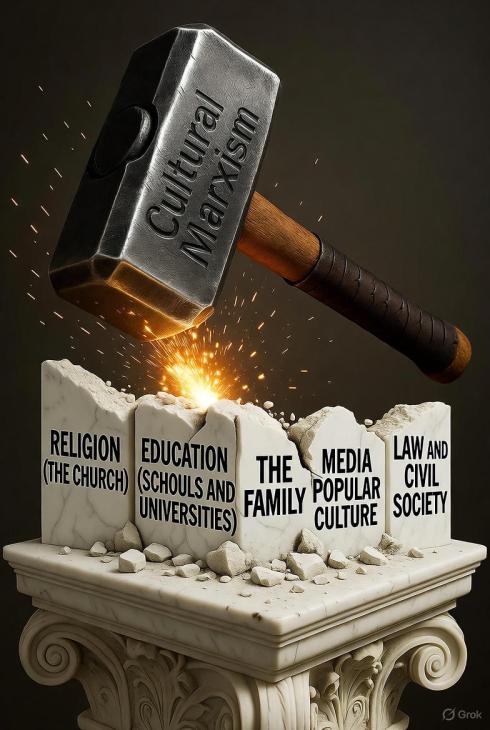
Gramsci never offered a neat checklist, but his writings identify five interlocking domains where the battle for hegemony is fought—and where Western institutions have since seen the most visible transformations:
- Religion and Moral Order – For centuries, the Church anchored Western moral consensus. Gramsci saw it as the spiritual foundation of bourgeois power. Undermining or secularizing that foundation was essential to remaking moral consciousness.
- Education and the Intelligentsia – Schools and universities, he observed, do not merely transmit knowledge; they reproduce ideology. Control the curriculum, train the teachers, shape the young—and you shape tomorrow’s society.
- Media and Popular Culture – Newspapers, cinema, art, and now digital media cultivate public sentiment. Altering how people speak, joke, and imagine themselves can shift the moral vocabulary of an entire civilization.
- Civil Society and Voluntary Institutions – Clubs, unions, NGOs, and advocacy groups form the connective tissue between individuals and the state. They generate the “organic intellectuals” who articulate a new worldview and lend legitimacy to political change.
- Law, Politics, and the Administrative State – Finally, cultural transformation must be consolidated through legal norms, policy, and bureaucratic language, ensuring that the new values become institutional reflexes rather than contested ideas.
Each domain is a theatre in the long “war of position.” The aim is not an immediate coup but the gradual erosion of inherited norms until the revolutionary outlook feels like common sense.
Why Gramsci Still Matters
Gramsci’s legacy is paradoxical. His analysis was intellectually brilliant—but by detaching revolution from economics and anchoring it in culture, he supplied future radicals with a strategy for subverting liberal democracy from within. The New Left of the 1960s and its academic descendants adopted his playbook, translating class struggle into struggles over race, gender, language, and identity. In this sense, Gramsci stands as both the diagnostician and the progenitor of our current ideological turbulence.
For those tracing the lineage of today’s cultural battles, reading Gramsci is essential. His theory of hegemony explains why institutions that once served as stabilizing forces—universities, churches, professional guilds, and even the arts—have become arenas of moral and political conflict. It also clarifies why dissenters within those institutions are treated not as intellectual adversaries but as heretics.
Reading the Intellectual Landscape
This essay continues the Learning the Lay of the Land series here at Dead Wild Roses, which maps the ideas that reshaped Western political thought:
- Hannah Arendt’s The Origins of Totalitarianism — how ideological certainty breeds totalitarian temptation.
- Gramsci’s Prison Notebooks and the Birth of Cultural Hegemony — a deep dive into his original ideas.
- Orwell’s Politics and the English Language — how linguistic corruption becomes political control.
- Mill’s On Liberty — a defence of intellectual freedom against the new orthodoxy.
Together they outline the terrain of our ideological crisis: from Arendt’s warning about totalitarian habits of mind, through Gramsci’s theory of cultural capture, to Orwell’s exposure of linguistic manipulation and Mill’s insistence on free thought.
Closing Reflection
Gramsci’s insight—that the health of a society depends on who defines its common sense—remains the axis on which our modern conflicts turn. Understanding his ideas is not an act of homage, but of inoculation. To preserve a free and open civilization, one must know precisely how it can be subverted—and Gramsci told us, in meticulous detail, how that can be done.
Primary Sources
Gramsci, Antonio. *Selections from the Prison Notebooks*. Edited and translated by Quintin Hoare and Geoffrey Nowell Smith. New York: International Publishers, 1971. (Core text for concepts of cultural hegemony, war of position, civil society, and organic intellectuals; selections from Notebooks 1–29, written 1929–1935.)
Secondary Sources
Arendt, Hannah. *The Origins of Totalitarianism*. New York: Harcourt, Brace, 1951. (Referenced in series context for ideological escalation into totalitarianism.)
Mill, John Stuart. *On Liberty*. London: John W. Parker and Son, 1859. (Referenced in series context as counterpoint to hegemonic orthodoxy.)
Orwell, George. “Politics and the English Language.” *Horizon* 13, no. 76 (April 1946): 252–265. (Referenced in series context for linguistic mechanisms of ideological control.)
Additional Contextual Works
Jay, Martin. *The Dialectical Imagination: A History of the Frankfurt School and the Institute of Social Research, 1923–1950*. Boston: Little, Brown, 1973. (Provides linkage between Gramsci’s cultural pivot and post-war Critical Theory.)
Rudd, Mark. “The Long March Through the Institutions: A Memoir of the New Left.” In *The Sixties Without Apology*, edited by Sohnya Sayres et al., 201–218. Minneapolis: University of Minnesota Press, 1984. (Illustrates practical adoption of Gramscian strategy in 1960s activism.)
Antonio Gramsci (1891–1937) was an Italian Marxist philosopher and revolutionary who reimagined the battlefield of socialism. Where Marx envisioned revolution through economic crisis and class struggle, Gramsci located the real battleground in culture—in the stories, moral codes, and institutions that shape how people perceive reality. His insight reshaped leftist strategy throughout the 20th century and remains the foundation of what has come to be known, often critically, as Cultural Marxism.
Gramsci’s imprisonment by Mussolini between 1926 and 1937 produced the Prison Notebooks, a collection of reflections on history, education, religion, and power that would change Marxism forever. Rather than calling for immediate insurrection, Gramsci argued that Western societies were held together not merely by force, but by consent—the consent of people whose minds had been molded by dominant cultural institutions. To overthrow capitalism, the revolution would first have to capture culture.
The Concept of Cultural Hegemony
Gramsci coined the term “cultural hegemony” to describe the way ruling classes maintain control by shaping what society considers “common sense.” Schools, churches, media, literature, and even family life all help reproduce the values that support the existing order. To Gramsci, the working class could never achieve political power until it produced a counter-hegemony—a rival moral and intellectual framework capable of displacing the dominant bourgeois worldview.
This insight was transformative. It shifted Marxist focus from economic structures to cultural superstructures—from factories to universities, from political parties to publishing houses. The revolution would be waged not only with rifles and manifestos, but with textbooks, art, and language itself.
The Five Pillars of Western Hegemony
Gramsci identified several key arenas where cultural hegemony is maintained and where revolutionary transformation must occur. Though he never formally listed “five areas,” his writings consistently emphasize these interlocking domains as the loci of bourgeois cultural power:
- Religion (The Church) – The Church was, for Gramsci, the moral anchor of Western civilization. Its authority shaped notions of duty, sin, and redemption. For a new socialist order to take root, Marxists would need to displace religious authority with secular, materialist moral systems.
- Education (Schools and Universities) – Schools reproduce social hierarchies by transmitting the ideology of the ruling class. Gramsci saw education as the most potent tool for cultivating a new “collective will.” Intellectuals, teachers, and professors were to become “organic intellectuals” of the working class—agents of counter-hegemony.
- The Family – As the smallest unit of moral and cultural reproduction, the family passes on norms of obedience, gender roles, and private property. Gramsci argued that socialist transformation required reconfiguring family life to reflect collective rather than patriarchal or bourgeois values.
- Media and Popular Culture – Newspapers, radio, and entertainment function as instruments of social consent. Control over communication channels would allow the revolutionary movement to redefine reality itself—to make socialist ideas seem natural and just.
- Law and Civil Society – Beyond the coercive power of the state lies civil society: courts, voluntary associations, clubs, and unions. These mediate between individuals and the state, embedding ruling-class ideology in everyday life. The Left’s long march through these institutions, later theorized by figures like Rudi Dutschke, stems directly from Gramsci’s idea of building a counter-hegemonic presence within civil society.
From Class War to Culture War
Gramsci’s influence has proven far greater than his lifetime achievements would suggest. His Prison Notebooks became a cornerstone for postwar Marxist thinkers of the Frankfurt School—Herbert Marcuse, Theodor Adorno, and others—who expanded his ideas into critical theory. Together, they seeded what would evolve into the New Left, identity-based activism, and much of today’s academic “social justice” thought.
While critics argue that Gramsci’s ideas have fostered divisive cultural politics, even they concede his enduring genius: he saw that culture precedes politics. Whoever controls a society’s moral vocabulary ultimately controls its laws, institutions, and collective imagination.
Why Gramsci Matters Today
Understanding Gramsci is essential to understanding the modern cultural landscape. His legacy explains why ideological movements increasingly contest meanings—of gender, race, language, and history—rather than material production. The “long march through the institutions” that Gramsci inspired is visible across Western education, media, and bureaucracies.
Whether one views this as intellectual renewal or cultural subversion, Gramsci’s insight endures: power begins in the mind before it manifests in law.
References
- Gramsci, Antonio. Selections from the Prison Notebooks. Edited by Quintin Hoare and Geoffrey Nowell Smith. New York: International Publishers, 1971.
- Buttigieg, Joseph A. Antonio Gramsci: Prison Notebooks, Vols. I–III. Columbia University Press, 1992–2007.
- Crehan, Kate. Gramsci, Culture and Anthropology. University of California Press, 2002.
- Dutschke, Rudi. “The Long March Through the Institutions.” (Speech, 1967).
- Jay, Martin. The Dialectical Imagination: A History of the Frankfurt School and the Institute of Social Research, 1923–1950. University of California Press, 1973.
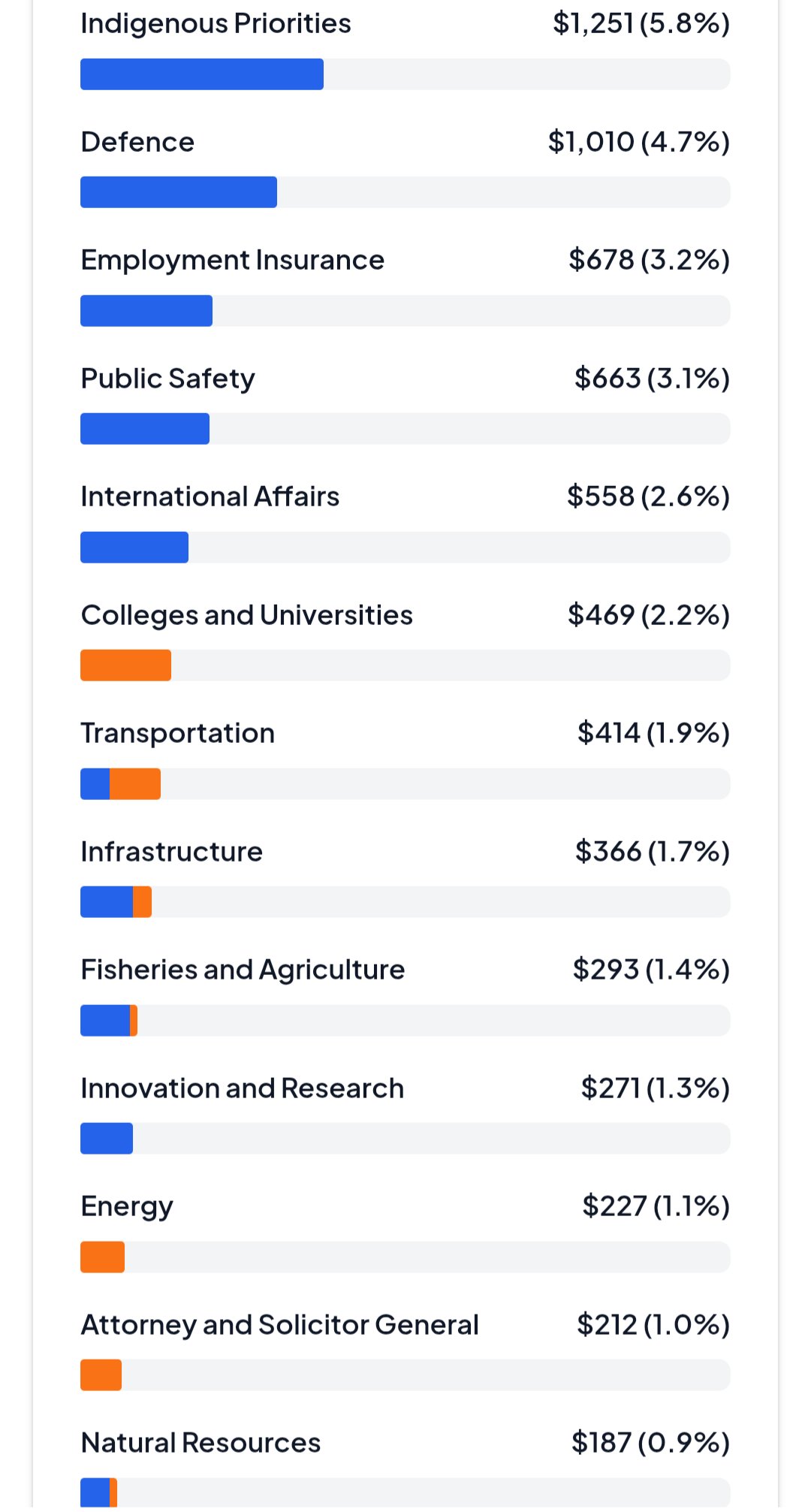
Canada’s federal budget tells a story that few seem willing to read critically. According to CanadaSpends.com, Ottawa allocates $1.251 billion—5.8 percent of the budget—to “Indigenous Priorities,” eclipsing even Defence ($1.010 billion, 4.7 percent). The arithmetic alone invites scrutiny. At what point does reconciliation become a fiscal reflex, untethered from measurable outcomes?
The Arithmetic of Imbalance
Consider a simple exercise in opportunity cost. Halving “Indigenous Priorities” to $625.5 million would free an equal amount—$625.5 million—for redeployment elsewhere. Redirecting that sum to Public Safety, currently $663 million (3.1 percent), would nearly double its capacity to $1.288 billion. The outcome: stronger policing resources, reinforced border security, and potentially measurable reductions in crime—objectives grounded in deterrence rather than symbolism.
This is not an argument against Indigenous advancement. It is an argument for proportionality and accountability. “Indigenous Priorities” now consume more than Employment Insurance ($678 million), International Affairs ($558 million), and Colleges and Universities ($469 million) combined. Defence, tasked with national sovereignty, trails by $241 million. When cultural or consultative programs eclipse citizen security and education, something in our fiscal compass is misaligned.
The Accountability Deficit
Proponents will cite historical redress, and that moral claim has force. But truth in budgeting requires evidence, not sentiment. Where are the audited outcomes showing that each billion spent yields measurable gains in Indigenous health, education, or economic independence?
The problem is not merely bureaucratic inertia—it is structural opacity, worsened by political choice. In December 2015, the newly elected Liberal government suspended enforcement of the First Nations Financial Transparency Act, which had required Indigenous governments to publish audited financial statements and leadership salaries. The minister at the time, Carolyn Bennett, directed her department to “cease all discretionary compliance measures” and reinstated funding to communities that refused disclosure.
In effect, Ottawa dismantled the only system ensuring public visibility into how billions of tax dollars are spent. Nearly a decade later, the Auditor General’s 2025 report found “unsatisfactory progress” on more than half of all Indigenous-services audit recommendations, despite an 84 percent increase in program spending since 2019. The data are undeniable: accountability has eroded even as expenditures have soared.
Fiscal Compassion, Not Fiscal Indulgence
Canada does not need less compassion; it needs measurable compassion—spending that demonstrably improves lives rather than perpetuates dependency. Halving the current Indigenous Priorities budget would not abolish support or reverse reconciliation. It would introduce accountability, allowing funds to be reallocated to public safety, infrastructure, or innovation—areas with immediate and empirically verifiable benefits.
Until Indigenous programs are evaluated with the same rigour applied to defence, education, or social insurance, billion-dollar gestures will remain ends in themselves—virtue without verification.
References
- CanadaSpends.com – Federal Tax Visualizer
- Government of Canada Statement on the First Nations Financial Transparency Act (2015)
- Office of the Auditor General of Canada, 2025 Report – Programs for First Nations
- Canadian Affairs News – Poll: Canadians Want Transparency in First Nations Finances (2025)
- Standing Committee Appearance: Supplementary Estimates (2024)
- Crown-Indigenous Relations and Northern Affairs Canada 2023–24 Results Report
Across Canada, we are witnessing a subtle yet sweeping shift: ideology increasingly outweighs empirical judgment, and institutions once grounded in caution are now pressing ahead with conviction. When belief eclipses observation, society risks felling its own future. This essay explores how the parable of A Short History of Progress becomes a cautionary mirror for our age, when economic vitality, civic trust, and long-term health hang, in effect, on that final swing of the axe.

“The Last Tree” draws a sharp line from the collapse of Easter Island’s ecosystem to three modern Canadian crises—net-zero policy, selective law-enforcement in protest, and rapid-onset gender-affirming care—to ask: when ideology becomes our arbiter rather than evidence, what are we willing to sacrifice?
The Last Tree: When Ideology Fells the Future
In Ronald Wright’s A Short History of Progress, the tale of Easter Island stands as a stark parable of human folly. Isolated in the vast Pacific, the Rapa Nui people arrived around 800 AD and transformed a forested paradise into a monument to their ingenuity and hubris. Over centuries, they felled the island’s palm groves to haul colossal moai statues across the terrain, using timber for sledges, ropes from bark, and fuel for fires. What began as a display of ancestral piety and clan prestige spiraled into ecological catastrophe. Soil eroded, fertility plummeted, bird populations vanished, and the once-vibrant ecosystem crumbled. By the 17th century, the population had crashed from perhaps 15,000 to a few thousand, amid famine, warfare, and cannibalism. Wright captures the inexorable logic: progress, unchecked, devours its own foundations.
Yet it is the final act that lingers—a moment of crystalline horror. The people who felled the last tree could see it was the last, could know with complete certainty that there would never be another. Imagine that islander, axe in hand, gazing at the solitary palm swaying against the horizon. The wind carries the salt of an empty sea, the ground beneath him scarred and barren. What raced through his mind? Not ignorance, for the warnings were etched in the dust: topsoil washing into the ocean, rats devouring every seed, canoes rotting on barren shores. No, it was something fiercer—a conviction forged in ritual and rivalry.
This tree, he might have reasoned, honours the ancestors; to spare it is to dishonour them, to invite the gods’ wrath. The rival clan cannot be allowed supremacy in statue-toppling; one more moai secures our lineage’s glory. Tradition demands it, the priests decree it, and in the face of clan elders’ unyielding stares, doubt withers like the fronds around him. Survival? A coward’s calculus, subordinate to the sacred narrative of progress through monument. With a swing, ideology claims its victory over reality, sealing the island’s doom.
This scene, Wright implies, is not ancient history but a mirror to our own susceptibilities. Ideological blindness is not partisan—it afflicts any society where belief eclipses observation. We stand at analogous thresholds today, where cherished convictions compel us to strike the final blow.
Consider our pursuit of net-zero emissions, pursued with a fervour that borders on the messianic. The federal government’s 2030 targets, however well-intentioned, risk undermining the very prosperity they claim to safeguard. The rhetoric of existential apocalypse—tipping points invoked like divine judgments—drowns out the data: Canada’s emissions constitute roughly 1.5 percent of the global total, and even full compliance would yield negligible climatic impact while rivals like China and India accelerate coal-fired expansion. Policymakers, axe raised, justify the cut: it honours the intergenerational covenant, shames the sceptic as a heretic. Yet the last “tree” here is economic vitality itself, felled in service to a narrative that confuses virtue with viability.
No less alarming is the selective blindness in enforcing the rule of law, particularly amid the surge of “Free Palestine” protests since October 7, 2023. These demonstrations, while not all hateful, have coincided with a documented explosion of antisemitism: synagogues vandalised, Jewish students harassed, and public chants equating Zionism with Nazism increasingly tolerated under the banner of free expression. Authorities often cite the need to avoid escalation or protect equity rights—but to apply the law unevenly corrodes the Charter’s promise of equal protection. The justification echoes the islander’s: equity demands deference to the aggrieved, lest we be branded oppressors. Thus, the final tree of civic trust is hacked away under the banner of performative solidarity.
Perhaps most viscerally, our medical institutions’ embrace of gender-affirming care reveals ideology’s grip on empirical mercy. Provincial guidelines expedite hormones and surgeries for minors, often with scant longitudinal scrutiny, despite emerging evidence of regret and harm. Critics—including those echoing the UK’s Cass Review—argue that compassion has been recast as affirmation, turning clinics into ideological fortresses where dissent is pathologised. This is not to deny the reality of gender dysphoria or the dignity of trans adults seeking relief; it is to insist that true compassion must rest on evidence, not dogma. The clinician, scalpel poised, rationalises: empathy compels affirmation; to probe deeper risks transphobia’s charge. Reality—the patient’s lifelong body, the data’s gaps—yields to the doctrine, mutilating futures in the name of inclusion.
These Canadian vignettes, like Easter Island’s denouement, expose ideology’s seductive tyranny: a narrative so totalising it renders the evident obsolete. Friedrich Nietzsche foresaw this abyss in his dissection of nihilism, that devaluation where “the highest values are losing their value.” Like Wright’s islanders, we mistake self-destruction for virtue—a form of nihilism Nietzsche saw as civilisation’s end-game. Cloaked in Marxist activist garb—equity as the new god, progress as its prophet—these policies dissolve society’s sinews not through malice but through a will to power masquerading as justice. Nietzsche warned that such illusions prolong torment, for “hope in reality is the worst of all evils because it prolongs the torments of man.”
To reclaim our ground, we must confront the axe in our hand: interrogate the story, honour the verifiable, and plant anew before the last tree falls. The islanders could not. We still can.
References
- Wright, Ronald. A Short History of Progress. Anansi, 2004.
- Fraser Institute, “Measuring the Cost of Canada’s Net-Zero Climate Policy,” 2024.
- B’nai Brith Canada, Annual Audit of Antisemitic Incidents, 2024.
- Government of Canada, 2030 Emissions Reduction Plan, 2022.
- Cass, Hilary. Independent Review of Gender Identity Services for Children and Young People (The Cass Review). UK NHS, 2024.
- For Canada-specific studies on gender-affirming care outcomes:
- Jackman, Liam et al., “Patient-reported outcomes, provider-reported outcomes, and physiologic parameters after gender-affirming hormone treatment in Canada: a systematic review” (2025). (SpringerLink)
- Lawson, M.L. et al., “A Cross-Sectional Analysis from the Trans Youth CAN! Study” (2024). (Jah Online)
- “At-a-glance – Gender identity and sexual attraction among Canadian youth: findings from the 2019 Canadian Health Survey on Children and Youth” (2023). (canada.ca)











 bleatmop
 Mystro
 The Arbourist


 Dead Wild Roses
Your opinions…