
You are currently browsing the category archive for the ‘Politics’ category.
Collin May has published a long, ambitious essay in the C2C journal (Hearts of Darkness: How the Left Uses Hate to Fuel its 21st Century Universal Imperium) on cancel culture, “hate” rhetoric, and the modern left’s moral posture. It is broader than I would write, more philosophical than most readers will tolerate, and occasionally overbuilt. But it names a pattern that matters, and one I return to often here: once “hate” becomes a universal accusation, institutions stop persuading and start policing.
May’s most useful contribution is not just the complaint (“cancel culture exists”) but the mechanism: “hate” stops being a moral description and becomes a category that pre-sorts who may be argued with and who may simply be managed.
That is the issue.
Not whether hatred exists. It does. Not whether some speech is vicious. It is. The issue is what happens when “hate” becomes the default label for disagreement, skepticism, refusal, dissent, or plain moral and factual judgments that cut against elite narratives.
At that point, the term stops describing and starts doing administrative work.
You can watch this happen across the institutions that shape public life: media, HR departments, professional bodies, universities, bureaucracies, and the expanding quasi-legal space around speech regulation. The sequence is familiar. Someone raises a concern about policy, ideology, language rules, school programming, medical ethics, public safety, immigration, religion, or sex-based rights. Instead of answering the argument, the institution reframes the speaker. Not wrong—harmful. Not questioning—spreading hate. Not participating in democratic friction—a threat to social order.
That move changes the rules of engagement. A wrong claim can be debated. A “hateful” claim can be quarantined. Once a claim is reclassified as harm rather than argument, the institutional response changes with it: less rebuttal, more restriction.
This language matters because it is not only moral language. It is managerial language. It justifies deplatforming, censorship, professional discipline, reputational destruction, and exclusion from ordinary civic legitimacy. It creates a class of people whose arguments no longer need to be answered on the merits. It also trains bystanders to confuse moral panic with moral seriousness.
May explains this through a large historical and philosophical genealogy. Fair enough. I am less interested in the full genealogy than in the practical result in front of us. In plain terms: the rhetoric of “hate” is often used to centralize authority in institutions that no longer trust the public and no longer feel obliged to reason with them.
That is one reason trust keeps collapsing.
People can live with disagreement. They can even live with policies they dislike. What they do not tolerate for long is being handled—being told their questions are illegitimate before they are heard. Once citizens conclude that institutions are using moral language as a shield against scrutiny, every future statement gets discounted. Even true statements are heard as spin.
And then the damage compounds. If “hate” is defined so broadly that it includes dissent, genuinely hateful speech becomes harder to identify and confront. The category gets inflated, politicized, and cheapened. Meanwhile, ordinary democratic disagreement becomes harder to conduct without professional or social risk.
That is not a confident free society. It is a managerial one.
Canada is not exempt. We have our own versions of this habit: speech debates reframed as safety debates, policy criticism recoded as identity harm, and public disputes (including over schools, sex-based rights, and even routine civic rituals like land acknowledgements) routed through tribunals, regulators, HR offices, and media scripts instead of open argument. The details vary by case. The mechanism does not. This tactic is not unique to one political tribe, but it is now especially entrenched in progressive-managerial institutions, which is precisely why it has so much reach.
The answer is not to deny hatred exists, or to become casual about cruelty. The answer is to recover civic discipline.
Name actual incitement when it occurs. Enforce existing laws where there are real threats, harassment, or violence. But stop using “hate” as a catch-all for disfavoured views. Stop treating condemnation as a substitute for evidence. Stop teaching institutions that the way to win an argument is to disqualify the speaker.
May quotes Pope Francis on cancel culture as something that “leaves no room.” Whether or not one follows his full historical argument, that phrase captures the operational problem.
A liberal society cannot function if citizens are only permitted to disagree inside moral boundaries drawn in advance by bureaucrats, activists, and legacy media.
The test is simple: can a claim be examined without first being moralized into silence?
If the answer is no, that is not moral confidence. It is institutional insecurity backed by power.
That is the pattern worth naming. And that is why essays like May’s, even when they overshoot, remain worth reading.

References
Collin May, “Hearts of Darkness: How the Left Uses Hate to Fuel its 21st Century Universal Imperium,” C2C Journal (February 16, 2026), https://c2cjournal.ca/2026/02/hearts-of-darkness-how-the-left-uses-hate-to-fuel-its-21st-century-universal-imperium/. (C2C Journal)
Canada’s Bill C-4 was sold as a targeted ban on abusive “conversion therapy.” That goal of ending coercive, shame-based attempts to “pray the gay away”is legitimate, and the harms from such practices are well documented. (Library of Parliament)
But C-4 didn’t stop at prohibiting coercion. It built contested premises about “gender identity” into the Criminal Code—then wrapped ordinary clinical caution in legal risk. For children, that’s not a symbolic problem. It’s a downstream harm problem.
1) C-4 hard-codes a contested concept into criminal scope
The Criminal Code definition of “conversion therapy” includes any “practice, treatment or service designed to… change a person’s gender identity to cisgender,” or “repress… a person’s non-cisgender gender identity.” (Department of Justice Canada)
That’s not the same category as sexual orientation. Whatever one’s politics, “gender identity” is not measured like blood pressure. In real child psychotherapy, you do differential diagnosis: you test hypotheses, you treat comorbidities, you watch patterns over time, you revisit interpretations.
C-4 makes one interpretive direction toward “cisgender”a uniquely danger to be seen as the “design” of therapy. (Department of Justice Canada)
2) The preamble signals something stronger than “don’t abuse people”
The Act’s preamble denounces “myths and stereotypes,” including “the myth that… cisgender gender identity… [and] gender expression that conforms to the sex assigned… are to be preferred over other… gender identities.” (Parliament of Canada)
Supporters will say this is a dignity claim: no one should be pressured to “be cis.” Fine. But when Parliament declares a core premise a “myth,” it doesn’t just condemn abuse it pressures institutions to treat skepticism as suspect.
In therapy, that matters, because the clinician’s job is not to recite a moral slogan. It’s to find the causal engine of distress in a specific child.
3) “Exploration” is permitted—until it looks like exploration with a destination
C-4 includes a “for greater certainty” carve-out for “exploration or development of an integrated personal identity… such as… gender transition,” provided the service is not “based on an assumption that a particular… gender identity… is to be preferred over another.” (Department of Justice Canada)
Here’s the problem: in actual clinical practice, the line between exploration and influence is not a clean statutory boundary.
A careful therapist might say:
- “Let’s treat anxiety/OCD first and see what remains.”
- “Let’s explore trauma and dissociation before we interpret identity claims.”
- “Let’s reduce online reinforcement and stabilize sleep, mood, and social stress.”
- “Let’s slow down—puberty is a confounder, not an oracle.”
That’s not “conversion.” That’s normal clinical sequencing.
But under C-4’s language, a motivated complainant (or risk-averse administrator) can reframe caution as an attempt to “repress” a non-cis identity, or as therapy “designed” to steer toward “cisgender.” (Department of Justice Canada)
Even if a prosecution is unlikely, the chilling effect doesn’t require convictions. It only requires enough ambiguity that clinicians and clinics decide it’s not worth the exposure.
4) This isn’t “college policy.” It’s Criminal Code territory.
Bill C-4 received Royal Assent on December 8, 2021 and came into force in January 2022. (Parliament of Canada)
It created Criminal Code offences around causing someone to undergo conversion therapy, promoting/advertising it, and profiting from it. (Parliament of Canada)
So when therapists ask, “Can I safely do exploratory work with this child without being accused of ‘conversion’?” they are not being melodramatic. They are doing what professionals do when lawmakers write broad definitions: they assume the worst plausible reading—and they self-censor.
5) Why this hits children hardest
Adults can absorb bad ideology and still have time to course-correct. Kids often can’t.
Children need therapy that is:
- exploratory (many hypotheses, not one script),
- developmentally sober (puberty changes the picture),
- comorbidity-first (anxiety, depression, autism traits, trauma, dissociation),
- family-systems aware (parents are usually the safety net, not “the enemy”),
- outcome-humble (no foreclosed conclusions).
C-4 subtly tilts the playing field: it makes “don’t be seen as steering away from trans identity” the safest institutional posture regardless of whether that posture serves the child in front of you.
6) Why this question is sharper now
After the February 10, 2026 Tumbler Ridge shootings, public attention has turned—again—to institutional failure chains: mental health, gatekeeping, warning signs, and what “care” actually means when a young person is unstable. The BC RCMP’s Feb 13 update refers to autopsies for “eight victims and the suspect” (nine deceased total), and notes ongoing review of prior interactions with the suspect. (RCMP)
A tragedy doesn’t “prove” a policy critique. But it does remove the luxury of pretending that scripts are the same thing as safeguards.
A better standard (without reviving abusive conversion practices)
If Parliament’s aim is to ban coercion and fraud, it can do so cleanly without criminalizing clinical caution.
A fix would explicitly protect:
- Open-ended psychotherapy for gender distress, including differential diagnosis and comorbidity treatment.
- Neutral therapeutic goals (reducing distress, improving functioning, strengthening self-acceptance) without predetermining identity outcomes.
- The clinician’s ability to discuss biological sex reality, uncertainty, and developmental pathways without that being treated as “preference” or “myth.” (Parliament of Canada)
- Bright-line prohibitions aimed at the actual evils: coercion, aversive techniques, confinement, threats, and misrepresentation.
Canada can still denounce abuse and defend evidence-based exploration. Kids deserve therapists unbound by ideology—not just ideology unbound by evidence.

References
- Bill C-4 — First Reading (House of Commons) — Nov 29, 2021
https://www.parl.ca/DocumentViewer/en/44-1/bill/C-4/first-reading
Source: (Parliament of Canada) - Bill C-4 — Third Reading (House of Commons) — Dec 1, 2021
https://www.parl.ca/DocumentViewer/en/44-1/bill/C-4/third-reading
Source: (Parliament of Canada) - Bill C-4 — Royal Assent (Chapter 24) — Dec 8, 2021
https://www.parl.ca/DocumentViewer/en/44-1/bill/C-4/royal-assent
Source: (Parliament of Canada)
Core legal text (Criminal Code, consolidated)
- Criminal Code — s. 320.101 (definition + exploration carve-out)
https://laws-lois.justice.gc.ca/eng/acts/c-46/section-320.101.html - Statutes of Canada 2021, c. 24 (Annual Statutes full text — includes preamble)
https://laws-lois.justice.gc.ca/eng/AnnualStatutes/2021_24/FullText.html
Official legislative record / metadata (timeline, status)
- LEGISinfo — Bill C-4 (44-1) (dates, stages, summary trail)
https://www.parl.ca/legisinfo/en/bill/44-1/c-4
Source: (Parliament of Canada)
Neutral institutional summary
- Library of Parliament — Legislative Summary (PDF)
https://publications.gc.ca/collections/collection_2022/bdp-lop/ls/YM32-3-441-C4-eng.pdf
Source: (Government of Canada Publications)
Government explainer / enforcement framing
- Justice Canada — “Conversion therapy” page (in-force date, offences overview)
https://www.justice.gc.ca/eng/rp-pr/jr/ct-tc/p1.html
Context reference used in the essay (Tumbler Ridge)
- RCMP — Tumbler Ridge investigative update (Feb 13, 2026)
https://rcmp.ca/en/bc/tumbler-ridge/news/2026/02/4350292
The most important part of the British Columbia Human Rights Tribunal’s decision in Chilliwack Teachers’ Association v. Neufeld (No. 10) is not the political noise around it. It is a short passage in page 19 paragraph 55. [attributed as paragraph 19, originally].
That passage matters because it appears to recode a contested idea as a condition of basic civic recognition. In plain terms, it moves from “do not discriminate against people” toward “you must affirm a specific theory to count as accepting them.”
This primer focuses on that point only. It does not attempt to relitigate the entire case.
The tribunal’s decision was issued February 18, 2026, indexed as 2026 BCHRT 49.
What this article argues in one paragraph
TL;DR: The BCHRT can punish discrimination without requiring Canadians to affirm a contested theory of sex and gender as the price of being considered non-discriminatory. Paragraph 19 matters because it blurs that line: it treats disagreement with a conceptual framework as “existential denial” of a person. That is a legal and civic problem, even for people who support anti-discrimination protections.
What this critique is not saying
Before the legal and logical analysis, a boundary line.
This critique is not saying:
- LGBTQ teachers cannot suffer real harm from public rhetoric.
- Human rights law cannot address discriminatory publications or poisoned work environments.
- Every criticism of SOGI, gender identity policy, or youth transition debates is lawful.
- Barry Neufeld’s rhetoric was prudent, fair, or wise.
The tribunal found multiple contraventions under the Code, including ss. 7(1)(a), 7(1)(b), and 13, and the decision contains detailed findings about workplace impact and discriminatory effects.
This primer makes a narrower claim:
Page 19 paragraph 55 uses an analogy that collapses the distinction between recognizing a person and affirming a contested ideological premise.
That distinction matters for free expression, legal clarity, and public trust.
The passage that changes the frame
Here is the core language from parge 19, paragraph 55 (including the definitional lead-in):
“Transpeople are, by definition, people ‘whose gender identity does not align with the sex assigned to them at birth’…”
“If a person elects not to ‘believe’ that gender identity is separate from sex assigned at birth, then they do not ‘believe’ in transpeople. This is a form of existential denial…”
“A person does not need to believe in Christianity to accept that another person is Christian. However, to accept that a person is transgender, one must accept that their gender identity is different than their sex assigned at birth.”
This is the paragraph Canadians should read for themselves.
The issue is not whether one can be civil. The issue is whether civil recognition is being redefined as mandatory assent to a disputed concept.
The core problem: equivocation on “accept” and “believe”
The tribunal’s analogy uses accept and believe as if they do the same work in both examples. They do not.
Christianity example
In the Christianity example, “accept that another person is Christian” usually means:
- acknowledging a descriptive fact about that person’s profession of faith,
- recognizing what they claim to believe,
- without requiring your own doctrinal agreement.
You can think Christianity is false and still accurately say, “Yes, that person is Christian.”
That is descriptive recognition.
Transgender example (as framed in para. 55)
In the tribunal’s wording, “accept that a person is transgender” is not left at description. It is tied to a required premise:
- that gender identity is separate from sex assigned at birth, and
- that this premise must be accepted in order to count as accepting the person at all.
That is not merely descriptive recognition. It is affirmation of a contested theory built into the definition.
That is the logical shift.
Why this matters legally and civically
A liberal legal order normally distinguishes between:
- Recognition of persons
- Protection from discrimination
- Compelled assent to contested beliefs
Paragraph 55 blurs those lines.
A person can acknowledge all of the following without contradiction:
- that someone identifies as transgender,
- that the person may experience distress, dysphoria, or social vulnerability,
- that harassment or discrimination against them is wrong,
while still disputing:
- whether sex is best described as “assigned” rather than observed,
- whether gender identity should override sex in all legal contexts,
- whether specific policies (sports, prisons, shelters, schools) should follow from that framework.
If disagreement on those latter questions is relabeled as “existential denial,” the public is no longer being asked to tolerate persons. It is being asked to affirm a framework.
That is the warning.
A concrete example most readers can use
Here is the distinction in everyday terms.
A teacher, coach, employer, or colleague can:
- treat a transgender person courteously,
- avoid harassment,
- maintain ordinary workplace civility,
- refrain from discriminatory conduct,
without conceding that sex categories disappear in every policy context.
For example, a person may choose to use a student’s preferred name in daily interaction and still argue that elite female sports should remain sex-based. A person may reject insults and harassment and still dispute whether “sex assigned at birth” is the best scientific language.
That is not incoherence. That is how pluralist societies work.
Paragraph 19 pressures this distinction by framing conceptual dissent as equivalent to non-recognition of the person.
The definitional trap in paragraph 55
Paragraph 19 does something subtle but powerful.
It defines “transpeople” using a specific conceptual framework (“gender identity” versus “sex assigned at birth”), then treats non-acceptance of that framework as non-acceptance of trans people themselves.
That is a question-begging structure:
- Premise (built into the definition): trans identity necessarily means gender identity distinct from sex assigned at birth.
- Conclusion: if you reject that premise, you deny trans people.
But the premise is precisely what is contested in public debate.
A tribunal can rule against discriminatory conduct. It can interpret the Code. It can assess workplace effects. But once it turns a contested framework into the test of whether one “accepts” a class of persons at all, it risks moving from adjudication into ideological gatekeeping.
Context matters, but it does not fix the analogy
To be fair to the decision, the tribunal is not writing in a vacuum.
The reasons frame Mr. Neufeld’s rhetoric as part of a broader pattern of statements the tribunal found denigrating, inflammatory, and connected to the work environment of LGBTQ teachers. The tribunal also found a direct connection between his public rhetoric and a school climate that felt unsafe to many LGBTQ teachers.
That context may explain the tribunal’s forceful language.
It does not solve the logic problem in paragraph 19.
Even in hard cases, legal reasoning should preserve key distinctions:
- personhood vs. theory,
- conduct vs. belief,
- discrimination vs. disagreement.
When those lines blur, institutions may satisfy partisans while losing credibility with ordinary readers who can still detect the category error.
Remedies matter too (and should be stated plainly)
This was not a symbolic ruling.
The tribunal ordered multiple remedies, including a cease-and-refrain order, $442.00 to Teacher C for lost wages/expenses, and a $750,000 global award for injury to dignity, feelings, and self-respect to be paid to the CTA for equal distribution to class members. It also ordered interest on monetary amounts as specified.
The tribunal also states that the dignity award is compensatory and “not punitive.”
Readers can disagree about the amount. They should still understand that paragraph 19 sits inside a decision with real legal and financial consequences.
Why Canadians should pay attention
Most Canadians will never read a tribunal decision. They will hear summaries.
That is why paragraph page 19 paragraph 55 deserves attention.
If public institutions begin treating disagreement with a contested theory as “existential denial,” the zone of legitimate disagreement shrinks by definition. The public is no longer told only, “Do not discriminate.” It is told, in effect, “Affirm this framework, or your dissent may be treated as denial of persons.”
That is not a stable basis for pluralism.
A rights-respecting society needs a better rule:
- protect people from discrimination,
- punish actual harassment and unlawful conduct,
- preserve space for lawful disagreement on contested concepts.
Paragraph 55, as written, weakens that line.

Glossary for readers
Page 19, Paragraph 55
A specific paragraph in the tribunal’s reasons that contains the Christianity analogy and the “existential denial” language. This primer focuses on that paragraph.
“Existential denial”
The tribunal’s phrase in para. 19 for refusing to “believe” that gender identity is separate from sex assigned at birth, which it links to not “believing in transpeople.”
Section 7(1)(a) (BC Human Rights Code)
A Code provision dealing with discriminatory publications (as applied by the tribunal in this case).
Section 7(1)(b) (BC Human Rights Code)
A Code provision dealing with publications likely to expose a person or group to hatred or contempt (the tribunal found some publications met this threshold).
Section 13 (BC Human Rights Code)
A Code provision dealing with discrimination in employment, including discriminatory work environments (the tribunal found a poisoned work environment for the class of LGBTQ teachers).
“Poisoned work environment”
A human rights / employment law concept referring to a workplace atmosphere made discriminatory through conduct, speech, or conditions connected to protected grounds.
SOGI 1 2 3
Resources discussed in the decision in connection with BC public education and inclusion policies; the tribunal notes they are resources and addresses their role in the factual background. (See source map below.)
Source map so readers can verify for themselves
Use this map to read the decision directly and check each claim the PDF is available here.
Case identification and issuance
- Paras. 1–3 (intro/citation/date/caption)
- Verified from the front matter: issued February 18, 2026, indexed as 2026 BCHRT 49.
Overview of findings and what was decided
- Paras. 4–6 (high-level findings; which Code sections were violated)
- Tribunal later reiterates finding the complaint justified in part and violations of ss. 7(1)(a), 7(1)(b), and 13.
Freedom of expression framework / limits
- Paras. 8–10 (overview-level framing)
- Also see Part VII heading “Freedom of expression and its limits” in the table of contents.
SOGI factual background
- Paras. 13–15 (background on SOGI 1 2 3 in public education)
- See TOC references to “SOGI 1 2 3 in public education” and Neufeld’s response.
The key analogy and “existential denial”
- Para. 19 (full lead-in + Christianity analogy + “existential denial” language)
This is the central paragraph for the primer.
Tribunal’s “veneer of reasonableness” concern
- Para. 55 (same paragraph; immediate context of the analogy)
Workplace impact evidence / climate findings
- Paras. 38 onward (teacher evidence and climate effects)
- Example evidence and findings on climate and workplace effects are reflected in the teacher testimony excerpts and the tribunal’s acceptance of a direct connection to unsafe school climate.
s. 13 conclusion (employment discrimination)
- Para. 82 (and surrounding paras.) / section conclusion in Part V-C
- Tribunal concludes violation of s. 13 for the class.
Remedies overview (s. 37(2))
- Paras. 99 onward (remedies discussion starts in the remedies part)
- Includes declaration, cease/refrain order, expenses, dignity award, and interest.
Cease and refrain order
- Remedies section, Part A (paras. around 100–101)
- “We order him to cease the contravention and refrain from committing the same or a similar contravention…”
Training remedy requested but declined
- Part B (ameliorative steps) (paras. around 102)
- Tribunal says it was not persuaded mandatory training would have a beneficial effect in this case.
Teacher C expenses ($442)
- Part C (expenses incurred) (paras. around 103)
- Tribunal orders $442.00 to Teacher C.
Dignity award ($750,000 global)
- Part D (compensation for injury to dignity…) (paras. around 104–111)
- Tribunal says the purpose is compensatory, not punitive; later orders $750,000 to the CTA for equal distribution to class members.
Interest orders
- Part E (Interest) (paras. around 112)
- Tribunal orders interest as set out in the Court Order Interest Act.
If “process legitimacy” is the immune system of pluralist democracy, then institutional behaviour on gender policy is a stress test. The question isn’t whether an organization “supports trans kids.” Most Canadians want distressed kids treated with compassion. The real question is whether a major institution preserves the rules that let citizens disagree without declaring each other enemies: transparent standards, viewpoint tolerance, due process, and consistent safeguarding norms.
On gender issues in Alberta schools, the Alberta Teachers’ Association (ATA) has repeatedly positioned itself against provincial policies that increase parental consent/notification requirements (for under-16 name/pronoun changes) and opt-in consent for certain explicit instruction around gender identity and sexuality. (Reuters) (Those positions are not obscure; they are central to ATA’s public posture around the province’s direction of travel.)
More important than the slogans is the procedural stance that shows up in teacher guidance: ATA-affiliated materials have explicitly cautioned educators against disclosing a student’s sexual orientation or gender identity to parents or colleagues without the student’s consent. (Office of Population Affairs) That is a high-stakes choice about where authority sits—between child, family, and school. You can argue for it. You can argue against it. But you can’t pretend it’s neutral. It quietly rewrites safeguarding defaults: the family becomes, at minimum, a conditional partner rather than the presumption.
Now add the evidence environment. Over the last two years the confidence level around pediatric medical interventions has become more openly disputed—not only in Europe but in the Anglosphere generally. A major American federal review published under HHS/OPA in late 2025 frames the evidence base for pediatric gender-dysphoria treatments as weak/low-certainty and calls for greater caution and higher standards of evidence. (Office of Population Affairs) Separately, a 2025 systematic review and meta-analysis focused on puberty blockers for youth with gender dysphoria rated the certainty of evidence as very low for many outcomes and called for higher-quality studies. (PMC)
None of that automatically tells Alberta what to do. But it does tell you what institutions shouldn’t do: treat a contested landscape as settled; treat caution as moral failure; treat parental involvement as presumptive danger; or treat dissent as “misinformation” rather than as disagreement about evidence thresholds and child-protection tradeoffs.
Because once an institution behaves that way, it teaches a poisonous lesson: the process is legitimate only when it produces the “right” outcomes. That’s outcome legitimacy wearing a procedural costume. And it’s exactly how you get an arms race in which every faction concludes it must “capture” the institution before the other faction does.
To be clear: there are serious researchers and clinicians who report short-term mental-health improvements in cohorts receiving gender-affirming medical interventions, and there are studies reporting low regret among youth who accessed puberty blockers/hormones in particular samples. (PubMed) That’s precisely why process legitimacy matters: when evidence is mixed, partial, or uncertain, the only adult stance is procedural humility—clear standards, honest uncertainty, room for argument, and policies that can survive being applied by your opponents next year.
Verdict (process-first, not tribe-first)
If an institution wants to avoid the “friend/enemy” trap on this file, it should stop acting like moral certainty is a substitute for good procedure. In practice that means:
- publish the evidence threshold being used (and why),
- separate student support from ideological doctrine,
- adopt viewpoint-neutral professional norms (no loyalty tests),
- and set safeguarding rules that can be defended symmetrically—not only when your side holds the pen.
That’s how you reduce ideological capture risk without replacing it with counter-capture. 🧯

Glossary 📌
Process legitimacy — Accepting an institution’s decision as binding even when you dislike the outcome, because rules were lawful, fair, transparent, and consistently applied.
Outcome legitimacy — Treating a process as legitimate mainly when it produces your preferred outcome.
Ideological capture — A condition where a contested worldview becomes so dominant in an institution’s norms and incentives that dissent is chilled and policy becomes insulated from evidence contestation and pluralism. (Best treated as an inference from mechanisms, not a slogan.)
Safeguarding — Child-protection norms and practices: role clarity, duty of care, appropriate parental involvement, documentation, escalation pathways, and risk management.
Low certainty evidence — A systematic-review judgment (often using GRADE) indicating limited confidence that an observed effect is real and durable; future studies may change the conclusion materially.
Puberty blockers (in this context) — Medications used to pause pubertal development; the debate concerns indications, outcomes, and risk–benefit in youth with gender dysphoria.
Citations 🧾
ATA / Alberta schooling context
- ATA-affiliated guidance on confidentiality around students’ sexual orientation/gender identity (GSA/QSA guide). (Office of Population Affairs)
American evidence review
- HHS/OPA report PDF: Treatment for Pediatric Gender Dysphoria: Review of Evidence and Best Practices (Nov 19, 2025). (Office of Population Affairs)
- HHS press release summarizing the report (Nov 19, 2025). (HHS.gov)
- Scholarly critique/response to the HHS report (J Adolesc Health, 2025). (JAH Online)
Systematic review on puberty blockers
- Miroshnychenko et al. 2025 systematic review/meta-analysis (PubMed + full text). (PubMed)
Evidence suggesting benefit / satisfaction in some cohorts (for balance and accuracy)
- Tordoff et al. 2022 (JAMA Network Open): association with lower depression/suicidality over 12 months. (JAMA Network)
- Olson et al. 2024 (JAMA Pediatrics): satisfaction/regret findings in youth accessing blockers/hormones (regret rare in that sample). (JAMA Network)
This essay is not an argument against transgender adults living freely and being treated decently. It is an argument about a specific set of claims—metaphysical, political, and clinical—that tends to generate persistent institutional conflict because it lacks a shared stopping rule. By “stopping rule,” I mean a principled boundary that both sides can recognize as legitimate: a line where accommodation ends and coercion begins, or where uncertainty requires caution. When subjective identity claims are treated as authoritative and dissent is treated as harm, disputes recur across domains—speech norms, public policy, and pediatric medicine—because there is no common adjudicator capable of resolving the underlying disagreement.
1) Thesis and scope: what is being argued, and what is not
The claim here is procedural. Whatever one’s moral intuitions, systems built to enforce contested metaphysics predictably produce friction that neither side can permanently “win.” A pluralist society can enforce civility and prohibit harassment. It cannot, without escalating conflict, require citizens and institutions to treat an internally felt identity as the final authority over publicly legible categories—especially when those categories structure law, safety, and fairness.
2) Metaphysical claim: identity as authoritative reality
The metaphysical claim, stated minimally, is: when sex and self-declared gender conflict, identity is treated as the authoritative reality for how others must speak and for how institutions must categorize. In a liberal society, people routinely request courtesy; the tension begins when courtesy becomes a duty enforced by institutional sanctions, because that converts disagreements about contested concepts into compliance problems.
The mechanism is structural rather than psychological. If a proposition is treated as morally obligatory yet largely unverifiable, enforcement shifts from evidence to norms, and from norms to penalties. This does not require attributing motives; it is a predictable consequence of asking public systems to operationalize contested metaphysics. The cost is an expansion of “speech governance,” where ordinary interpersonal mistakes or dissenting beliefs are treated as policy violations rather than social disputes. The verdict: making subjective identity authoritative at the level of public rulemaking tends to destabilize shared norms, because the principle contains no internal boundary that can settle recurring disputes.
3) Political claim: institutions forced to referee contested categories
The political claim extends the metaphysical one: public institutions must treat identity as authoritative in classification and access. The “no stopping rule” problem becomes concrete when policy must decide eligibility, categories, and competing rights. Sport is not the whole controversy, but it is a clear case study because sex-segregated categories exist to preserve fairness under stable biological differences.
World Athletics’ 2023 regulations excluding transgender women who have experienced male puberty from elite female competition were an explicit attempt to draw a boundary grounded in performance-relevant biology rather than identity.(worldathletics.org) This example does not “prove” the broader thesis; it illustrates the governing dilemma: once identity is treated as determinative, any sex-based boundary becomes contestable on the same logic, and institutions are pulled into continuous adjudication. The cost is not only policy churn but legitimacy loss, as significant segments of the public come to see institutions as enforcing contested beliefs rather than administering neutral rules. The verdict: when institutions are made to referee contested metaphysical claims, policy disputes harden into identity conflicts and become difficult to resolve through ordinary pluralist compromise.
4) Clinical claim: minors, uncertainty, and the need for evidentiary brakes
The clinical claim is narrower and higher-stakes: affirmation-first protocols are often presented as the evidence-based default for minors, despite ongoing disputes about evidence quality, long-term outcomes, and appropriate thresholds for irreversible interventions.
The mechanism is again about stopping rules. In pediatrics, where patients may have limited capacity to grasp lifelong tradeoffs and where interventions can be difficult to reverse, uncertainty normally triggers caution: structured assessment, conservative pathways, and high evidentiary standards. In England, the Cass Review’s recommendations prompted major service redesign, and NHS England’s implementation document outlines steps already taken and planned in response to those recommendations.(england.nhs.uk) The UK government also announced that emergency restrictions on the private sale and supply of puberty blockers would be made indefinite following advice from the Commission on Human Medicines, citing safety concerns; the DHSC explainer situates this within a broader shift toward research frameworks.(gov.uk)
The point is not that UK policy settles the science. The point is procedural: a major public health system treated evidentiary uncertainty as a reason to tighten pathways and emphasize research structures. The cost of overstating certainty is predictable—trust erosion among families, clinicians, and the public when policy appears to run ahead of evidence. The verdict: for minors, uncertainty should operate as a brake; when it does not, clinical decision-making becomes vulnerable to political and ideological pressure.
5) Steelman, with a credibility caveat: what proponents argue, and why WPATH cannot be treated as neutral authority
A fair steelman starts with the humane premise: some young people experience profound distress; social rejection correlates with worse mental health; supportive environments may reduce suffering; and for adults, liberal societies generally presume wide autonomy over body and presentation. Observational research has reported short-term associations between receiving puberty blockers or hormones and lower reported depression or suicidality among transgender and nonbinary youth, while still facing the usual limitations of nonrandomized designs (selection effects, confounding, short follow-up).(jamanetwork.com)
Advocates often cite WPATH’s Standards of Care (SOC8) as a professional consensus reference point. A publishable essay, however, has to include a procedural caveat: SOC8 is now contested as an uncontested authority, particularly for minors, due to public disputes about guideline-development process and evidentiary representation. The “WPATH Files” publication by Environmental Progress alleges internal discussions inconsistent with the public posture of evidentiary confidence.(environmentalprogress.org) Separately, an HHS report alleged that during SOC8 development, WPATH suppressed certain systematic reviews considered potentially undermining to preferred protocols.(opa.hhs.gov) WPATH and USPATH responded by disputing key characterizations and criticizing the HHS report, framing it as misrepresenting evidence, and noting constraints around ongoing litigation and related processes.(wpath.org)
The responsible conclusion is limited but important: SOC8 may still be used to describe the best-case articulation of the pro-affirmation position, but it cannot function as a neutral “settled science” stamp—especially in a pediatric domain where evidentiary confidence must be demonstrable rather than asserted. The verdict: steelman the humane intent and the reported short-term associations; do not outsource epistemic certainty to a guideline whose development and representation are under active public dispute.
6) Synthesis: stopping rules as the governance solution
The practical question is governance, not moral panic: can a pluralistic society accommodate people without compelling metaphysical assent, and can pediatric medicine proceed without overstating certainty? The answer is unglamorous: stopping rules.
In institutions, stopping rules mean enforcing civil treatment and anti-harassment norms while refusing to treat metaphysical agreement as a condition of participation in public life. In medicine, stopping rules mean evidence thresholds, transparent review, and heightened caution for minors where long-term outcomes remain contested. If stopping rules are refused, conflict tends to migrate: from clinics to courts, from policy to punishment, from persuasion to compulsion. The cost is durable polarization and degraded trust in institutions. The verdict: if the goal is social peace and clinical integrity, the burden is on advocates and opponents alike to articulate boundaries that are evidence-responsive, rights-consistent, and enforceable without demanding ideological conformity.

Glossary
Affirmation-first: A clinical approach that treats a person’s stated gender identity as true and prioritizes support for it; critics argue it may reduce exploratory assessment, especially for minors.
Cass Review: Independent review commissioned by NHS England into child and adolescent gender services; its recommendations prompted service redesign and tighter evidence standards.(england.nhs.uk)
Observational study: Research that observes outcomes without random assignment; can show association but generally cannot prove causation.(pubmed.ncbi.nlm.nih.gov)
Puberty blockers (GnRHa): Medications that suppress pubertal development; debated in youth gender medicine due to evidence-quality and risk/benefit uncertainty.(gov.uk)
SOC8: WPATH Standards of Care, version 8 (2022), widely cited in gender medicine; currently disputed as neutral authority in some public controversies.(environmentalprogress.org)
Stopping rule: A principled boundary that can settle recurring disputes (e.g., evidence thresholds for minors; category rules in sport).
WPATH Files: A publication of alleged internal WPATH materials by Environmental Progress; relevant here because it is part of an ongoing credibility dispute about guideline development.(environmentalprogress.org)
References
- NHS England, Implementing the Cass Review recommendations (PDF). https://www.england.nhs.uk/wp-content/uploads/2024/08/PRN01451-implementing-the-cass-review-recommendations.pdf
- NHS England, Children and young people’s gender services: implementing the Cass Review recommendations (long read). https://www.england.nhs.uk/long-read/children-and-young-peoples-gender-services-implementing-the-cass-review-recommendations/
- UK Department of Health and Social Care, “Ban on puberty blockers to be made indefinite on experts’ advice” (11 Dec 2024). https://www.gov.uk/government/news/ban-on-puberty-blockers-to-be-made-indefinite-on-experts-advice
- DHSC Media Blog, “Puberty blockers: what you need to know.” https://healthmedia.blog.gov.uk/2024/12/11/puberty-blockers-what-you-need-to-know/
- World Athletics press release (Mar 2023) on female eligibility. https://worldathletics.org/news/press-releases/council-meeting-march-2023-russia-belarus-female-eligibility
- World Athletics eligibility regulations PDF. https://worldathletics.org/download/download?filename=c50f2178-3759-4d1c-8fbc-370f6aef4370.pdf&urlslug=C3.5A%20%E2%80%93%20Eligibility%20Regulations%20Transgender%20Athletes%20%E2%80%93%20effective%2031%20March%202023
- Tordoff et al., JAMA Network Open (2022). https://jamanetwork.com/journals/jamanetworkopen/fullarticle/2789423
- Environmental Progress, “The WPATH Files.” https://environmentalprogress.org/big-news/wpath-files
- HHS, Treatment for Pediatric Gender Dysphoria (Nov 2025). https://opa.hhs.gov/sites/default/files/2025-11/gender-dysphoria-report.pdf
- WPATH/USPATH response (May 2025). https://wpath.org/wp-content/uploads/2025/05/WPATH-USPATH-Response-to-HHS-Report-02May2025-3.pdf
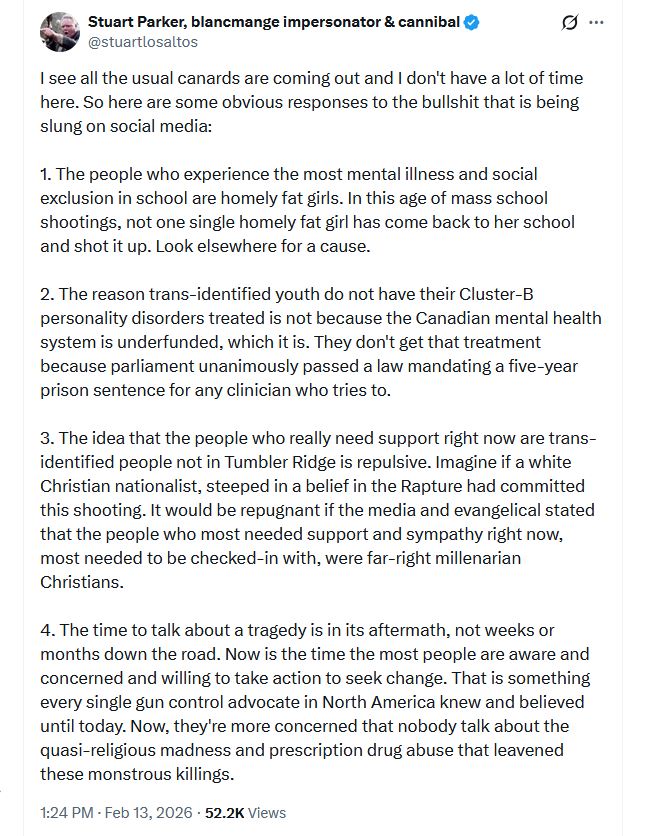
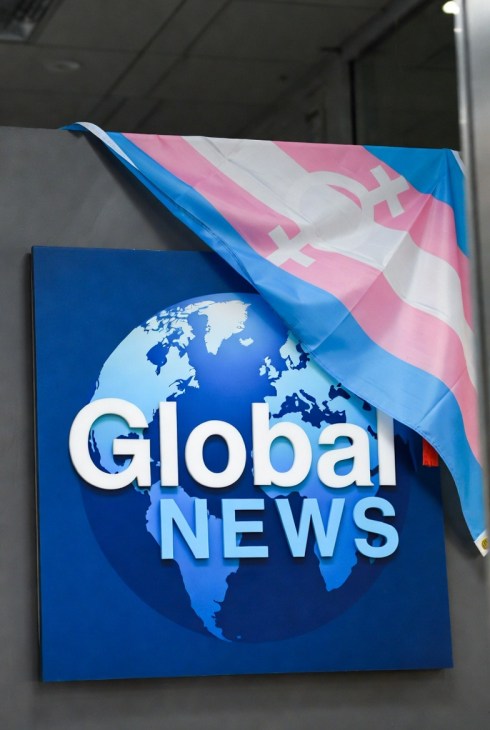
Global National ran an “overnight” segment after the Tumbler Ridge massacre under a framing that is, in its own way, a confession: “Anti-trans disinformation circulates after mass shooting.” (Global News)
Not Who died? Not How did this happen? Not What failed? Not What do we change Monday morning?
The story, as packaged, is not forensic. It’s prophylactic. The first institutional instinct is not to look hard at systems and sequences, but to manage reputational spillover: prevent a narrative from becoming “dangerous,” protect a constituency from backlash, and pre-label certain lines of inquiry as moral contamination.
That choice matters, because a town is burying children.
And because when journalism reaches for a firewall before it reaches for an autopsy, it stops being a public service and becomes a public-relations function.
What Actually Happened: Sequence Before Sermon
On February 10, 2026, an 18-year-old, Jesse Van Rootselaar, killed people at home and then attacked Tumbler Ridge Secondary School before dying by suicide. Multiple accounts report that the attack began with the killing of the shooter’s mother and 11-year-old half-brother, followed by the school shooting. (The Wall Street Journal)
The victims include five students (ages 12–13) and a 39-year-old education assistant, with the mother and half-brother killed beforehand. Names and details have been published widely and confirmed in Canadian Press reporting and related coverage. (People.com) The BC RCMP also issued a public confirmation of deceased victims. (RCMP)
That’s the baseline: a chain of events with a clear order—home, then school—ending in a pile of dead kids and a town whose grief will not be solved by better discourse hygiene.
Sequence matters because it points to systems:
- What warnings existed and where?
- What interventions were attempted and by whom?
- How were firearms stored and accessed?
- What did the school know, and when?
- What did police know, and what tools were used (or not used)?
- What gaps exist between “we did a wellness check” and “we prevented a catastrophe”?
Reporting indicates a history of mental-health-related police interactions and investigators reviewing digital footprint and online activity. (The Wall Street Journal)
These are the questions you chase when you treat murder as a real event in the world—not as a pretext for messaging.
What Global Chose to Do Instead
Global’s piece does not begin at the crime scene. It begins in the information ecosystem.
In the related Global coverage and clip description, the emphasis is on how the suspected shooter’s trans identity is “being used to fuel misinformation online,” and the segment elevates advocacy voices concerned about anti-trans sentiment. (Global News)
To be blunt: they treat the massacre as a vector for disinformation, rather than as a symptom of institutional failure.
This isn’t a claim that concerns about backlash are always illegitimate. It’s a claim about priority and timing.
You can caution against scapegoating without making that caution the lead, the thesis, and the moral center—while the basic forensic questions remain unasked in the same breath.
Worse, the frame is fortified by official moral language. BC’s Human Rights Commissioner issued a statement warning against conflating trans identity with violence and calling such conflation “incorrect, irresponsible and frankly dangerous.” (bchumanrights.ca)
Again: that statement may be true as a general principle—identity is not destiny—but it is also rhetorically useful as a solvent. It dissolves scrutiny by implying that scrutiny is the harm.
And in the current media climate, once a question is placed inside the “dangerous” bucket, it stops being investigated and starts being policed.
That is what narrative-commitment looks like: not lying, necessarily—just selecting a reality tunnel and treating alternate tunnels as morally suspicious.
Why This Reads as Out of Touch
Because the public is not asking for a sermon. The public is asking for accountability you can measure.
When parents hear “anti-trans disinformation” as the headline after a school attack, the implied hierarchy is:
- protect the narrative
- protect the vulnerable (as defined by the segment)
- later, perhaps, protect the public
That hierarchy does real damage.
It tells the bereaved: “We have already decided what the real emergency is.”
It tells the skeptical: “Your questions are morally tainted.”
It tells institutions: “If your policies intersect with a protected narrative, you will be insulated from the normal post-disaster autopsy.”
And it tells everyone else to stop trusting the gatekeepers.
Journalism doesn’t lose trust because it has values. It loses trust because it has values that pre-empt facts.
What a Forensic Post-Tumbler Ridge Agenda Looks Like
If you want a serious follow-up—one that serves victims, not narratives—here are the obvious “system” targets. None of this requires scapegoating an identity. It requires the courage to audit failures like adults.
1) A full public timeline, cross-agency
A public accounting that stitches together: school records, police contacts, mental-health interventions, family context, and warning signs—chronologically, with decision points. This is how you find the failure nodes.
2) Firearms access: storage, compliance, and enforcement gaps
Reporting indicates multiple firearms were used and investigators are examining how they were obtained. (The Wall Street Journal)
The question is not “gun control” as a slogan. The question is: What specific mechanisms failed—safe storage, licensing, supervision, enforcement, reporting? Fix the mechanism, not the talking point.
3) Threat assessment and school safety protocols that actually bite
Most institutions are good at paperwork and bad at escalation. Schools need a protocol that converts “concerning behavior” into structured threat assessment, and threat assessment into action—without letting “this might stigmatize” become the veto.
4) Mental-health intervention that doesn’t stop at “wellness checks”
If repeated mental-health-related police visits are part of the story—as reporting suggests—then the system question is: what happens after the tenth check? (NBC 5 Dallas-Fort Worth)
Communities need a bridge between crisis contact and sustained containment: follow-up, risk management, family support, and clear thresholds for escalation.
5) Media standards: separate “backlash management” from “causal inquiry”
A newsroom can do both—but not in a way that treats one as taboo. Post-massacre coverage should have a simple rule:
- Name the victims.
- Lay out the timeline.
- Identify plausible failure points.
- Present what is known, what is not, and what must be investigated.
- Only then: address secondary narratives (backlash, misinformation, online dynamics).
Right now, too many outlets reverse that order.
The Real Test: Can We Ask the Questions Without Being Moralized Into Silence?
There is a difference between scapegoating and scrutiny.
Scrutiny is what you owe dead children.
If the media class cannot bring itself to treat Tumbler Ridge as a forensic event first—if it must immediately translate it into a morality play about discourse—then it is not merely “out of touch.” It is structurally incapable of learning.
And systems that cannot learn repeat.
Not because people are evil, but because the firewall held—until it didn’t.











 bleatmop
 Mystro
 The Arbourist


 Dead Wild Roses
Your opinions…