
You are currently browsing the category archive for the ‘Queer Bullshit’ category.
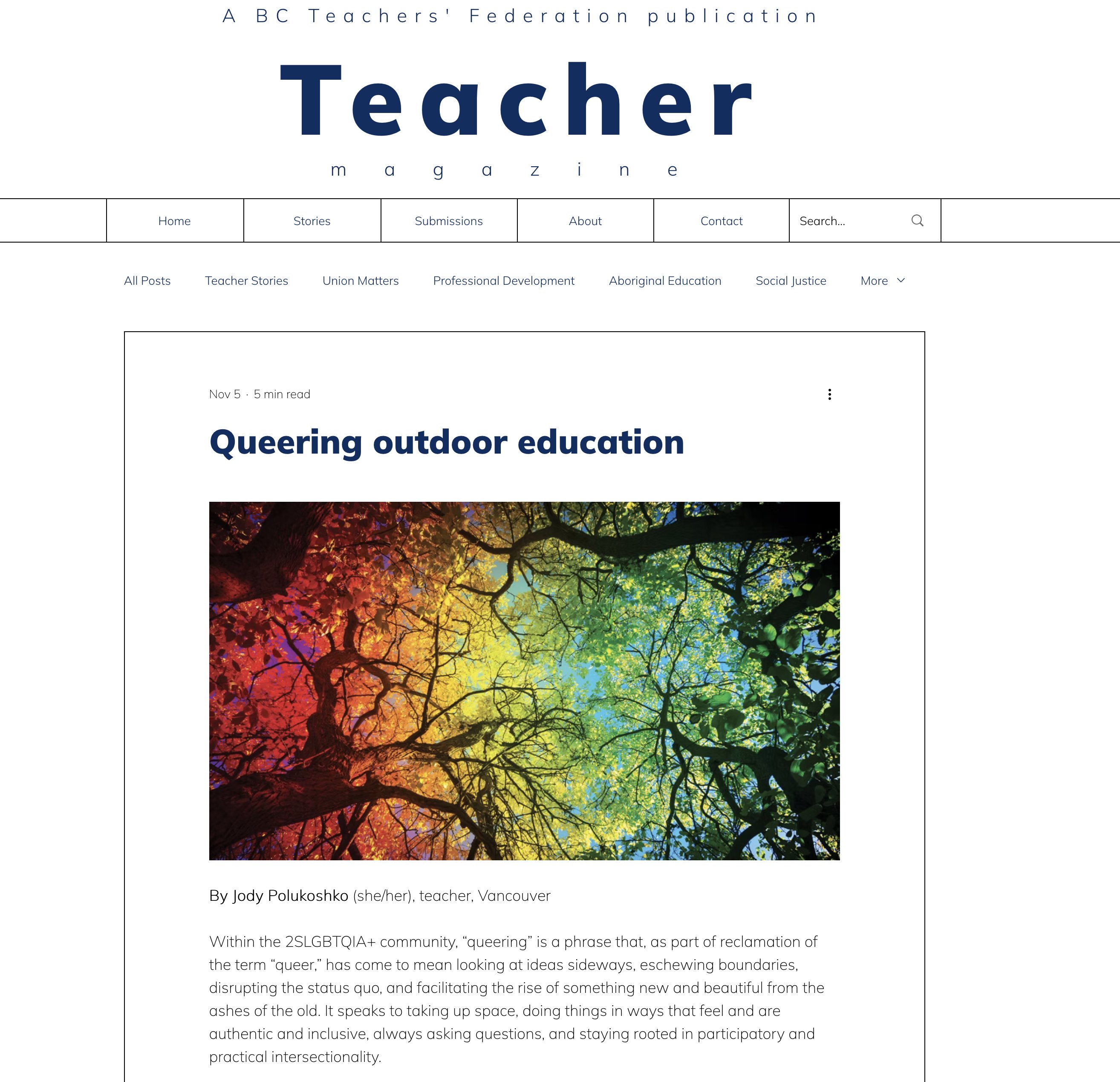
See Jonathan Kay’s X thread on the queering of outdoor education.
The British Columbia Teachers’ Federation (BCTF) has introduced a framework termed “Queering Outdoor Education,” which integrates queer theory, drag pedagogy, and decolonial approaches into environmental learning. This curriculum comprises lessons that encourage students to interpret natural phenomena through the lens of fluid identities, anti-normative critique, and social justice. While the framework is promoted as fostering inclusivity and challenging colonial and heteronormative assumptions, it raises substantive concerns regarding developmental appropriateness, educational clarity, and the potential for early ideological enculturation.
Metaphor and Conceptual Instability
The initial lessons employ metaphor as a primary pedagogical tool. Students are encouraged to draw analogies between natural elements—such as clouds, logs, or plants—and human identities, emphasizing fluidity and anti-essentialist perspectives. While metaphor can be valuable in education, these lessons risk overextending conceptual abstraction, replacing concrete environmental observation with ideological instruction. For children, particularly in early or middle childhood, excessive abstraction can hinder cognitive development by conflating empirical phenomena with normative social and political constructs.
Additionally, the curriculum critiques conventional linguistic frames, including metaphors like “birds and the bees,” positioning them as instruments of colonial and heteronormative power. Such framing may introduce complex sociopolitical interpretations into contexts traditionally reserved for foundational biological and ecological learning, potentially overwhelming young learners.
Moralizing Nature and Identity
Subsequent lessons extend these metaphorical frameworks into moral and social instruction. Students are asked to emulate the perceived allyship of natural objects and to conceptualize human identities in terms of ecological hierarchies, categorizing queer identities as “native” and others as “invasive.” While intended to promote reflection on inclusion and belonging, these exercises risk essentializing human worth according to ideologically charged criteria, substituting experiential learning with prescriptive social norms. By conflating ecological systems with social hierarchies, the curriculum may foster confusion rather than ethical understanding, undermining both environmental literacy and social cohesion.
Sexualization and Performative Instruction
The later lessons introduce overtly sexualized and performative elements, including the celebration of non-reproductive animal behaviors and the incorporation of drag-based exercises into outdoor activities. While drag pedagogy emphasizes self-invention and challenges normative binaries, its application to children’s environmental education raises questions of age-appropriateness. Embedding explicit discussions of sexuality and performative gender in contexts intended to cultivate observation, curiosity, and engagement with nature may distract from core learning objectives and impose adult conceptual frameworks onto immature cognitive and moral development.
Implications for Pedagogy
The queering of outdoor education exemplifies a broader pedagogical tension between radical inclusivity and the developmental needs of children. Integrating complex adult theoretical frameworks into early environmental education risks destabilizing students’ conceptual understanding, substituting guided inquiry with ideological instruction. While well-intentioned, such approaches may inadvertently limit children’s capacity for independent exploration, critical reasoning, and unmediated interaction with the natural world. Educational practice promote the idea of equality, not equity, along with the preservation of developmental appropriateness and cognitive accessibility.
Glossary
- Queer Pedagogy: An educational approach that incorporates queer theory to challenge traditional assumptions about gender, sexuality, and identity.
- Drag Pedagogy: A subset of queer pedagogy emphasizing performance, self-invention, and the destabilization of normative social roles.
- Decolonial Education: Curriculum frameworks aimed at addressing and countering the legacies of colonialism, often by centering Indigenous perspectives.
- Anti-Normative Critique: A critical approach that questions conventional social, cultural, or gender norms.
- Cognitive Development: The mental growth and acquisition of knowledge, reasoning, and understanding in children.
- Ideological Enculturation: The process of instilling a particular worldview or set of political beliefs, often through education.
References
- British Columbia Teachers’ Federation. Queering Outdoor Education Newsletter. 2025.
- Lacandona, Gaia. Drag Pedagogy: Performance and Learning. 2018.
- Polukoshko, Jody. Queer and Decolonial Approaches to Outdoor Learning. BCTF publication, 2024.
- Sumara, Dennis. Alternative Pedagogies and Cognitive Development: A Critical Review. 2017.
Suggested Readings Critiquing Queer Pedagogy
- Lindsay, James & McEwen, Bob. Critical Pedagogy and the Limits of Ideological Education. 2021.
- Wood, Peter. The Manipulation of Youth: How Ideology Enters the Classroom. 2019.
- Scholes, Robert. Childhood, Ideology, and the Limits of Social Theory. 2018.
- Davies, Belinda. Rethinking Radical Curricula: Balancing Innovation with Developmental Appropriateness. 2020.
The future of queer theory in public life will be defined by tension — between liberation and dissolution, between critique and nihilism. As the concept of queer migrates from academic theory into social activism, its anti-normative roots have begun to destabilize not only rigid hierarchies but also the shared frameworks that hold civil society together. Recognizing this dynamic is essential if we hope to preserve the moral and cultural balance that allows both freedom and order to coexist.
At its core, queer theory began as a revolt against imposed boundaries: gender binaries, heteronormative expectations, and cultural assumptions about propriety. But when “resistance to norms” becomes the sole moral compass, society loses its capacity to define virtue, responsibility, or even truth. The queer ethos—“whatever is at odds with the normal”—risks transforming from an emancipatory critique into a perpetual revolution against coherence itself.
Radical activists now extend this logic beyond sexuality, framing any attempt to establish limits or standards—biological, moral, or linguistic—as acts of “hegemonic oppression.” Efforts to balance queer aspirations with reasonable critique are thus recast as betrayal. This rhetorical maneuver shields the ideology from correction: dissent becomes proof of guilt.
Yet a healthy society requires shared reference points. Boundaries around meaning, family, education, and biology are not inherently oppressive—they are stabilizing norms that protect continuity while still allowing reform. To restore equilibrium, we must distinguish between compassionate inclusion and ideological dissolution. Supporting human dignity does not require denying human nature.
The road ahead will be difficult. Reintroducing critical engagement into discussions of gender and identity will be framed as reactionary or “anti-queer.” But clarity is not cruelty. The challenge is to defend open debate and the material basis of truth while affirming genuine freedom for individuals to live authentically. A future where queerness and normalcy coexist in mutual respect, rather than mutual negation, is possible—but only if the conversation itself remains open.

Closing Summary & Series Links
To help readers navigate the series and access each part easily.
- Part 1 — What Does “Queer” Mean?
Introduces David Halperin’s foundational definition of “queer” as opposition to societal norms and explores what it means to have an “identity without an essence.” - Part 2 — Insights from Judith Butler and Eve Kosofsky Sedgwick
Examines how Butler and Sedgwick expanded queer theory by deconstructing gender and sexuality, framing queer as a disruptor of cultural meaning. - Part 3 — The Unraveling of Society and the Quest for Balance
Analyzes how queer politics, when detached from social reality, can erode shared meaning, and proposes a framework for restoring balance between critique and stability.
How did queer move from academic theory to a political movement that challenges the foundations of society itself? This piece traces the rise of queer politics—its rejection of norms, its destabilizing effects on social cohesion, and how we might restore balance between personal liberation and shared moral order.
In earlier parts of this series, we explored how David Halperin, Judith Butler, and Eve Kosofsky Sedgwick defined queer as resistance to norms, a deconstruction of identity, and a fluid space of meaning. What began as a radical academic critique of social conformity has since evolved into a cultural and political movement with far-reaching effects.
Today, queer no longer resides in seminar rooms—it animates public policy, education, and identity politics. But in leaving theory for activism, the term’s oppositional nature has escaped its intellectual bounds, producing not only liberation but also a kind of cultural entropy: a systematic unmooring of shared social meaning.
From Theory to Politics: Queer as Permanent Revolution
Queer theory’s original intent was analytical—to question how society constructs categories like man, woman, normal, and deviant. In politics, however, queer became a mandate to dismantle norms altogether.
What Halperin called an “identity without an essence” turned into an activism without limits—one that views all boundaries, including biological sex or family structure, as oppressive fictions. This logic fuels a form of cultural revolutionism, in which dismantling social stability is seen as a moral good in itself.
In queer politics, there are no stable endpoints—only endless opposition. Marriage, gender, education, and even language are treated as battlegrounds for deconstruction. But where theory sought critique, politics now demands compliance with rebellion—a paradox in which resistance becomes dogma and moral relativism becomes orthodoxy.
The Unraveling Effect: When Everything Becomes “Queer”
The activist expansion of queer has dissolved its boundaries. Once a critique of exclusion, it now risks becoming a totalizing lens through which all social order appears suspect.
Institutions that once grounded shared life—family, religion, law, science—are increasingly framed as “heteronormative” or “cisnormative” systems of oppression. The result is not freedom but fragmentation, as the concept of “normativity” itself is recast as injustice.
This produces an untenable social paradox: a society that cannot define normality cannot define harm, health, or truth. When every structure is suspect, moral and civic coherence erode. A politics that celebrates perpetual queering thus becomes a politics of disintegration, unable to build or sustain the very freedoms it claims to advance.
Restoring Balance: Queer Aspirations and Reasonable Critique
Despite this, not all is lost. The queer impulse—to challenge hypocrisy, to broaden empathy, to question power—is valuable. The problem lies not in critique but in absolutizing critique—turning deconstruction into dogma.
Restoring balance requires three things:
- Reaffirming the material basis of human life.
A humane society must recognize biological reality, family structure, and civic order as real—not oppressive myths. Identity is socially shaped, but it is not infinitely malleable. - Distinguishing moral reform from moral anarchy.
Social change is just when it improves justice, not when it destroys coherence. Liberation without moral boundaries breeds confusion, not freedom. - Reviving liberal pluralism.
A society that allows dissent, but also values shared truth, can accommodate queer critique without succumbing to nihilism. We can defend individual freedom while preserving the cultural scaffolding that makes freedom meaningful.
The task is not to “abolish” queer politics but to discipline its insights—to channel its challenge to conformity into dialogue rather than destruction. As with all revolutions of thought, the test of queer theory is whether it can evolve from rebellion into renewal.
Key Takeaways
- 1. Queer politics began as critique but now rejects all norms, turning opposition itself into ideology.
- 2. The loss of shared meaning leads to social fragmentation, as institutions become targets rather than foundations.
- 3. Balance can be restored by grounding freedom in material reality, moral boundaries, and pluralist debate.
References
Butler, Judith. Gender Trouble: Feminism and the Subversion of Identity. Routledge, 1990.
Halperin, David M. Saint Foucault: Towards a Gay Hagiography. Oxford University Press, 1995.
Sedgwick, Eve Kosofsky. Epistemology of the Closet. University of California Press, 1990.
Paglia, Camille. Sexual Personae: Art and Decadence from Nefertiti to Emily Dickinson. Yale University Press, 1990.
Pluckrose, Helen, and Lindsay, James. Cynical Theories: How Activist Scholarship Made Everything About Race, Gender, and Identity—and Why This Harms Everybody. Pitchstone Publishing, 2020.
Building on David Halperin’s view of queer as opposition to societal norms, Judith Butler and Eve Kosofsky Sedgwick expanded queer theory into a deeper critique of how culture constructs identity. Both scholars dismantled binary thinking—male/female, heterosexual/homosexual—and recast queer as a method of disruption rather than a label of identity. Their work helps explain why queer today functions as both a tool of liberation and a source of confusion in activism.
Judith Butler: Gender as Performance
In Gender Trouble (1990), Butler argues that gender is performative, not an inner truth but a social act repeated until it feels natural. She writes:
“Gender is an identity tenuously constituted in time, instituted in an exterior space through a stylized repetition of acts.”
In simple terms, gender isn’t something we are; it’s something we do—a performance shaped by cultural expectations. Butler points to drag as the clearest example:
“In imitating gender, drag implicitly reveals the imitative structure of gender itself—as well as its contingency.”
By showing how gender can be exaggerated and parodied, drag exposes its artificial construction. The idea that “drag is life and life is drag” captures Butler’s insight: our daily behaviors—clothing, speech, posture—continually recreate gender norms.
To “queer” gender, then, means to expose and subvert these routines. This view empowered movements challenging rigid gender roles, though it has also been misapplied in activism to deny the material reality of biological sex, leading to conceptual confusion between gender and sex.
Eve Kosofsky Sedgwick: The Open Mesh of Meaning
In Epistemology of the Closet (1990), Sedgwick broadened queer into a conceptual space where meanings overlap and resist closure. She writes:
“That’s one of the things that ‘queer’ can refer to: the open mesh of possibilities, gaps, overlaps, dissonances and resonances, lapses and excesses of meaning when the constituent elements of anyone’s gender, of anyone’s sexuality aren’t made (or can’t be made) to signify monolithically.”
For Sedgwick, queer describes a fluid network of meanings—a refusal to let identity solidify into fixed categories. This “open mesh” fosters inclusivity and complexity, inviting individuals to exist beyond rigid classifications. Yet, when applied too broadly, it risks erasing distinctions among groups and experiences, turning inclusivity into abstraction.
Queer as Liberation—and Its Limits
Butler and Sedgwick turned queer from a noun into a verb—something one does to challenge norms. Their theories helped dismantle oppressive binaries and opened new space for expression. But when translated into activism, queer sometimes loses its analytical precision. By denying all boundaries, it can undermine the very identities and realities it once sought to liberate.
In essence, queer remains a double-edged concept:
- It liberates by revealing the instability of identity.
- It destabilizes by dissolving the shared meanings that make political organization possible.
Understanding both sides of that tension is key to engaging queer theory honestly—and to applying it responsibly in public discourse.
Key Takeaways
- 1. Butler’s “performative gender” means gender is produced through repeated social acts, not innate essence.
- 2. Sedgwick’s “open mesh” describes queer as fluid meaning that defies fixed categories.
- 3. Both see queer as a method of critique—liberating but unstable when detached from material or social realities.
References
Butler, Judith. Gender Trouble: Feminism and the Subversion of Identity. Routledge, 1990.
Sedgwick, Eve Kosofsky. Epistemology of the Closet. University of California Press, 1990
What does “queer” actually mean? Far from a simple label for sexual minorities, queer theory defines itself in opposition to normality. Drawing on David Halperin’s Saint Foucault, this piece explains how queer became a philosophical stance of resistance—an “identity without an essence.”
The word queer has traveled a long road—from an insult meaning “strange” or “abnormal” to a proud rallying cry and the foundation of an entire intellectual movement: queer theory. At its core, the term doesn’t just describe sexual minorities; it represents a philosophical rebellion against everything considered “normal.”
One of the most influential queer theorists, David M. Halperin, explains this in his 1995 book Saint Foucault: Towards a Gay Hagiography. For Halperin, queer is not a stable identity but a position of resistance.
“Queer identity need not be grounded in any positive truth or in any stable reality. As the very word implies, ‘queer’ does not name some natural kind or refer to some determinate object; it acquires its meaning from its oppositional relation to the norm. Queer is by definition whatever is at odds with the normal, the legitimate, the dominant… It is an identity without an essence.”
(Halperin, 1995, p. 62)
In plain language, queer is not like gay or lesbian, which refer to specific sexual orientations. Queer means whatever challenges or defies the normal order. It’s an umbrella term for standing against social expectations—whether those expectations involve heterosexual marriage, gender roles, family structure, or even conventional ideas of decency or success.
Halperin calls it “an identity without an essence.” That means being queer isn’t about belonging to a group with shared traits; it’s about rejecting the very idea of fixed identity. If society defines what’s “normal,” queer theory defines itself by refusing that definition. It is a form of perpetual opposition.
He even jokes that queer could include “some married couples without children, or even (who knows?) some married couples with children—with, perhaps, very naughty children.” His point is that queer has no natural limits. Anything that unsettles the norms of family, sexuality, or respectability can count as queer.
Queer as Permanent Rebellion
In this sense, queer is not just a sexual category—it’s a political and philosophical stance. It seeks to expose and subvert the power structures that make certain ways of living “normal” and others “deviant.”
To be queer, in Halperin’s sense, is to stand in intentional opposition to society’s standards of legitimacy, authority, and order. That’s why queer theorists often speak of “queering” institutions—education, law, art, religion—meaning to challenge or destabilize their traditional foundations.
This also means that queer can never be fully accepted into normal society without losing its essence. The moment it becomes “normal,” it ceases to be queer. Its identity depends on remaining at odds with whatever is considered conventional, natural, or moral.
What This Reveals
For ordinary readers trying to make sense of today’s cultural debates, this definition clarifies something crucial: “queer” doesn’t simply describe non-heterosexual people. It’s a theoretical commitment to resisting normativity itself.
Where older gay rights movements sought inclusion—the right to marry, raise families, and participate equally in civic life—queer theory often seeks subversion: to question whether those norms should exist at all. It replaces the pursuit of equality with the pursuit of deconstruction.
In short, queer stands in opposition to what most people call normal life—not necessarily out of hatred for it, but out of a conviction that “normality” itself is a social construct that limits freedom. Understanding that distinction helps explain why many ordinary people feel confused or alienated by “queer” politics today: it is not asking to join society, but to transform or even overturn its organizing principles.
Key Takeaways: What “Queer” Actually Means
- 1. Queer is not an identity, it’s opposition.
“Queer” doesn’t describe who someone is but how they stand—against whatever society considers normal, moral, or legitimate. - 2. Queer has no fixed boundaries.
Anything that defies traditional norms—about sex, family, gender, or behavior—can be called queer. It’s a fluid, open-ended stance of resistance. - 3. Queer exists only in contrast to the normal.
The concept depends on rejecting normality itself. The moment “queer” becomes accepted or mainstream, it loses its defining feature—its rebellion.
Reference
Halperin, David M. Saint Foucault: Towards a Gay Hagiography. Oxford University Press, 1995, p.

In October 2025, Brighton witnessed a stark confrontation between feminist and trans activist groups, culminating in the vandalism of the FiLiA conference venue by the direct-action group Bash Back. This incident has sparked widespread debate over the boundaries of free speech, the safety of women-only spaces, and the tactics employed in the defense of trans rights.
In the seaside city of Brighton, where the English Channel laps against shores long synonymous with progressive ideals, a gathering of women became the target of deliberate aggression last weekend. The FiLiA conference—Europe’s largest feminist event, drawing over 2,400 delegates from around the world—convened from October 10 to 12, 2025, to confront the unyielding realities of women’s lives: domestic abuse, sexual violence, lesbian safety, anti-racism, health equity, and political organizing. What should have been a sanctuary for sisterhood instead became a stage for intimidation, vandalism, and moral inversion, carried out by activists who cloaked their belligerence in the guise of righteous victimhood. This was no spontaneous protest; it was an orchestrated assault on women’s autonomy, executed through the psychological tactic known as DARVO—Deny, Attack, Reverse Victim and Offender—flipping aggressor and victim roles to confuse and shame the true defenders.
FiLiA, the Feminist International Leadership and Action charity, has championed women’s voices and sex-based rights since its founding in 1982 as Feminists in London. Rebranded in 2019, the organization organizes workshops, advocacy campaigns, and international solidarity events, explicitly excluding male speakers to foster unmediated discourse. Alumni include figures like J.K. Rowling, and sessions routinely interrogate male violence without apology. In Brighton, hosted at the council-owned Brighton Centre, FiLiA aimed to advance this mission amid escalating threats to female-only spaces. Organizers preemptively requested a Public Spaces Protection Order from Brighton and Hove Council to mitigate anticipated disruptions, only to be rebuffed—a decision that left delegates exposed to the very dangers the conference sought to address.
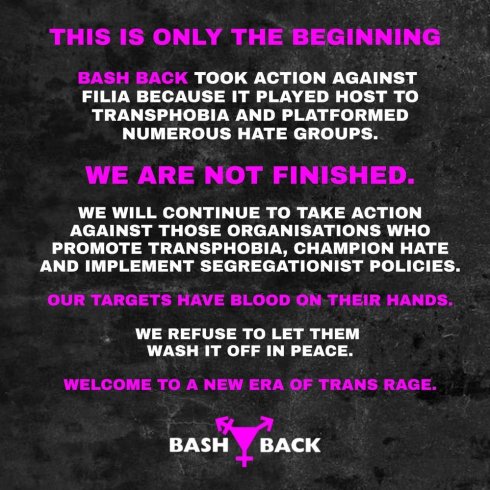
The aggression began hours before the conference doors opened on October 10. Activists associated with the direct-action group Bash Back vandalized the venue: windows were shattered, purple paint—symbolizing queer defiance—splashed across entrances, and graffiti labeled FiLiA “transphobic” and worse. As women arrived on Saturday, masked protesters surrounded them, chanting, jeering, filming without consent, and blocking access to the entrance. One man was bundled into a police van amid the chaos. Sussex Police launched an investigation, but the damage was done: a conference on male violence against women had itself been disrupted by male violence.
This incident exemplifies DARVO in practice. Attacks were simultaneously denied or minimized as mere “direct action,” while FiLiA was cast as inherently bigoted for prioritizing biological sex in discussions of oppression. Reversal of victimhood followed swiftly: women convening to safeguard their rights were recast as provocateurs, deserving retaliation. Green MP Sian Berry’s comments faulting organizers for “inflaming division” exemplify this inversion, as if women’s speech is a privilege revocable at the whim of the offended. Online, Bash Back celebrated targeting “hate groups” like the LGB Alliance and Transgender Trend, further amplifying the narrative of moral righteousness while eroding accountability. Eyewitness reports indicate that many of the aggressors were male, cross-dressing in the guise of protest—a striking irony in a city branding itself a “City of Sanctuary.”
The Brighton disruption is part of a broader pattern of hostility toward women’s spaces, where the veneer of inclusivity is used to justify exclusion. Militant transactivism often prioritizes gender self-identification over material sex realities, demanding access to refuges, prisons, and sports at the expense of female safety. By framing sex-based protections as inherently “transphobic,” these tactics erode the foundations of feminism: the recognition that sex is the axis of patriarchal power and a critical factor in protecting women from violence. The FiLiA delegates were not debating abstract theory—they were strategizing for survival against rape, trafficking, and erasure. To disrupt their forum is to reinforce the patriarchal dynamics they resist.
The path forward requires vigilance and clarity. DARVO’s manipulations must be unmasked; women’s sex-based rights defended without apology; and discourse reclaimed from those who mistake volume and spectacle for moral authority. Only then can women gather safely, unmolested, to build the liberation FiLiA envisions—a liberation grounded in reality, accountability, and the enduring fight against male violence.
📚 References
- “Council refused feminists security after trans activists smashed venue.” The Times, October 10, 2025. (The Times)
- “Trans activists vandalise feminist conference.” Yahoo News Canada, October 10, 2025. (Yahoo News)
- “Trans group ‘BASH BACK’ targets Brighton Centre – FiLiA has ‘blood on their hands’.” Scene Magazine, October 10, 2025. (Scene Magazine)
- “FiLiA Conference Sparks Trans Rights Protests In Brighton.” Evrimagaci, October 10, 2025. (Evrim Ağacı)
- “FiLiA.” Wikipedia, October 2025. (Wikipedia)
- “Bash Back!” Wikipedia, October 2025. (Wikipedia)
“A celebration of diversity that silences certain voices… is not inclusive—it is ideologically selective.”
The Montreal Pride Parade’s decision to exclude Jewish organizations like Ga’ava and the Centre for Israel and Jewish Affairs (CIJA) reveals the brittle nature of contemporary inclusion. Organizers explained that the festival’s board had “made the decision to deny participation in the Pride Parade to organizations spreading hateful discourse”—widely interpreted as targeting groups perceived to hold Zionist views amid the Israeli-Palestinian conflict (National Post). Yet this rationale exposes a contradiction: a celebration of diversity that silences certain voices based on political affiliation is not inclusive—it is ideologically selective. True inclusion doesn’t retreat under pressure or disqualify those with unpopular views; it endures in the face of discomfort. By barring these organizations, Montreal Pride signals that its version of inclusion functions not as a principle, but as a privilege granted only to those aligned with a narrow ideological consensus.
Considering the Organizers’ Perspective
It’s worth acknowledging why the organizers might have made this decision. They could argue that pro-Israel groups might provoke protests or distress among participants, given the polarized nature of the Israeli-Palestinian conflict. However, without specific, credible threats, this rationale appears more like a preemptive strike against ideological discomfort than a genuine safety measure. Pride has weathered controversy before—its history is one of defiance in the face of societal pushback. To retreat now suggests a prioritization of ideological purity over inclusivity.
Safety as a Pretext for Exclusion
Invoking “physical and mental safety” may appear commendable, but applying it to justify excluding Ga’ava—a Montreal-based LGBTQ+ Jewish organization—and CIJA appears unfounded in concrete threats. Ga’ava’s president characterized the exclusion as “based on flimsy, politically motivated reasons decided behind closed doors under pressure from groups that hate Jews, deny Israel’s existence, and whose members celebrated the atrocities of October 7, 2023” (i24NEWS). Who gets to determine what’s safe? In this case, the organizers prioritized avoiding discomfort among critics of Zionist expression over the dignity of those excluded. This risks prioritizing ideological comfort over genuine safety concerns.
According to CIJA’s director of strategic communications, Julien Corona, the decision represents “a dark day for the LGBTQ+ movement here in Quebec but also in all of Canada” (National Post).
The Perils of Moral Absolutism
Montreal Pride’s actions illustrate how moral certainty, when unchecked, can corrupt even the most noble ideals. By conflating the participation of Jewish organizations with “hateful discourse,” organizers implicitly deemed dissenting political views as unacceptable, suggesting their perspective is immune from challenge (i24NEWS). But in reducing disagreement to danger, they betray their own professed values of inclusion and pluralism. What remains is not a broad tent of solidarity, but a gated enclave of ideological approval.
This episode fits into a broader pattern: similar exclusions have occurred in other Pride contexts—Toronto, Chicago, Washington DC—involving Jewish symbols or groups linked to Israel/Palestine debates (Wikipedia). By excluding Ga’ava and CIJA, Montreal Pride reinforces a troubling trend: replacing complexity of identity with a simplistic tribal test.
Moreover, this isn’t the first time a social movement has been fractured by ideological litmus tests. The feminist movement, for example, has seen bitter divisions over issues like sex work and transgender rights, with some factions excluding others based on perceived ideological impurity. Similarly, the civil rights movement grappled with tensions between integrationist and separatist ideologies. In each case, moral certainty led to splintering rather than solidarity. Montreal Pride risks a similar fate if it continues down this path.
A Forward-Looking Conclusion
If Pride movements hope to sustain moral legitimacy and relevance, they must resist equating disagreement with harm. Exclusion based on political affiliation not only wounds the excluded but weakens the movement itself. Pride must recommit to its radical roots—embracing all marginalized voices, even those that spark debate—or risk losing its soul. The true test of inclusion isn’t welcoming those who agree with us; it’s extending that welcome to those who challenge us. Only then can Pride fulfill its promise as a beacon of diversity and defiance.

Works Cited
- Amador, Marisela. “Montreal Pride excludes Jewish LGBTQ+ group, citing ‘hateful discourse’.” CTV News, July 31, 2025. Link
- Corona, Julien. Quoted in “‘A dark day for the LGBTQ movement’: Montreal Pride Parade organizers bar Jewish groups from march.” National Post, August 1, 2025. Link
- “Montreal’s Pride Parade bans 2 Jewish groups.” i24NEWS, July 31, 2025. Link
- “Pride parade.” Wikipedia. Link











 bleatmop
 Mystro


 Dead Wild Roses
Your opinions…