One of the argumentative dodges that ideologues like to employ is something I’ve termed the ‘complexity dodge’. Now to clear many arguments and many issue are complex and nuanced and do require careful examination and sometimes expert knowledge to fully grasp in their entirety. Legitimate expert guidance and knowledge must not be dismissed when it comes to understanding and discussing issues that affect society.
However, certain contentious topics in society have intentionally had their definitional clarity muddied and obscured to prevent people from clearly understanding what the terms mean and how they are being used in social contexts. For instance the intentional blurring of boundaries around the word “woman” has created situations like this:
When a Supreme Court Justice hedges on correctly defining a woman as an adult human female we can know for certain that something weird is going on ‘under the hood’, so to speak.
The meaning of the word “woman” has been intentionally made fuzzy and unclear. The rival notion rather than ‘adult human female’ is ‘anyone who identifies as a woman’ which is clearly a circular definition because the definition when provided does not tell us what a woman actually is. If we cannot clearly define the terms in an argument it becomes very difficult to understand arguments and to parse the logic of people using the terms in question.
Witness:
This is the kind of bullshite that goes on in Gotham when people have intentionally muddied the waters in the ideological pursuit of their goals. This exchange is from a thread about a Canadian Nurse being put on trial for adhering to basic human biological facts. It’s crazy making.
So, appreciate complexity and nuance but be aware that both of these attributes can be weaponized to make arguing much more difficult and onerous than it needs to be.
I’ve has the honour and pleasure to meet some brilliant people over the years. Some even happen to reside in my home province and share some of the same political tribulations that I do. This letter is a call to halt the erasure of females and female history in our society in the name of being diverse and inclusive.
I encourage everyone to get a hold of ATB if you deal with them and ask why are they participating in activities that remove women from the public sphere and edit them out of history.
“Dear Ms.————,
I hope this finds you and yours well. I have received your email response, made on behalf of the Alberta Treasury Branches’ Customer Service department, in response to my earlier email which was in regards to the ATB art show “In Full Bloom” which is scheduled to be held in Calgary in 2023 on International Woman’s Day. As you know the call was for “artists who identify as women.” The description of the exhibit is as follows: “In Full Bloom: A celebration of artwork by and about women will focus on artwork that celebrates the creative practices of women with an emphasis on female- and nature-inspired imagery and narratives.” In a nutshell my initial complaint was that opening this show to men was both highly insulting and sexist. The response I received on behalf of the bank was that the ATB believes in “inclusivity.” But what exactly is “inclusivity”? After having researched Diversity, Equity, and Inclusion ideology I have concluded that so called inclusivity, as the ATB is practicing it, is a postmodern concept which is playing a role in deconstructing and redefining the material reality of the human sex class of men and women/boys and girls.
As a student of art history and a woman with a degree in painting from the Alberta University of the Arts, I can assure you that the disappearance of women’s and girls’ artistic endeavours in order to centre men is nothing new. For millennia the artistic works of women were disappeared, negated, or not even brought to life. Not because women lacked talent or artistic merit, but solely based on the material reality of our sexed lives. Artistic women had a brief window, beginning in the late 1960’s with the rise of second wave feminism, where we successfully challenged the system which had resulted in an art history full of nude portrayals of the female form created by men and a tiny percentage of art works created by women. It was those successful challenges to the artistic norm that lead institutions like the ATB to offer sex-based opportunities for female artists. Now the ATB simultaneously asks us to reflect and create art work on the theme of womanhood and nature while literally redefining woman from adult human female to nothing more than a claimed identity.
This brings me to the portion of my letter where I will illustrate how the ideology of inclusion negatively impacts the lives of girls and women in societies where DEI have risen to the forefront of society. It is via the mechanism of inclusion that the following events are taking place: In June of 2017, with no public accountability and without being made clear to the voters of the 2016 election, Bill C-16 was passed into law. The bill amended the Canadian Human Rights Act to add gender identity and gender expression to the list of prohibited grounds of discrimination. Running along side Bill C-16 was a change as to how Canadians were identified on their legal documents. Sex was overturned in favour of “gender.” This alteration allowed any man to “identify as a woman” with four simple words: “I am a woman. In the same year the federal government began housing convicted male criminals in women’s prisons where they were put into the general population. It is difficult to get clear numbers on the number of violent and sexual offenses these men committed because all crimes are recorded via “gender” so all crimes appear to be women on women. However, testimony gathered from women within the prison system anecdotally suggest that they are being harassed, terrorized, robbed, assaulted, sexually assaulted, and even raped by criminal men.
I assume the ATB would like to consider itself as partners in Reconciliation, yet First Nation’s women are disproportionately housed in prisons. Now they must attempt to rehabilitate themselves while taking shifts at night in order to attempt to keep violent males at bay. As I draft this response Canada’s top ranked woman competitive cyclist is currently a man. This means that at least one outstanding woman cyclist has been pushed from the podium. We will never know how many women no longer compete because of the policies which allow men to steal the podium. The sporting events women fought for so that our daughters could make their mark are now used to affirm men’s identities. This bizarre colonization by men and boys increases the number of serious, even life threatening, injuries to female athletes, including concussion and spinal injuries. This policy of inclusion also subjects girls and women to naked males in their formerly female only change rooms. As well, mediocre males can now easily change their “identity” at any time so that they may claim the prize monies, awards, and educational scholarships which were formerly for girls and women.
The notion of inclusion also affects matters of justice. For instance, in 2019 during a trial where a woman was giving testimony against her rapist in British Columbia, the victim was forced to perjure herself and mis-sex her attacker because his “preferred pronouns” were she and her. As a survivor of male sexual violence, I can well imagine the mental torture and humiliation of being forced affirm a rapist’s wrong sex identity rather than speak to the material reality of the sex of her assaulter. More recently in August of 2022, a woman in Ontario entered a rape shelter for counselling and housing after she was raped. While at the shelter seeking care and safety, she was raped again by a serial rapist who gained access to the shelter by “identifying as a woman.” Does the ATB really want to practice “inclusion” when it has this kind of real-world impact? I am sure the ATB thinks of itself as a supporter of gay and lesbian rights. Yet there is an inherent conflict between a heterosexual man who “identifies as a woman” and lesbian women who are exclusively same sex attracted. Thanks to the same inclusivity the ATB proudly claims, lesbians are now told they must “get over their genital preferences.” A well documented example of this took place in Toronto when a heterosexual man who “identifies as a woman” and therefore as a lesbian, set up a workshop on how to “overcome the cotton ceiling.” The event was aimed at teaching men how to get lesbians to accept “women with a female penis” in their dating pool. That is an attack on the rights of homosexual women to practice their sexuality free from harassment from male persons. Finally, the inclusivity the ATB declares as policy puts women and girls like myself in real danger as well as financial and mental crisis. We are harassed, silenced, fired, cancelled, and even physically assaulted when we attempt to discuss this rewriting of the rules of society in both private and public spaces.
So, what is it I would like from the ATB?
Going forward I would like the ATB to alter its language on the calls for submissions for opportunities set aside for women and girls so that those programs are for girls/woman only. Should the ATB want to offer separate artistic opportunities for people who identify as the opposite sex, or asexual or non binary or cat or cake gender I have no issue with that at all. Cat and cake gender are real examples by the way. For example, I can be “A woman who used to have $$$$$$$ in savings at the ATB” gender. After all, gender is undefinable, subject to change at any time and, as I am constantly reminded, all genders are valid. In closing, I certainly appreciate the situation the ATB finds itself in. While other countries like the UK have had several successful legal challenges to Gender ideology, Canada lags a few years behind.
However, as the issues become clearer over time and more courageous Canadians and First Nation members begin to re assert the need to provide sex-based rights for girls and women, things will change. I am providing the ATB with a chance to assess their policy and tweak it in order to provide everyone a chance to excel in their field while serving the sex-based rights of more than half of the population of Alberta. As I mentioned in my last email to you, I was planning on closing my ATB account over this issue even though my husband and I have been dedicated ATB clients since 199-. Currently the combined balance in our saving accounts is in excess of $$$$$$$, a sum we see as having some significant value. We also have an ATB Line of Credit and ATB Mastercards. I would of course prefer to stay with my local branch because the women who work there are pleasant and familiar with our needs but given the scope of the issues brought about by “being inclusive,” should no policy change be forthcoming, we will be forced to close our accounts and take our business elsewhere. I have researched other institutions and I believe I have found one who still respects women and our sex-based rights. I look forward to your response in this matter.”
Well said and unfortunately a very necessary action that needs to be taken in our society.
“Redesigning democracy for the digital age is far beyond my abilities, but I can suggest three categories of reforms––three goals that must be achieved if democracy is to remain viable in the post-Babel era. We must harden democratic institutions so that they can withstand chronic anger and mistrust, reform social media so that it becomes less socially corrosive, and better prepare the next generation for democratic citizenship in this new age.
Harden Democratic Institutions
Political polarization is likely to increase for the foreseeable future. Thus, whatever else we do, we must reform key institutions so that they can continue to function even if levels of anger, misinformation, and violence increase far above those we have today.
For instance, the legislative branch was designed to require compromise, yet Congress, social media, and partisan cable news channels have co-evolved such that any legislator who reaches across the aisle may face outrage within hours from the extreme wing of her party, damaging her fundraising prospects and raising her risk of being primaried in the next election cycle.
Reforms should reduce the outsize influence of angry extremists and make legislators more responsive to the average voter in their district. One example of such a reform is to end closed party primaries, replacing them with a single, nonpartisan, open primary from which the top several candidates advance to a general election that also uses ranked-choice voting. A version of this voting system has already been implemented in Alaska, and it seems to have given Senator Lisa Murkowski more latitude to oppose former President Trump, whose favored candidate would be a threat to Murkowski in a closed Republican primary but is not in an open one.
A second way to harden democratic institutions is to reduce the power of either political party to game the system in its favor, for example by drawing its preferred electoral districts or selecting the officials who will supervise elections. These jobs should all be done in a nonpartisan way. Research on procedural justice shows that when people perceive that a process is fair, they are more likely to accept the legitimacy of a decision that goes against their interests. Just think of the damage already done to the Supreme Court’s legitimacy by the Senate’s Republican leadership when it blocked consideration of Merrick Garland for a seat that opened up nine months before the 2016 election, and then rushed through the appointment of Amy Coney Barrett in 2020. A widely discussed reform would end this political gamesmanship by having justices serve staggered 18-year terms so that each president makes one appointment every two years.
Reform Social Media
A democracy cannot survive if its public squares are places where people fear speaking up and where no stable consensus can be reached. Social media’s empowerment of the far left, the far right, domestic trolls, and foreign agents is creating a system that looks less like democracy and more like rule by the most aggressive.
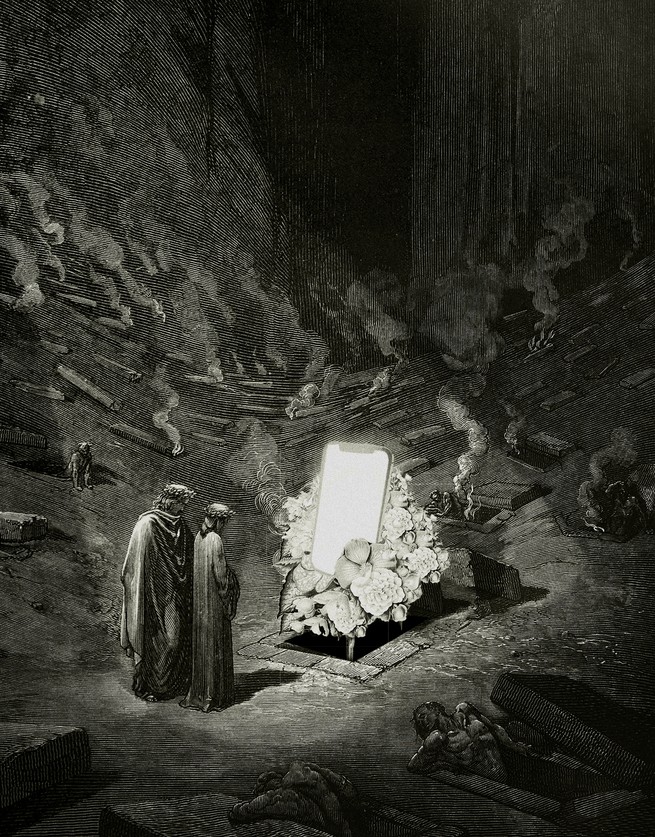
Illustration by Nicolás Ortega. Source: The Arch Heretics, Gustave Doré, c. 1861.
But it is within our power to reduce social media’s ability to dissolve trust and foment structural stupidity. Reforms should limit the platforms’ amplification of the aggressive fringes while giving more voice to what More in Common calls “the exhausted majority.”
Those who oppose regulation of social media generally focus on the legitimate concern that government-mandated content restrictions will, in practice, devolve into censorship. But the main problem with social media is not that some people post fake or toxic stuff; it’s that fake and outrage-inducing content can now attain a level of reach and influence that was not possible before 2009. The Facebook whistleblower Frances Haugen advocates for simple changes to the architecture of the platforms, rather than for massive and ultimately futile efforts to police all content. For example, she has suggested modifying the “Share” function on Facebook so that after any content has been shared twice, the third person in the chain must take the time to copy and paste the content into a new post. Reforms like this are not censorship; they are viewpoint-neutral and content-neutral, and they work equally well in all languages. They don’t stop anyone from saying anything; they just slow the spread of content that is, on average, less likely to be true.
Perhaps the biggest single change that would reduce the toxicity of existing platforms would be user verification as a precondition for gaining the algorithmic amplification that social media offers.
Banks and other industries have “know your customer” rules so that they can’t do business with anonymous clients laundering money from criminal enterprises. Large social-media platforms should be required to do the same. That does not mean users would have to post under their real names; they could still use a pseudonym. It just means that before a platform spreads your words to millions of people, it has an obligation to verify (perhaps through a third party or nonprofit) that you are a real human being, in a particular country, and are old enough to be using the platform. This one change would wipe out most of the hundreds of millions of bots and fake accounts that currently pollute the major platforms. It would also likely reduce the frequency of death threats, rape threats, racist nastiness, and trolling more generally. Research shows that antisocial behavior becomes more common online when people feel that their identity is unknown and untraceable.
In any case, the growing evidence that social media is damaging democracy is sufficient to warrant greater oversight by a regulatory body, such as the Federal Communications Commission or the Federal Trade Commission. One of the first orders of business should be compelling the platforms to share their data and their algorithms with academic researchers.
Prepare the Next Generation
The members of Gen Z––those born in and after 1997––bear none of the blame for the mess we are in, but they are going to inherit it, and the preliminary signs are that older generations have prevented them from learning how to handle it.
Childhood has become more tightly circumscribed in recent generations––with less opportunity for free, unstructured play; less unsupervised time outside; more time online. Whatever else the effects of these shifts, they have likely impeded the development of abilities needed for effective self-governance for many young adults. Unsupervised free play is nature’s way of teaching young mammals the skills they’ll need as adults, which for humans include the ability to cooperate, make and enforce rules, compromise, adjudicate conflicts, and accept defeat. A brilliant 2015 essay by the economist Steven Horwitz argued that free play prepares children for the “art of association” that Alexis de Tocqueville said was the key to the vibrancy of American democracy; he also argued that its loss posed “a serious threat to liberal societies.” A generation prevented from learning these social skills, Horwitz warned, would habitually appeal to authorities to resolve disputes and would suffer from a “coarsening of social interaction” that would “create a world of more conflict and violence.”
Depression makes people less likely to want to engage with new people, ideas, and experiences. Anxiety makes new things seem more threatening. As these conditions have risen and as the lessons on nuanced social behavior learned through free play have been delayed, tolerance for diverse viewpoints and the ability to work out disputes have diminished among many young people. For example, university communities that could tolerate a range of speakers as recently as 2010 arguably began to lose that ability in subsequent years, as Gen Z began to arrive on campus. Attempts to disinvite visiting speakers rose. Students did not just say that they disagreed with visiting speakers; some said that those lectures would be dangerous, emotionally devastating, a form of violence. Because rates of teen depression and anxiety have continued to rise into the 2020s, we should expect these views to continue in the generations to follow, and indeed to become more severe.
The most important change we can make to reduce the damaging effects of social media on children is to delay entry until they have passed through puberty. Congress should update the Children’s Online Privacy Protection Act, which unwisely set the age of so-called internet adulthood (the age at which companies can collect personal information from children without parental consent) at 13 back in 1998, while making little provision for effective enforcement. The age should be raised to at least 16, and companies should be held responsible for enforcing it.
More generally, to prepare the members of the next generation for post-Babel democracy, perhaps the most important thing we can do is let them out to play. Stop starving children of the experiences they most need to become good citizens: free play in mixed-age groups of children with minimal adult supervision. Every state should follow the lead of Utah, Oklahoma, and Texas and pass a version of the Free-Range Parenting Law that helps assure parents that they will not be investigated for neglect if their 8- or 9-year-old children are spotted playing in a park. With such laws in place, schools, educators, and public-health authorities should then encourage parents to let their kids walk to school and play in groups outside, just as more kids used to do.”
What is ad block? It is an application that, at your discretion blocks out advertising so you can browse the internet for content as opposed to ads. If you do not have it, get it here so you can enjoy my blog without the insidious advertising.














 bleatmop
 Mystro


 Dead Wild Roses
Your opinions…