I was a strong proponent of the Harm Reduction strategy until more data has come out about its effectiveness and benefits for society versus other methods. There might be a case for Harm Reduction, but as currently implemented in BC it is a like a 4 legged stool that is missing three legs -harm reduction, law enforcement, prevention and treatment – just focusing on harm reduction and not the other areas is a recipe for social disaster.
The Alberta rehabilitation model has been modestly more successful in dealing with the problems of addictions. Both systems require overlapping programs working together to get people out of the drug abuse loop – whether Alberta has been more successful in coordinating the synergy of anti-addiction programs or that rehabilitation programs are just more effective remains to be seen. Initial data points to the Alberta method being more successful.
The divergent policies and politics of B.C. and Alberta have played a major role in determining the public perception of Canada’s opioid crisis. Left-leaning media outlets have tended to laud B.C.’s harm reduction as being more compassionate, while conservative voices point to Alberta’s focus on treatment as more practical and realistic. What Canada had lacked until recently was an impartial, data-driven assessment of the two competing systems.
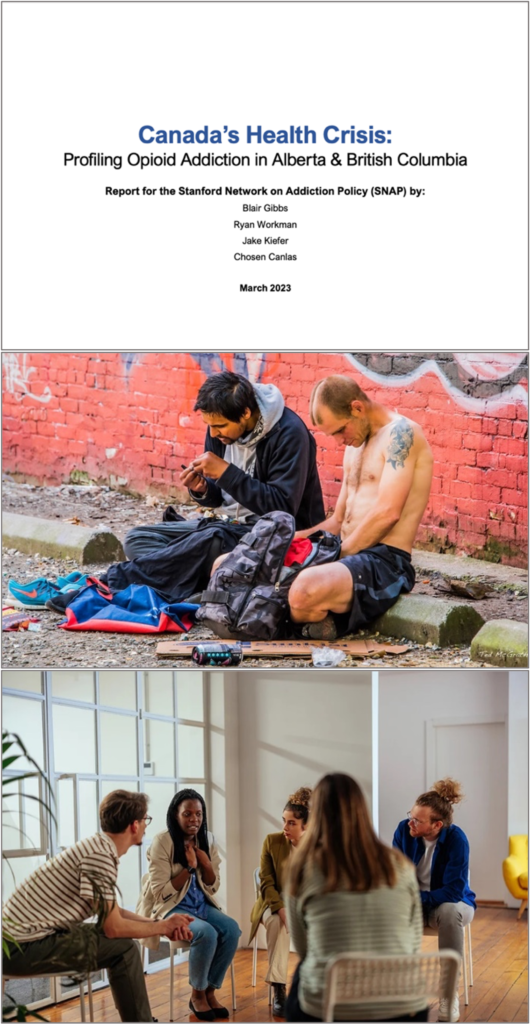
Advantage Alberta: The Stanford Network on Addiction Policy’s 2023 report (depicted above) observes that, “Alberta is currently experiencing a reduction in key addiction-related harms,” while “Canada overall, and BC in particular, is not yet showing the progress that the public and those impacted by drug addiction deserve.” At middle, a typical street scene in Vancouver’s Downtown Eastside; at bottom, a therapy session at Alberta’s new Red Deer Recovery Community. (Sources of photos: (middle) Ted McGrath, licensed under CC BY-NC-SA 2.0 DEED; (bottom) EHN Canada)
That problem was partially solved last year with the release of a report from the U.S.-based Stanford Network on Addiction Policy. Entitled Canada’s Health Crisis: Profiling Opioid Addiction in Alberta & British Columbia, the document offers an even-handed review of the differing policies of the two provinces, summarizes the latest available data (which it criticizes as inadequate) and cautiously evaluates the results. B.C., the report notes, emphasizes harm reduction, “safe supply” of illicit drugs, decriminalization of possession and reduction of addiction stigma. Alberta, by contrast, is focusing on “investment in rehabilitation beds and spaces, such as therapeutic communities,” while moving away from “safe supply” of opioids and instead providing addicts with medications.
Using these differences as a natural experiment, the Stanford report comes to a few key conclusions. First, it observes “a lack of policy innovation in BC on the issue of drug addiction.” Obsessive attention to harm reduction appears to have blinded politicians and public health officials to the longer-term consequences of their favoured policy. “Enforcement against drug crime has [been] reduced in recent years,” the report notes, “indicating a general lessening of criminal justice enforcement against drug offences in Canada during the escalating health crisis of opioid addiction.”
Second, “Of the two provinces studied for this report, Alberta is currently experiencing a reduction in key addiction-related harms.” The province’s rate of overdose deaths declined by 17 percent from 2021 to 2022 (B.C.’s remained almost unchanged), although it was still Alberta’s second-worst year on record. Using the most recent data available, the Stanford researchers point to B.C.’s higher death rate as suggestive of the two approaches’ relative effectiveness: “Our research indicates that Canada overall, and BC in particular, is not yet showing the progress that the public and those impacted by drug addiction deserve.”
Here at DWR we’ve already talked about how our theories about addiction are quite flawed. However, this is such an important topic that we’ll cover it again, but now in an animated format that is quite appealing and easy to understand.
Many social problems can be addressed by ‘changing the cage’, however, recognizing that the cage is the problem is often a monumental step.
Recently I posted a quote from John Hari on addiction. See it here. I’ve also updated the post to include the video below as well. What is detailed in this TED talk is idea that we should punish and isolate addicts from society. This idea, according to Hari is about 100 years old and also, more importantly completely wrong.
The methodology we base the current “War on Drugs” and how we treat people who are addicted is based on poor experimental design. When we control for environmental factors – addiction mostly disappears.
This TED talk was too important to bury in an update of an old blog post. So please enjoy John Hari and his important ideas on addiction.
This is taken from the interview titled: Does Capitalism Cause Drug Addiction? The piece that I am going to excerpt is about how we view addiction in society. If we are to believe Hari, it isn’t about a failure in moral rectitude or falling into a drug laden trap of compulsion; but rather it is the atomization and rampant consumerism in society that causes the addictions we see today.
“Drugs are not what we think they are. Addiction is not what we think it is. The drug war is certainly not what we’ve been told it is. And the alternatives aren’t what we think they are.
And there were two people here in Canada who really helped me to think about this. One is guy called Bruce Alexander. He’s someone you will know the work of. If you had said to me four years ago, say, “What causes heroin addiction?” right, I would have—I would have looked at you like you were a little bit simpleminded. I would have said, “Well, heroin causes heroin addiction, right?” There’s a story we’ve been told about addiction, how it works, for a hundred years now, that’s so deeply ingrained in our consciousness that it seems like our common sense, right? We think if the first 20 people on the rows here, if we all used heroin together for, say, 20 days, there are chemical hooks in heroin that our body would start to physically need, right? So, on day 21, we would need that heroin. We would physically crave it. And that’s what addiction is; that’s how we think it works.
And the first kind of chink in my doubt about that was explained to me by another great Canadian, Gabor Maté in Vancouver, who some of you will know the work of, amazing man. And he pointed out to me, if any of us step out of here today and we’re hit by a bus, right, God forbid, and we break our hip, we’ll be taken to hospital. It’s very likely we’ll be given a lot of diamorphine. Diamorphine is heroin. It’s much better heroin than you’ll score on the streets, because it’s medically pure, right? It’s really potent heroin. You’ll be given it for quite a long period of time. Every hospital in the developed world, that’s happening, right? If what we think about addiction is right, what should—I mean, those people should leave as addicts. That never happens, virtually never happens. You will have noticed your grandmother was not turned into a junkie by her hip replacement operation, right?
I didn’t really know what to do with it. When Gabor first explained that to me, I didn’t really know how to process that, until I met Bruce Alexander. Bruce is a professor in Vancouver, and Bruce explained something to me. The idea of addiction we have, the one that we all implicitly believe—I certainly did—comes from a series of experiments that were done earlier in the 20th century. They’re really simple experiments. You can do them yourself at home if you’re feeling a little bit sadistic. Get a rat and put it in a cage and give it two water bottles. One is just water, and one is water laced with either heroin or cocaine. If you do that, the rat will almost always prefer the drugged water and almost always kill itself very quickly, right, within a couple of weeks. So there you go. It’s our theory of addiction.
Bruce comes along in the ’70s and said, “Well, hang on a minute. We’re putting the rat in an empty cage. It’s got nothing to do. Let’s try this a little bit differently.” So Bruce built Rat Park, and Rat Park is like heaven for rats. Everything your rat about town could want, it’s got in Rat Park. It’s got lovely food. It’s got sex. It’s got loads of other rats to be friends with. It’s got loads of colored balls. Everything your rat could want. And they’ve got both the water bottles. They’ve got the drugged water and the normal water. But here’s the fascinating thing. In Rat Park, they don’t like the drugged water. They hardly use any of it. None of them ever overdose. None of them ever use in a way that looks like compulsion or addiction. There’s a really interesting human example I’ll tell you about in a minute, but what Bruce says is that shows that both the right-wing and left-wing theories of addiction are wrong. So the right-wing theory is it’s a moral failing, you’re a hedonist, you party too hard. The left-wing theory is it takes you over, your brain is hijacked. Bruce says it’s not your morality, it’s not your brain; it’s your cage. Addiction is largely an adaptation to your environment.
There was a really interesting human experiment going on at the same time as Rat Park, which kind of demonstrates this really interestingly. It was called the Vietnam War, right? Twenty percent of American troops in Vietnam were using heroin a lot, right? And if you look at the reports from the time, they were really worried. They thought—because they believed the old theory of addiction. They were like, “My god, these guys are all going to come home, and we’re going to have loads of heroin addicts on the streets of the United States.” What happened? They came home, and virtually all of them just stopped, because if you’re taken out of a hellish, pestilential jungle, where you don’t want to be, you can die at any moment, and you go back to a nice life in Wichita, Kansas, you can bear to be present in your life. We could all be drunk now. Forget the drug laws. We could all be drunk now, right? None of you look very drunk. I’m guessing you’re not, right? That’s because we’ve got something we want to do. We’ve got things we want to be present for in our lives.
So, I think this has—Bruce taught us about how this has huge implications, obviously, for the drug war. The drug war is based on the idea that the chemicals cause the addiction, and we need to physically eradicate these chemicals from the face of the Earth. If in fact it’s not the chemicals, if in fact it’s isolation and pain that cause the addiction, then it suddenly throws into sharp contrast the idea that we need to impose more isolation and pain on addicts in order to make them stop, which is what we currently do.
But it actually has much deeper implications that I think really relate to what Naomi writes about in This Changes Everything, and indeed before. We’ve created a society where significant numbers of our fellow citizens cannot bear to be present in their lives without being drugged, right? We’ve created a hyperconsumerist, hyperindividualist, isolated world that is, for a lot of people, much more like that first cage than it is like the bonded, connected cages that we need. The opposite of addiction is not sobriety. The opposite of addiction is connection. And our whole society, the engine of our society, is geared towards making us connect with things. If you are not a good consumer capitalist citizen, if you’re spending your time bonding with the people around you and not buying stuff—in fact, we are trained from a very young age to focus our hopes and our dreams and our ambitions on things we can buy and consume. And drug addiction is really a subset of that.”
I’m very happy to see that some places in Canada are starting to turn on to this sort of thinking – Medicine Hat Alberta for instance where they are working toward eradicating homelessness – by giving people homes to live in – because it is cheaper to do so that the current methods.
**update** John Hari speaking on a TED talk about addiction.
Reading Mate’s book called In the Realm of Hungry Ghosts. I’ve been unable to put this book down as his research and insight into addictions and associated behaviours dovetails snugly with the clientele I work with most days. Here is a brief excerpt from the chapter titled Trauma, Stress and the Biology of Addiction.
“Hardcore drug addicts, whose lives invariably began under conditions of severe stress, are all too readily triggered into a stress reaction. Not only does the stress response easily overwhelm the addict’s already challenged capacity for rational thought when emotionally aroused, but also the hormones of stress “cross-sensitize” with addictive substances. The more one is present, the more the other is craved. Addiction is a deeply ingrained response to stress, an attempt to cope with it through self-soothing. Maladaptive in the long term, it is highly effective in the short term.
Predictably, stress is a major cause of continued drug dependence. It increases opiate craving and use, enhances the reward efficacy of drugs and provokes relapse to drug-seeking and drug-taking. “Exposure to stress is the most powerful and reliable experimental manipulation used to induce reinstatement of alcohol or drug use,” one team of researchers reports. “Stressful experiences,” another research group points out, “increase the vulnerability of the individual to either develop drug self-administration or relapse”.
Stress also diminishes the activity of the dopamine receptors in the emotional circuits of the forebrain, particularly in the nucleus accumbens, where the cravings for drugs increases as the dopamine receptors function decreases. The research literature has identified three factors that universally lead to stress for human beings: uncertainty, lack of information and lose of control. To these we may add conflict that the organism is unable to handle and isolation from emotionally supportive relationships. Animal studies have demonstrated that isolation leads to changes in brain receptors and increased propensity for drug use in infant animals, and in adults reduces the activity of dopamine-dependent nerve cells. Unlike rats reared together in isolation, rats housed together in stable social groupings resisted cocaine self-administration – in the same way that Bruce Alexander’s tenants in Rat Park were impervious to the charms of heroin.”
– Dr. Gabor Mate. In The Realm of Hungry Ghosts p.198
I’m not finished reading the book yet, so I expect to have a few more quotes to share. What initially drew me in was the stories of how Dr.Maté interacts with his clientele in Vancouver’s Lower East Side and how he can see his own addictions mirrored in the people he helps everyday.
What is ad block? It is an application that, at your discretion blocks out advertising so you can browse the internet for content as opposed to ads. If you do not have it, get it here so you can enjoy my blog without the insidious advertising.

“Drugs are not what we think they are. Addiction is not what we think it is. The drug war is certainly not what we’ve been told it is. And the alternatives aren’t what we think they are.











 bleatmop
 Mystro
 The Arbourist


 Dead Wild Roses
Your opinions…