
You are currently browsing the tag archive for the ‘Bad for Canada’ tag.
The recent protests at McGill University, where anti-Israel activists physically blocked access to lecture halls and disrupted classes, represent a troubling departure from the principles of free speech and Canadian values. On April 2, 2025, as reported by B’nai Brith Canada, masked protesters in the Bronfman Building prevented students from attending classes, with chants of “McGill, McGill you can’t hide, you’re complicit in genocide” echoing through the campus. While protest is a protected right, these actions crossed into intimidation and coercion, as students were denied their fundamental right to education. Free speech in Canada is about expressing ideas without fear of retribution, not about obstructing others’ rights or creating a hostile environment. Such behavior is distinctly un-Canadian, as it undermines the nation’s commitment to mutual respect, dialogue, and the rule of law—values that have long defined Canadian society.
McGill University’s response to these protests highlights a glaring abdication of responsibility. Despite the disruptions, which forced some classes online and led to acts of vandalism, the university’s initial reaction was tepid, only implementing ID-based access controls on April 4, 2025, after days of chaos. Advocacy groups like the Canadian Friends of Simon Wiesenthal Center and concerned individuals have called for decisive action, pointing to the hostile environment created for Jewish students and the broader student body. McGill’s failure to swiftly address the physical blockades and ensure safe access to education sends a dangerous message: that the university prioritizes appeasing disruptive activists over protecting the rights of all students. This inaction not only erodes trust in the institution but also sets a precedent for tolerating intimidation under the guise of activism, further emboldening such behavior on Canadian campuses.
The protests at McGill reveal a deeper issue: a two-tier system of justice that is profoundly divisive for Canadian society. While the protesters faced little immediate consequence for their actions, students attempting to attend classes were left to fend for themselves, as seen in videos where individuals were physically blocked from entering lecture halls. This disparity in treatment—where one group’s “right” to protest is elevated above others’ rights to safety and education—creates a fractured campus environment. Jewish students, in particular, have reported feeling unsafe, with advocacy groups framing the protests as antisemitic. Meanwhile, some individuals with differing views supported the protesters, accusing Israel and its supporters of enabling genocide. This polarization reflects a broader societal trend where identity-based grievances are weaponized, pitting groups against each other rather than fostering unity, a core Canadian ideal.
My blog post *The Oblivious Irony of Canada’s Progressive Left* provides a stark illustration of this trend, noting, “The progressive left’s obsession with identity politics has created a hierarchy of victimhood, where certain groups are given carte blanche to act with impunity, while others are silenced or vilified.” This observation captures the essence of the McGill protests, where the activists’ cause—framed as a fight against oppression—seemingly justified their coercive tactics, while the rights of other students were dismissed. Identity politics, as I argue, has become a divisive force in Canada, eroding the shared values of fairness and equality that once united the nation. The McGill protests are a microcosm of this larger societal shift, where the pursuit of “justice” for one group comes at the expense of others, deepening divisions and resentment.
In conclusion, the actions at McGill University are not a legitimate exercise of free speech but a violation of the principles that define Canada as a nation. By allowing protesters to intimidate and obstruct, McGill has failed its students, particularly those who felt targeted or unsafe, and has contributed to a two-tier system of justice that undermines Canadian unity. The divisive impact of identity politics, as highlighted in previously, underscores the urgent need for a return to shared values—respect, dialogue, and equal treatment under the law. Canadian society cannot thrive when one group’s rights are prioritized over another’s, and institutions like McGill must take responsibility to ensure that campuses remain spaces for learning, not coercion. Only by upholding these principles can Canada reclaim its identity as a nation of fairness and inclusion for all.

The Liberal government supports the corrosion of the basis of our society – a stable family structure is under siege as usual under the guise of “progressive” values.
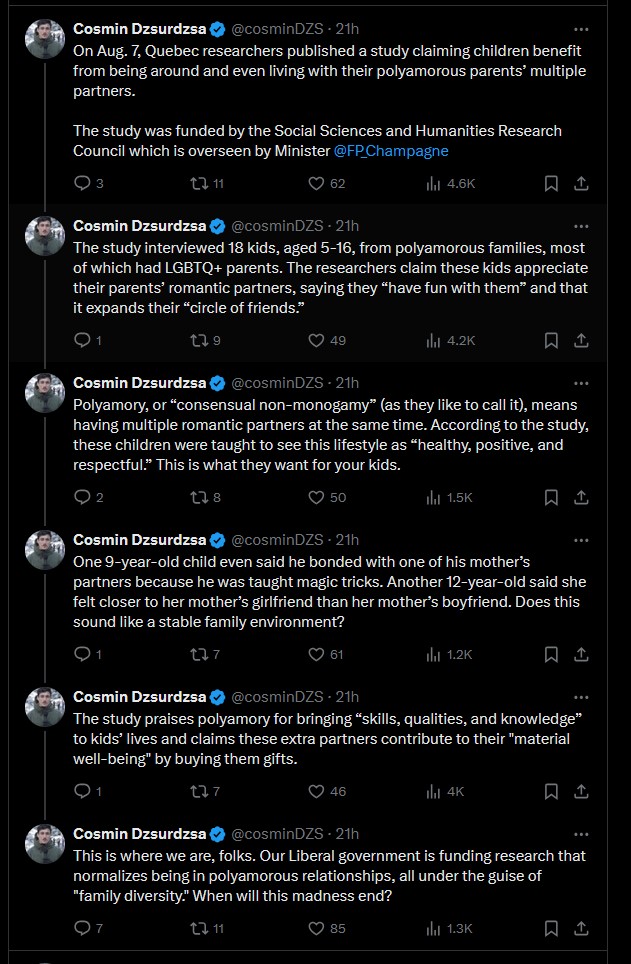
On Aug. 7, Quebec researchers published an article on “Children’s views on the romantic partners of their polyamorous parents” in the Journal of Social and Personal Relationships.
The research was funded by the Social Sciences and Humanities Research Council of Canada, a federal grant-giving body that distributes taxpayer funds to academic projects.
SSHRC communications advisor Nicole Swiaterk confirmed to True North taxpayers paid $70,662 between 2019 and 2021 for the study. Funds were awarded via the Insight Development Grants competition.
Researchers interviewed 18 children between the ages of 5 and 16 years old. Three of the children in the cohort lived in households with their parents’ multiple sexual partners. Nine of the ten households interviewed included adults who identified as LGBTQ+.
“We found that the participating children generally appreciate their parents’ romantic partners,” researchers concluded.”
–Hat tip to the The True North


Canadians need to be exposed to the end product of inducting the concept of gender identity into Charter and laws. The end result is that we have incarcerated male rapists in female prisons. It is the ultimate expression of placing the feelings of males above the *safety* of females in our society.
This is not about ‘being kind’ or being inclusive. This is ignoring the reality we all share for some kind of gender fucking fantasy land where what people say about themselves MUST be accepted by everyone around them. Our internal perception of ourselves is precisely that – it is ours – and there should be no expectations of others to abide with said perception.
Our laws must deal with the world as it is, not the world as individuals want to perceive it if we value the notion of a just and fair Canadian society (that also happens to be safe for females).
CA — Ottawa, Ontario. Women Are Human recently disclosed Anngela Valentino’s Parole Board of Canada (PBC) decision, which confirmed female prisoners’ reports of Valentino assaulting and/or threatening them while incarcerated at Grand Valley Institution for Women (GVI). Women Are Human has additionally obtained the July 2020 PBC decision for a different male prisoner, Steve Mehlenbacher, which also confirms a female prisoner’s report that Mehlenbacher repeatedly sexually assaulted her. Mehlenbacher’s sexual assaults were first reported by Women Are Human in August 2020, after Heather Mason sounded the alarm on social media. Mason is a former Canadian federal prisoner at GVI and is now an advocate for women in prison. At that time, Women Are Human reached out to Mason and another former prisoner, who detailed multiple instances of Mehlenbacher’s predatory and abusive behaviour, and who were thus completely unsurprised that Mehlenbacher had been charged with sexual assault. Continue reading Parole Decision Confirms Another Male Prisoner Was Violent Towards Incarcerated Women | Women Are Human. Read more at: https://www.womenarehuman.com/parole-decision-confirms-another-male-prisoner-was-violent-towards-incarcerated-women/

Paul Street writes a foreboding analysis of what the TPP is on Counterpunch.
“Lawyers and lobbyists for giant multinational corporations have been working up the TPP and promoting it for nearly a decade. The measure would join the United States along with 11 other nations along the Pacific Rim (Australia, Brunei, Canada, Chile, Japan, Malaysia, Mexico, New Zealand, Peru, Singapore, and Vietnam) in a “free-trade zone” covering nearly 40 percent of the world’s economy. Obama and his largely Republican “free trade” allies say the TPP will open foreign markets to American goods and “level the playing field by forcing Asian competitors to improve labor and environmental standards.”
But that’s just blatantly deceptive business propaganda. The measure isn’t really about trade and it certainly isn’t about improved standards. Its real thrust is to strengthen corporations’ ability to protect and extend their intellectual property rights (drug patents, movie rights, and the like) and to guarantee that they will be compensated by governments for any profits they might lose from having to meet decent public labor and environmental (and other) standards – something certain to discourage the enactment and enforce of such standards. Key parts of the TPP permit foreign capital to freely and easily enter a country and for profits to be just as easily removed. The TPP would ban capital controls, which let nations block disruptive inflows of ‘hot money’ from speculative investors and then escape before the bubble they create explodes. It would also block the passage of financial transaction taxes, a method for checking speculation and generating public revenue. The measure also legitimizes the extensive privatization of public enterprises.
The TPP is designed to help big multinational businesses attain special deals they would be unable to get through existing political processes, considered excessively democratic by the global deep state of capital. A foreign corporation could sue and receive damages for anticipated profit losses resulting from an increase in the minimum wage (federal, state, or local) in the United States. A U.S. state or Canadian province (or any other member-state jurisdiction) would have to compensate oil and gas companies for anticipated profits lost to bans on the environmentally disastrous practice of hydraulic fracturing (fracking). Big Pharma and the big corporate media firms would be granted stronger and longer-lasting patent and copyright protections across the “free trade” zone. Big multinational banking and investment firms would have to be paid by TPP governments that wanted to keep their nations’ financial systems safe through responsible regulation. Food, chemical, consumer goods, and pesticide industries will be able to able to limit the ability of TPP governments to impose safety and environmental regulations on the things they sell and how they make them. The giant global and U.S.-based consumer packaged goods firm Procter & Gamble could demand compensation from any TPP nation (including the U.S.) that dared to subject its products and workplaces to basic social and environmental standards. (One could go on and on with such examples.)
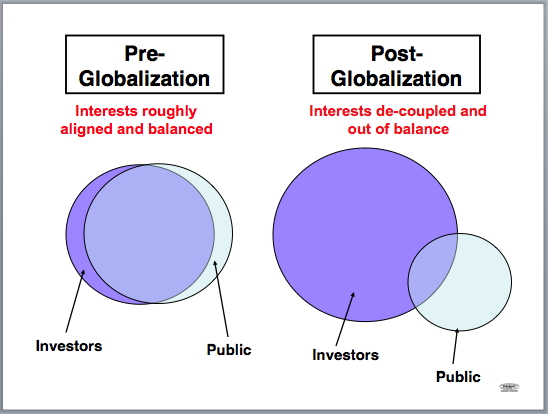
“Level playing field”? The TPP is about a race to the capitalist bottom, a levelling down of people and government’s capacity to impose limits on business behavior. Like its regressive predecessor the North American Free Trade Agreement (NAFTA), it’s about what the New York Times calls “investor protection.”
Of critical and dark significance, the TPP constructs a new legal structure that transcends the existing, nation-based legal system.
Phone, write, send smoke signals to your MP’s fellow Canadians. We do not want this for our country, NAFTA is bad enough.











 bleatmop
 Mystro
 The Arbourist


 Dead Wild Roses
Your opinions…