
You are currently browsing the tag archive for the ‘Book Banning’ tag.
Picture a library, its shelves stripped of Orwell and Atwood, replaced by outrage: this is the activist’s trap. Critical social constructivism—commonly branded as “woke ideology”—does not depend on truth-seeking but on the imposition of narrative, luring well-meaning observers into excusing captured institutions as merely inept (Kincheloe, 2005). To extend such charity is to enable agendas that corrode trust in public institutions and divide communities.
The Edmonton Public School Board’s (EPSB) recent book removal controversy exemplifies this dynamic. In late August 2025, a leaked list of more than 200 titles slated for removal from K–12 school libraries ignited national outrage. The list included canonical works such as Margaret Atwood’s The Handmaid’s Tale and Aldous Huxley’s Brave New World. Media coverage swiftly framed the list as a right-wing purge: a literary witch-hunt torching academic freedom and signaling Alberta’s dystopian slide.
Yet this spectacle obscures the actual policy. In July 2025, Education Minister Demetrios Nicolaides issued a directive requiring school boards to remove sexually explicit materials by October 1, 2025, to ensure age-appropriate resources in K–12 libraries (Alberta Ministry of Education, 2025). The directive does not ban classics nor prohibit parents from providing controversial works privately. Its scope is limited: public schools, funded by taxpayers, must not circulate sexually explicit material to children.
Seen in this light, the EPSB’s list appears less a bureaucratic stumble than a narrative maneuver. By placing revered classics alongside contested titles such as Maia Kobabe’s Gender Queer—which contains explicit illustrations of sexual acts—and Jonathan Evison’s Lawn Boy, which describes sexual encounters between minors, the Board ensured the reaction would focus on “censorship” rather than explicit content. The outrage generated by the supposed “banning” of Atwood and Huxley distracts from the substantive question: whether K–12 libraries should carry graphic sexual material at all.
To be fair, some argue this was an honest misstep. Officials under pressure may have over-applied vague guidelines, fearing punishment if they erred on the side of permissiveness. From this perspective, the inflated list reflects incompetence, not ideology. This interpretation has surface plausibility—and acknowledging it is crucial. Yet it falters when weighed against the broader intellectual context.
The precise inclusion of classics alongside sexually explicit texts mirrors the rhetorical tactics of queer pedagogy, which openly embraces provocation as a teaching tool. In their influential article Drag Pedagogy: The Playful Practice of Queer Imagination in Early Childhood, Harper Keenan and Lil Miss Hot Mess (2021) describe initiatives such as Drag Queen Story Hour as “strategic defiance” designed to “disrupt normative understandings of childhood” (p. 433). Drawing on José Esteban Muñoz’s Cruising Utopia (2009), they frame queerness as a “future-oriented ideality” (p. 1), using performance and play to challenge authority, destabilize binary categories, and cultivate “embodied kinship” rather than passive empathy (Keenan & Lil Miss Hot Mess, 2021, pp. 434–436).
This framework is not hypothetical. It explicitly advocates the use of aesthetics, provocation, and imaginative unruliness to reshape children’s perceptions. In their words, “Drag pedagogy embraces an unruly vision of childhood as a site of potentiality” (p. 437). Texts like Gender Queer or Lawn Boy, with their focus on sexual exploration and destabilization of normative boundaries, can be read as curricular extensions of this agenda. Their presence in K–12 libraries is not incidental but reflects a coherent intellectual project to prioritize queer cultural forms over developmental appropriateness.
From this perspective, the EPSB’s list functions as a narrative cudgel. By spotlighting Orwell and Atwood, defenders can recast the government’s directive as authoritarian censorship while obscuring the ideological drive to embed queer pedagogy in public institutions. The effect is the same whether activists deliberately curated the list or whether bureaucrats, steeped in activist frameworks, reproduced them unconsciously: outrage is amplified, and the debate is reframed on activist terms.
This is the trap of charitable interpretation. To dismiss the list as simple incompetence is to ignore its functional alignment with queer pedagogy’s playbook: provoke, inflate, and obscure. Even if intent cannot be definitively proven, the effect is unmistakable—a shift of public discourse away from the legitimate question of protecting children’s developmental environments and toward a defensive posture about “book banning.”
The consequences are corrosive. Communities fracture, as defenders of childhood innocence are painted as censors, and activists wield “inclusivity” as a battering ram against parental concerns. Public trust in schools erodes further. And children—the supposed beneficiaries—are caught in the crossfire of ideological contestation.
Children deserve age-appropriate materials in their school libraries—full stop. No law prevents parents from accessing contested works privately, but schools should not be battlegrounds for ideological conquest. The EPSB controversy demonstrates how critical social constructivism (woke) thrives not on truth but on narrative imposition. To resist this, we must reject the activist trap of charitable interpretation and confront directly how such narratives are engineered. Only by doing so can we restore unity, rebuild trust, and protect the integrity of public education.

“Queer is by definition whatever is at odds with the normal, the legitimate, the dominant. There is nothing in particular to which it necessarily refers. It is an identity without an essence.”
(Halperin, 1995, p. 62)
References
-
Alberta Ministry of Education. (2025). Ministerial Order No. 2025-07: Age-Appropriate Resources in School Libraries. Edmonton, AB: Government of Alberta. Retrieved from https://www.alberta.ca/ministerial-orders
-
Keenan, H. B., & Lil Miss Hot Mess. (2021). Drag pedagogy: The playful practice of queer imagination in early childhood. Curriculum Inquiry, 51(5), 433–452. https://doi.org/10.1080/03626784.2020.1864621
-
Kincheloe, J. L. (2005). Critical constructivism. New York: Peter Lang.
-
Muñoz, J. E. (2009). Cruising utopia: The then and there of queer futurity. New York: NYU Press.
A book-banning campaign by Gays Against Gentrification (GAG) is demanding the Vancouver Woman’s Library (VWL) remove and ban over twenty feminist books from their collection. These works — written by renowned women authors who have a long history of engaging in critical analysis against the oppression of women as class — focus on female exploitation, male supremacy, violence against women, reproductive freedom, lesbian identity and women’s health. As a matter of principle and in defense of freedom of speech and thought, no library should ever ban any books under any circumstance – especially ones written by and for women at the VWL. As authoritarianism takes deeper root throughout the world, it is more important than ever that any attempt to silence women in their struggle for liberation is resisted by all, at every moment. We urge VWL to keep these books on their shelves.
Source: Petition: Protect Feminist Books at Vancouver Women’s Library
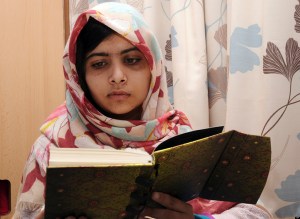 Pakistan announced that Malala Yousafzai’s book “I Am Malala” was banned from private schools. From the CBC:
Officials say they have banned teenage education activist Malala Yousafzai’s book from private schools across Pakistan, calling her a tool of the West.
It isn’t about religion, holiness, or allah, god (etc.). It’s not about defending the country from Western influences or even polishing allah’s knob at exactly the correct speed as mandated by the Qur’an.
This book banning is about charlatans and courtiers defending their privileged status against the radical notion that women are people.
Adeeb Javedani, president of the All Pakistan Private Schools Management Association, said Sunday his group banned Malala’s book from the libraries of its 40,000 affiliated schools. He said Malala was representing the West, not Pakistan.
The Deluded will go to any length to defend their fetid bullshit. See the christian analog (among many examples)in the the United States of christian loons shaming women as they attempt to shame women for legally ending a pregnancy.
Malala has become an international hero for opposing the Taliban and standing up for girls’ education. But conspiracy theories have flourished in Pakistan that her shooting was staged to create a hero for the West.
Because getting shot in the face is the most reliable way to become a hero? It is outrageous how far the religious will go to defend their mythology. Isn’t it enough that Malala was gunned down for the crime of being female and seeking an education, but now the same authorities (the ones ‘responsible’ for her security) are banning her book.
The Pakistani religious authorities are confabulating a grand story about the West’s plot to overthrow their country and religion – hero for the West, indeed! The only theory that is being consistently applied here is Patriarchy. It is patriarchal misogyny reinforced by religious tradition and implicit cultural norms that makes the banning of Malala’s book possible.
*ed. Wow, misspelling the name of the blog and forgetting what syntax is, all in the same post – sadly, this was after “proofing”. The dangers of early morning posting.











 bleatmop
 Mystro


 Dead Wild Roses
Your opinions…