
You are currently browsing the tag archive for the ‘British Columbia’ tag.
Some children are genuinely vulnerable, atypical, or distressed, and they deserve careful support.
That should be easy to say. It should also be the beginning of the conversation, not the end of it.
The problem starts when a narrow duty of care is expanded into a broad teaching mandate. Support for a small number of children becomes a reason to saturate schools, children’s media, and online spaces with contested identity frameworks. What begins as accommodation becomes doctrine. What begins as care becomes a general lens for everyone.
That is the central move.
It is usually framed in soft language: inclusion, visibility, affirmation, making room. Sometimes that language is fair. But it can also hide a scope change. A real minority need is used to justify population-level exposure. The existence of some children who need unusual support does not, by itself, justify turning child-facing institutions into delivery systems for anti-normative identity scripts many children are not developmentally ready to evaluate.
Put simply: support is not the same thing as saturation.
A useful heuristic is the inoculation model. The implicit argument often sounds like this: expose everyone early and often to the framework so harm is prevented later. But that assumes the framework is age-appropriate, conceptually clear, and socially harmless when applied at scale. Those assumptions are usually asserted, not argued.
You can see the pattern in school frameworks like SOGI 123. SOGI 123 describes itself as an initiative to help educators make schools safer and more inclusive for students of all sexual orientations and gender identities, with tools spanning policy, school culture, and teaching resources. In British Columbia, SOGI 123 has been broadly integrated through educator networks and district participation structures. In Alberta, similar SOGI 123 resources and supports exist and are used, but public acceptance and implementation have been more contested and uneven. (Your local framing here is fine; if you want, we can add a specific Alberta anchor in the next pass.)
The point is not that every teacher using these materials has radical intentions. Most likely do not. The point is structural. A framework introduced in the name of protecting a minority of vulnerable students can become a general lens for shaping the environment of all students. That is exactly where support turns into saturation.
None of this requires pretending there are no benefits. Anti-bullying frameworks and school supports can reduce harassment and improve school climate for vulnerable students, and in some cases for other students as well. Recent SOGI 123 evaluation reporting in B.C. has explicitly claimed reductions in some forms of bullying and sexual-orientation discrimination, including effects observed for heterosexual students in studied schools. But that is a different question from whether a framework is well-bounded, developmentally fitted, and appropriate as a general lens for all children. A program can produce some good outcomes and still be overextended in scope.
This is also where ordinary parents often feel morally cornered. They are told the framework is simply about kindness and safety. Then they discover it also carries contested claims about identity, norms, and development. When they raise questions about age, fit, or timing, the objection is treated as hostility rather than prudence.
That rhetorical move matters. It is how debate gets shut down.
Some activist frameworks are not just asking for tolerance or non-harassment. They are more ambitious. They treat ordinary social norms as presumptively suspect—or as things to be actively challenged—rather than mostly inherited and refined. Adults can debate that in adult spaces. The problem is when those frameworks are translated into child guidance and presented as common sense before children are developmentally ready to sort through the concepts.
You do not need a graduate seminar to see the issue. Children imitate. Children seek belonging. Children absorb prestige cues. Children are shaped by what trusted adults celebrate. That is not bigotry. That is basic reality.
This is why developmental fit matters. Children do not process abstract identity questions the way adults do. Identity formation is gradual. Social context matters. Timing matters. Adult authority matters. Age appropriateness is not a slogan; it shifts across developmental stages, and what may be discussable at 16 is not automatically suitable at 6. When institutions present contested frameworks in a celebratory register first and a cautionary register later (or never), adults should worry.
The usual public binary is false. The choice is not between cruelty and total affirmation. It is not between neglect and ideological immersion. A sane society can do both things at once: provide targeted support for the children who truly need it, while refusing to reorganize the symbolic environment of all children around contested anti-normative frameworks.
That is not repression. It is proportion.
And proportion is exactly what gets lost when every concern is moralized and every request for limits is treated as harm.
We should be able to say, plainly, that some children need exceptional care without turning exceptional cases into the template for everyone else. We should be able to protect the vulnerable few without swamping the many. We should be able to teach kindness without requiring ideological inoculation.
If we cannot make those distinctions, then we are not practicing compassion. We are practicing scope creep with moral language.
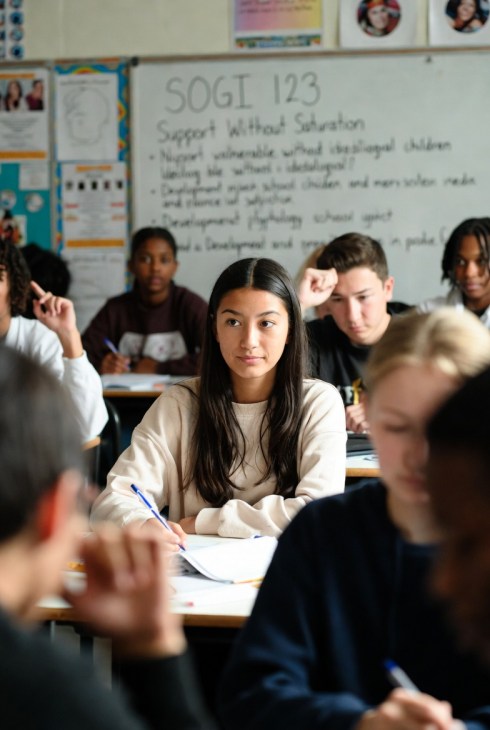
Support for vulnerable students is necessary. But targeted care is not the same as saturating schools with contested identity frameworks for all children.
References
- SOGI 123 / SOGI Education. “SOGI 123 | Making Schools Safer and More Inclusive for All Students.”
https://www.sogieducation.org/ (SOGI 123) - SOGI Education. “What Is SOGI 123?”
https://www.sogieducation.org/question/what-is-sogi-123/
(official explainer page) - SOGI Education. “British Columbia.”
https://www.sogieducation.org/our-work/where-we-support/british-columbia/
(B.C. implementation / network context) - ARC Foundation. “UBC Evaluation of SOGI 123 (October 2024).”
https://www.arcfoundation.ca/ubc-evaluation-sogi-123-october-2024
(evaluation / outcomes framing from SOGI-supportive side) - Alberta Teachers’ Association. “What is SOGI 123?”
https://teachers.ab.ca/news/what-sogi-123 (teachers.ab.ca) - Keenan, H., and Lil Miss Hot Mess. “Drag Pedagogy: The Playful Practice of Queer Imagination in Early Childhood.” Curriculum Inquiry 51, no. 5 (2021): 578–594.
https://doi.org/10.1080/03626784.2020.1864621 - Gender Report (opinion/critical perspective). “We need to take ideological gender rhetoric out of education.” (Jan. 28, 2021).
https://genderreport.ca/sogi-gender-curriculum-queer-theory/ (CANADIAN GENDER REPORT) - Global News. “Duelling protests held in Edmonton over sexual orientation and gender identity policies in schools” (Sept. 20, 2024).
https://globalnews.ca/news/10766483/edmonton-gender-identity-sexual-orientation-alberta-schools/ (Global News)
In British Columbia, a dangerous woke ideology masquerading as “reconciliation” is being weaponized by Premier David Eby and his inner circle to dismantle the foundations of Canadian society. As Caroline Elliott reveals in her piercing National Post opinion piece, Eby’s advisors—figures like Doug White and Dr. Roshan Danesh—promote a worldview that treats Canada’s formation as an “original sin” demanding atonement through “turbulent transition,” “rupture,” “sacrifice,” and the “utter transformation of human affairs.” This is not benign progressivism; it is extremist zealotry that views Western civilization as inherently oppressive, requiring painful societal upheaval to achieve absolution.
By framing non-Indigenous Canadians as “settlers,” “colonizers,” or “uninvited guests,” these ideologues sow division and guilt, paving the way for the erosion of property rights, economic stability, and democratic norms.
At the heart of this agenda lies the Declaration on the Rights of Indigenous Peoples Act (DRIPA), which mandates aligning B.C. laws with the United Nations Declaration on the Rights of Indigenous Peoples (UNDRIP), including taking “all measures necessary” to enforce it. Elliott highlights how this has led to precedents like the Haida agreement, which recognizes Aboriginal title over private property for the first time, and the B.C. Supreme Court’s Cowichan decision, creating profound uncertainty for landowners. Advisors like Danesh explicitly link this to colonialism’s “domino effect,” where ignoring Indigenous title “knocks down much of the foundation for certainty of fee simple property title.” What woke zealots celebrate as justice is, in reality, a calculated assault on private ownership—the bedrock of a free society—turning secure homes and businesses into contested territories subject to Indigenous jurisdiction.
This radical push extends to land-use and resource development, where officials demand Indigenous consent as the “rightful owners,” effectively halting projects and ceding control over vast public lands. NDP figures like Spencer Chandra Herbert and Christine Boyle openly advocate for the “LandBack” movement, criticizing government ownership and calling for jurisdiction to be handed over to Indigenous groups. Elliott quotes the advisors’ chilling vision of reconciliation as a “coming of age” process that renders “widely accepted practices and conventions, cherished attitudes and habits… one by one being rendered obsolete.” Such language betrays the true intent: not coexistence, but the deliberate obsolescence of Canadian traditions, values, and economic prosperity in favor of a reorganized society built on perpetual atonement.
The consequences of this woke extremism are already manifesting in an “ungovernable province,” where economic devastation looms from blocked development, property values plummet amid title uncertainty, and social cohesion fractures under the weight of imposed guilt. By prioritizing ideological purity over the public interest, Eby’s government treats disagreement as complicity in oppression, dismissing concerns as veiled racism. This is the hallmark of authoritarian zealotry: silencing opposition while pursuing a transformative agenda that benefits a narrow elite of activists and bureaucrats at the expense of ordinary citizens.
Ultimately, British Columbia’s radical reconciliation agenda exemplifies how woke ideology seeks the destruction of society as we know it—replacing merit, individuality, and rule of law with collective guilt, tribalism, and state-enforced rupture. If unchecked, this precedent will spread, undermining Canada’s sovereignty and prosperity nationwide. True reconciliation requires mutual respect and practical solutions, not the painful demolition demanded by these extremists. Citizens must resist this zealotry before the foundations of our civilized order are irrevocably shattered.

Introduction
Canada’s provincial and national parks are cherished public assets, symbolizing the nation’s commitment to preserving its natural heritage and fostering a shared sense of identity among its citizens. These spaces, funded by taxpayers and managed for the public good, serve as venues for recreation, education, and connection with the natural environment. However, in 2025, temporary closures of prominent British Columbia (BC) parks, such as Joffre Lakes Provincial Park and Botanical Beach in Juan de Fuca Park, have ignited significant controversy. These closures, primarily initiated by First Nations to facilitate cultural practices, environmental recovery, and reconciliation efforts, restrict access predominantly to non-Indigenous visitors. While the objectives of these closures—cultural preservation, environmental protection, and reconciliation—are undeniably important, this essay argues that restricting park access based on group identity is a divisive practice that does not benefit all Canadians. Canada’s parks are intended for all citizens, not solely for particular groups. By presenting the strongest arguments in favor of these closures and subsequently refuting them, this essay advocates for supererogatory and unifying policies that respect Indigenous rights while ensuring equitable access for all Canadians.
Steel Manning the Case for Park Closures
The rationale for the temporary closures of BC parks is grounded in compelling cultural, environmental, and reconciliatory imperatives. First, these closures enable First Nations to exercise their constitutionally protected rights to reconnect with their traditional territories through cultural and spiritual practices. For instance, at Joffre Lakes Park, the Lil’wat and N’Quatqua First Nations have established “Reconnection Periods” to engage in activities such as hunting, fishing, harvesting medicines, and spiritual ceremonies, which require privacy and exclusivity (CityNews). Second, the closures address significant environmental degradation caused by a surge in park visitors. Joffre Lakes experienced a 222% increase in annual visitors from 2010 to 2019, reaching nearly 200,000, resulting in trampled vegetation, litter, and trail congestion (The Narwhal). Temporary restrictions allow the land to recover, ensuring its sustainability for future generations. Third, these closures align with broader reconciliation efforts under the Declaration on the Rights of Indigenous Peoples Act (DRIPA), recognizing historical injustices and supporting Indigenous stewardship of their ancestral lands (BC Gov News). Collectively, these arguments present a robust case for the closures, emphasizing legal obligations, ecological necessity, and moral imperatives.
Refuting the Case for Closures
Despite the strength of these arguments, the approach of restricting park access based on group identity is fundamentally flawed and divisive. Canada’s parks are public spaces, established and maintained for the benefit of all citizens, regardless of background. Restricting access to non-Indigenous visitors creates a perception of inequality, where certain groups are prioritized over others, fostering resentment and undermining social cohesion. The closure of Joffre Lakes for over 100 days in 2025, including peak seasons, denies many Canadians the opportunity to experience this iconic destination, impacting not only individual enjoyment but also local economies reliant on tourism (CityNews). Critics argue that such policies set a troubling precedent, potentially allowing widespread restrictions across BC’s public lands, given that most of the province is claimed by Indigenous groups (National Post). Moreover, the environmental rationale, while valid, can be addressed through less exclusionary measures. For instance, implementing visitor quotas, reservation systems, or enhanced trail management could mitigate ecological impacts without barring non-Indigenous visitors entirely. Similarly, cultural practices could be accommodated by designating specific areas or times for exclusive use, rather than closing entire parks. These alternatives would achieve the same objectives—cultural preservation and environmental protection—while upholding the principle that parks are for all Canadians.
Advocating for Supererogatory and Unifying Policies
Rather than resorting to divisive measures, Canada should pursue supererogatory and unifying policies that go beyond legal obligations to promote inclusivity and national unity. Supererogatory policies, which exceed minimum requirements to promote goodwill, can bridge divides and create a shared sense of stewardship over public spaces. For example, parks could establish collaborative management frameworks involving both Indigenous and non-Indigenous stakeholders to ensure that cultural, environmental, and public access needs are balanced. Such models have been successfully implemented in other contexts, such as co-management agreements in national parks (Parks Canada). Additionally, parks could designate specific zones or time periods for cultural activities, allowing First Nations to practice their traditions without excluding others. Educational programs could also be introduced to inform visitors about Indigenous heritage, fostering mutual respect and understanding. These approaches would not only respect Indigenous rights but also reinforce the idea that Canada’s parks are a shared heritage, accessible to all citizens. By prioritizing inclusivity, such policies would strengthen social cohesion and mitigate the tensions exacerbated by exclusionary closures.
Addressing Broader Implications
The controversy surrounding BC park closures reflects broader challenges in balancing Indigenous rights with public access in a diverse nation. Critics of the closures, such as those cited in the National Post, argue that decisions made by small Indigenous governments without a democratic relationship to the broader population undermine public interest (National Post). This perception is amplified by public backlash, with some labeling the closures as “apartheid, Canadian-style” on platforms like X (Daily Mail). While such rhetoric is inflammatory, it underscores the need for transparent and inclusive decision-making processes. Conversely, supporters emphasize that these closures are a necessary step toward reconciliation, given the historical dispossession of Indigenous lands (The Narwhal). To navigate these tensions, Canada must adopt policies that acknowledge both the unique rights of Indigenous peoples and the collective rights of all citizens to access public spaces. Failure to do so risks deepening divisions and eroding the unifying potential of Canada’s parks.
Conclusion
In conclusion, while the temporary closures of BC parks like Joffre Lakes and Botanical Beach are driven by important cultural, environmental, and reconciliatory goals, their exclusionary nature is divisive and does not serve the best interests of all Canadians. Canada’s parks are public assets, intended to unite citizens through shared access to natural beauty and heritage. By restricting access based on group identity, these closures create inequality and foster resentment, undermining national unity. Instead, Canada should embrace supererogatory and inclusive policies that respect Indigenous rights while ensuring equitable access for all. Collaborative management, designated cultural zones, and enhanced visitor management offer viable alternatives that balance competing interests without exclusion. By prioritizing unity and inclusivity, Canada can uphold its commitment to both reconciliation and the principle that its parks are for every citizen.

Key Details of Park Closures
| Park Name | First Nations Involved | Closure Periods (2025) | Reasons for Closure |
|---|---|---|---|
| Joffre Lakes Provincial Park | Lil’wat and N’Quatqua | April 25–May 16, June 13–27, Aug 22–Oct 23 (over 100 days total) | Cultural practices (hunting, fishing, spiritual activities), environmental recovery |
| Juan de Fuca Park (Botanical Beach) | Pacheedaht | 24 hours over May 24 weekend | Harvest marine resources, cultural reconnection |
| Gulf Islands National Park Reserve | Not specified | Indefinite from April 15 | Protect natural and cultural resources |
| Pacific Rim National Park Reserve (Willis Island) | Not specified | Entire 2025 season | Management, cultural purposes, safety, infrastructure repairs |
References
- CityNews. (2025). Joffre Lakes Park to close again for First Nations reconnection. Retrieved from https://vancouver.citynews.ca/2025/05/26/joffre-lakes-closures-to-continue/
- The Narwhal. (2025). Why are First Nations closing B.C. parks? Retrieved from https://thenarwhal.ca/bc-parks-first-nations-closures-racism/
- National Post. (2025). Non-Indigenous visitors being turned away from B.C. public parks. Retrieved from https://nationalpost.com/opinion/non-indigenous-visitors-being-turned-away-from-b-c-public-parks
- National Post. (2025). Closures of B.C. parks to non-Indigenous visitors a sign of what’s to come. Retrieved from https://nationalpost.com/opinion/closures-of-b-c-parks-to-non-indigenous-visitors-a-sign-of-things-to-come
- @NVanCaroline. (2025). X Post on Joffre Lakes closures. Retrieved from https://x.com/NVanCaroline/status/1926677179217089001
- BC Gov News. (2025). B.C. supports land stewardship at Pipi7íyekw/Joffre Lakes Park. Retrieved from https://news.gov.bc.ca/releases/2025ENV0016-000364
- Daily Mail. (2025). Canada blocking millions from parks over ‘apartheid’ scheme. Retrieved from https://www.dailymail.co.uk/news/article-14757639/outrage-canada-beauty-spots-closed-natives-reconnect-land.html
- Parks Canada. (n.d.). Official website. Retrieved from https://www.canada.ca/en/parks-canada.html
The faux-feminists and men’s rights activists currently in power in British Columbia need to be voted out ASAP. Ms.Boyle decided that female only spaces AT A RAPE CRISIS centre were wrong in EXCLUDING MEN from their lodgings and services.
This half baked fuck-wittery needs to be very, very, far away from the levers of political power.

I heard this story on the radio while driving into work this morning. I had hoped I had misheard the announcer when they said that health care workers had been verbally assaulted and in some cases physically assaulted while doing their jobs.
But sadly, no.
“Crowds of people opposed to COVID-19 vaccinations clogged the streets of Vancouver and demonstrated outside hospitals across B.C. on Wednesday afternoon, earning the indignation of some political leaders.
According to police estimates, thousands of demonstrators gathered outside hospitals in Vancouver, Kelowna, Kamloops, Victoria, Prince George, Nanaimo and in other Canadian cities.
The protests were organized by Canadian Frontline Nurses, a group founded by two Ontario nurses who have promoted conspiracy theories about COVID-19 and attended rallies in the U.S. for those who think the pandemic is a “fraud.” In posters for the event, dubbed “worldwide walkout,” the group urged supporters to “stand up for freedom” and “reject the tyranny of mandatory vaccines.”
Unbelievable.

“Protesters carried signs with slogans criticizing vaccine passports as a form of discrimination and chanted “freedom” and “crimes against humanity.”
By the early evening, one health authority was reporting a physical assault against a health-care worker. Island Health’s president and CEO Kathy MacNeil said some of the protests on Vancouver Island had disrupted people’s safe access to health care.”
You can’t go to school without the mandated vaccinations. This is just like that, public health mandates are good for society. These people are protesting for the freedom to spread Covid-19 to others, because of their monumental ignorance and gullibility.
“What happened to our health-care teams today is not acceptable to me nor to the people and communities they serve. Our health-care teams deserve respect and support, no matter what personal beliefs we hold.”
Health Minister Adrian Dix described the protests as “despicable.”
“The nature of the protest to disrupt people when they go to hospital, people who are going there for surgery or for other circumstances, or to visit loved ones or to be with loved ones when they pass away, to have a protest there is really not acceptable behaviour,” he said.”
It is not the people at the hospitals that are ‘ruining your freedom’ and ‘imposing tyranny’ on you. Look at your political class. They are making the call here and if you have issues with them, go protest at the legislature or city hall. But stay the heck away from hospitals and health care workers who are doing their best (and have been doing their best for a very long time) to keep people alive during this pandemic.
The stupid people are now the deadly dynamos of this pandemic.
“We have a window of opportunity to rapidly accelerate vaccine uptake and close the protection gap in younger age groups.”
The number of cases in Canada each day grew from about 700 in early August, to almost 3,500 now. The vast majority of cases are among unvaccinated individuals, with Tam saying unvaccinated people are 12 times more likely to be infected and 36 times more likely to be hospitalized if they get infected.
New modelling released Friday showed if the current rate of transmission of COVID-19 remains the same, Canada could see more than 15,000 new cases a day by the beginning of October.
So, the ignorant are weeding themselves out of society, but at too great a cost for the rest of us. It’s sad a I have to compile stories like this, I thought Canadians as a whole had a better grip on reality.
 A big shout out to those who will be starting and solidifying the next wave of the pandemic.
“Many B.C. restaurants and retailers already struggling to recover from the pandemic are now imploring the public to be patient with staff and respect the rules — after reports of customers behaving badly in response to COVID-19 safety protocols.
From verbal attacks to physical assaults, the backlash directed against employees is forcing some business owners to take extreme measures.
“It’s a death by a thousand cuts, it’s day after day,” restaurant owner Robert Stodola told Global News.
“This is stressful for every single person.”
Our society, to avoid the tailspin that the US is currently in, needs to adapt to a new normal. The status quo is changing and the old expectations of ‘how things work’ must be discarded.
“Things literally reached a “breaking point” inside another restaurant in the Southern Interior city earlier this month, when one of the owners attempted to enforce a health order on a tour group that kept pushing their tables together.
“They threw their plate of food on the ground and actually assaulted the restaurateur,” said Pangilinan.
“That is completely unacceptable.”
Kamloops RCMP are investigating the July 4 incident at Mittz Kitchen, in which an owner was allegedly pushed over a table.”
Imagine that. Thinking that you know better than the health authorities and the owner of the restaurant about how to behave within their private premise. The people responsible for assaulting the owner and putting other people at risk should be prosecuted to the fullest extent of the law.
Given the evidence available, it is possible to not have society in complete lockdown for the remainder of the pandemic. What it does require though is people to alter their expectations and adopt new behaviours that won’t cause a further spread of the virus.
See you all in the Xmas Lockdown. :(
Source: globalnews.ca











 bleatmop
 Mystro


 Dead Wild Roses
Your opinions…