
You are currently browsing the tag archive for the ‘Classical Liberal Democracy’ tag.
A classically liberal society survives on habits, not slogans. It needs restraint, due process, toleration, and the willingness to lose without declaring the system illegitimate. Those habits are the machinery that lets disagreement stay political instead of becoming civil war by other means.
Here is the problem: liberalism can be weakened without censorship or coups. You dissolve it by corroding its reflexes. Make truth optional. Make process contemptible. Make opponents morally untouchable. Then the only “honest” politics left is permanent emergency.
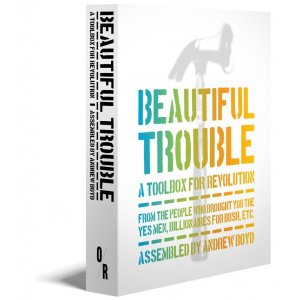
Toolkits like Beautiful Trouble matter because they don’t merely argue for outcomes. They teach a style of conflict that can push a society toward that emergency posture. Not secretly. Openly. Proudly.
The mechanism: reaction as leverage
The core move is simple: the decisive moment is not what you do; it is how the target reacts. Beautiful Trouble states this as principle. Create a situation where the target has only bad options. If the target responds forcefully, you get optics of oppression. If the target hesitates, you get optics of weakness or complicity. Either way, you harvest narrative.
This is not foreign to the Alinsky lineage. The organizing sensibility there is similarly pressure-driven: personalize, polarize, keep heat on, force choices. Whether you call that “empowering the powerless” or “cynical theatre” depends on your politics. But the effect is measurable. It rewards escalation.
In an attention economy, that reward multiplies. The clip travels. The caption hardens. The audience concludes. Process arrives too late to matter.
Why this is corrosive to liberal life
Classical liberalism is not blind to power. It assumes power exists and will be abused. That’s why it builds constraints: rule of law, rights, neutral adjudication, stable procedures, and a civic ethic that treats opponents as citizens.
Revolutionary politics often treats those constraints as camouflage for domination. Once you accept that premise, liberal restraint stops being virtue and becomes collaboration. Due process becomes “violence.” Neutrality becomes “support for the status quo.” Compromise becomes betrayal.
That frame is solvent. It dissolves the very institutions that make peaceful reform possible. Courts become illegitimate. Journalism becomes propaganda. Elections become theatre. At that point, direct action isn’t one tool among many. It becomes the only “authentic” politics. And authenticity is a poor substitute for governance.
Three tactics that act like acid
1) Identity tricks that blur truth and theatre
Impersonation formats, spoof announcements, and “identity correction” are often defended as satire. Sometimes they are. But they also train a destructive habit: truth is what produces the right reaction.
In a low-trust society, that habit is gasoline. It makes people easier to steer. They learn to treat moral satisfaction as verification.
2) Reaction capture that rewards escalation
Media-jacking and engineered dilemmas push institutions into visible confrontation. Institutions then over-respond to avoid losing control. Activists then present the response as the point. The public is invited to judge the system from the most inflammatory ten seconds.
This is why incremental reform struggles. Incrementalism is procedural. It is slow. It is boring. It does not produce good clips. When politics is mediated by clips, boredom becomes political death. And the responsible becomes invisible.
3) Framing that turns disagreement into moral emergency
The most dangerous tool is not a hoax. It is framing that converts disagreement into existential crisis. Once politics is narrated as emergency, restraint becomes treason. Any compromise becomes proof of corruption. The only acceptable posture becomes maximal conflict.
That is how a society stops being governable. Not because people disagree, but because they can no longer share a procedure for disagreement.
The case for incremental progress
Incrementalism is mocked as cowardice. It is not. It is the political expression of two hard truths.
First, institutions are complex. Sudden shocks break things you cannot rebuild at will. Second, moral certainty is a poor engineer. It is good at burning. It is bad at designing.
Classical liberal reform says: specify the harm, propose bounded remedies, build coalitions, accept partial wins, and keep the legitimacy of procedure intact. That is not complacency. It is the recognition that power vacuums don’t stay empty, and that revolutions rarely end with stable liberty.
If you care about justice, you should fear the emergency habit. Emergency is where rights go to die. Emergency is where “temporary” powers become permanent. Emergency is where the loudest faction learns it can rule by accusation.
A prediction worth taking seriously
As these tactics normalize, politics will become less about persuasion and more about provocation. Institutions will either harden into managerial coercion or retreat into paralysis. Both outcomes invite more radicalism, because both outcomes confirm the radical story.
A liberal society that wants to survive has to stop rewarding engineered crisis. That means demanding evidence over captions, procedure over theatre, and reform over revolution, even when reform is unsatisfying. Especially then.
References
-
Beautiful Trouble toolbox and principle page (reaction as leverage).
Beautiful Trouble tactic pages: Identity correction; Media-jacking.
OR Books listing / bibliographic info for Beautiful Trouble editions.
Secondary summaries of Rules for Radicals (Alinsky overview used for comparison of tactical sensibility).
I. Certitude as a Cross-Ideological Poison
In the modern culture war, the most dangerous weapon isn’t censorship or cancellation—it is certainty. Certainty that your worldview is the only legitimate one. Certainty that dissent equals harm. Certainty that debate is violence. This mindset—what I’ve previously called sociognostic certainty—is most visible in the ideological left, but it is increasingly mirrored on the right.
The woke movement often silences critics not through reasoned rebuttal, but through moral accusation: you’re not just wrong—you’re a racist, bigot, or transphobe. But as anti-woke voices grow louder, many fall into the same trap: purity tests, denunciations, and rhetorical gatekeeping in reverse. The danger isn’t just that woke ideology dominates—it’s that we become it while resisting.
We’ve seen this before. The New Atheist movement began as a defense of rationality and open inquiry. But its leading voices soon traded in dialogue for dogma, responding to disagreement with sneers and smug certitude. It became a mirror image of the religious authoritarianism it once critiqued.
So how do we fight the woke juggernaut without turning into zealots ourselves? The answer lies in rediscovering the epistemic foundations of liberal democracy: open-ended inquiry, equal participation, and structured disagreement. These norms are what thinkers like Jonathan Rauch, Karl Popper, John Stuart Mill, Jonathan Haidt, and James Lindsay have defended—often against powerful ideological tides.
II. Liberal Science and the Culture of Disagreement
In Kindly Inquisitors, Jonathan Rauch identifies two rules at the heart of a liberal society’s truth-seeking tradition:
- No one gets the final say.
“Every idea is open to challenge, no matter how sacred or widely accepted.”
- No one gets to say who may speak.
“Everyone has the right to participate in the conversation. There are no gatekeepers of legitimacy.”
Rauch calls this “liberal science”—a decentralized process that evolves through open critique and trial-and-error. “The liberal regime is the only one ever devised that systematically seeks out and corrects its own errors,” he writes. It is a system designed for humility.
This insight builds on Karl Popper’s concept of falsification: that scientific progress happens not by proving ideas right, but by exposing them to the possibility of being wrong. Popper warned that ideologies insulated from criticism drift toward totalitarianism. Liberal societies flourish not by avoiding mistakes, but by remaining willing to correct them.
III. Why These Norms Are Being Abandoned
Woke ideology, rooted in the practice of consciousness-raising, assumes that those who have not been “awakened” are epistemically and morally inferior. This produces what James Lindsay has described as “a knowledge regime based on belief, not inquiry.” It assumes that disagreement is not just misguided, but oppressive.
As Lindsay and Helen Pluckrose write in Cynical Theories, “Woke ideology doesn’t merely assert ideas—it positions itself as the one true way of seeing the world. It replaces knowledge with belief and inquiry with obedience.”
This ideology treats opposition as evidence of guilt. White Fragility teaches that resisting anti-racist training proves one’s racism. Ibram X. Kendi insists neutrality is impossible: “You’re either a racist or an antiracist.” These are not empirical frameworks. They are gnostic in character—immune to criticism and uninterested in falsifiability.
But the anti-woke response is often no better. The populist right, with its own culture-war crusades and purity tests, increasingly mirrors the very forces it claims to fight. Declarations of moral emergency are replacing liberal norms of debate.
In Canada, we’ve seen this from both ends. When the University of British Columbia postponed a speech by philosopher Mark Mercer on academic freedom, critics called it “institutional cowardice,” yet some of those same critics support political interference in other academic expressions. Meanwhile, psychologist Jordan Peterson’s ongoing regulatory battles with the College of Psychologists of Ontario highlight a broader cultural breakdown in tolerating dissent—no matter the direction it flows.
As Jonathan Haidt puts it in The Coddling of the American Mind: “When we teach students that their feelings are always right, and that disagreement equals danger, we do not prepare them for citizenship in a pluralistic society—we prepare them for life in a war zone.”
IV. The Classical Liberal Antidote
To escape the cycle of tribal certainty, we must return to the liberal framework that allows for conflict without coercion.
In On Liberty, John Stuart Mill made a timeless argument: suppressing even false opinions robs humanity of the “collision of ideas” that refines our understanding. “He who knows only his own side of the case,” Mill warned, “knows little of that.”
Rauch extends this into our age of information: “Liberal science does not protect feelings. It protects the process by which we challenge claims and revise beliefs.”
This is not about defending speech merely for its own sake. It is about preserving a culture of mutual correction. That means:
- Tolerating speech we disagree with, not because we approve of it, but because suppressing it corrodes our capacity for self-correction.
- Engaging rather than excommunicating, even when our interlocutors are wrong or offensive.
- Resisting the tribal call to certainty, even when we feel most justified in wielding it.
To do this, we need courage—not the moral grandstanding of cancel culture, but the intellectual humility of listening, debating, and sometimes losing the argument.
V. Conclusion: How to Win Without Destroying What We’re Defending
If we truly want to defeat woke ideology—or any ideology that claims moral and epistemic supremacy—we must do more than oppose it. We must model a better way.
That means rejecting the tools of coercion, purification, and outrage. It means embracing fallibility, tolerating disagreement, and recommitting to open inquiry as a civic virtue.
We won’t always win the argument. But we can keep the argument alive. That is the foundation of liberal society—not that it always gets things right, but that it remains willing to be wrong.
Lose that, and we don’t just lose to the woke. We lose the very civilization we’re trying to save.

References
- Rauch, J. (1993). Kindly Inquisitors: The New Attacks on Free Thought. University of Chicago Press.
- Popper, K. (1963). Conjectures and Refutations: The Growth of Scientific Knowledge. Routledge.
- Mill, J.S. (1859). On Liberty. [Various editions].
- Lindsay, J. & Pluckrose, H. (2020). Cynical Theories: How Activist Scholarship Made Everything about Race, Gender, and Identity—and Why This Harms Everybody. Pitchstone Publishing.
- Haidt, J., & Lukianoff, G. (2018). The Coddling of the American Mind. Penguin Books.
- DiAngelo, R. (2018). White Fragility. Beacon Press.
- Kendi, I.X. (2019). How to Be an Antiracist. One World.
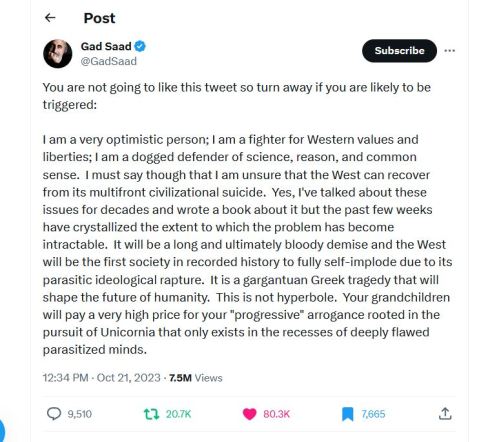
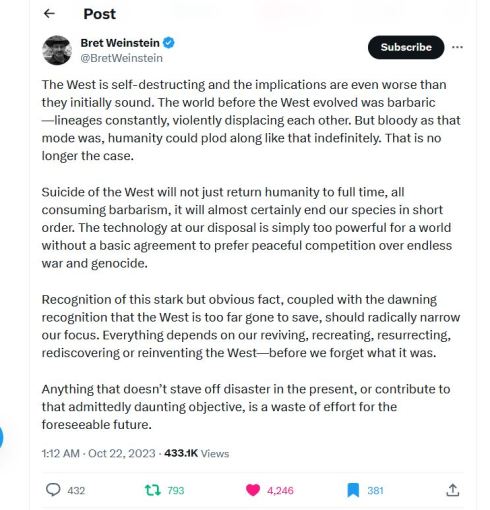
Two views on the current state of the West. Both share a fairly grim tone. We need to as nations of the West turn things around. The classical liberal* principles that our societies were founded on need to be restored and refreshed in their primacy of how we exist as people in society.
There are competing narratives of how we are supposed to advance society, I think if we stray from the path we’re on we going to be in trouble.
*Classical liberalism is a political tradition and a branch of liberalism which advocates free market and laissez-faire economics; and civil liberties under the rule of law, with special emphasis on individual autonomy, limited government, economic freedom, political freedom and freedom of speech











 bleatmop
 Mystro
 The Arbourist


 Dead Wild Roses
Your opinions…