
You are currently browsing the tag archive for the ‘Critical thinking’ tag.
This is a critical thinking exercise. It exists to help people understand why they say and support the things they say and support. It fails utterly for the activist students who take up the camp on the ‘strongly agree’ side.
What is most telling is when Dr. Boghossian asks them what evidence or what information would make them change their mind to move one step toward being neutral on the topic. Neither of the women say their are any arguments or information that would persuade them. And that folks, is the sole domain of the ‘true believer’ and/or ideologue – a blessed state where no fact, no amount of reason or evidence will change your mind.
It is a dangerous position to hold for the individual and society. Do not miss the irony of the true believers calling other ‘bigoted’, it is truly something to behold.
Watch the video, grit your teeth if you have to, but know that much of the activist Left simply do not have arguments they can defend in a conversation. What they do have is social shaming and name calling, and let me assure you, they have that in abundance. Do not give into their coercion, not standing up for yourself reflects poorly on you, not them. Do not let their lies come through you at the very least.
Sometimes a concept is so good one must ruthlessly crib from another source – So here ya be, the notion of Chesterson’s Fence and how important it is to understand the reasons why something was done in the first place.
“Second-order thinking will get you extraordinary results, and so will learning to recognize when other people are using second-order thinking. To understand exactly why this is the case, let’s consider Chesterton’s Fence, described by G. K. Chesterton himself as follows:
There exists in such a case a certain institution or law; let us say, for the sake of simplicity, a fence or gate erected across a road. The more modern type of reformer goes gaily up to it and says, “I don’t see the use of this; let us clear it away.” To which the more intelligent type of reformer will do well to answer: “If you don’t see the use of it, I certainly won’t let you clear it away. Go away and think. Then, when you can come back and tell me that you do see the use of it, I may allow you to destroy it.”
***
Chesterton’s Fence is a heuristic inspired by a quote from the writer and polymath G. K. Chesterton’s 1929 book, The Thing. It’s best known as being one of John F. Kennedy’s favored sayings, as well as a principle Wikipedia encourages its editors to follow. In the book, Chesterton describes the classic case of the reformer who notices something, such as a fence, and fails to see the reason for its existence. However, before they decide to remove it, they must figure out why it exists in the first place. If they do not do this, they are likely to do more harm than good with its removal. In its most concise version, Chesterton’s Fence states the following:
Do not remove a fence until you know why it was put up in the first place.
Chesterton went on to explain why this principle holds true, writing that fences don’t grow out of the ground, nor do people build them in their sleep or during a fit of madness. He explained that fences are built by people who carefully planned them out and “had some reason for thinking [the fence] would be a good thing for somebody.” Until we establish that reason, we have no business taking an ax to it. The reason might not be a good or relevant one; we just need to be aware of what the reason is. Otherwise, we may end up with unintended consequences: second- and third-order effects we don’t want, spreading like ripples on a pond and causing damage for years.”
But the kit, Sagan argues, isn’t merely a tool of science — rather, it contains invaluable tools of healthy skepticism that apply just as elegantly, and just as necessarily, to everyday life. By adopting the kit, we can all shield ourselves against clueless guile and deliberate manipulation. Sagan shares nine of these tools:
- Wherever possible there must be independent confirmation of the “facts.”
- Encourage substantive debate on the evidence by knowledgeable proponents of all points of view.
- Arguments from authority carry little weight — “authorities” have made mistakes in the past. They will do so again in the future. Perhaps a better way to say it is that in science there are no authorities; at most, there are experts.
- Spin more than one hypothesis. If there’s something to be explained, think of all the different ways in which it could be explained. Then think of tests by which you might systematically disprove each of the alternatives. What survives, the hypothesis that resists disproof in this Darwinian selection among “multiple working hypotheses,” has a much better chance of being the right answer than if you had simply run with the first idea that caught your fancy.
- Try not to get overly attached to a hypothesis just because it’s yours. It’s only a way station in the pursuit of knowledge. Ask yourself why you like the idea. Compare it fairly with the alternatives. See if you can find reasons for rejecting it. If you don’t, others will.
- Quantify. If whatever it is you’re explaining has some measure, some numerical quantity attached to it, you’ll be much better able to discriminate among competing hypotheses. What is vague and qualitative is open to many explanations. Of course there are truths to be sought in the many qualitative issues we are obliged to confront, but finding them is more challenging.
- If there’s a chain of argument, every link in the chain must work (including the premise) — not just most of them.
- Occam’s Razor. This convenient rule-of-thumb urges us when faced with two hypotheses that explain the data equally well to choose the simpler.
- Always ask whether the hypothesis can be, at least in principle, falsified. Propositions that are untestable, unfalsifiable are not worth much. Consider the grand idea that our Universe and everything in it is just an elementary particle — an electron, say — in a much bigger Cosmos. But if we can never acquire information from outside our Universe, is not the idea incapable of disproof? You must be able to check assertions out. Inveterate skeptics must be given the chance to follow your reasoning, to duplicate your experiments and see if they get the same result.
The answer for many people, including myself would be: Not Soon Enough!
The usual regrets aside, my descent into critical thinking, strangely enough, started after University as it was only then that I had enough time to really start powering through the books that I had been accumulating while working on my degree. All that stuff that I was ‘responsible’ for learning was still there, but my curiosity led me down the path toward a greater understanding of the mechanics of how our society works. I owe a great deal to Noam Chomsky, Howard Zinn and Ronald Wright for fuelling my intellectual growth and move toward a more nuanced understanding of how history and society works and access to a larger context background that helped(s) make sense of world events as they unfolded.
The difference in taking courses before and after my degree was quite startling as learning because you ‘have to’ versus because you ‘want to’.
The challenge now is to continue the journey and start reading again seriously. With the rise of the siren song of social media and video games maintaining an intellectual focus is quite challenging. Getting back into the reading for comprehension and understanding groove is quite difficult. I’m thinking that hitting the University for some courses may be the tonic to this particular problem.
We’ll have to see what’s in the cards and hope to heck there is something interesting to take this upcoming spring/summer. :)
How does one deal with conspiracy theorists? Quassim Cassam tackles this often thorny adventure in the dealing with the tinfoil hat crew.
On the individual level, I think it comes down to how dedicated the individual is to the pursuit of the relevant evidence and knowledge associated with topic at hand. The fictional character “Oliver” is a 9/11 conspiracy buff and is used as a exemplar of what one can run into online and in real life. Unsurprisingly, the key to combating conspiracy theorists is education, especially one that focuses on Critical thinking and being intellectually rigorous (duh?). So this isn’t the tonic to fixing stupid people saying “go educate yourself” isn’t particularly helpful because it isn’t necessarily the absence of evidence for one position or another, but rather, the ability to evaluate the quality and reputability of the sources being used.
The other solution, at least on social media is the block button, because nobody has enough time in the day to fix all the stupid in the world. :>
“Closed-mindedness is one of the toughest intellectual vices to tackle because it is in its nature to be concealed from those who have it. And even if you somehow get the Olivers of this world to acknowledge their own vices, that won’t necessarily make things any better. Tackling one’s intellectual vices requires more than self-knowledge. You also need to be motivated to do something about them, and actually be able to do something about them.
Should Oliver be condemned for his weaknesses? Philosophers like to think of virtues as having good motives and vices as having bad motives but Oliver’s motives needn’t be bad. He might have exactly the same motivation for knowledge as the intellectually virtuous person, yet be led astray by his gullibility and conspiracy mentality. So, both in respect of his motives and his responsibility for his intellectual vices, Oliver might not be strictly blameworthy. That doesn’t mean that nothing should be done about them or about him. If we care about the truth then we should care about equipping people with the intellectual means to arrive at the truth and avoid falsehood.
Education is the best way of doing that. Intellectual vices are only tendencies to think in certain ways, and tendencies can be countered. Our intellectual vices are balanced by our intellectual virtues, by intellectual character traits such as open-mindedness, curiosity and rigour. The intellectual character is a mixture of intellectual virtues and vices, and the aims of education should include cultivating intellectual virtues and curtailing intellectual vices. The philosopher Jason Baehr talks about ‘educating for intellectual virtues’, and that is in principle the best way to deal with people such as Oliver. A 2010 report to the University College London Council about the Abdulmutallab case came to a similar conclusion. It recommended the ‘development of academic training for students to encourage and equip them not only to think critically but to challenge unacceptable views’. The challenge is to work out how to do that.
What if Oliver is too far gone and can’t change his ways even if he wanted to? Like other bad habits, intellectual bad habits can be too deeply entrenched to change. This means living with their consequences. Trying to reason with people who are obstinately closed-minded, dogmatic or prejudiced is unlikely to be effective. The only remedy in such cases is to try to mitigate the harm their vices do to themselves and to others.
Meanwhile, those who have the gall to deliver homilies about other peoples’ intellectual vices – that includes me – need to accept that they too are likely very far from perfect. In this context, as in most others, a little bit of humility goes a long way. It’s one thing not to cave in to Oliver’s attempt to turn the tables on you, but he has a point at least to this extent: none of us can deny that intellectual vices of one sort or another are at play in at least some of our thinking. Being alive to this possibility is the mark of a healthy mind.”
Consider the Hollywood actor giving the classic “follow your dreams and never give up” line is bad advice and is pure survivorship bias at work. Well what is surviorship bias? Let’s take a look friends and learn. :)
“Survivorship bias, or survival bias, is the logical error of concentrating on the people or things that “survived” some process and inadvertently overlooking those that did not because of their lack of visibility. This can lead to false conclusions in several different ways. The survivors may be actual people, as in a medical study, or could be companies or research subjects or applicants for a job, or anything that must make it past some selection process to be considered further.
Survivorship bias can lead to overly optimistic beliefs because failures are ignored, such as when companies that no longer exist are excluded from analyses of financial performance. It can also lead to the false belief that the successes in a group have some special property, rather than just coincidence (Correlation proves Causation). For example, if three of the five students with the best college grades went to the same high school, that can lead one to believe that the high school must offer an excellent education. This could be true, but the question cannot be answered without looking at the grades of all the other students from that high school, not just the ones who “survived” the top-five selection process.
Survivorship bias is a type of selection bias.”
“During World War II, the statistician Abraham Wald took survivorship bias into his calculations when considering how to minimize bomber losses to enemy fire. Researchers from the Center for Naval Analyses had conducted a study of the damage done to aircraft that had returned from missions, and had recommended that armor be added to the areas that showed the most damage. Wald noted that the study only considered the aircraft that had survived their missions—the bombers that had been shot down were not present for the damage assessment. The holes in the returning aircraft, then, represented areas where a bomber could take damage and still return home safely. Wald proposed that the Navy instead reinforce the areas where the returning aircraft were unscathed, since those were the areas that, if hit, would cause the plane to be lost.[8][9]”
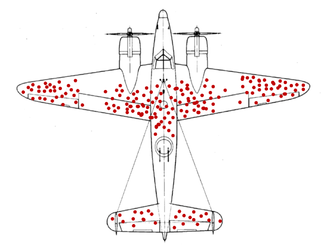
So, they said: the red dots are where bombers are most likely to be hit, so put some more armor on those parts to make the bombers more resilient. That looked like a logical conclusion, until Abraham Wald – a mathematician – started asking questions:
– how did you obtain that data?
– well, we looked at every bomber returning from a raid, marked the damages on the airframe on a sheet and collected the sheets from all allied air bases over months. What you see is the result of hundreds of those sheets.
– and your conclusion?
– well, the red dots are where the bombers were hit. So let’s enforce those parts because they are most exposed to enemy fire.
– no. the red dots are where a bomber can take a hit and return. The bombers that took a hit to the ailerons, the engines or the cockpit never made it home. That’s why they are absent in your data. The blank spots are exactly where you have to enforce the airframe, so those bombers can return.This is survivorship bias. You only see a subset of the outcomes. The ones that made it far enough to be visible. Look out for absence of data. Sometimes they tell a story of their own.
BTW: You can see the result of this research today. This is the exact reason the A-10 has the pilot sitting in a titanium armor bathtub and has it’s engines placed high and shielded.
If you want to think scientifically, ALWAYS ask what data was included in a conclusion. And ALWAYS ask what data was EXCLUDED when making a conclusion.
How many people are well-read enough to see what is happening? The assault on journalism and journalistic values in the name of bloody acquiescence to power grinds onward. A excerpt from Robert Fisk’s article “We Do Not Live in a “Post Truth” World, We Live in a World of Lies and We Always Have.”
“Today, you can not only deny history – the Armenian and Jewish Holocausts, Anne Frank’s diary, the gas chambers of Auschwitz – you can also tell fibs, big or small, about almost anything which annoys you. The Middle East, with our journalistic help, is deep in the same false world. Every dictator is now fighting “terrorism” – along with the US, Nato, the EU, Russia, Hezbollah, Iran, the entire Arab Gulf (minus Yemen, for rather embarrassing reasons), China, Japan, Australia and – who knows? – Greenland as well.
But justice is not on the menu. This is a word which few politicians, statesmen, even journalists, any longer use. Neither Trump nor Clinton, nor the Brexiteers, have talked about justice. I’m not talking about justice for victims of “terror”, or Brits who think they’ve been cheated by the EU, but real justice for entire nations, for peoples, for the Middle East, even – dare I mention them? – for Palestinians. They do not live in a “post-truth” world. They’ve been living among other people’s lies for decades.
The only effect of last year’s political earthquakes is that we shall feel less guilty in repeating all these lies. They have now – like war – become normal, a “diversity of perspectives”, part of a familiar, fraudulent world in which untruthfulness has acquired a “weird authenticity”.
Trump is Hitler. Trump is Jesus. National suicide is reincarnation. We may not yet have understood this. But there are many in the Middle East who will understand us. Maybe they’ll have the last laugh.”
Check your sources, use some of your time to evaluate the merit of an argument being made in the media, as a citizen it is your duty to inform yourself to the best of your ability as to how the world works and how to change it toward the better.











 bleatmop
 Mystro
 The Arbourist


 Dead Wild Roses
Your opinions…