
You are currently browsing the tag archive for the ‘Cultural Marxism’ tag.
Antonio Gramsci (1891–1937) was an Italian Marxist philosopher and revolutionary who reimagined the battlefield of socialism. Where Marx envisioned revolution through economic crisis and class struggle, Gramsci located the real battleground in culture—in the stories, moral codes, and institutions that shape how people perceive reality. His insight reshaped leftist strategy throughout the 20th century and remains the foundation of what has come to be known, often critically, as Cultural Marxism.
Gramsci’s imprisonment by Mussolini between 1926 and 1937 produced the Prison Notebooks, a collection of reflections on history, education, religion, and power that would change Marxism forever. Rather than calling for immediate insurrection, Gramsci argued that Western societies were held together not merely by force, but by consent—the consent of people whose minds had been molded by dominant cultural institutions. To overthrow capitalism, the revolution would first have to capture culture.
The Concept of Cultural Hegemony
Gramsci coined the term “cultural hegemony” to describe the way ruling classes maintain control by shaping what society considers “common sense.” Schools, churches, media, literature, and even family life all help reproduce the values that support the existing order. To Gramsci, the working class could never achieve political power until it produced a counter-hegemony—a rival moral and intellectual framework capable of displacing the dominant bourgeois worldview.
This insight was transformative. It shifted Marxist focus from economic structures to cultural superstructures—from factories to universities, from political parties to publishing houses. The revolution would be waged not only with rifles and manifestos, but with textbooks, art, and language itself.
The Five Pillars of Western Hegemony
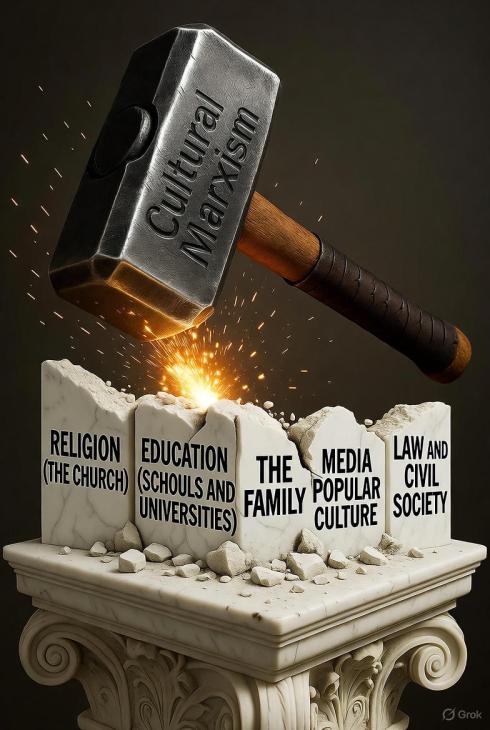
Gramsci identified several key arenas where cultural hegemony is maintained and where revolutionary transformation must occur. Though he never formally listed “five areas,” his writings consistently emphasize these interlocking domains as the loci of bourgeois cultural power:
- Religion (The Church) – The Church was, for Gramsci, the moral anchor of Western civilization. Its authority shaped notions of duty, sin, and redemption. For a new socialist order to take root, Marxists would need to displace religious authority with secular, materialist moral systems.
- Education (Schools and Universities) – Schools reproduce social hierarchies by transmitting the ideology of the ruling class. Gramsci saw education as the most potent tool for cultivating a new “collective will.” Intellectuals, teachers, and professors were to become “organic intellectuals” of the working class—agents of counter-hegemony.
- The Family – As the smallest unit of moral and cultural reproduction, the family passes on norms of obedience, gender roles, and private property. Gramsci argued that socialist transformation required reconfiguring family life to reflect collective rather than patriarchal or bourgeois values.
- Media and Popular Culture – Newspapers, radio, and entertainment function as instruments of social consent. Control over communication channels would allow the revolutionary movement to redefine reality itself—to make socialist ideas seem natural and just.
- Law and Civil Society – Beyond the coercive power of the state lies civil society: courts, voluntary associations, clubs, and unions. These mediate between individuals and the state, embedding ruling-class ideology in everyday life. The Left’s long march through these institutions, later theorized by figures like Rudi Dutschke, stems directly from Gramsci’s idea of building a counter-hegemonic presence within civil society.
From Class War to Culture War
Gramsci’s influence has proven far greater than his lifetime achievements would suggest. His Prison Notebooks became a cornerstone for postwar Marxist thinkers of the Frankfurt School—Herbert Marcuse, Theodor Adorno, and others—who expanded his ideas into critical theory. Together, they seeded what would evolve into the New Left, identity-based activism, and much of today’s academic “social justice” thought.
While critics argue that Gramsci’s ideas have fostered divisive cultural politics, even they concede his enduring genius: he saw that culture precedes politics. Whoever controls a society’s moral vocabulary ultimately controls its laws, institutions, and collective imagination.
Why Gramsci Matters Today
Understanding Gramsci is essential to understanding the modern cultural landscape. His legacy explains why ideological movements increasingly contest meanings—of gender, race, language, and history—rather than material production. The “long march through the institutions” that Gramsci inspired is visible across Western education, media, and bureaucracies.
Whether one views this as intellectual renewal or cultural subversion, Gramsci’s insight endures: power begins in the mind before it manifests in law.
References
- Gramsci, Antonio. Selections from the Prison Notebooks. Edited by Quintin Hoare and Geoffrey Nowell Smith. New York: International Publishers, 1971.
- Buttigieg, Joseph A. Antonio Gramsci: Prison Notebooks, Vols. I–III. Columbia University Press, 1992–2007.
- Crehan, Kate. Gramsci, Culture and Anthropology. University of California Press, 2002.
- Dutschke, Rudi. “The Long March Through the Institutions.” (Speech, 1967).
- Jay, Martin. The Dialectical Imagination: A History of the Frankfurt School and the Institute of Social Research, 1923–1950. University of California Press, 1973.
James Lindsay’s *New Discourses* podcast (July 9, 2020) contends that Marxist-inspired critical theories—queer theory, critical race theory (CRT), and postcolonial theory—undermine childhood innocence to destabilize Western society. According to this view, “innocence” is not a universal good but a social construct, one that maintains oppressive structures such as heteronormativity and white privilege. In this framing, schools become the frontline where innocence is dismantled, often through social-emotional learning (SEL) and comprehensive sex education, exposing children to adult categories of sexuality and race earlier than previous generations.
This essay acknowledges the conspiratorial risks of Lindsay’s framing but nonetheless argues that there is a coherent intellectual genealogy behind today’s educational shifts. By situating them in the work of Lukács, Marcuse, Gramsci, and Freire, and by engaging primary texts and empirical evidence, the essay concludes that premature sexualization and racialization of children carry measurable psychological risks and are best understood as destabilizing strategies with ideological consequences.
—
Queer Theory: Liberation or Destabilization?
Judith Butler’s *Gender Trouble* (1990) famously argued that identity is performative, “a stylized repetition of acts” rather than a fixed essence.[^1] For advocates, this opens liberatory possibilities, freeing individuals from restrictive norms. Eve Sedgwick similarly contended that destabilizing binaries allows marginalized groups to resist cultural oppression.[^2] In practice, queer pedagogy has translated into inclusive curricula—GLSEN (2022) reports that 43% of LGBTQ students feel safer in schools with gender-affirming materials.[^3]
Yet destabilization comes at a cost. Lindsay connects Butler’s performativity with Herbert Marcuse’s *Eros and Civilization* (1955), where liberation from sexual repression is imagined as a step toward a “non-repressive reality principle.”[^4] Marcuse’s focus was on adult emancipation, but his call for “mature individuals” leaves ambiguity when applied to educational contexts. Graphic materials such as *Gender Queer* (Fairfax County, 2021) in school libraries illustrate how theory, once filtered through activist pedagogy, risks exposing children to sexual content beyond developmental readiness.
Empirical concerns are not negligible: the American Psychological Association (2004) found that early sexualization is associated with depression and anxiety.[^5] While proponents highlight empowerment and reduced bullying, Lindsay’s point stands: identity destabilization in children risks long-term psychological harm.
Sexualization in Schools: Protection or Premature Exposure?
Comprehensive sex education is promoted as a health intervention. The Guttmacher Institute (2022) notes it is implemented in 39% of U.S. states, with studies showing reductions in risky sexual behaviors and teen pregnancy.[^6] Organizations like SIECUS (2021) argue that early, inclusive curricula protect sexual minorities by giving them language and resources.
The counterpoint, however, is about **age-appropriateness**. Some curricula, such as exercises in North Carolina’s 7th-grade program requiring public discussion of bodily changes,[^7] cross into territory that can be experienced as intrusive or shaming. Materials with explicit depictions of sex, regardless of intent, blur the line between protection and premature exposure.
Here Lindsay’s thesis holds: while not designed as “grooming,” the net effect can mimic destabilization. Children’s innocence functions as a developmental safeguard, and undermining it—however well-meaning—risks exploitation rather than empowerment.
Critical Race Theory: Equity or Burden?
Critical Race Theory reframes “racial innocence” as an illusion, a shield for systemic racism. Charles Mills’s *The Racial Contract* (1997) argues that white society maintains domination through unacknowledged compacts.[^8] In educational practice, this has meant materials like Ibram X. Kendi’s *Antiracist Baby* (2022), which encourage young children to see themselves in racial categories early. Advocates such as the American Educational Research Association (2021) claim this reduces bias, and SEL programs aligned with CRT have been adopted in roughly 35% of schools.[^9]
But here too, risks surface. Children may experience racial labeling as destabilizing, especially when framed in terms of guilt or privilege. The National Institute of Mental Health (2022) reports a 25% rise in youth anxiety,[^10] though causation is complex. Lindsay interprets this trend as evidence that CRT primes children for grievance and division. Whether or not one accepts that conclusion, the risk of prematurely burdening children with adult racial narratives deserves scrutiny.
Lukács and the Frankfurt School: The Intellectual Roots
George Lukács’s *History and Class Consciousness* (1923) criticized Christian morality as an impediment to revolution. In the short-lived 1919 Hungarian Soviet Republic, he promoted radical educational reforms, including sexual education programs, which opponents claimed encouraged promiscuity.[^11] While some historians downplay this episode as exaggerated,[^12] it remains clear that Lukács saw morality and family life as barriers to revolutionary consciousness.
The Frankfurt School developed this trajectory further. Marcuse in particular fused Freud with Marx, arguing that capitalism relies on sublimated sexuality.[^13] Though intended for adults, modern applications—whether in SEL or in the normalization of explicit material in schools—echo Marcuse’s suspicion of repression, sometimes at children’s expense.
Gramsci, Freire, and Pedagogical Inversion
Antonio Gramsci’s *Prison Notebooks* (1971) emphasized that family and education sustain cultural hegemony.[^14] Paulo Freire’s *Pedagogy of the Oppressed* (1968) reframed education as a site of liberation, recasting students as oppressed subjects.[^15] These ideas empower marginalized voices, as bell hooks celebrated in *Teaching to Transgress* (1994).[^16]
But Lindsay notes a darker possibility: that reorienting children as political subjects destabilizes family authority and primes youth for activism before they are developmentally prepared. Historical parallels, such as Mao’s Red Guards, show how youth mobilization can lead to intergenerational rupture and social turmoil.[^17]
The Family Under Pressure
Modern legislation such as California’s FAIR Education Act (2019), mandating LGBTQ-inclusive curricula, is framed as inclusive and affirming. Surveys support benefits: GLSEN (2022) found reduced bullying in such schools.[^3] Yet CDC (2023) data also show a steep rise in youth mental health crises—up 30% in a decade—raising questions about unintended consequences.[^18]
Gramsci’s prediction that family would be a central site of ideological struggle seems borne out. When curricula bypass or override parental values, trust between parent and child can erode, leaving children caught between competing moral frameworks.
Addressing Conspiratorial Risks
It is important not to collapse every educational reform into a single Marxist “plot.” CRT, sex education, and SEL are diverse movements with many non-Marxist motivations. Critics such as Angela Harris note that CRT is primarily a legal framework for examining structural racism, not a revolutionary program.[^19] Similarly, sex education advocates highlight empirical successes in health outcomes.
The stronger critique, therefore, is not that Marxists control education, but that Marxist categories—sexual liberation, identity destabilization, cultural hegemony—have been influential in shaping educational trends. Once filtered through activist practice, these categories can be misapplied to children with destabilizing effects.
Conclusion: Safeguarding Development
From Lukács’s early experiments to Marcuse’s liberationist theory and Freire’s pedagogical inversion, critical theory has consistently targeted family, morality, and cultural transmission as barriers to social change. Applied to adults, these ideas invite debate. Applied to children, they risk harm.
The evidence suggests that early exposure to explicit sexual material and premature racial labeling correlate with increased anxiety and depression in youth.[^5][^18] Protecting childhood innocence is not a reactionary fantasy but a developmental necessity.
Parents, educators, and policymakers should insist on transparency in curricula, ensure age-appropriate content, and preserve the family’s role as the primary context for moral and cultural formation. Resistance is less about conspiracy-hunting than about reaffirming a principle as old as education itself: children deserve protection while they grow.

References
[^1]: Butler, J. (1990). *Gender Trouble: Feminism and the Subversion of Identity*. Routledge.
[^2]: Sedgwick, E. K. (1990). *Epistemology of the Closet*. University of California Press.
[^3]: GLSEN. (2022). *National School Climate Survey*. [https://www.glsen.org/research](https://www.glsen.org/research)
[^4]: Marcuse, H. (1955). *Eros and Civilization*. Beacon Press.
[^5]: American Psychological Association. (2004). *Report of the APA Task Force on the Sexualization of Girls*. [https://www.apa.org/pi/women/programs/girls/report](https://www.apa.org/pi/women/programs/girls/report)
[^6]: Guttmacher Institute. (2022). *Sex and HIV Education*. [https://www.guttmacher.org/state-policy/explore/sex-and-hiv-education](https://www.guttmacher.org/state-policy/explore/sex-and-hiv-education)
[^7]: Wake County Public Schools. (2021). *Healthful Living Curriculum*.
[^8]: Mills, C. (1997). *The Racial Contract*. Cornell University Press.
[^9]: National Center for Education Statistics. (2021). *School Survey on Social and Emotional Learning*.
[^10]: National Institute of Mental Health. (2022). *Youth Mental Health Data*. [https://www.nimh.nih.gov](https://www.nimh.nih.gov)
[^11]: Tormay, C. (1920). *An Outlaw’s Diary: The Hungarian Revolution*. London: Allen & Unwin.
[^12]: Anderson, K. (2010). *Marx at the Margins: On Nationalism, Ethnicity, and Non-Western Societies*. University of Chicago Press.
[^13]: Marcuse, H. (1955). *Eros and Civilization*, p. 87.
[^14]: Gramsci, A. (1971). *Selections from the Prison Notebooks*. International Publishers.
[^15]: Freire, P. (1968). *Pedagogy of the Oppressed*. Continuum.
[^16]: hooks, b. (1994). *Teaching to Transgress: Education as the Practice of Freedom*. Routledge.
[^17]: Dikötter, F. (2016). *The Cultural Revolution: A People’s History, 1962–1976*. Bloomsbury.
[^18]: Centers for Disease Control and Prevention. (2023). *Youth Risk Behavior Survey*. [https://www.cdc.gov/healthyyouth/data/yrbs](https://www.cdc.gov/healthyyouth/data/yrbs)
[^19]: Harris, A. (2001). *Critical Race Theory*. International Encyclopedia of the Social & Behavioral Sciences.
James Lindsay writes about how to recognize the prevalent patterns of Neo-Marxist thought and how to they promulgate in society:
“Take race, for example. If one assumes, as did Cheryl I. Harris in 1993, that “whiteness” defines a special form of property that certain people (“whites”) can treat as exclusive, a complete Marxist theory of race can drop out of the political economy machine. They call it “Critical Race Theory,” and, for reasons that are about to be perfectly clear, I call it “Race Marxism.” Here’s how it works, comparing against classical Marxism with a forward slash between the concepts.
Some people (whites/capitalists) unjustly declare themselves the exclusive possessors of a special form of private property (whiteness/capital), thereby divide society into those who have it and those who don’t, and begin to arrange society such that the power granted through that access increases for those people over time. Those excluded from the resource and thus power by this declaration (people of color/workers) are thereby exploited for their productive capacity that is then turned into surplus value (cultural property/profit) for the advantaged class. Not only are the exploited thereby robbed of what they produce (cultural property/labor value), but they are estranged from who they really are (valid representatives of a culture/producers). More specifically, the product of their work (cultural production/labor) is subsumed into the privileged class (becomes part of white culture/is turned into profit), leaving the exploited (people of color/worker) impoverished (culturally/materially) and unable to recognize himself for who he really is (say, authentically Black/a producer). All this is enabled by the privileged class structuring society at its most fundamental levels for their own benefit (structural or systemic racism/structural classism), justified by the privileged class promulgating an ideology that it’s how things are supposed to be (white supremacy/capitalism and meritocracy). People in this dynamic system can be awakened to the structural “realities” of their lives and become (race/class) conscious activists (antiracists/proletarians) who work to seize the means of production (cultural/material) of their society to make it more fair (equitable/socialist). Eventually, this will be generally understood as the right way to order a society and will, through their praxis inverting into the inversion of praxis and thus socially conditioning people to accept it, become spontaneously fair (socially just/communist).
This extends to other forms of property, construed more abstractly as not just material as in capital and land, but also as social, cultural, and even human capital. This allows for the instantaneous creation of the entire constellation of “Identity Marxist” theories of identity politics with virtually no work (which makes it funny how much work it has taken these people to devise this stuff). Again, technically none of these is a theory (they’re all anthroposophies and/or theosophies). Here’s a quick summary:
Marxism: The bourgeoisie claims access to a special form of property called capital. They create an ideology called capitalism (based on things like meritocracy) to justify this. This allows them to structure society with structural classism that advantages the bourgoisie and exploits, estranges, and disenfranchises the working class. People can be made aware of the Marxist theory of societal production and become class-conscious proletarians or a bourgeois vanguard operating in solidarity on their behalf. If they seize the means of production of society and Man, they will usher in socialism that will eventually ripen into Communism through the inversion of praxis.
Critical Race Theory: The whites (and their adjacents) claims access to a special form of property called whiteness. They create an ideology called white supremacy (based on things like meritocracy and racism) to justify this. This allows them to structure society with structural or systemic racism that advantages whites and exploits, estranges, and disenfranchises people of color. People can be made aware of the Critical Race theory of societal production and become race-conscious antiracists and/or “white allies” operating in solidarity on their behalf. If they seize the means of race-cultural production of society and Man, they will usher in racial equity that will eventually ripen into racial justice (a kind of social justice) through the inversion of praxis.
(Marxian) Feminism: Men claim access to a special form of property called maleness or masculinity. They create an ideology called male supremacy or hegemonic masculinity (based on things like meritocracy and sexism) to justify this. This allows them to structure society with patriarchy and structural or systemic sexism, enforced by misogyny, that advantages men and exploits, estranges, and disenfranchises women, as a class. People can be made aware of the (Marxian) feminist theory of societal production and become feminist-conscious feminists and/or “male allies” operating in solidarity on their behalf. If they seize the means of sex-cultural and material production of society and Man, they will usher in gender equity that will eventually ripen into feminist justice (a kind of social justice) through the inversion of praxis.
Queer Theory: Straight people whose “gender identity” and sex match (and those who pass as such) claim access to a special form of property called normalcy (by declaring themselves the normal ones and defining normalcy to mean like themselves). They create an ideology called normativity (e.g., heteronormativity and cisnormativity) to justify this. This allows them to structure society with structural or systemic homophobia and/or transphobia (or, generally, queer-phobia) that advantages the “normal” and exploits, estranges, and disenfranchises “queers” (anyone different, especially gays, lesbians, bisexuals, the gender non-conforming, transgenders, and the mentally ill). People can be made aware of the Queer Theory theory of societal production and become queer-conscious (“proud”) allies operating in solidarity on their behalf. If they seize the means of normative cultural production of society and Man, they will usher in gender, sexual, and sex equity that will eventually ripen into gender, sexual, and sex justice (a kind of social justice) through the inversion of praxis.
Disability Studies: The able-bodied claim access to a special form of property called “ability.” They create an ideology described from the outside as dis/ableism (based on a belief that it is generally better to be fully able-bodied than not, and further based in ideas like “medicalism”) to justify this. This allows them to structure society with structural or systemic dis/ableism that advantages able-bodied and exploits, estranges, disenfranchises, and disables the disabled or “differently abled.” People can be made aware of the Disability Studies theory of societal production and become disability activists conscious allies operating in solidarity on their behalf. If they seize the means of ability-relevant cultural and material production of society and Man, they will usher in ability-based equity that will eventually ripen into ability-based justice (a kind of social justice) through the inversion of praxis.
Fat Studies: The “thin” (those who are not “fat”) claim access to a special form of property called “normal weight” or even “health.” They create an ideology described from the outside as thinnormativity (based on a belief that it is generally better to be at a healthy weight than not, and further based in ideas like “healthism” and “medicalism”) to justify this. This allows them to structure society with structural or systemic fatphobia that advantages “thin” people and exploits, estranges, and disenfranchises the “fat” (they cannot be called “obese” because that “medicalizes” them or “overweight” because that “unjustly” implies a normal or acceptable weight). People can be made aware of the Fat Studies theory of societal production and become fat activists fat-conscious allies (or fat) operating in solidarity on their behalf. If they seize the means of weight/health-relevant cultural and material production of society and Man, they will usher in fat-based equity that will eventually ripen into fat-based justice (a kind of social justice) through the inversion of praxis.
It’s extremely important to understand Marxism on this general level so that what we’re dealing with around us in the world can be properly understood, called out for what it is, and prevented from achieving its ultimately destructive goal of seizing the means of production of anything, especially Man and History. Understanding these “theories” for what they really are not only allows us to call them out accurately and understand why they must be stopped, but it also allows us to be strategic in our fight against them because it enables us to easily predict their next moves and to delegitimize their manipulations as quickly as they arise. Failure to understand them this way means continually being taken off-guard, losing, and being manipulated, or—more accurately and through the inversion of their praxis—being exploited, estranged, and disenfranchised from our own societies.”
James Lindsay purports to find a common thread among the new critical theories that have garnered attention in the United States and to a lesser extent, Canada. For the purposes of the podcast, he summarizes what Marxism is and some of the related terminology (including marxist-feminism 18:50).
Different points of view and different analysis are necessary when evaluating ideologies and systems present in society. Lindsay is a critic of Marxist methodology and it is important to hear his critiques.
“We often hear that Woke Marxism is a new ideology in the world. I’ve even said so. Well, it isn’t. It’s just an old one repackaged in various ways without any essential changes made to it at all. Critical Race Theory is Race Marxism in the same way as what we usually call Marxism is Class Marxism. Radical Feminism is Sex Marxism. Gender ideology and Queer Theory are Sex, Gender, and Sexuality Marxism, or just Gender Marxism or Sexual Marxism to be more concise. Fat studies is Fat Marxism. Disability studies is Ability Marxism. Critical Education Theory (Critical Pedagogy) is Knowledge Marxism in terms of what it means to be formally educated or literate within the existing system. Postmodern postructuralism is Language Marxism. Postcolonial Theory is National Origin Marxism. And on it goes, with all of these cobbled together by intersectionality, which is Identity Marxism.”
Educational.
“You are never going to be paid what you’re worth”

Wow, Cultural Marxism apparently is nightmare fuel to the wingnut, racist right.
Cultural Marxism? As the feminist tag in the wordpress reader becomes more diverse (read filled with dudes and their important ideas) this phrase is popping up all over as of late. I’ve never seen it before, and as a minor logophile my curiosity was peaked. The context of how the term Cultural Marxism (CM) is being used was my first clue that this is yet another sad portmanteau of the right-wingers/dudes to mischaracterize ideas and notions that make them uncomfortable.
It was this putrid nugget of a sentence, fresh from the high mountains of Turdistan, that started my logophilic escapade:
“Leftist ideology (cultural Marxism) ascribes all observed statistical differences in group performance to nefarious cultural forces, therefore nefarious cultural forces must be at work everywhere, therefore you must be oppressed at all times, thus you must dedicate yourself to finding the oppression in every aspect and moment of your life. “
What we can see above exhibit the hallmarks of what will be a reason-free mind-fap-festival of fail; usually with a side of misogyny or racism thrown in just for fun. But, apart from the haphazard generalizations, the erection of grand strawmen and a generally uncharitable starting point, the above sentence is perfectly fine.
So doing some arduous research, a.k.a typing “Cultural Marxism” into Duck Duck Go, the fateful shrouds of mystery were slowly pulled back. Oh the magic of Wikipedia:
“The Frankfurt School (German: Frankfurter Schule) is a school of social theory and philosophy associated in part with the Institute for Social Research at the Goethe University in Frankfurt, Germany. The school initially formed during the interwar period in Germany and consisted of dissidents who were at home neither in the existent capitalist, fascist, nor communist systems that had formed during the interwar period. Meanwhile, many of these theorists believed that traditional theory could not adequately explain the turbulent and unexpected development of capitalist societies in the twentieth century. Critical of both capitalism and Soviet socialism, their writings pointed to the possibility of an alternative path to social development.[1]
Although sometimes only loosely affiliated, Frankfurt School theorists spoke with a common paradigm in mind, thus sharing the same assumptions and being preoccupied with similar questions.[2] To fill in the perceived omissions of traditional Marxism, they sought to draw answers from other schools of thought, hence using the insights of antipositivist sociology, psychoanalysis, existential philosophy, and other disciplines.[3] The school’s main figures sought to learn from and synthesize the works of such varied thinkers as Kant, Hegel, Marx, Freud, Weber and Lukács.[4]
Following Marx, they were concerned with the conditions that allow for social change and the establishment of rational institutions.[5] Their emphasis on the “critical” component of theory was derived significantly from their attempt to overcome the limits of positivism, materialism and determinism by returning to Kant’s critical philosophy and its successors in German idealism, principally Hegel’s philosophy, with its emphasis on dialectic and contradiction as inherent properties of human reality.“
Erm…ya. A lot of word salad that makes academics feel important and the basis of a school of interpretive historical though. In other words, nothing about leftist ideology and ‘oppression seeking’ going on there outside of arcane historical theory relevant mostly to academic historians. The Rational Wiki though has a pithy summation of Cultural Marxism which roughly aligns with my first impressions of the use of the word:
“In current wingnut usage, the term is a favourite of Pat Buchanan and, to the most dangerous extent, Anders Behring Breivik. It is a Cold Warrior’s way of decrying “political correctness” or “multiculturalism.”[2][3] It’s when capitalism and democracy are still the law of the land, but they don’t work exclusively for you anymore.
Despite its widespread popularity among the hard-right, many on the right have thoroughly debunked the concept as not being Marxist at all, including Christian Dominionist Gary North, Michael Acuña from Common Ruin, and How to Paint Your Panda.[4][5][6][7]
It’s become a favorite term of many of the nuttier Gamergaters—demonstrating the movement’s attraction of many anti-Semites, white supremacists, and MRAs — to explain why those bitch slut whores won’t shut up about sexism in video games. They got their collective jockstraps in a knot when discussions on Wikipedia predating their obsession with the term resulted in the “Cultural Marxism” article on Wikipedia being redirected to the “Conspiracy theory” section of Frankfurt School, restored after appealing to the God-King, no consensus after that, then deletion and redirection back to the conspiracy theory.“
Laughing out loud forever – you know when the gamergaters show up sexism and misogyny are never far behind.
Well, fellow word travellers, that’s all there is for this session. I’ve done the long form work here, but all you need to know is in the title of this blogpost. :)











 bleatmop
 Mystro
 The Arbourist


 Dead Wild Roses
Your opinions…