
You are currently browsing the tag archive for the ‘Debate’ tag.
This is a common activist argument. It often arrives pre-loaded with moral certainty, as if the analogy itself settles the question. That should set off your spider-senses immediately: when moral certitude and ideological correctness are doing the work, argumentative rigour usually is not.
The claim is familiar. Left-handedness once looked rare because it was stigmatized and suppressed; stigma eased, reported rates rose. Therefore, the rise in transgender identification among youth should be read the same way.
The analogy is rhetorically useful. It is also weak.
It forces two different kinds of phenomena into one moral script. Left-handedness is a motor preference: early-emerging, directly observable, and generally stable across the life course. Childhood transgender identification is not that. It involves self-interpretation, language, social meaning, and developmental concepts that mature unevenly. Whatever one’s broader politics, these are not the same kind of thing. Treating them as equivalent does not clarify the issue. It pre-loads the conclusion.
The first failure is developmental. Handedness does not require a child to grasp an abstract social category. A child reaches for a spoon, a crayon, a ball. The preference is visible in action. Gender identity claims are different. They depend on how a child understands sex categories, role expectations, persistence over time, and what it means to “be” a boy or girl beyond clothing, imitation, or preference. That is a heavier cognitive task. Piaget and Kohlberg do not settle today’s policy disputes, but they do establish a relevant caution: young children often reason concretely, and stable identity concepts develop in stages. A child can show a hand preference before the child can fully articulate an abstract identity claim in a mature sense.
That difference changes what counts as evidence. Handedness does not need interpretive reinforcement to remain legible. It persists without adults affirming a narrative about the child’s inner state. Childhood gender self-description does not operate that way. It unfolds inside a social field: family language, peer dynamics, institutional scripts, online models, and adult interpretation. Saying that does not make every case shallow or insincere. It does mean the left-handedness analogy smuggles in false simplicity by equating a physical preference with a socially mediated self-concept.
The second failure is pattern. The rise in reported left-handedness is commonly explained, in large part, by declining suppression and changing norms around forcing children to write with the right hand. The increase was broad and gradual. It was not driven by intense peer clustering in narrow demographic bands. Recent increases in transgender identification among youth have shown a different profile, including marked concentration in particular age and sex cohorts in some settings. That pattern is harder to explain by destigmatization alone. At minimum, it supports a mixed account in which social influence, peer effects, and online environments may contribute in some cases. That is not proof of a single-cause “contagion” model for every child. It is enough to show that the left-handedness analogy is doing more moral work than explanatory work.
The third failure is stability. Handedness, once established, is typically stable and does not initiate a pathway of medical intervention. Childhood gender distress is more variable. Longitudinal studies from earlier clinic-referred cohorts often found that many children presenting with gender dysphoria did not continue to identify as transgender in adulthood, especially after puberty. Those findings need careful handling. They come from older cohorts, older diagnostic frameworks, and a literature now heavily contested on definitions and generalizability. Even with those caveats, the central point remains: childhood gender distress has historically shown developmental fluidity in a way handedness does not. That alone should make the analogy suspect.
The practical asymmetry is harder to ignore. If society was wrong to suppress left-handedness, the correction was simple: stop forcing children to switch hands. No endocrine pathway. No fertility implications. No irreversible surgeries. No high-stakes clinical decisions under uncertainty. Pediatric gender care is not identical in stakes or consequences. That does not answer every clinical question. It does mean “this is just like left-handedness” is not an argument. It is a reassurance strategy.
A more honest framing is available. Stigma can affect disclosure and prevalence reporting without making every rise in identification analogous to left-handedness. Some young people experience deep and persistent gender distress. Childhood identity development is also shaped by cognition, peers, institutions, and timing. Those claims can coexist. Compassion does not require category collapse.
The left-handedness comparison survives because it is emotionally efficient. It offers a ready-made progress narrative and casts skeptics as yesterday’s moral failures. Efficient is not the same thing as accurate. If the aim is responsible care for vulnerable young people, the first obligation is conceptual hygiene: use comparisons that illuminate developmental reality, not analogies that flatten it.

References
- Kohlberg, L. (1966). A cognitive-developmental analysis of children’s sex-role concepts and attitudes. In E. E. Maccoby (Ed.), The Development of Sex Differences. Stanford University Press.
- Gilbert, A. N., & Wysocki, C. J. (1992). Hand preference and age in the United States. Neuropsychologia, 30(7), 601–608.
- Steensma, T. D., Biemond, R., de Boer, F., & Cohen-Kettenis, P. T. (2011). Desisting and persisting gender dysphoria after childhood: A qualitative follow-up study. Clinical Child Psychology and Psychiatry, 16(4), 499–516.
- Singh, D., Bradley, S. J., & Zucker, K. J. (2021). A follow-up study of boys with gender identity disorder. Frontiers in Psychiatry, 12, 632784.
- Cass, H. (2024). Independent Review of Gender Identity Services for Children and Young People (Final Report).
I’ve watched conversations snap shut the moment a label lands. “Authoritarian.” “Racist.” “Groomer.” “Commie.” “Fascist.” Sometimes it’s shouted; sometimes it’s delivered with a calm that’s worse. Either way, the label does the same job: it turns dialogue into sorting.
If you care about persuasion—or even just about staying human with people you disagree with—this is the moment that matters. Because once someone is convinced you are morally radioactive, your facts don’t enter the room. And once you decide they’re unreachable, you stop trying to reach them. The relationship becomes a trench. 🕳️
I’m writing about a specific conversational pattern—fast moral labeling that turns disagreement into contamination, and makes inquiry feel like betrayal. This post is about how to keep a relationship intact long enough to examine the certainty behind that label.
It draws heavily on the “impossible conversations” approach: connection first, then a mutual audit of certainty, then one claim we can actually test. Not a conversion campaign. Not a dunk. Not more fuel.
My claim is simple:
If you want a real conversation with someone who reaches for moral labels quickly, start by making a real connection—then invite a shared audit of certainty, not a duel of conclusions.
Lens A: From inside the moral-alarm posture
From the inside, this posture often doesn’t feel like ideology. It feels like moral eyesight. You can see harms other people don’t see—or don’t want to see—and the world keeps asking you to speak softly about it, to “debate,” to “be civil,” to wait your turn while people get hurt.
In that frame, neutrality isn’t neutral. A demand for “open inquiry” can sound like a demand to treat someone’s dignity as a hypothesis. So when I hear a policy proposal, a joke, a statistic, even a question—my mind scans for the pattern: Who gets harmed? Who gets protected? Who gets erased?
That’s why labels arrive quickly. Often, “fascist” isn’t meant as a careful historical claim. It’s shorthand for: this is authoritarian; it threatens vulnerable people; it belongs in the moral quarantine. The label is a gate. It keeps the moral community safe.
And to be fair: sometimes the alarm is justified. There are real authoritarian impulses in politics and institutions. The question isn’t whether harm exists. The question is whether a particular claim about harm is being held in a way that stays connected to evidence—and stays connected to other people.
So what keeps me in the conversation?
- You don’t start by correcting my language. You start by understanding what harm I think I’m preventing.
- You don’t perform neutrality. You show you have values too—especially values I recognize: dignity, fairness, reducing cruelty.
- You lower the temperature by reducing threat: to my identity, my group, my moral standing.
What makes me leave immediately?
- “You’re brainwashed.”
- “You’re evil.”
- “You’re hysterical.”
- Any vibe of: I need you to be stupid for me to be confident.
If you need me to feel small so you can feel right, I’m gone.
Lens B: Where I am now, and what I’m trying to do
I’m wary of ideological capture. I care about fairness and free inquiry, and I’m suspicious of moral language used as a weapon to shut down reasoning. I also know this: you don’t talk someone out of certainty by attacking it head-on. You often strengthen it. Certainty is frequently doing work: protecting identity, status, belonging, safety.
So my aim isn’t “defeat your conclusion.” It’s two-fold:
- Make enough connection that you feel safe staying in the room.
- Shift the conversation from “What do you believe?” to “How sure are you, and why?”
Beliefs can be tribal. But certainty is often a crack where curiosity can enter. 🌱
The approach: connection → certainty → one claim we can actually test
1) Connection before correction
Connection isn’t flattery. It isn’t surrender. It’s reducing the sense that this conversation is a status fight or a moral trial.
Concrete moves:
- Name a shared value.
“I think we both want fewer people harmed.”
“I’m with you on dignity; I’m unsure about the mechanism.” - Name your intent.
“I’m not trying to score points. I want to understand how you’re seeing this.” - Steelman one piece before touching the claim.
“If those outcomes are real, I can see why you’re alarmed.”
None of this concedes the label. It makes it possible to talk about what the label is trying to protect.
2) The certainty questions
Once connection is real—not perfect, just real—you invite a mutual audit. This is where the conversation becomes “impossible” in the good way: you’re not arguing conclusions; you’re exploring how the conclusion is held.
The simplest sequence I know:
- “On a scale from 0–10, how certain are you that [assertion]?”
- “What gets you to that number?”
- “What would move you down one point?”
- “What evidence would you expect to see if you were wrong?”
That last question is the tell. If nothing could change it, you’re not in a disagreement—you’re in a boundary ritual.
Guardrail: this isn’t meant to be an endless epistemology loop. If you’re auditing certainty forever and never testing a claim, you may be stalling—or being stalled.
3) Only then: test one claim together
Most fights fail because we try to litigate an entire worldview. Don’t. Pick one claim. Keep it local. Make it about outcomes and standards, not about moral status.
Rules that help:
- One topic. One example.
- Ask what counts as good evidence for both sides.
- Keep it falsifiable-ish. If it can’t be wrong, don’t wrestle it.
A short dialogue when “fascist” shows up
Here’s the kind of exchange I mean. It’s deliberately plain.
Them: “That’s basically fascist.”
Me: “When you say ‘fascist’ here, do you mean historically fascist, or more like authoritarian and harmful?”
Them: “Authoritarian. It targets marginalized people.”
Me: “Okay. On a 0–10 scale, how certain are you it leads to that harm?”
Them: “A 9.”
Me: “What gets you to 9?”
Them: “The pattern. It always goes this way.”
Me: “If we found out the outcomes didn’t increase harm to that group—say they were neutral or improved—would your certainty drop at all?”
Them: “Maybe.”
Me: “What evidence would you need to see for that ‘maybe’ to feel real?”
Notice what happened. I didn’t accept the label. I didn’t attack it either. I moved from label → claim → certainty → conditions for revision. That’s the move.
And I try to hold myself to the same standard. If I ask what would change your mind, I should be able to answer what would change mine. Symmetry is disarming. ⚖️
The “three doors” rule
When things get hot, offer choices so the other person doesn’t feel trapped:
“Do you want to do one of these?”
- Clarify terms (what do we mean?)
- Check certainty (how sure, and why?)
- Test one claim (what evidence would move us?)
If they refuse all three, I stop—not in anger, but in conservation mode:
“It sounds like we’re not in a place for a real exchange right now. I’m here if you want to try again later.”
When not to use this approach
Connection is not a duty in every context. If the exchange is coercive, humiliating, or unsafe—or if someone demands you accept a moral confession just to keep talking—leave. If concrete harm is immediate, address the harm first. Certainty-audits are not a substitute for accountability.
What success looks like
Success is not conversion. It’s not winning. It’s smaller—and because it’s smaller, it’s more real:
- “I still disagree, but I understand why you think that.”
- “Here’s what might change my mind.”
- “I don’t need to call you evil to keep my beliefs intact.”
If we can’t talk about certainty—ours or theirs—we will keep outsourcing moral judgment to labels. Labels are efficient. They are also corrosive. They turn disagreement into contamination. ☣️
The culture war runs on that corrosion. It doesn’t need more fuel.
If you want to reach someone deep in moral certainty, connection is the price of admission. Once you’re in, don’t aim for the headline. Aim for the one honest question that makes certainty visible—then sit there together long enough for reality to have a chance.

A few clarifications before the comments do what comments do
- “So you’re saying fascism isn’t real?” No. I’m saying labels are often used as conversation-stoppers, and I’m interested in testing the underlying claim together rather than trading moral verdicts.
- “So you’re saying just be nice to bigots?” No. Boundaries still matter. This is about how to talk when you choose to talk, and how to exit cleanly when you shouldn’t.
- “So you’re tone-policing people who are alarmed?” No. I’m describing a pattern where moral alarm hardens into moral certainty—and how to make certainty discussable without contempt.
- “So this is manipulation?” Only if you use it to stall forever. The point is mutual standards and one testable claim—if we can’t do that, the conversation ends.
Suggested reading
- How to Have Impossible Conversations — The core toolkit: rapport, questions, and clean exits.
- The Righteous Mind — Moral intuition first, reasoning second; helps explain threat dynamics.
- **Mistakes Were Made (But Not by Me) — Cognitive dissonance and why doubling down feels like integrity.
- Never Split the Difference — Emotional-safety techniques that pair well with “connection first.”
- How Minds Change — A modern synthesis on belief change and identity.
I. Certitude as a Cross-Ideological Poison
In the modern culture war, the most dangerous weapon isn’t censorship or cancellation—it is certainty. Certainty that your worldview is the only legitimate one. Certainty that dissent equals harm. Certainty that debate is violence. This mindset—what I’ve previously called sociognostic certainty—is most visible in the ideological left, but it is increasingly mirrored on the right.
The woke movement often silences critics not through reasoned rebuttal, but through moral accusation: you’re not just wrong—you’re a racist, bigot, or transphobe. But as anti-woke voices grow louder, many fall into the same trap: purity tests, denunciations, and rhetorical gatekeeping in reverse. The danger isn’t just that woke ideology dominates—it’s that we become it while resisting.
We’ve seen this before. The New Atheist movement began as a defense of rationality and open inquiry. But its leading voices soon traded in dialogue for dogma, responding to disagreement with sneers and smug certitude. It became a mirror image of the religious authoritarianism it once critiqued.
So how do we fight the woke juggernaut without turning into zealots ourselves? The answer lies in rediscovering the epistemic foundations of liberal democracy: open-ended inquiry, equal participation, and structured disagreement. These norms are what thinkers like Jonathan Rauch, Karl Popper, John Stuart Mill, Jonathan Haidt, and James Lindsay have defended—often against powerful ideological tides.
II. Liberal Science and the Culture of Disagreement
In Kindly Inquisitors, Jonathan Rauch identifies two rules at the heart of a liberal society’s truth-seeking tradition:
- No one gets the final say.
“Every idea is open to challenge, no matter how sacred or widely accepted.”
- No one gets to say who may speak.
“Everyone has the right to participate in the conversation. There are no gatekeepers of legitimacy.”
Rauch calls this “liberal science”—a decentralized process that evolves through open critique and trial-and-error. “The liberal regime is the only one ever devised that systematically seeks out and corrects its own errors,” he writes. It is a system designed for humility.
This insight builds on Karl Popper’s concept of falsification: that scientific progress happens not by proving ideas right, but by exposing them to the possibility of being wrong. Popper warned that ideologies insulated from criticism drift toward totalitarianism. Liberal societies flourish not by avoiding mistakes, but by remaining willing to correct them.
III. Why These Norms Are Being Abandoned
Woke ideology, rooted in the practice of consciousness-raising, assumes that those who have not been “awakened” are epistemically and morally inferior. This produces what James Lindsay has described as “a knowledge regime based on belief, not inquiry.” It assumes that disagreement is not just misguided, but oppressive.
As Lindsay and Helen Pluckrose write in Cynical Theories, “Woke ideology doesn’t merely assert ideas—it positions itself as the one true way of seeing the world. It replaces knowledge with belief and inquiry with obedience.”
This ideology treats opposition as evidence of guilt. White Fragility teaches that resisting anti-racist training proves one’s racism. Ibram X. Kendi insists neutrality is impossible: “You’re either a racist or an antiracist.” These are not empirical frameworks. They are gnostic in character—immune to criticism and uninterested in falsifiability.
But the anti-woke response is often no better. The populist right, with its own culture-war crusades and purity tests, increasingly mirrors the very forces it claims to fight. Declarations of moral emergency are replacing liberal norms of debate.
In Canada, we’ve seen this from both ends. When the University of British Columbia postponed a speech by philosopher Mark Mercer on academic freedom, critics called it “institutional cowardice,” yet some of those same critics support political interference in other academic expressions. Meanwhile, psychologist Jordan Peterson’s ongoing regulatory battles with the College of Psychologists of Ontario highlight a broader cultural breakdown in tolerating dissent—no matter the direction it flows.
As Jonathan Haidt puts it in The Coddling of the American Mind: “When we teach students that their feelings are always right, and that disagreement equals danger, we do not prepare them for citizenship in a pluralistic society—we prepare them for life in a war zone.”
IV. The Classical Liberal Antidote
To escape the cycle of tribal certainty, we must return to the liberal framework that allows for conflict without coercion.
In On Liberty, John Stuart Mill made a timeless argument: suppressing even false opinions robs humanity of the “collision of ideas” that refines our understanding. “He who knows only his own side of the case,” Mill warned, “knows little of that.”
Rauch extends this into our age of information: “Liberal science does not protect feelings. It protects the process by which we challenge claims and revise beliefs.”
This is not about defending speech merely for its own sake. It is about preserving a culture of mutual correction. That means:
- Tolerating speech we disagree with, not because we approve of it, but because suppressing it corrodes our capacity for self-correction.
- Engaging rather than excommunicating, even when our interlocutors are wrong or offensive.
- Resisting the tribal call to certainty, even when we feel most justified in wielding it.
To do this, we need courage—not the moral grandstanding of cancel culture, but the intellectual humility of listening, debating, and sometimes losing the argument.
V. Conclusion: How to Win Without Destroying What We’re Defending
If we truly want to defeat woke ideology—or any ideology that claims moral and epistemic supremacy—we must do more than oppose it. We must model a better way.
That means rejecting the tools of coercion, purification, and outrage. It means embracing fallibility, tolerating disagreement, and recommitting to open inquiry as a civic virtue.
We won’t always win the argument. But we can keep the argument alive. That is the foundation of liberal society—not that it always gets things right, but that it remains willing to be wrong.
Lose that, and we don’t just lose to the woke. We lose the very civilization we’re trying to save.

References
- Rauch, J. (1993). Kindly Inquisitors: The New Attacks on Free Thought. University of Chicago Press.
- Popper, K. (1963). Conjectures and Refutations: The Growth of Scientific Knowledge. Routledge.
- Mill, J.S. (1859). On Liberty. [Various editions].
- Lindsay, J. & Pluckrose, H. (2020). Cynical Theories: How Activist Scholarship Made Everything about Race, Gender, and Identity—and Why This Harms Everybody. Pitchstone Publishing.
- Haidt, J., & Lukianoff, G. (2018). The Coddling of the American Mind. Penguin Books.
- DiAngelo, R. (2018). White Fragility. Beacon Press.
- Kendi, I.X. (2019). How to Be an Antiracist. One World.
Critical Social Constructivism (CSC) underpins the ideology known as “woke,” as explained by James Lindsay on his New Discourses website. Lindsay (2025) describes CSC, or Critical Constructivism, as a framework where knowledge and reality are entirely socially constructed, devoid of any objective foundation beyond human perception and agreement. Within woke ideology, this perspective views social concepts like race, gender, and justice as products of narratives and power dynamics rather than universal truths. Woke activism uses this foundation to prioritize marginalized groups’ narratives, aiming to reshape societal truths to align with ideological goals. By rejecting objective reality, CSC enables woke activists to redefine reality based on who controls the dominant discourse.
Woke activists often avoid debate due to CSC’s logic, which Lindsay (2025) argues fosters a totalitarian power dynamic. Since CSC denies an objective reality accessible through reason or evidence, truth depends on social consensus shaped by power rather than rational dialogue. For woke activists, debating risks validating opposing views, which conflicts with their belief that truth emerges from enforcing the “correct” narrative. Instead of engaging in discussion, they employ social coercion through tactics like shaming, cancellation, or institutional pressure to silence dissent and ensure conformity. Lindsay emphasizes that this approach stems from viewing power as the ultimate determinant of accepted truth.
This reliance on coercion reflects a core CSC tenet: whoever holds power to enforce a narrative defines what is “true.” Lindsay (2025) notes that CSC’s rejection of objective reality implies truth is not discovered but created, and those controlling institutions, media, or cultural norms shape reality. In woke ideology, this translates to a relentless push to dominate discourse, equating narrative enforcement with truth establishment. By prioritizing power over reason, woke activists favor control over debate, using social force to validate their constructed realities and ensure their version of truth prevails.

Reference
- Lindsay, J. (2025). The Book of Woke: Introducing Critical Constructivism. Retrieved from https://newdiscourses.com/2025/04/the-book-of-woke-introducing-critical-constructivism
Queer theory has its origins in postmodern thought. The use and misuse of language is a key part of how activists move the ball in arguments and society.
When up against an activist it is advisable to define terms and always name the dynamic present. The responsibility lies with you to inform the low information audience exactly what the activist means when they say things that, ostensibly, sound reasonable.
Twitter people are getting better at dismantling the activist bullshit. Let’s look at this example.
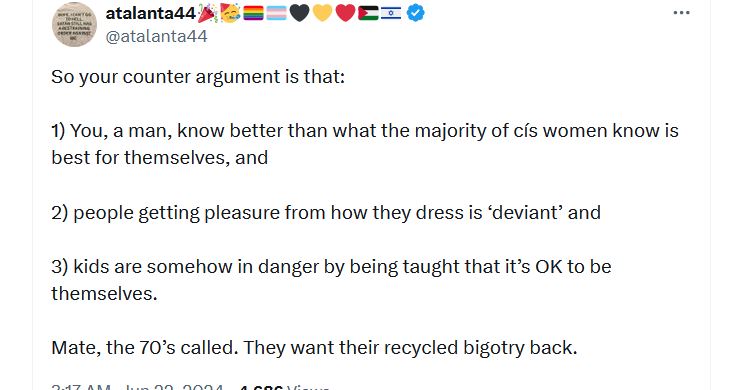
Notice the framing of the activist. Here is the reply though.
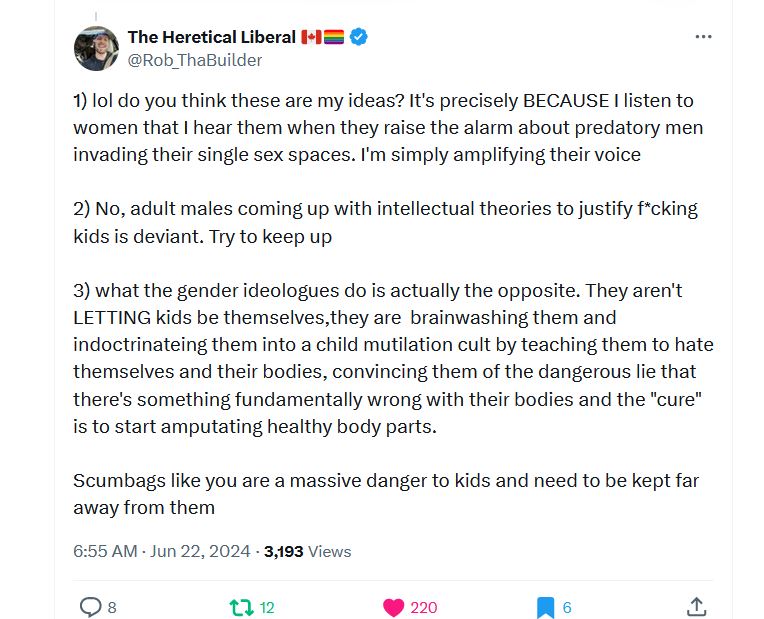
See? It takes so much more time to reveal the false claim – the truth married to a lie – the permeates most activist discourse.
1) Here we have a man who ‘identifies as woman’ saying how could a man possibly know what women want/think. Ironic.
2) Queer Theory is against every norm in society – to be a queer activist is to have a political identity without as essence – there are no positive facts about being queer – it is a stance predicated on critiquing, deconstructing, and destroying the norms and ethics of stable societies. There are no boundary conditions for queer activism.
3) Gender ideology preaches to kids that if they feel uncomfortable in their bodies (part of going through puberty and adolescence) then changing your body to fit stereotypical gender roles and behaviour is the solution. Of course, most children, grow out of any sort notions of dysphoria with their bodies, often becoming normal homosexual adults. The activist is advocating for early hormone and surgical intervention to permanently mutilate a child’s physical body in an attempt to treat a mental condition – the polar opposite of ‘being themselves’.
It is work to refute the activists if they actually engage, but try to keep in mind you must always name the dynamic they are using and spell out exactly what they are arguing for. Once the truth is revealed it is painfully obvious how tenuous the activist positions are.
The second part of my series on conversational gambits and habits that are annoying, funnily enough, happened in the first Gambits post I made. Go check out the comment section as I will be pulling my example for this post directly from the text of a commentor.
“Guilt by association” is also near the top of the list of ‘argumentative styles’ that are prevalent online and also happen to annoy me. Let us begin.

My last post was about how people, in order to avoid arguing, conflate disagreement with hate. Let’s search for the counter argument presented here. Let’s break it down.
- “As to the Alabama, Christian Fundamentalist position you advocate on this blog.”
Analysis: It would be enlightening to know what the Alabama Christian Fundamentalist position is, and really if my arguments mirror theirs, does that make the argument in question wrong?
2. “The research has already spoken (although it will refine over time).”
Analysis: Just saying that “research has spoken” is not in anyway an argument especially if there is no evidence presented to qualify your claim. Hitchens said that a claim presented without evidence can be be dismissed without evidence. That is the case here.
3. “Who knows, maybe sensitive and loving treatments will change, either way.
Analysis: This is the informal fallacy of Begging the Question. With regards to gender affirming care and the mutilation of minors via surgery and cross-sex hormones there are no “sensitive and loving treatments” to be had. Permanent sterilization and the amputation of healthy tissue in no way can be considered “sensitive and loving” and yet that very conclusion was embedded in the statement.
4. “Right now, that’s where the science is.”
Analysis: This is a claim presented without evidence. “The science” currently states that the quality of the evidence for the efficacy of Gender Affirming Care and the procedures involved is poor at best. Several national health services, including Britain, France, Norway, Sweden, and Denmark have all either stopped or slowed GAC because of the lack of evidence. In reality – most children that experience ‘gender dysphoria’ will have their symptoms disappear with the onset of puberty – in the range of 80% to 90% (link to study). Be wary of anyone conclusively stating “what the science says”. The process of doing science is never complete as with new information theories will change to move closer toward the truth.

1. “There are scientists who said smoking doesn’t kill, and those who say climate change is a leftist/Jewish hoax. Your dissenting scientists as well as the right wing deplorables you site to trumpet them, are in that group.”
Analysis: Several processes are going on here, let’s tackle the overarching motif first. The setup is as follows: Group A (scientists in favour of Smoking) that, as history has illustrated, were wrong. In Group B (Other Scientists and right-wing deplorables) are exactly the same as group A. We should not follow group B because of a comparison (that contains a conclusion) has been drawn, in this case without charity or evidence provided.
It doesn’t follow that group B must share the same failings of group A, yet we are to condemn group B because the person who is making the argument says so. It’s quite bizarre.
Also, to address the guild by association angle the legitimate studies and credible scientists that have found and published evidence that does not “fit” with Brian’s world view must be spuriously associated with so called ‘deplorables’ and people who were wrong in the past. Who you are aligned with, or associate with does not affect the quality of the arguments you make. A solid argument from a reprehensible individuals is still a solid argument regardless of social standing.
So, the guilt by association ploy is used in the place of presenting an argument that has a solid factual base. This route of argumentation is rooted in emotional social coercion rather than presenting a counter argument that is based in fact.
Look at this clear example I culled from Twitter. It fits the coercive guilt by association tactic perfectly.

It is a textbook example of how not argue. Stay frosty and cogent folks, and learn to recognize poor argumentation when it comes your way. :)
We need to be able identify thought terminating cliches and deal with them appropriately. We need to encourage not suppress speech in society.











 bleatmop
 Mystro


 Dead Wild Roses
Your opinions…