
You are currently browsing the tag archive for the ‘Diversity’ tag.
“A celebration of diversity that silences certain voices… is not inclusive—it is ideologically selective.”
The Montreal Pride Parade’s decision to exclude Jewish organizations like Ga’ava and the Centre for Israel and Jewish Affairs (CIJA) reveals the brittle nature of contemporary inclusion. Organizers explained that the festival’s board had “made the decision to deny participation in the Pride Parade to organizations spreading hateful discourse”—widely interpreted as targeting groups perceived to hold Zionist views amid the Israeli-Palestinian conflict (National Post). Yet this rationale exposes a contradiction: a celebration of diversity that silences certain voices based on political affiliation is not inclusive—it is ideologically selective. True inclusion doesn’t retreat under pressure or disqualify those with unpopular views; it endures in the face of discomfort. By barring these organizations, Montreal Pride signals that its version of inclusion functions not as a principle, but as a privilege granted only to those aligned with a narrow ideological consensus.
Considering the Organizers’ Perspective
It’s worth acknowledging why the organizers might have made this decision. They could argue that pro-Israel groups might provoke protests or distress among participants, given the polarized nature of the Israeli-Palestinian conflict. However, without specific, credible threats, this rationale appears more like a preemptive strike against ideological discomfort than a genuine safety measure. Pride has weathered controversy before—its history is one of defiance in the face of societal pushback. To retreat now suggests a prioritization of ideological purity over inclusivity.
Safety as a Pretext for Exclusion
Invoking “physical and mental safety” may appear commendable, but applying it to justify excluding Ga’ava—a Montreal-based LGBTQ+ Jewish organization—and CIJA appears unfounded in concrete threats. Ga’ava’s president characterized the exclusion as “based on flimsy, politically motivated reasons decided behind closed doors under pressure from groups that hate Jews, deny Israel’s existence, and whose members celebrated the atrocities of October 7, 2023” (i24NEWS). Who gets to determine what’s safe? In this case, the organizers prioritized avoiding discomfort among critics of Zionist expression over the dignity of those excluded. This risks prioritizing ideological comfort over genuine safety concerns.
According to CIJA’s director of strategic communications, Julien Corona, the decision represents “a dark day for the LGBTQ+ movement here in Quebec but also in all of Canada” (National Post).
The Perils of Moral Absolutism
Montreal Pride’s actions illustrate how moral certainty, when unchecked, can corrupt even the most noble ideals. By conflating the participation of Jewish organizations with “hateful discourse,” organizers implicitly deemed dissenting political views as unacceptable, suggesting their perspective is immune from challenge (i24NEWS). But in reducing disagreement to danger, they betray their own professed values of inclusion and pluralism. What remains is not a broad tent of solidarity, but a gated enclave of ideological approval.
This episode fits into a broader pattern: similar exclusions have occurred in other Pride contexts—Toronto, Chicago, Washington DC—involving Jewish symbols or groups linked to Israel/Palestine debates (Wikipedia). By excluding Ga’ava and CIJA, Montreal Pride reinforces a troubling trend: replacing complexity of identity with a simplistic tribal test.
Moreover, this isn’t the first time a social movement has been fractured by ideological litmus tests. The feminist movement, for example, has seen bitter divisions over issues like sex work and transgender rights, with some factions excluding others based on perceived ideological impurity. Similarly, the civil rights movement grappled with tensions between integrationist and separatist ideologies. In each case, moral certainty led to splintering rather than solidarity. Montreal Pride risks a similar fate if it continues down this path.
A Forward-Looking Conclusion
If Pride movements hope to sustain moral legitimacy and relevance, they must resist equating disagreement with harm. Exclusion based on political affiliation not only wounds the excluded but weakens the movement itself. Pride must recommit to its radical roots—embracing all marginalized voices, even those that spark debate—or risk losing its soul. The true test of inclusion isn’t welcoming those who agree with us; it’s extending that welcome to those who challenge us. Only then can Pride fulfill its promise as a beacon of diversity and defiance.

Works Cited
- Amador, Marisela. “Montreal Pride excludes Jewish LGBTQ+ group, citing ‘hateful discourse’.” CTV News, July 31, 2025. Link
- Corona, Julien. Quoted in “‘A dark day for the LGBTQ movement’: Montreal Pride Parade organizers bar Jewish groups from march.” National Post, August 1, 2025. Link
- “Montreal’s Pride Parade bans 2 Jewish groups.” i24NEWS, July 31, 2025. Link
- “Pride parade.” Wikipedia. Link
Activists use polysemy to make their corrosive ideas sound palatable to people not versed in their conversational inanity. The play is usually a cloak and dagger affair where they use the commonly accepted definition of a particular word, in this case ‘Diversity’ and use it in a dishonest setup that is really about pushing their specialist meanings into society and society’s institutions.
Here is great example.
Diversity (M1): Generally refers to the presence of variety within an organizational workforce, encompassing differences in identity, such as race, gender, sexual orientation, disability, age, culture, class, religion, or opinion. It’s about having a mix of different people.
Diversity(M2): Some critics argue that in “woke” contexts, diversity might be seen more as a means to an end rather than an end in itself, potentially focusing on increasing representation of certain politically aligned marginalized groups. This view suggests that diversity is less about broad inclusion and more about specific group representation.
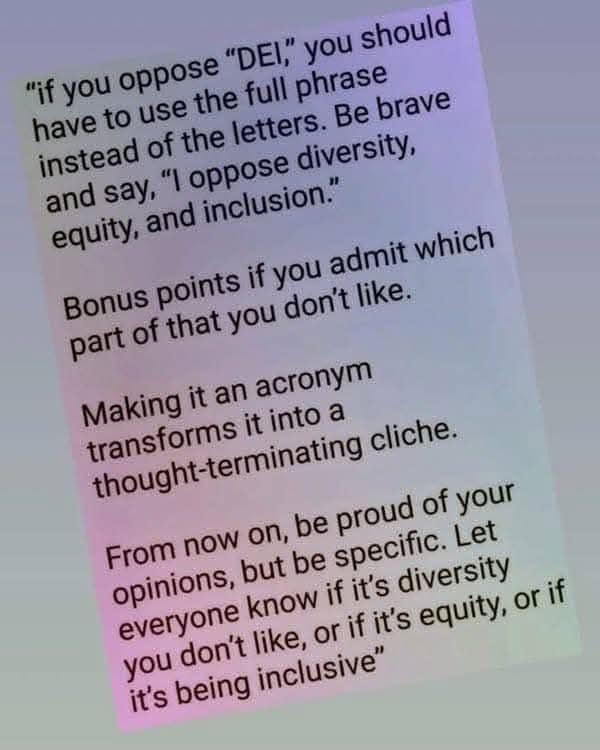
The woke will push M1 and be morally outraged if you speak against Diversty(M1). How could you oppose having a different mix of people involved in a situation/task?
How could one indeed? But the pushback isn’t against Diversity(M1) it is pushback against Diversity(M2) which is infused with identity politics and the oppressor/oppressed narrative. It is the Diversity(M2) narrative that calls for a diversity of group identities with the proviso that they share the same ideological beliefs. This idea is illustrated by the fact that, for example, Black Conservatives are not considered to be a ‘diverse choice’ since they often opposed the oppressor/oppressed narrative.
How deep does the polysemic rabbit hole go? Well…
The term “diversity” in the context of social justice advocacy often exhibits polysemy, where the word has multiple related or unrelated meanings. Here are three examples of how the term “diversity” is used:
Diversity as Representation: Meaning: This refers to the inclusion of different racial, ethnic, gender, and sexual orientation groups within organizations, institutions, or media.
Usage: In this context, “diversity” is often used to describe efforts to ensure that various demographic groups are represented in workplaces, schools, and public life. For example, a company might strive for diversity in its hiring practices to reflect the broader community’s composition.
Diversity as Ideological Uniformity:
Meaning: Some critics argue, as seen in posts on X, that “diversity” in certain circles is used to mean a variety of backgrounds but with a uniform set of political or social views, particularly those aligned with progressive or “woke” ideologies.
Usage: This interpretation suggests that while there might be diversity in appearance or demographic markers, there’s an expectation of conformity in thought, especially in terms of social justice issues. This usage is often highlighted in debates over free speech and ideological diversity.
Diversity as a Tool for Inclusion vs. Exclusion:
Meaning: “Diversity” can sometimes be perceived as inclusive when it pertains to groups historically underrepresented or marginalized, but it can also be seen as exclusive if it’s interpreted as excluding certain groups (like straight white males) from consideration for diversity initiatives.
Usage: This dual interpretation can lead to confusion or contention, where diversity initiatives are praised for broadening perspectives but criticized by others for being exclusionary based on identity rather than merit or broader inclusivity.
These examples show how “diversity” can be a multifaceted term within social justice discourse, with its meaning shaped by context, intent, and perspective. The web results and posts on X suggest that while the term is generally used positively to advocate for broader representation, there’s a significant debate around its implications and actual practice.
Let’s take a look at the three arguments and counter-arguments commonly used to when discussing Diversity policies within the framework of Diversity, Equity, and Inclusion (DEI):
Undermining Merit-Based Systems:
Explanation: Critics argue that diversity policies can lead to a focus on demographic representation over merit, potentially resulting in less qualified individuals being selected for positions. This perspective suggests that prioritizing diversity might mean overlooking the most competent candidates, thereby undermining the meritocratic principles that are supposed to drive organizational success and fairness.
Counterpoint: Proponents of DEI might argue that what’s often labeled as “merit” can be influenced by biases, where traditional metrics of merit do not account for systemic disadvantages some groups face. They propose that diversity initiatives aim to expand the pool of candidates, ensuring that merit is assessed within a broader, more equitable context.
Promoting Division and Resentment:
Explanation: There’s an argument that DEI policies can foster division by emphasizing differences rather than commonalities, leading to resentment among those who feel they are discriminated against or unfairly overlooked due to their demographic characteristics. This can create an “us vs. them” mentality, potentially fracturing team cohesion and morale.
Counterpoint: Supporters might counter that acknowledging and addressing differences is essential for true inclusion, promoting understanding rather than division. They argue that well-implemented DEI strategies educate, unite, and enrich workplace culture by celebrating diversity as a strength rather than a source of division.
Inefficiency and Reduced Performance:
Explanation: Some critics claim that diversity for its own sake can introduce inefficiencies. They suggest that integrating diverse perspectives might initially slow down decision-making processes due to the need for more discussion to reconcile differing viewpoints or cultural misunderstandings. This could be seen as a hindrance in fast-paced environments where quick, decisive action is valued.
Counterpoint: Advocates for diversity would argue that while there might be an initial adjustment period, the long-term benefits include more innovative solutions, better problem-solving, and resilience against groupthink. They cite studies showing that diverse teams can outperform homogeneous ones over time by leveraging a wider range of experiences and ideas.
These arguments are part of a broader, ongoing debate about the implementation and impact of DEI policies. Each point of view has its merits and criticisms, and the effectiveness of diversity policies can depend significantly on how they are executed within specific organizational contexts. The goal should be to critically assess both the challenges and benefits in pursuit of a balanced approach that truly enhances equity and inclusion.
When school boards and school officials refuse to listen, concerned parents take action. Canada is a pluralistic multi-cultural society. It is the duty of our institutions to reflect the diversity that exists in our country. It is not our institutions responsibility to decide which types of ‘diversity’ is acceptable and which are not.
“Last June in a shocking but unreported event at Vimy Ridge, an Ottawa Public School under the OCDSB, more than 70% of K-8 children were mysteriously absent on Pride Celebration Day. There was no media coverage of the event but I’ve since spoken with parents and teachers from the school who shared details. Parents of Muslim children are over the Rainbow.
The School announced that it was holding a Pride celebration day though an e-mail to parents. When Muslim parents pushed back, saying that this was contrary to their religious beliefs they were met with lectures about their own doctrines of tolerance and acceptance from school administrators. Needless to say, this didn’t go well.
One parent I spoke with, who gathered more than 7,500 signatures in just a few days before Change.org throttled petition, said that school officials were informed that tolerance and acceptance did not mean celebrating and affirming and the parents of kids at the school showed their disagreement by sending a message – we will keep our kids home.
An event like this was reported earlier this year in a southern Ontario school where 30% of kids were absent on a rainbow day. This week, the same London, Ontario school, staged a repeat performance. According to my source, this is an issue of concern at the national level for Muslim organizations.
In another case of religious tradition under attack, Josh Alexander of “Save Canada” stood outside a Calgary High-school this week handing out Bibles and was physically accosted by rainbow protestors. Alexander had called for an international student walkout day on the 17th of May, #IDAHOBIT day, through his growing social media network and counter protestors turned up, assaulted him and attempted to burn bibles. Click the image to go to the bird platform to see the unsettling repeated assaults against Josh in the Rebel News Video.
One of the few times that adding beer to the equation will make things better – an analogy between competition and diversity in the forest, and the supermarket.
And no, you may not have a Dude Beer. : )











 bleatmop
 Mystro
 The Arbourist


 Dead Wild Roses
Your opinions…