
You are currently browsing the tag archive for the ‘Economics’ tag.
 A double-quick quiz to see if need to read this article or not – Is the following statement true? – Egalitarian societies are in general are more economically, socially and politically sound than those where inequality more pronounced.
If you answered false go here and evaluate the evidence for yourself. If you answered true, then the following will make sense. :)
“Washington, DC – As evidence mounts that income inequality is increasing in many parts of the world, the problem has received growing attention from academics and policymakers. In the United States, for example, the income share of the top one per cent of the population has more than doubled since the late 1970s, from about eight per cent of annual GDP to more than 20 per cent recently, a level not reached since the 1920s.
While there are ethical and social reasons to worry about inequality, they do not have much to do with macroeconomic policy per se. But such a link was seen in the early part of the twentieth century: Capitalism, some argued, tends to generate chronic weakness in effective demand due to growing concentration of income, leading to a “savings glut”, because the very rich save a lot. This would spur “trade wars”, as countries tried to find more demand abroad.
From the late 1930’s onward, however, this argument faded as the market economies of the West grew rapidly in the post-World War II period and income distributions became more equal. While there was a business cycle, no perceptible tendency toward chronic demand weakness appeared. Short-term interest rates, most macroeconomists would say, could always be set low enough to generate reasonable rates of employment and demand.
Now, however, with inequality on the rise once more, arguments linking income concentration to macroeconomic problems have returned. The University of Chicago’s Raghuram Rajan, a former chief economist at the International Monetary Fund, tells a plausible story in his recent award-winning book Fault Lines about the connection between income inequality and the financial crisis of 2008.”
This is not about “socialism” or “communism” or any of the other words the business press has corrupted. This is about what has happened and what is happening now.
“Rajan argues that huge income concentration at the top in the US led to policies aimed at encouraging unsustainable borrowing by lower – and middle-income groups, through subsidies and loan guarantees in the housing sector and loose monetary policy. There was also an explosion of credit-card debt. These groups protected the growth in consumption to which they had become accustomed by going more deeply into debt. Indirectly, the very rich, some of them outside the US, lent to the other income groups, with the financial sector intermediating in aggressive ways. This unsustainable process came to a crashing halt in 2008.
Joseph Stiglitz in his book Freefall and Robert Reich in his Aftershock have told similar stories, while economists Michael Kumhof and Romain Ranciere have devised a formal mathematical version of the possible link between income concentration and financial crisis. While the underlying models differ, the Keynesian versions emphasise that if the super-rich save a lot, ever-increasing income concentration can be expected to lead to a chronic excess of planned savings over investment.
Macroeconomic policy can try to compensate through deficit spending and very low interest rates. Or an undervalued exchange rate can help to export the lack of domestic demand. But if the share of the highest income groups keeps rising, the problem will remain chronic. And, at some point, when public debt has become too large to allow continued deficit spending, or when interest rates are close to their zero lower bound, the system runs out of solutions.”
So, consider the implications of a monetary policy that encourages people not to hold onto gratuitous wealth. The 90% tax rate on 3 million and above seems a little less unseemly if it can spurn economic growth and development.
“This story has a counterintuitive dimension. Is it not the case that the problem in the US has been too little savings, rather than too much? Doesn’t the country’s persistent current-account deficit reflect excessive consumption, rather than weak effective demand?
The recent work by Rajan, Stiglitz, Kumhof, Ranciere and others explains the apparent paradox: Those at the very top financed the demand of everyone else, which enabled both high employment levels and large current-account deficits. When the crash came in 2008, massive fiscal and monetary expansion prevented US consumption from collapsing. But did it cure the underlying problem?
Although the dynamics leading to increased income concentration have not changed, it is no longer easy to borrow and in that sense another boom-and-bust cycle is unlikely. But that raises another difficulty. When asked why they do not invest more, most firms cite insufficient demand. But how can domestic demand be strong if income continues to flow to the top?
Consumption demand for luxury goods is unlikely to solve the problem. Moreover, interest rates cannot become negative in nominal terms and rising public debt may increasingly disable fiscal policy.
So, if the dynamics fuelling income concentration cannot be reversed, the super-rich save a large fraction of their income, luxury goods cannot fuel sufficient demand, lower-income groups can no longer borrow, fiscal and monetary policies have reached their limits, and unemployment cannot be exported, an economy may become stuck.”
Is this a hate the rich tract? No, it is not. It is an article merely identifying a probable framework behind what is going on in the US economy.
“The early 2012 upturn in US economic activity still owes a lot to extraordinarily expansionary monetary policy and unsustainable fiscal deficits. If income concentration could be reduced as the budget deficit was reduced, demand could be financed by sustainable, broad-based private incomes. Public debt could be reduced without fear of recession, because private demand would be stronger. Investment would increase as demand prospects improved.
This line of reasoning is particularly relevant to the US, given the extent of income concentration and the fiscal challenges that lie ahead. But the broad trend toward larger income shares at the top is global and the difficulties that it may create for macroeconomic policy should no longer be ignored.”
This article supports the idea that a more egalitarian society is a more healthy economic society. I just wonder if the US policy makers have enough political will to enact this possible solution to some of the economic problems facing the US.

A fascinating video about how irrational we actually are as a species despite all of our material advancements. I would have to agree with what Dan Ariely says in this talk, we need to simplify our cognitive models and constructs so we can actually make rational, informed choices based on them.
How a coffee chain changed how many think about coffee…
Is this a Craps game we should play?
“The consequences of the Japanese earthquake – especially the ongoing crisis at the Fukushima nuclear power plant – resonate grimly for observers of the American financial crash that precipitated the Great Recession. Both events provide stark lessons about risks, and about how badly markets and societies can manage them.
 Of course, in one sense, there is no comparison between the tragedy of the earthquake – which has left more than 25,000 people dead or missing – and the financial crisis, to which no such acute physical suffering can be attributed. But when it comes to the nuclear meltdown at Fukushima, there is a common theme in the two events.
Experts in both the nuclear and finance industries assured us that new technology had all but eliminated the risk of catastrophe. Events proved them wrong: not only did the risks exist, but their consequences were so enormous that they easily erased all the supposed benefits of the systems that industry leaders promoted.”
The elites who are insulated from many of the problems they cause, continue to promote ideas and systems that are destructive to the people and very societies that allow them to become wealthy.
“Before the Great Recession, America’s economic gurus – from the head of the Federal Reserve to the titans of finance – boasted that we had learned to master risk. “Innovative” financial instruments such as derivatives and credit-default swaps enabled the distribution of risk throughout the economy. We now know that they deluded not only the rest of society, but even themselves.”
Not a bad description of the state of the financial sector in North America these days. Deluded, self-absorbed and self interested individuals dedicated to getting their profits at any cost.
“These wizards of finance, it turned out, didn’t understand the intricacies of risk, let alone the dangers posed by “fat-tail distributions”- a statistical term for rare events with huge consequences, sometimes called “black swans”. Events that were supposed to happen once in a century – or even once in the lifetime of the universe – seemed to happen every ten years. Worse, not only was the frequency of these events vastly underestimated; so was the astronomical damage they would cause – something like the meltdowns that keep dogging the nuclear industry.”
Yep, with less regulation and less government interventions the cycles become even more unstable and prone to catastrophic failure.
“Research in economics and psychology helps us understand why we do such a bad job in managing these risks. We have little empirical basis for judging rare events, so it is difficult to arrive at good estimates. In such circumstances, more than wishful thinking can come into play: we might have few incentives to think hard at all. On the contrary, when others bear the costs of mistakes, the incentives favour self-delusion. A system that socialises losses and privatises gains is doomed to mismanage risk.”
Ah, but socialism for the rich is GOOD. It is what the keeps the country running, it is the heroic investment/business class that is building society… except, while on its never-ending quest for profit, it is actively destroying the fundamental supports and institutions required to keep society running.
“Indeed, the entire financial sector was rife with agency problems and externalities. Ratings agencies had incentives to give good ratings to the high-risk securities produced by the investment banks that were paying them. Mortgage originators bore no consequences for their irresponsibility, and even those who engaged in predatory lending or created and marketed securities that were designed to lose did so in ways that insulated them from civil and criminal prosecution.”
For politicians who preach responsibility, it would seem that the message is only for the poor who have to continually tighten their belts, while the message of irresponsibility aka the status quo, is maintained for the financial sector.
“This brings us to the next question: are there other “black swan” events waiting to happen? Unfortunately, some of the really big risks that we face today are most likely not even rare events. The good news is that such risks can be controlled at little or no cost. The bad news is that doing so faces strong political opposition – for there are people who profit from the status quo.
We have seen two of the big risks in recent years, but have done little to bring them under control. By some accounts, how the last crisis was managed may have increased the risk of a future financial meltdown.”
Oh hey you really screwed up, just keep doing what you’re doing we’ll let the public take care of the herculean pile of debt you amassed while shuffling your paper around. And yet at the same time conservative politicians preach austerity for poor people and deride people on welfare for ‘abusing the system’. The irony is galling.
“Too-big-to fail banks, and the markets in which they participate, now know that they can expect to be bailed out if they get into trouble. As a result of this “moral hazard”, these banks can borrow on favourable terms, giving them a competitive advantage based not on superior performance but on political strength. While some of the excesses in risk-taking have been curbed, predatory lending and unregulated trading in obscure over-the-counter derivatives continue. Incentive structures that encourage excess risk-taking remain virtually unchanged.
So, too, while Germany has shut down its older nuclear reactors, in the US and elsewhere, even plants that have the same flawed design as Fukushima continue to operate. The nuclear industry’s very existence is dependent on hidden public subsidies – costs borne by society in the event of nuclear disaster, as well as the costs of the still-unmanaged disposal of nuclear waste. So much for unfettered capitalism!”
Ah yes, externalities, the Capitalists best friend. See the concept of private profits and public risk…gambling with other peoples money is always so much easier. Given the course of our society, I think a serious reevaluation of the concept of limited liability is in order.
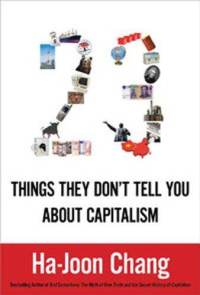 As I am often told by my free market indoctrinated friends the market will solve societies problems, if….(insert the big whingy diatribe about government interfering here) it was just left to its own devices.
A sample of the pap I usually hear, coherently summarized by Mr.Chang and his book I happen to be reading right now.
“We should leave markets alone, because, essentially, market participants know what they are doing – that is, they are rational. Since individuals (and firms as collections of individuals who share the same interests) have their own best interests in mind and since they know their circumstances best, attempts by outsiders, especially the governement, to restrict freedom of their actions can only produce inferior results. It is presumptuous of any government to prevent market agents from doing things they find profitable or force them to to do things they do not want to do, when it possesses inferior information.
What they don’t tell you…
People do not necessarily know what they are doing, because our ability to comprehend even matters that concern us directly is limited – or, in the jargon, we have “bounded rationality”. The world is very complex and our ability to deal with it is severely limited. Therefore, we need to, and usually do, deliberately restrict our freedom of choice in order to reduce the complexity of the problems we face. Often, government regulation works, especially in complex areas like the modern financial market, not becaues the government has superior knowledge but because it restricts choices and thus the complexity of the problems at hand, thereby reducing the possibility that things may go wrong.”
-Excerpt from 23 Things they don’t tell you about Capitalism – Ha – Joon Chang. pp. 168-169
People always seem to forget that the rational self maximizing actors they talk about in economics text books are merely theoretical constructions and do not figure prominently in the real world. We are neither rational nor do we have complete information when it comes to making economic decisions. Therefore, as Mr. Chang implies government regulation can be a good, even helpful thing, when it comes to market conditions.
 It is nice to establish base definitions everyone once and awhile. With all the rambling going on in the blogosphere it seems that certain basic terminology needs a good going over. Socialism happens to be one of those terms as suddenly in the US healthcare debate it has been repeatedly mischaracterized as misanthropically evil. Socialism, like Capitalism, has its flaws but it is certainly not intrinsically evil. A system based on exploitation of another however might qualify….
I grabbed this definition from a ytube video that attempts to define what Socialism is. The video is a little bombastic, but gets the point across. Socialism is a political economic philosophy that is based on a democratically cooperative society in which the means of production and distribution are owned by the people.
Or see what dictionary.com has to say about Socialism:
so⋅cial⋅ism
| 1. | a theory or system of social organization that advocates the vesting of the ownership and control of the means of production and distribution, of capital, land, etc., in the community as a whole. |
| 2. | procedure or practice in accordance with this theory. |
| 3. | (in Marxist theory) the stage following capitalism in the transition of a society to communism, characterized by the imperfect implementation of collectivist principles. |
 The Chicago School of thought is opportunity capitalism at its finest. Naomi Klein wrote about how that if no crisis exists then state actors will often create a crisis to get the public to accept changes that during a non-crisis period they would not accept. The Shock Doctrine is an important book that is definitely worth reading to gain a better understanding of how the world works.
Furthermore, it goes a long a way to answering the question: “Why do they hate us so much?”. Our policies toward other nations can be quite horrific at times as we encourage profit over people almost in every case. Klein’s detailed analysis should make you feel a little ill by the time you are done with the book.
See the film short about the Shock Doctrine on ytube.











 bleatmop
 Mystro


 Dead Wild Roses
Your opinions…