
You are currently browsing the tag archive for the ‘Education’ tag.
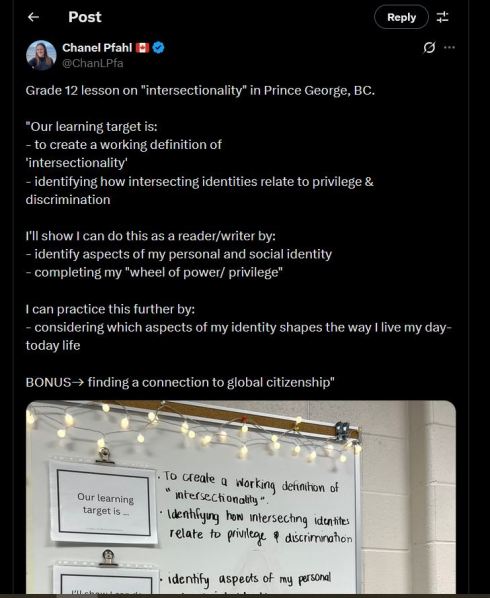
In Prince George, British Columbia, Grade 12 students were recently asked to “map their identities” on a wheel of power and privilege and define how overlapping traits like race, gender, and class shape their lives. The exercise was meant to foster empathy. Instead, it taught students to see themselves—and one another—through a hierarchy of guilt and grievance.
This is intersectionality in action. Coined by legal scholar Kimberlé Crenshaw in 1989, the theory originally sought to highlight how overlapping identities could compound discrimination. But in today’s classrooms, HR seminars, and activist spaces, intersectionality has evolved into something more aggressive: a political sorting tool that assigns moral value based on group identity rather than personal conduct. When used this way, it becomes weaponized intersectionality.
1. Define It Precisely
When arguing against it, start by defining intersectionality clearly. Don’t caricature it. Acknowledge its original intent—understanding overlapping forms of discrimination—but distinguish that from its modern mutation, which treats identity as destiny. This makes your critique credible and inoculates against claims of ignorance or bad faith.
2. Expose the Hidden Premise
Weaponized intersectionality rests on a simple but flawed assumption: that all disparities are the result of oppression and that moral authority flows from victimhood. Challenge that premise. Inequality does not always mean injustice. Lived experience matters, but it does not override evidence or reason.
3. Defend Universalism
Reassert the Enlightenment principle that all individuals possess equal moral worth regardless of group identity. Intersectionality divides by assigning virtue or guilt to immutable traits; universalism unites by judging actions, not ancestry. This is not denial of injustice—it’s the precondition for solving it.
4. Point Out Its Social Effects
Weaponized intersectionality erodes solidarity. It breeds resentment, teaching students and citizens alike to view each other as oppressors or oppressed. Even some leftist thinkers, like Nancy Fraser, have warned that intersectionality replaces economic analysis with “cultural essentialism,” fracturing potential alliances for real reform.
5. Offer a Better Vision
Don’t just oppose—propose. Replace identity grids with human rights frameworks. Discuss shared values such as dignity, equality before the law, and freedom of conscience. These ideas have lifted more people from oppression than any taxonomy of privilege ever could.
The Prince George lesson shows what happens when ideology replaces education: empathy becomes accusation, and learning becomes confession. Weaponized intersectionality promises justice but delivers division. The antidote is not denial of difference but defense of common humanity—an argument every student deserves to hear.
James Lindsay’s *New Discourses* podcast (July 9, 2020) contends that Marxist-inspired critical theories—queer theory, critical race theory (CRT), and postcolonial theory—undermine childhood innocence to destabilize Western society. According to this view, “innocence” is not a universal good but a social construct, one that maintains oppressive structures such as heteronormativity and white privilege. In this framing, schools become the frontline where innocence is dismantled, often through social-emotional learning (SEL) and comprehensive sex education, exposing children to adult categories of sexuality and race earlier than previous generations.
This essay acknowledges the conspiratorial risks of Lindsay’s framing but nonetheless argues that there is a coherent intellectual genealogy behind today’s educational shifts. By situating them in the work of Lukács, Marcuse, Gramsci, and Freire, and by engaging primary texts and empirical evidence, the essay concludes that premature sexualization and racialization of children carry measurable psychological risks and are best understood as destabilizing strategies with ideological consequences.
—
Queer Theory: Liberation or Destabilization?
Judith Butler’s *Gender Trouble* (1990) famously argued that identity is performative, “a stylized repetition of acts” rather than a fixed essence.[^1] For advocates, this opens liberatory possibilities, freeing individuals from restrictive norms. Eve Sedgwick similarly contended that destabilizing binaries allows marginalized groups to resist cultural oppression.[^2] In practice, queer pedagogy has translated into inclusive curricula—GLSEN (2022) reports that 43% of LGBTQ students feel safer in schools with gender-affirming materials.[^3]
Yet destabilization comes at a cost. Lindsay connects Butler’s performativity with Herbert Marcuse’s *Eros and Civilization* (1955), where liberation from sexual repression is imagined as a step toward a “non-repressive reality principle.”[^4] Marcuse’s focus was on adult emancipation, but his call for “mature individuals” leaves ambiguity when applied to educational contexts. Graphic materials such as *Gender Queer* (Fairfax County, 2021) in school libraries illustrate how theory, once filtered through activist pedagogy, risks exposing children to sexual content beyond developmental readiness.
Empirical concerns are not negligible: the American Psychological Association (2004) found that early sexualization is associated with depression and anxiety.[^5] While proponents highlight empowerment and reduced bullying, Lindsay’s point stands: identity destabilization in children risks long-term psychological harm.
Sexualization in Schools: Protection or Premature Exposure?
Comprehensive sex education is promoted as a health intervention. The Guttmacher Institute (2022) notes it is implemented in 39% of U.S. states, with studies showing reductions in risky sexual behaviors and teen pregnancy.[^6] Organizations like SIECUS (2021) argue that early, inclusive curricula protect sexual minorities by giving them language and resources.
The counterpoint, however, is about **age-appropriateness**. Some curricula, such as exercises in North Carolina’s 7th-grade program requiring public discussion of bodily changes,[^7] cross into territory that can be experienced as intrusive or shaming. Materials with explicit depictions of sex, regardless of intent, blur the line between protection and premature exposure.
Here Lindsay’s thesis holds: while not designed as “grooming,” the net effect can mimic destabilization. Children’s innocence functions as a developmental safeguard, and undermining it—however well-meaning—risks exploitation rather than empowerment.
Critical Race Theory: Equity or Burden?
Critical Race Theory reframes “racial innocence” as an illusion, a shield for systemic racism. Charles Mills’s *The Racial Contract* (1997) argues that white society maintains domination through unacknowledged compacts.[^8] In educational practice, this has meant materials like Ibram X. Kendi’s *Antiracist Baby* (2022), which encourage young children to see themselves in racial categories early. Advocates such as the American Educational Research Association (2021) claim this reduces bias, and SEL programs aligned with CRT have been adopted in roughly 35% of schools.[^9]
But here too, risks surface. Children may experience racial labeling as destabilizing, especially when framed in terms of guilt or privilege. The National Institute of Mental Health (2022) reports a 25% rise in youth anxiety,[^10] though causation is complex. Lindsay interprets this trend as evidence that CRT primes children for grievance and division. Whether or not one accepts that conclusion, the risk of prematurely burdening children with adult racial narratives deserves scrutiny.
Lukács and the Frankfurt School: The Intellectual Roots
George Lukács’s *History and Class Consciousness* (1923) criticized Christian morality as an impediment to revolution. In the short-lived 1919 Hungarian Soviet Republic, he promoted radical educational reforms, including sexual education programs, which opponents claimed encouraged promiscuity.[^11] While some historians downplay this episode as exaggerated,[^12] it remains clear that Lukács saw morality and family life as barriers to revolutionary consciousness.
The Frankfurt School developed this trajectory further. Marcuse in particular fused Freud with Marx, arguing that capitalism relies on sublimated sexuality.[^13] Though intended for adults, modern applications—whether in SEL or in the normalization of explicit material in schools—echo Marcuse’s suspicion of repression, sometimes at children’s expense.
Gramsci, Freire, and Pedagogical Inversion
Antonio Gramsci’s *Prison Notebooks* (1971) emphasized that family and education sustain cultural hegemony.[^14] Paulo Freire’s *Pedagogy of the Oppressed* (1968) reframed education as a site of liberation, recasting students as oppressed subjects.[^15] These ideas empower marginalized voices, as bell hooks celebrated in *Teaching to Transgress* (1994).[^16]
But Lindsay notes a darker possibility: that reorienting children as political subjects destabilizes family authority and primes youth for activism before they are developmentally prepared. Historical parallels, such as Mao’s Red Guards, show how youth mobilization can lead to intergenerational rupture and social turmoil.[^17]
The Family Under Pressure
Modern legislation such as California’s FAIR Education Act (2019), mandating LGBTQ-inclusive curricula, is framed as inclusive and affirming. Surveys support benefits: GLSEN (2022) found reduced bullying in such schools.[^3] Yet CDC (2023) data also show a steep rise in youth mental health crises—up 30% in a decade—raising questions about unintended consequences.[^18]
Gramsci’s prediction that family would be a central site of ideological struggle seems borne out. When curricula bypass or override parental values, trust between parent and child can erode, leaving children caught between competing moral frameworks.
Addressing Conspiratorial Risks
It is important not to collapse every educational reform into a single Marxist “plot.” CRT, sex education, and SEL are diverse movements with many non-Marxist motivations. Critics such as Angela Harris note that CRT is primarily a legal framework for examining structural racism, not a revolutionary program.[^19] Similarly, sex education advocates highlight empirical successes in health outcomes.
The stronger critique, therefore, is not that Marxists control education, but that Marxist categories—sexual liberation, identity destabilization, cultural hegemony—have been influential in shaping educational trends. Once filtered through activist practice, these categories can be misapplied to children with destabilizing effects.
Conclusion: Safeguarding Development
From Lukács’s early experiments to Marcuse’s liberationist theory and Freire’s pedagogical inversion, critical theory has consistently targeted family, morality, and cultural transmission as barriers to social change. Applied to adults, these ideas invite debate. Applied to children, they risk harm.
The evidence suggests that early exposure to explicit sexual material and premature racial labeling correlate with increased anxiety and depression in youth.[^5][^18] Protecting childhood innocence is not a reactionary fantasy but a developmental necessity.
Parents, educators, and policymakers should insist on transparency in curricula, ensure age-appropriate content, and preserve the family’s role as the primary context for moral and cultural formation. Resistance is less about conspiracy-hunting than about reaffirming a principle as old as education itself: children deserve protection while they grow.

References
[^1]: Butler, J. (1990). *Gender Trouble: Feminism and the Subversion of Identity*. Routledge.
[^2]: Sedgwick, E. K. (1990). *Epistemology of the Closet*. University of California Press.
[^3]: GLSEN. (2022). *National School Climate Survey*. [https://www.glsen.org/research](https://www.glsen.org/research)
[^4]: Marcuse, H. (1955). *Eros and Civilization*. Beacon Press.
[^5]: American Psychological Association. (2004). *Report of the APA Task Force on the Sexualization of Girls*. [https://www.apa.org/pi/women/programs/girls/report](https://www.apa.org/pi/women/programs/girls/report)
[^6]: Guttmacher Institute. (2022). *Sex and HIV Education*. [https://www.guttmacher.org/state-policy/explore/sex-and-hiv-education](https://www.guttmacher.org/state-policy/explore/sex-and-hiv-education)
[^7]: Wake County Public Schools. (2021). *Healthful Living Curriculum*.
[^8]: Mills, C. (1997). *The Racial Contract*. Cornell University Press.
[^9]: National Center for Education Statistics. (2021). *School Survey on Social and Emotional Learning*.
[^10]: National Institute of Mental Health. (2022). *Youth Mental Health Data*. [https://www.nimh.nih.gov](https://www.nimh.nih.gov)
[^11]: Tormay, C. (1920). *An Outlaw’s Diary: The Hungarian Revolution*. London: Allen & Unwin.
[^12]: Anderson, K. (2010). *Marx at the Margins: On Nationalism, Ethnicity, and Non-Western Societies*. University of Chicago Press.
[^13]: Marcuse, H. (1955). *Eros and Civilization*, p. 87.
[^14]: Gramsci, A. (1971). *Selections from the Prison Notebooks*. International Publishers.
[^15]: Freire, P. (1968). *Pedagogy of the Oppressed*. Continuum.
[^16]: hooks, b. (1994). *Teaching to Transgress: Education as the Practice of Freedom*. Routledge.
[^17]: Dikötter, F. (2016). *The Cultural Revolution: A People’s History, 1962–1976*. Bloomsbury.
[^18]: Centers for Disease Control and Prevention. (2023). *Youth Risk Behavior Survey*. [https://www.cdc.gov/healthyyouth/data/yrbs](https://www.cdc.gov/healthyyouth/data/yrbs)
[^19]: Harris, A. (2001). *Critical Race Theory*. International Encyclopedia of the Social & Behavioral Sciences.
I’ve given the paper “Navigating Parental Resistance: Learning from Responses of LGBTQ-Inclusive Elementary School Teachers” a first read through. I’m quite thoroughly shocked as to how this paper made it publication, and even more dismayed at its content. My first reading response:
A Critique of Queer Pedagogy in Elementary Education
The article “Navigating Parental Resistance: Learning from Responses of LGBTQ-Inclusive Elementary School Teachers” by Jill M. Hermann-Wilmarth and Caitlin Law Ryan advocates for incorporating LGBTQ topics into elementary education, relying on critical theory and queer pedagogy. This approach, however, is fundamentally flawed. Teaching queerness—defined as opposition to societal norms—has no place in elementary classrooms, where the focus should be on factual learning rather than activism. The authors employ a motte-and-bailey strategy to conflate inclusiveness with queerness, misuse critical theory in an age-inappropriate manner, and dismiss parental concerns as mere resistance to be navigated. This essay will expose these weaknesses, demonstrating the destabilizing nature of queer pedagogy and the methods used to obscure its implementation.
Conflation of Inclusiveness with Queerness
The article repeatedly equates inclusiveness with queerness, a misleading comparison that masks its radical intent. For example, the authors quote a teacher, Linda, saying, “I like the language that [says] teachers … ‘teach inclusively.’ Because … it helps frame it for parents in a way that is more palatable for anybody who might have an issue” (p. 92). Here, “teaching inclusively” serves as a euphemism for introducing queer theory, which is not the same as general inclusivity. Inclusivity in education typically involves recognizing diverse backgrounds—such as race or disability—without delving into controversial topics like gender identity. By framing queer pedagogy as inclusivity, the authors retreat to a defensible position when challenged, while advancing a destabilizing agenda. Queer theory, as Britzman (1995) states, seeks to “disrupt the commonplace” (p. 95), a goal irrelevant to elementary students’ needs.
Inappropriate Use of Critical Theory
The reliance on critical theory, particularly critical literacy, further undermines the article’s approach. The authors describe critical literacy as involving “disrupting the commonplace” and “focusing on sociopolitical issues” (Lewison et al., 2002, p. 382), which they apply to justify their pedagogy (p. 91). They argue it allows teachers to “disrupt notions of deviance” and “lay bare” power relations (p. 91). Such concepts, however, are too abstract for young children, who lack the cognitive maturity to grapple with ideological frameworks. Elementary education should prioritize facts—reading, writing, and arithmetic—not activism. By embedding critical theory, the authors risk confusing students and diverting focus from foundational skills, revealing the activist intent behind their destabilizing pedagogy.
Dismissal of Parental Concerns
Most troublingly, the article sidelines parental concerns, portraying them as obstacles to overcome rather than valid objections. The authors note how teachers “invited parents into dialogue” but maintained their curriculum, offering only minor accommodations (p. 93). For instance, when a parent objected, the teacher allowed the child to work elsewhere but refused to alter the class curriculum (p. 93). The article suggests teachers justify their choices by “leveraging policy as a shield” (p. 92), a tactic that ignores parents’ worries about age-appropriateness and bias. This dismissal undermines parents’ role as primary stakeholders, reducing them to passive bystanders. The authors’ approach reveals a disregard for parental authority, a critical flaw in their framework.
Conclusion
In sum, Hermann-Wilmarth and Ryan’s advocacy for LGBTQ-inclusive teaching in elementary schools is misguided. By conflating inclusiveness with queerness, they obscure their radical aims. Their use of critical theory introduces inappropriate activism into a setting where facts should reign. Worst of all, they marginalize parental concerns, eroding the teacher-parent partnership. A balanced, age-appropriate education—one focused on foundational learning and respectful of parental input—is essential. Queer pedagogy, with its destabilizing goals, has no place in elementary classrooms.

As a parent, you want your child’s education to focus on facts, skills, and values that prepare them for life. But in some classrooms, teachers are introducing queer theory—a radical ideology that challenges traditional norms about gender, sexuality, and society. This guide will help you understand what’s happening, why it’s a problem, and how you can take action to protect your child.
What Is the “Motte and Bailey” Tactic?
Imagine a castle with a strong, defensible tower (the “motte”) and a large, less defensible courtyard (the “bailey”). The motte and bailey tactic is a trick where someone makes a bold, controversial claim (the bailey) but, when challenged, retreats to a safer, less controversial claim (the motte). In education, this looks like:
- The Bailey (bold claim): Teachers say they’re “queering the curriculum” to challenge norms and promote radical ideas about gender and sexuality.
- The Motte (safe claim): When parents object, teachers retreat to saying they’re just being “inclusive” or “teaching diversity.”
This tactic makes it hard to argue against without seeming like you’re against inclusion. But inclusion and queerness are not the same thing, and it’s important to know the difference.
Key Terms You Need to Know
- Inclusivity: Making sure all students feel welcome and respected, regardless of their background (e.g., race, religion, disability). True inclusivity is about kindness and fairness, not ideology.
- Queer: Originally a slur, this term has been reclaimed by some to describe non-traditional sexual orientations or gender identities. In education, it often means challenging or rejecting societal norms.
- Queering the Curriculum: This means adding queer theory to lessons. Queer theory isn’t just about acceptance—it’s about questioning and destabilizing what’s considered “normal” (e.g., traditional family structures, biological sex). In elementary schools, this can confuse young children who need clear, factual learning.
Coercive and Deceptive Tactics Used in Schools
Some teachers push queer theory while dismissing parents’ concerns. Here are the main tactics they use:
- Hiding Behind “Inclusivity”: Teachers claim they’re just being inclusive, but they’re actually promoting queer ideology. For example, they might say they’re “teaching inclusively” to make it sound harmless, even though they’re introducing complex ideas about gender and sexuality.
- Using Critical Theory: Teachers use methods like critical literacy, which encourages students to question power and norms. This might sound educational, but it’s often a way to push activism instead of facts—too advanced and ideological for young kids.
- Ignoring Parents: When parents object, teachers might offer small compromises (like letting a child skip a lesson) but won’t change the overall curriculum. They dismiss concerns as unimportant or unreasonable.
- Leveraging Policy: Teachers use school rules or laws to defend their actions, even if parents disagree. This makes parents feel like they have no say.
These tactics are coercive because they force queer ideology into classrooms while sidelining parents. They’re deceptive because they hide behind feel-good words like “inclusivity” to avoid real discussion.
Why This Is a Problem
- It’s Not Age-Appropriate: Elementary students need to focus on basics like reading and math, not complex ideas about gender and sexuality.
- It Undermines Parental Authority: Parents should have a say in what their kids learn. Ignoring you breaks that trust.
- It Confuses Children: Challenging basic truths (like boys and girls) can unsettle young kids who need stability.
- It’s Activism, Not Education: Schools should teach facts, not push political ideas.
What Parents Can Do to Stop It
You have the power to protect your child’s education. Here’s how:
- Educate Yourself:
- Learn what queer theory is and how it’s used in schools. Look up articles or videos online.
- Ask for your school’s curriculum details—lesson plans, books, anything they’re teaching.
- Talk to Teachers:
- Ask clear questions: “What are you teaching about gender or sexuality? Why is this in the curriculum?”
- Stay calm but firm: “I’m all for kindness, but I’m worried about ideology in the classroom.”
- Engage with School Boards:
- Go to meetings and speak up. Bring examples of what’s being taught.
- Suggest focusing on core skills instead of controversial topics.
- Form Parent Groups:
- Team up with other parents who feel the same way.
- Share info and plan together—maybe write a group letter to the school.
- Monitor What Your Child Learns:
- Talk to your kid about their day. Check their homework or classwork.
- If something seems off, write it down and raise it with the teacher.
- Use Legal Resources:
- If the school won’t listen, talk to a lawyer who knows education law.
- Look up your state’s rules on parental rights.
- Advocate for Policy Changes:
- Push for rules that let parents approve or get notified about sensitive topics.
- Back school board members who care about parents’ voices.
- Consider Alternatives:
- If the school won’t budge, look into private schools or homeschooling.
- Find options that match your values and focus on real learning.
Final Thoughts
You’re your child’s best defender. Don’t let schools brush you off or confuse you with buzzwords. Demand clear answers and a focus on age-appropriate, fact-based education. By staying informed and active, you can keep your child’s classroom a place for learning—not ideology.

In this series, we’ve explored the oppressor/oppressed lens—a framework that divides society into those with power (oppressors) and those without (oppressed). The first post traced its roots to the Combahee River Collective, Paulo Freire, and Kimberlé Crenshaw, showing how intersectionality and class consciousness shaped a tool for naming systemic injustice, though Freire’s ideological focus sidelined factual learning. The second post examined its modern applications through Judith Butler’s fluid view of power, Robin DiAngelo’s struggle session-like workshops, and John McWhorter’s critique of its dogmatic turn. While the lens has illuminated real harms, it often oversimplifies morality, fosters division, and stifles dialogue. In this final post, we’ll dig into its deepest limitations with insights from Peter Boghossian, James Lindsay, Jonathan Haidt, bell hooks, and Joe L. Kincheloe. Then, we’ll propose a more nuanced moral framework for navigating our complex world.
The Lens’s Fatal Flaws
The oppressor/oppressed lens promises clarity: identify the oppressor, uplift the oppressed, and justice follows. But in practice, it falters as a universal moral guide. It reduces people to group identities, suppresses critical inquiry, and fuels tribalism, leaving little room for the messy realities of human experience. Five thinkers help us see why—and point toward a better way.
Peter Boghossian: Stifling Inquiry
Peter Boghossian, in How to Have Impossible Conversations (2019), argues that the oppressor/oppressed lens creates ideological echo chambers where questioning is taboo. He describes how labeling someone an “oppressor” based on identity—like race or gender—shuts down dialogue, as dissent is framed as defending privilege. For example, in a college seminar, a student questioning a claim about systemic racism might be silenced with accusations of “fragility,” echoing DiAngelo’s tactics. Boghossian emphasizes that true critical thinking requires open inquiry, not moral litmus tests. The lens’s binary framing discourages this, turning discussions into battles over who’s “right” rather than what’s true. By prioritizing ideology over evidence, it undermines the very understanding it seeks to foster.
James Lindsay: Ideological Rigidity
James Lindsay, through his work in Cynical Theories (2020) and on New Discourses (https://newdiscourses.com/), argues that the oppressor/oppressed lens, rooted in critical theory, imposes a power-obsessed worldview that distorts reality and suppresses dialogue. He contends that the lens reduces every issue—from education to science—to a battle between oppressors and oppressed, deeming “oppressed” perspectives inherently valid and “oppressor” ones suspect. For example, Lindsay cites school restorative justice programs, which often prioritize systemic oppression narratives over individual accountability, leading to increased classroom disruption (New Discourses Podcast, Ep. 160). On X, a scientific study might be dismissed as “colonial” if it challenges the lens, ignoring empirical evidence. Lindsay warns that this creates a moral absolutism where questioning the lens is equated with upholding oppression, stifling reason and fostering division. Like Freire’s class consciousness, this rigid ideology prioritizes narrative over nuance, limiting our ability to address complex problems.
Jonathan Haidt: Moral Tribalism
Jonathan Haidt, in The Coddling of the American Mind (2018) and The Righteous Mind (2012), shows how the lens fuels moral tribalism—dividing society into “us” (the oppressed or their allies) and “them” (the oppressors). He argues that it amplifies cognitive distortions, like catastrophizing, where minor slights are seen as existential threats. For example, a workplace disagreements might escalate into accusations of “oppression” if framed through the lens, as seen in DiAngelo-inspired DEI sessions. Haidt’s research on moral foundations suggests humans value not just fairness (the lens’s focus) but also loyalty, care, and liberty. By fixating on oppression, the lens neglects these other values, alienating people who might otherwise support justice. This tribalism turns potential allies into enemies, undermining collective progress.
bell hooks: Division Over Solidarity
bell hooks, in Feminist Theory: From Margin to Center (1984), critiques the oppressor/oppressed lens for fostering division rather than solidarity. She argues that pitting groups against each other—men vs. women, white vs. Black—reinforces hierarchies rather than dismantling them. For hooks, true liberation requires love and mutual understanding, not just naming oppressors. For instance, a feminist movement that vilifies all men as oppressors, as the lens might encourage, alienates male allies and ignores how class or race complicates gender dynamics. hooks’ vision of a “beloved community” emphasizes shared humanity over binary conflict, offering a moral framework that transcends the lens’s zero-sum approach.
Joe L. Kincheloe: Contextual Complexity
Joe L. Kincheloe, in Critical Constructivism: A Primer (2005), offers a nuanced alternative to the oppressor/oppressed lens by emphasizing that knowledge and power are co-constructed through social, cultural, and historical contexts. Building on social constructivism, Kincheloe argues that truth is negotiated through critical dialogue and evidence, not merely a function of power, rejecting the radical relativism that can accompany postmodern interpretations. He advocates empowering students to analyze their realities collaboratively, questioning how power shapes knowledge without reducing issues to a binary of oppressors vs. oppressed. For example, a teacher might guide students to investigate how local economic policies impact their community, fostering shared inquiry that considers multiple perspectives and real-world consequences. Kincheloe critiques universalizing frameworks like the oppressor/oppressed lens for ignoring local nuances and individual agency. By promoting a critical consciousness rooted in contextual, evidence-based analysis, he supports a moral framework that values complexity and collaboration over ideological absolutes.
A Better Way Forward
The oppressor/oppressed lens has illuminated systemic wrongs, from Maya’s workplace barriers to the interlocking oppressions Crenshaw described. But as Boghossian, Lindsay, Haidt, hooks, and Kincheloe show, it falls short as a moral compass. It stifles inquiry, rigidifies thought, fuels tribalism, divides communities, and oversimplifies power. So, what’s the alternative?
A more nuanced moral framework starts with three principles:
- Context Over Categories: Instead of judging people by group identities, consider their actions and circumstances. A white worker struggling with poverty isn’t inherently an “oppressor,” just as a wealthy person of color isn’t automatically “oppressed.” Context, as Kincheloe’s critical constructivism and Butler’s performativity suggest, reveals the fluidity of power.
- Dialogue Over Dogma: Following Boghossian and hooks, prioritize open conversation over moral litmus tests. Ask questions, listen, and assume good faith, even when views differ. This builds bridges, not walls.
- Shared Humanity Over Tribalism: Inspired by hooks and Haidt, focus on common values—care, fairness, resilience—rather than pitting groups against each other. Solutions to injustice come from collaboration, not zero-sum battles.
In practice, this might look like a workplace addressing Maya’s barriers by examining hiring data and fostering inclusive policies, not just hosting struggle sessions. Or an X discussion where users debate ideas with evidence, not identity-based accusations. This framework doesn’t ignore systemic issues—it builds on the lens’s insights—but approaches them with humility, curiosity, and a commitment to unity.
Closing Thoughts
The oppressor/oppressed lens gave voice to the marginalized, but it’s not the whole story. Its binary moralism, as we’ve seen, often divides more than it heals. By embracing context, dialogue, and shared humanity, we can move toward a morality that honors complexity and fosters progress. What do you think of this approach? Share your thoughts in the comments—I’d love to hear how you navigate these issues.
Sources: Peter Boghossian’s How to Have Impossible Conversations (2019), James Lindsay and Helen Pluckrose’s Cynical Theories (2020), New Discourses (https://newdiscourses.com/), Jonathan Haidt’s The Coddling of the American Mind (2018) and The Righteous Mind (2012), bell hooks’ Feminist Theory: From Margin to Center (1984), Joe L. Kincheloe’s Critical Constructivism: A Primer (2005, p. 23).
Epilogue: Reflecting on Truth and a Path Forward
This series has unpacked the oppressor/oppressed lens, a framework that shapes how we view justice and morality. We traced its roots to intersectionality and class consciousness, explored its modern misuses—from struggle sessions to dogmatic cancellations—and critiqued its limitations with insights on power, tribalism, and solidarity. The lens reveals systemic wrongs, like Maya’s workplace barriers, but its binary moralism often fuels division over dialogue.
We proposed a better way: a moral framework of context over categories, dialogue over dogma, and shared humanity over tribalism. This approach tackles injustice with nuance—think workplaces analyzing hiring data, not just moral confessions, or X debates grounded in evidence, not accusations. It honors complexity while fostering progress.
Why explore these ideas? For me, it’s about pursuing objective truth and working across divides—the only way forward, in my view. The lens’s ideology, from rigid narratives to tribal pile-ons, obscures truth and fractures us. I’m driven to seek truth through reason, as Kincheloe’s critical constructivism urges, and to bridge gaps, as hooks’ beloved community envisions. Truth and unity require tough conversations, not moral absolutes.
I invite you to reflect: How does the lens shape your world? Can we collaborate across divides? Try applying context and dialogue in your next discussion—whether at work or online. Share your thoughts in the comments. Let’s build a path forward together.

Critical Social Constructivism (CSC) emerged from the broader tradition of social constructivism, which posits that knowledge and reality are products of social processes and interactions. Social constructivism has its roots in the works of sociologists like Peter Berger and Thomas Luckmann, who, in their seminal book The Social Construction of Reality (1966), argued that reality is socially constructed through shared meanings and practices. This perspective was further developed by the strong programme in the sociology of scientific knowledge, with scholars such as David Bloor (1976) asserting that even scientific facts are socially constructed and inseparable from the social contexts in which they are produced. Critical Social Constructivism builds on these foundations by incorporating elements of critical theory, particularly the emphasis on power dynamics and ideologies. Influenced by the Frankfurt School’s critique of society, CSC highlights how dominant social and political forces shape what is accepted as knowledge or reality, thereby questioning the objectivity of knowledge claims.
As an anti-realist philosophy, Critical Social Constructivism rejects the notion of an objective reality that exists independently of human perception and social agreement. By claiming that all aspects of reality—including scientific facts, moral values, and social norms—are constructed through social processes, CSC challenges the realist position that there is a mind-independent world. However, CSC is more than just an ontological stance; it offers a comprehensive worldview that encompasses epistemology, ethics, and politics. Since knowledge is viewed as a social construct, the process of knowing is inherently embedded within social contexts, power relations, and cultural frameworks. This means that truth is not discovered but negotiated, and what is accepted as knowledge reflects the prevailing social and political dynamics rather than any objective standard. Thus, CSC provides a lens through which all human understanding and interaction can be analyzed.
Given that Critical Social Constructivism denies the existence of an objective reality, there is no external arbiter to settle disputes about what is true or real. Consequently, the acceptance of particular knowledge claims becomes a matter of social negotiation and consensus-building. In this context, adherents of CSC recognize that establishing a shared understanding of reality often involves the use of political and social mechanisms to persuade or coerce individuals and groups into adopting specific constructions of knowledge. This can range from rhetorical strategies and institutional support to more overt forms of social or political force, as dominant groups seek to impose their versions of reality onto others. Because there is no reality without human perception and social agreement, the validation of knowledge claims ultimately relies on the ability to garner social acceptance, which can be influenced by power structures and cultural hegemony.

References
- Berger, P. L., & Luckmann, T. (1966). The Social Construction of Reality: A Treatise in the Sociology of Knowledge. Anchor Books.
- Bloor, D. (1976). Knowledge and Social Imagery. Routledge & Kegan Paul.
The recent protests at McGill University, where anti-Israel activists physically blocked access to lecture halls and disrupted classes, represent a troubling departure from the principles of free speech and Canadian values. On April 2, 2025, as reported by B’nai Brith Canada, masked protesters in the Bronfman Building prevented students from attending classes, with chants of “McGill, McGill you can’t hide, you’re complicit in genocide” echoing through the campus. While protest is a protected right, these actions crossed into intimidation and coercion, as students were denied their fundamental right to education. Free speech in Canada is about expressing ideas without fear of retribution, not about obstructing others’ rights or creating a hostile environment. Such behavior is distinctly un-Canadian, as it undermines the nation’s commitment to mutual respect, dialogue, and the rule of law—values that have long defined Canadian society.
McGill University’s response to these protests highlights a glaring abdication of responsibility. Despite the disruptions, which forced some classes online and led to acts of vandalism, the university’s initial reaction was tepid, only implementing ID-based access controls on April 4, 2025, after days of chaos. Advocacy groups like the Canadian Friends of Simon Wiesenthal Center and concerned individuals have called for decisive action, pointing to the hostile environment created for Jewish students and the broader student body. McGill’s failure to swiftly address the physical blockades and ensure safe access to education sends a dangerous message: that the university prioritizes appeasing disruptive activists over protecting the rights of all students. This inaction not only erodes trust in the institution but also sets a precedent for tolerating intimidation under the guise of activism, further emboldening such behavior on Canadian campuses.
The protests at McGill reveal a deeper issue: a two-tier system of justice that is profoundly divisive for Canadian society. While the protesters faced little immediate consequence for their actions, students attempting to attend classes were left to fend for themselves, as seen in videos where individuals were physically blocked from entering lecture halls. This disparity in treatment—where one group’s “right” to protest is elevated above others’ rights to safety and education—creates a fractured campus environment. Jewish students, in particular, have reported feeling unsafe, with advocacy groups framing the protests as antisemitic. Meanwhile, some individuals with differing views supported the protesters, accusing Israel and its supporters of enabling genocide. This polarization reflects a broader societal trend where identity-based grievances are weaponized, pitting groups against each other rather than fostering unity, a core Canadian ideal.
My blog post *The Oblivious Irony of Canada’s Progressive Left* provides a stark illustration of this trend, noting, “The progressive left’s obsession with identity politics has created a hierarchy of victimhood, where certain groups are given carte blanche to act with impunity, while others are silenced or vilified.” This observation captures the essence of the McGill protests, where the activists’ cause—framed as a fight against oppression—seemingly justified their coercive tactics, while the rights of other students were dismissed. Identity politics, as I argue, has become a divisive force in Canada, eroding the shared values of fairness and equality that once united the nation. The McGill protests are a microcosm of this larger societal shift, where the pursuit of “justice” for one group comes at the expense of others, deepening divisions and resentment.
In conclusion, the actions at McGill University are not a legitimate exercise of free speech but a violation of the principles that define Canada as a nation. By allowing protesters to intimidate and obstruct, McGill has failed its students, particularly those who felt targeted or unsafe, and has contributed to a two-tier system of justice that undermines Canadian unity. The divisive impact of identity politics, as highlighted in previously, underscores the urgent need for a return to shared values—respect, dialogue, and equal treatment under the law. Canadian society cannot thrive when one group’s rights are prioritized over another’s, and institutions like McGill must take responsibility to ensure that campuses remain spaces for learning, not coercion. Only by upholding these principles can Canada reclaim its identity as a nation of fairness and inclusion for all.











 bleatmop
 Mystro


 Dead Wild Roses
Your opinions…