
You are currently browsing the tag archive for the ‘Education’ tag.
it’s fun-fact woke learning time! First a new vocabulary word!
Polysemy – Having a word or concept that has multiple meanings. What it does is allow the activists to say one thing, while meaning something completely different.
Employed skillfully, the woke can flit between the reasonable definition and the one they really intend.

The “woke mind virus” is a dogmatic, control-seeking ideology, not the benign traits listed. These 10 points misfire by assigning warped meanings to common virtues, fueling confusion and division.
- “Reading books, not burning them” sounds noble, but woke ideology often curates what’s “acceptable” to read, banning dissent subtly.
- “Embracing science” shifts to cherry-picking studies that fit narratives, not raw inquiry.
- “Changing your mind” becomes abandoning principles for trending dogma, not reasoned flexibility.
- “Issues aren’t black and white” morphs into relativism that dodges accountability.
- “True equality” redefines as forced sameness, not equal opportunity.
- “Liking to share” turns into mandating redistribution, not generosity.
- “Embracing cooperation” means silencing disagreement for fake unity.
- “Respecting rights” flips to prioritizing select groups’ feelings over universal freedoms.
- “Valuing culture and arts” becomes worshipping approved expressions, not creativity.
- “Caring for the planet” slides into eco-orthodoxy, shaming nonconformists.
By cloaking coercion in virtuous terms without admitting the shift, these points don’t expose the virus—they spread it, eroding clarity and free thought under a moral mask.
Chanel Pfahl, a high school teacher in Ontario, Canada, has become a focal point in the ongoing cultural battle over education, activism, and free expression. On March 8, 2025, Pfahl announced via X that she is facing her fourth investigation by the Ontario College of Teachers for her social media posts and podcast comments criticizing activist policies, such as those promoting critical race theory and gender ideology in schools. This repeated targeting exemplifies the tactics of “woke cancel culture,” where individuals who challenge progressive orthodoxies are subjected to professional scrutiny, public shaming, and potential career destruction. Pfahl’s case highlights a broader trend in Canadian education, where dissent against ideological conformity is met with punitive measures, undermining open dialogue.
The investigations into Pfahl’s tweets and podcast remarks reveal a pattern of selective enforcement and ideological policing. Her posts, which include sharing images of school pride decorations, questioning gender-affirming care policies, and critiquing the imposition of group identities in education, are being scrutinized as “problematic” by the Ontario College of Teachers. Yet, as Pfahl notes, the same schools and educators who originally shared these materials on social media face no consequences. This double standard suggests a deliberate attempt to silence her voice, a hallmark of cancel culture, where individuals are held to inconsistent standards based on their alignment with prevailing ideological norms. The Democracy Fund, representing Pfahl in a related 2022 investigation, has argued that her comments are neither racist nor offensive, yet the investigations persist, illustrating the weaponization of regulatory power.
Pfahl’s situation also demonstrates the use of “repressive tolerance,” a tactic described by critics of critical social justice movements, as noted on the website Stop Woke Activism. While proponents of these ideologies claim to champion inclusion and diversity, their actions often exclude and punish those with opposing views, such as Pfahl. By compiling “pages and pages” of her tweets and podcast quotes, the Ontario College of Teachers is engaging in a form of public shaming, aiming to deter other educators from questioning activist policies in schools. This approach mirrors the “cancelling” tactics outlined in web resources, where dissenters are smeared, investigated, and pressured to conform, undermining fundamental democratic principles like freedom of expression and equality before the law.
The impact of these tactics extends beyond Pfahl, threatening the broader educational landscape in Canada. As highlighted in the National Post’s 2022 article on critical race theory’s influence in Canadian education, large school boards and institutions have adopted these ideologies, often without room for debate. Pfahl’s case underscores the risks for teachers who challenge this orthodoxy, potentially chilling free speech in classrooms and stifling diverse perspectives. Parents, as the primary educators of their children, also have a stake in this issue, as Pfahl’s advocacy aligns with concerns about ideological indoctrination in schools, a point emphasized by critics of critical social justice movements. Her investigations signal a broader cultural shift where dissent is pathologized rather than debated.
Ultimately, Chanel Pfahl’s repeated investigations by the Ontario College of Teachers serve as a stark warning about the dangers of woke cancel culture in Canadian education. By targeting her for expressing views that question activist policies, the regulatory body is enforcing a narrow ideological conformity that suppresses open discourse and individual rights. This case, rooted in Pfahl’s commitment to fostering an inclusive education free from imposed ideologies, reveals the need for a balanced approach that respects diverse opinions while upholding professional standards. Without such balance, the principles of liberal democracy—freedom of expression, equality, and parental rights—risk being eroded in the very institutions tasked with nurturing critical thinking and open-mindedness.

Here are three effective strategies for countering false media narratives:
“Critical Media Literacy Education:
Strategy: Promote awareness and education about media literacy. This involves teaching individuals how to critically analyze media content, understand the motives behind information dissemination, and recognize common techniques used in propaganda or misinformation.
Implementation: Engage in or support programs that teach people how to verify information, understand source credibility, and recognize bias. Workshops, online courses, or school curriculums can include topics like fact-checking, source analysis, and understanding media economics and politics.
Impact: An educated public is less likely to fall for false narratives because they are equipped with the tools to discern truth from falsehood.
Fact-Checking and Reporting:
Strategy: Utilize and support independent, non-partisan fact-checking organizations. These entities systematically verify the accuracy of claims made in media reports, by politicians, or on social media.Implementation: When encountering a narrative that seems off, individuals or organizations can:
Refer to established fact-checking websites like PolitiFact, Snopes, or FactCheck.org.
Use tools or browser extensions that automatically flag or rate the reliability of news articles.
Engage in community-driven fact-checking through social platforms or forums dedicated to uncovering the truth.
Impact: Fact-checking can debunk myths in real-time, reducing the spread of misinformation and providing a counter-narrative with evidence.
Alternative and Diverse Media Sources:
Strategy: Encourage consumption of news from a variety of sources, especially those that are less mainstream or offer alternative viewpoints. This doesn’t mean promoting unreliable sources but rather diversifying where one gets their information from to avoid echo chambers.
Implementation: Support independent journalism that isn’t tied to large conglomerates, which might have vested interests in certain narratives.
Use news aggregators that compile stories from multiple outlets, giving a broader perspective on events.
Engage with local journalism which often provides more nuanced, ground-level reporting.
Impact: By exposing oneself to a broader spectrum of views and facts, individuals can better see through manipulated narratives. This approach also supports a healthier, more pluralistic media ecosystem where misinformation has less room to thrive.
These strategies work best in combination. While countering false media narratives is crucial, it’s also important to do so in a way that doesn’t contribute to further polarization or cynicism about all media. The goal is to foster a more informed, skeptical, yet open-minded public discourse.”
Let’s take a look at the three arguments and counter-arguments commonly used to when discussing Diversity policies within the framework of Diversity, Equity, and Inclusion (DEI):
Undermining Merit-Based Systems:
Explanation: Critics argue that diversity policies can lead to a focus on demographic representation over merit, potentially resulting in less qualified individuals being selected for positions. This perspective suggests that prioritizing diversity might mean overlooking the most competent candidates, thereby undermining the meritocratic principles that are supposed to drive organizational success and fairness.
Counterpoint: Proponents of DEI might argue that what’s often labeled as “merit” can be influenced by biases, where traditional metrics of merit do not account for systemic disadvantages some groups face. They propose that diversity initiatives aim to expand the pool of candidates, ensuring that merit is assessed within a broader, more equitable context.
Promoting Division and Resentment:
Explanation: There’s an argument that DEI policies can foster division by emphasizing differences rather than commonalities, leading to resentment among those who feel they are discriminated against or unfairly overlooked due to their demographic characteristics. This can create an “us vs. them” mentality, potentially fracturing team cohesion and morale.
Counterpoint: Supporters might counter that acknowledging and addressing differences is essential for true inclusion, promoting understanding rather than division. They argue that well-implemented DEI strategies educate, unite, and enrich workplace culture by celebrating diversity as a strength rather than a source of division.
Inefficiency and Reduced Performance:
Explanation: Some critics claim that diversity for its own sake can introduce inefficiencies. They suggest that integrating diverse perspectives might initially slow down decision-making processes due to the need for more discussion to reconcile differing viewpoints or cultural misunderstandings. This could be seen as a hindrance in fast-paced environments where quick, decisive action is valued.
Counterpoint: Advocates for diversity would argue that while there might be an initial adjustment period, the long-term benefits include more innovative solutions, better problem-solving, and resilience against groupthink. They cite studies showing that diverse teams can outperform homogeneous ones over time by leveraging a wider range of experiences and ideas.
These arguments are part of a broader, ongoing debate about the implementation and impact of DEI policies. Each point of view has its merits and criticisms, and the effectiveness of diversity policies can depend significantly on how they are executed within specific organizational contexts. The goal should be to critically assess both the challenges and benefits in pursuit of a balanced approach that truly enhances equity and inclusion.
Here’s a summary of the key points from the transcript of the discussion between Abigail Shrier and Coleman Hughes on Identity, Speech, and Policy, moderated by Mia Hughes:
Recent U.S. Election and Trump’s Victory:
The discussion began with reflections on the surprising decisiveness of Trump’s victory in the recent election, with Abigail Shrier noting she avoids political predictions but was surprised by the clear win. Coleman Hughes mentioned he won a bet by predicting Trump’s win, highlighting a pattern of polls underestimating Trump due to people’s reluctance to admit their support.
Implications of Trump’s Second Term:
Both speakers discussed the potential implications of Trump’s second term. Abigail expressed hope that Trump’s administration would focus on efficiency, reducing government bloat, and addressing critical issues like the economy and border security. Coleman viewed Trump as a high-risk, high-reward candidate, capable of unexpected successes but also erratic.
Woke Culture and Resistance:
The conversation touched on the resistance from the “woke” left. Abigail argued that this group hasn’t faced real resistance, referring to examples like campus protests where no punitive actions were taken. Coleman agreed that while there might be less resistance this time due to Trump’s clear mandate, the “woke” ideology remains deeply entrenched in academia.
Challenges to Free Speech and Gender Ideology:
They discussed the challenges to free speech, particularly around gender ideology. Abigail’s book “Irreversible Damage” was cited as an example of censorship attempts, and she emphasized the need for courage in standing against misinformation in gender ideology. Coleman added the importance of including detransitioners in discussions on gender-affirming care, a perspective often sidelined.
Impact of Therapy on Youth:
Abigail Shrier’s book “Bad Therapy” was referenced, criticizing the over-therapization of children, suggesting it undermines resilience by labeling normal responses to life’s challenges as disorders. She highlighted how this could affect identity formation, with many young people identifying with their mental health issues.
Towards a Colorblind Society:
Coleman Hughes discussed his advocacy for a colorblind society, explaining it as an ideal where race is not a factor in treatment by individuals or government, though acknowledging the presence of racism. He compared this to the pursuit of peace as an unattainable but worthy goal.
Hope for Civil Society:
Both speakers expressed cautious optimism about returning to a civil society. Abigail pointed to a consensus among parents across political lines on key issues, suggesting that rebuilding families could be hopeful. Coleman was more skeptical, citing the increasing polarization due to social media echo chambers.
Message to Well-Meaning Supporters of Harmful Policies:
The speakers addressed well-meaning individuals supporting policies they believe are compassionate but potentially harmful. Coleman encouraged self-challenge and listening to opposing views, while Abigail urged parents to assert traditional values at home to counteract broader cultural shifts.
Role of Institutions in Ideological Shifts:
The discussion concluded with reflections on how institutions have been overtaken by ideologies contrary to traditional values, with a call to reclaim these spaces with sound ideas, as exemplified by the mission of the Macdonald-Laurier Institute.
The event was framed as an important dialogue on how ideas shape society, with a call for intellectual courage and the reclamation of traditional values in the face of modern ideological challenges.
The more you know.
The Reid Technique, formally known as the Reid Psychological Technique, is an interrogation method developed by John E. Reid and Associates in the 1940s and 1950s. It’s primarily used by law enforcement in the United States to elicit confessions from suspects. Here’s a breakdown of its key components:
-
Behavioral Analysis Interview (BAI):
-
This initial phase involves a non-accusatory interview where the investigator assesses the subject’s behavior, verbal responses, and body language to determine if the person is likely deceptive or truthful. The focus is on observing signs like posture, eye contact, and verbal cues.
-
-
Nine Steps of Interrogation:
-
1. Direct, Positive Confrontation: The interviewer directly confronts the suspect with the evidence or belief of their guilt.
-
2. Theme Development: The interrogator offers moral justifications or themes for the crime, trying to minimize the suspect’s moral culpability.
-
3. Handling Denials: Denials are interrupted to prevent the suspect from gaining confidence or solidifying their denials.
-
4. Overcoming Objections: The interrogator counters any objections or reasons given by the suspect for not committing the crime.
-
5. Procurement of the Suspect’s Attention: The focus is shifted to listening to the interrogator rather than formulating their own defense.
-
6. Handling the Suspect’s Passive Mood: When the suspect becomes quiet or resigned, the interrogator takes this as a sign to push forward.
-
7. Presenting an Alternative Question: Offering two choices, one more socially acceptable than the other, both implying guilt, e.g., “Did you steal because you needed the money or because you were angry?”
-
8. Having the Suspect Orally Relate Details of the Offense: Encouraging the suspect to admit to details of the crime.
-
9. Converting an Oral Confession to a Written One: Ensuring the confession is documented, often with the suspect writing or signing a statement.
-
Criticism and Controversy:
-
The technique has been criticized for leading to false confessions, particularly because of its psychologically coercive methods. Critics argue that it can pressure innocent people into confessing due to the stress, isolation, and manipulation involved in the process.
-
There’s also a debate over its scientific validity, especially regarding the behavioral analysis for detecting deception, which many experts now consider unreliable.
-
Reform and Alternatives: Due to these criticisms, some jurisdictions have moved away from the Reid Technique, advocating for or adopting more evidence-based, less coercive methods like the PEACE model (Preparation and Planning, Engage and Explain, Account, Closure, Evaluate) used in places like the UK.
We all know that being woke requires you hand in your critical thinking card, because the ideology is circular and not internally consistent. But then there are those who through some strange series of events somehow think that being woke simply means becoming aware of injustice and its a good thing. This is an example of what the activists mean by being ‘woke’.
Being woke mean judging people inherently as members of superficial identity groups, then slotting them into a rubegoldberg-esque rubric of power/oppression ratings,and then judging their claim as to where they fall on this bullshit ‘matrix of oppression’. The more oppression factors you have been deemed to have the more troothiness your claim is.
Watch what happens though when you inadvertently break a trip wire and your ‘oppressed privilege rating’ isn’t high enough for the claim you make.
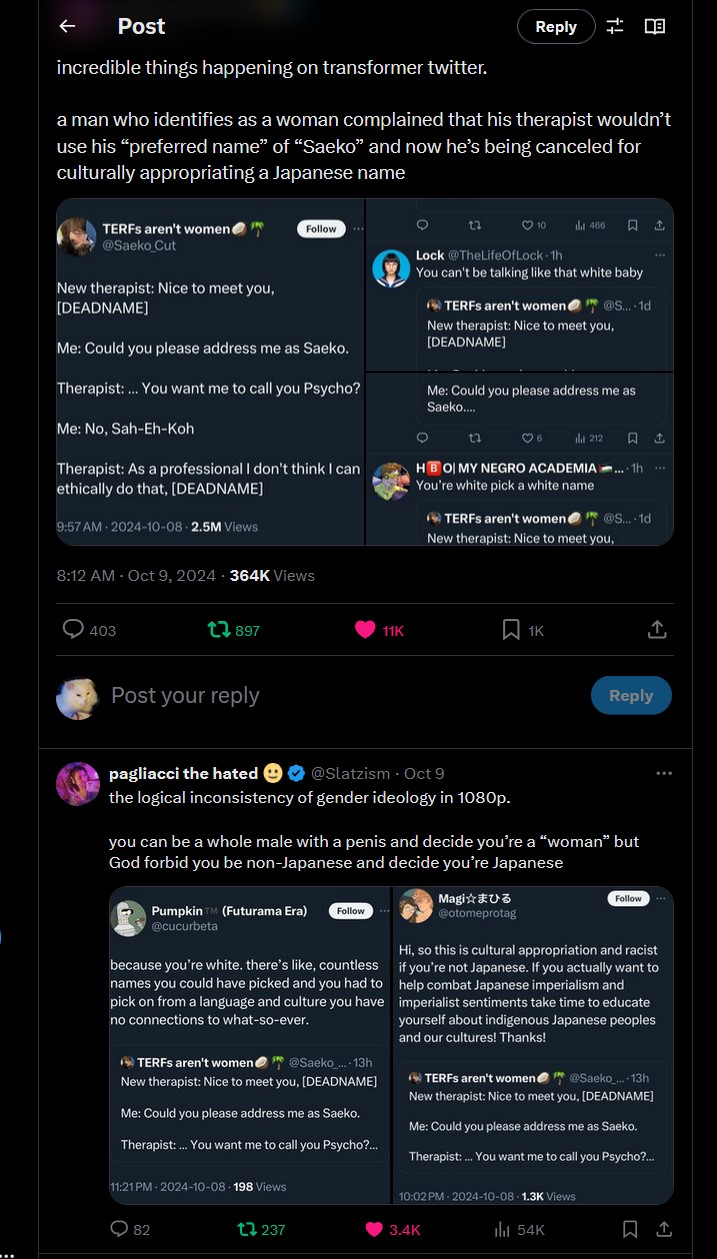
Man claiming to be a woman: NO PROBLEM.
WHITE Man claiming to be a woman and COLONIZING A JAPANESE name: ALL SORTS OF PROBLEMS.
Utterly ridiculous.











 bleatmop
 Mystro


 Dead Wild Roses
Your opinions…