
You are currently browsing the tag archive for the ‘Feminism’ tag.
Tyler Cowen once tried to name the biggest “revolutions” he’s lived through—moon landing, collapse of communism, the internet, and now AI. In the middle of that list he drops one that most people still don’t treat like a revolution at all: “Feminization.” (Marginal REVOLUTION)
That word isn’t a complaint. It’s a category. It says: a long-run compositional change is underway, and it matters.
Helen Andrews’ “Great Feminization” thesis—popularized in a talk and elaborated in her Compact essay—takes the next step: as women become a larger share of institutions, institutions don’t merely “include” women; they become substantively feminized, and what we call “wokeness” is basically the cultural exhaust of that process. (Compact)
Here’s my position up front: the demographic shift is real and measurable in Canada; the “feminization = wokeness” equation is an overconfident master key.
It explains too much, too easily, by psychologizing demographics instead of interrogating incentives.
Canadian anchors: the shift is measurable (not vibes)
Start with a handful of Canadian facts you can actually point to.
- Parliament: the House of Commons sits at 104 women out of 343 MPs (30.3%). (IPU Parline)
- Judiciary: the share of federally appointed judges who are women rose from 43.8% (2021) to 46.7% (2023), per Statistics Canada. (Statistics Canada)
- Universities: women are 43.7% of full-time teaching staff in 2024/2025, up from 15.9% in 1984/1985. (Statistics Canada)
- Management: women are 51.9% of public-sector managers but 35.2% of private-sector managers (2023), and hold 42.7% of middle management vs 30.8% of senior management (2021). (Statistics Canada)
- Psychology (Alberta snapshot): Job Bank puts psychologists at 81% women / 19% men in Alberta. (Job Bank)
You don’t need to think any of this is good or bad to recognize the basic point: elite and semi-elite Canadian pipelines have changed composition in living memory. The “Great Feminization,” at minimum, names something real.
Why composition changes institutions (and why noticing this isn’t misogyny)
Here’s the move that poisons discussion: someone observes a demographic shift and asks what it does to norms; the response is to treat the question itself as hatred.
That’s not an argument; it’s a veto.
Institutions aren’t just rulebooks. They are reward systems: what gets you promoted, what gets you ostracized, what gets you hauled into a meeting, what everyone learns not to say out loud. When composition changes, the informal equilibrium can change too—sometimes for the better, sometimes not.
Before anyone reaches for the “misogyny” stamp, three obvious distinctions:
- Descriptive claims aren’t moral verdicts. Saying “X is now 47% female” is not saying “women ruined X.”
- Group averages aren’t destinies. Even if differences exist on average, overlap is huge. Plenty of women are rule-first and combative; plenty of men are harmony-first and censorious.
- The target is incentives, not women. If a system rewards reputational risk-avoidance and punishes open conflict, it will drift toward soft enforcement and speech management—regardless of who staffs it.
Those distinctions don’t sanitize the topic. They make it discussable.
Where Andrews helps—and where her thesis becomes a master key
Steelman Andrews first: she’s right that the shift is large, and she’s right that institutions can be remade through changes in who occupies them. If you pretend otherwise, you’re pretending humans don’t do social enforcement.
Where she overreaches is the claim (often treated as self-evident) that “feminization = wokeness.” (Compact)
Two problems.
1) One variable can’t carry a multi-cause phenomenon
The rise of “woke” managerial dynamics tracks at least four forces that are not reducible to gender composition:
- social media: instant reputational escalation; permanent records of mistakes; a public audience for internal disputes
- liability culture: institutions optimizing to avoid lawsuits, complaints, and scandal
- bureaucratic expansion: more compliance, more policy, more internal language policing
- credential sorting: ideological clustering in certain professional strata
In Canada, you can see the basic direction without naming villains: risk management becomes a career track; “process” becomes protection; disputes become “incidents”; leaders learn to value quiet over truth because quiet is legible as safety.
You can believe feminization is one contributor. But treating it as the engine is an interpretive leap, not an established causal law.
2) It tempts essentialism even when it gestures at nuance
If “wokeness” is “women’s morality,” you’ve turned a complex institutional pathology into a personality profile of half the species. That’s analytically brittle and politically stupid: it hands critics the easiest rebuttal (“you’re essentializing women”) and it blinds you to male-led versions of the same pathologies (purges, conformity spirals, status policing), which history supplies in bulk.
If you want to criticize a norm regime, criticize the regime. Don’t smuggle in contempt.
What the evidence can support—more modestly
A defensible claim, one that doesn’t require you to psychologize women as a class, looks like this:
- Some sex-linked preference gaps show up in some contexts, especially around speech, conflict, and social sanction. For example, a Knight Foundation/College Pulse study reports large gender differences among U.S. college students: 41% of college women prioritized protecting free speech versus 71% of college men, while women were more likely to prioritize promoting an inclusive society.
- Institutions are sensitive to preference distributions because norms are enforced socially, not just formally.
- Incentives decide which preferences become “policy.” Liability, reputation, and managerial bureaucracy amplify harm-avoidance.
And this is the part Andrews gestures at, but doesn’t fully own: if you want to understand modern speech policing, HR creep, and the new professional fearfulness, start with incentives. The incentives turn every controversy into a corporate emergency; then people behave accordingly.
On that view, feminization isn’t the whole story. It’s a relevant input—and its effects depend on the system it enters.
The real Canadian question: can we preserve hard virtues mid-transition?
Canada is useful here because we’re visibly mid-shift rather than at some imagined endpoint. Parliament is at 30% women, not parity. (IPU Parline) The federal judiciary is closing on parity. (Statistics Canada) Universities have moved dramatically since the 1980s, but remain below parity in full-time teaching staff. (Statistics Canada) Management splits sharply by public vs private sector, and senior leadership remains male-skewed. (Statistics Canada)
So the live question isn’t “should women be here?” They are here, and they belong here.
The question is narrower and more urgent:
As composition changes, what norms do we want to protect because they are fragile?
A short list:
- due process and evidence standards (law)
- viewpoint tolerance and intellectual risk-taking (academia)
- candid disagreement and non-performative conflict (organizations)
- the capacity to make decisions that feel “unkind” but are necessary (policy)
If you think those virtues are real and fragile, you don’t need to scapegoat women. You need to design institutions that reward truth-telling and competence more than “harm management” and reputational prophylaxis. That means fewer performative “values” rituals and more procedural backbone: clear standards, clearer speech norms, and leaders who can say “no” without laundering it through therapy language.
Verdict and prediction
The Great Feminization is real in Canada. The numbers are not subtle. (IPU Parline)
But “feminization = wokeness” is a bad master key. It explains too much, too easily, by psychologizing demographics rather than interrogating incentives. (Compact)
My bet is that the next decade won’t be settled by shouting “misogyny” or shouting “women did this.” It will be settled by whether our institutions relearn a difficult skill: distinguishing “this feels harmful” from “this is false,” and building cultures where adults can endure disagreement without turning every conflict into a moral emergency.
Glossary
- Confounders — other factors that could be the real cause, making cause-and-effect hard to prove.
- Essentialism / essentialize — treating a group as if it has one fixed “essence” (“women are X”), ignoring variation.
- Epiphenomenon — a byproduct; something that looks important but is really “exhaust” from a deeper cause.
- Monocausal — blaming one cause for a complex outcome.
- Pathology (institutional pathology) — a recurring dysfunctional pattern inside an institution.
- Prophylaxis — preventative action; here, pre-emptive “avoid scandal” behavior.
- Psychologizing — explaining political/institutional behavior by reducing it to personality traits or “mental makeup.”

In October 2025, Brighton witnessed a stark confrontation between feminist and trans activist groups, culminating in the vandalism of the FiLiA conference venue by the direct-action group Bash Back. This incident has sparked widespread debate over the boundaries of free speech, the safety of women-only spaces, and the tactics employed in the defense of trans rights.
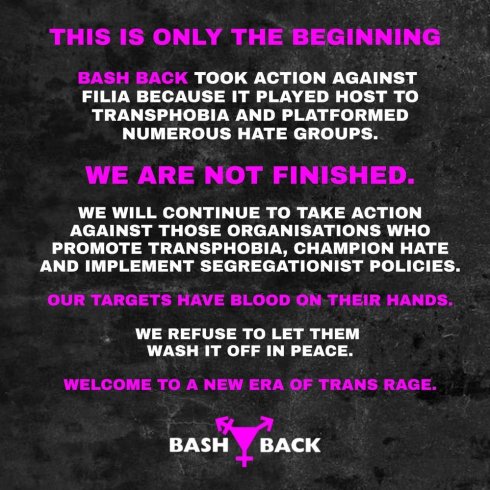
In the seaside city of Brighton, where the English Channel laps against shores long synonymous with progressive ideals, a gathering of women became the target of deliberate aggression last weekend. The FiLiA conference—Europe’s largest feminist event, drawing over 2,400 delegates from around the world—convened from October 10 to 12, 2025, to confront the unyielding realities of women’s lives: domestic abuse, sexual violence, lesbian safety, anti-racism, health equity, and political organizing. What should have been a sanctuary for sisterhood instead became a stage for intimidation, vandalism, and moral inversion, carried out by activists who cloaked their belligerence in the guise of righteous victimhood. This was no spontaneous protest; it was an orchestrated assault on women’s autonomy, executed through the psychological tactic known as DARVO—Deny, Attack, Reverse Victim and Offender—flipping aggressor and victim roles to confuse and shame the true defenders.
FiLiA, the Feminist International Leadership and Action charity, has championed women’s voices and sex-based rights since its founding in 1982 as Feminists in London. Rebranded in 2019, the organization organizes workshops, advocacy campaigns, and international solidarity events, explicitly excluding male speakers to foster unmediated discourse. Alumni include figures like J.K. Rowling, and sessions routinely interrogate male violence without apology. In Brighton, hosted at the council-owned Brighton Centre, FiLiA aimed to advance this mission amid escalating threats to female-only spaces. Organizers preemptively requested a Public Spaces Protection Order from Brighton and Hove Council to mitigate anticipated disruptions, only to be rebuffed—a decision that left delegates exposed to the very dangers the conference sought to address.
The aggression began hours before the conference doors opened on October 10. Activists associated with the direct-action group Bash Back vandalized the venue: windows were shattered, purple paint—symbolizing queer defiance—splashed across entrances, and graffiti labeled FiLiA “transphobic” and worse. As women arrived on Saturday, masked protesters surrounded them, chanting, jeering, filming without consent, and blocking access to the entrance. One man was bundled into a police van amid the chaos. Sussex Police launched an investigation, but the damage was done: a conference on male violence against women had itself been disrupted by male violence.
This incident exemplifies DARVO in practice. Attacks were simultaneously denied or minimized as mere “direct action,” while FiLiA was cast as inherently bigoted for prioritizing biological sex in discussions of oppression. Reversal of victimhood followed swiftly: women convening to safeguard their rights were recast as provocateurs, deserving retaliation. Green MP Sian Berry’s comments faulting organizers for “inflaming division” exemplify this inversion, as if women’s speech is a privilege revocable at the whim of the offended. Online, Bash Back celebrated targeting “hate groups” like the LGB Alliance and Transgender Trend, further amplifying the narrative of moral righteousness while eroding accountability. Eyewitness reports indicate that many of the aggressors were male, cross-dressing in the guise of protest—a striking irony in a city branding itself a “City of Sanctuary.”
The Brighton disruption is part of a broader pattern of hostility toward women’s spaces, where the veneer of inclusivity is used to justify exclusion. Militant transactivism often prioritizes gender self-identification over material sex realities, demanding access to refuges, prisons, and sports at the expense of female safety. By framing sex-based protections as inherently “transphobic,” these tactics erode the foundations of feminism: the recognition that sex is the axis of patriarchal power and a critical factor in protecting women from violence. The FiLiA delegates were not debating abstract theory—they were strategizing for survival against rape, trafficking, and erasure. To disrupt their forum is to reinforce the patriarchal dynamics they resist.
The path forward requires vigilance and clarity. DARVO’s manipulations must be unmasked; women’s sex-based rights defended without apology; and discourse reclaimed from those who mistake volume and spectacle for moral authority. Only then can women gather safely, unmolested, to build the liberation FiLiA envisions—a liberation grounded in reality, accountability, and the enduring fight against male violence.
📚 References
- “Council refused feminists security after trans activists smashed venue.” The Times, October 10, 2025. (The Times)
- “Trans activists vandalise feminist conference.” Yahoo News Canada, October 10, 2025. (Yahoo News)
- “Trans group ‘BASH BACK’ targets Brighton Centre – FiLiA has ‘blood on their hands’.” Scene Magazine, October 10, 2025. (Scene Magazine)
- “FiLiA Conference Sparks Trans Rights Protests In Brighton.” Evrimagaci, October 10, 2025. (Evrim Ağacı)
- “FiLiA.” Wikipedia, October 2025. (Wikipedia)
- “Bash Back!” Wikipedia, October 2025. (Wikipedia)
People should be consistent about their beliefs. Let’s put a bodily autonomy situation to the test.
-
Major Premise: Any moral principle protecting a woman’s bodily autonomy and safety must be applied consistently to all areas where her biological sex is directly relevant.
-
Minor Premise 1: Abortion rights protect a woman’s bodily autonomy.
-
Minor Premise 2: Female-only spaces protect a woman’s safety and dignity, which are inseparable from her biological sex.
-
Conclusion: Therefore, just as abortion is morally protected for bodily autonomy, the right of women to control access to female-only spaces must also be morally protected
Let’s consider a possible counter –
-
Trans inclusion claim: Some argue trans women should access female spaces.
-
Counterpoint: Biological sex, not gender identity, determines risk factors (e.g., privacy violations, physical safety concerns), which are the basis for female-only spaces. Moral protection of women’s autonomy and safety therefore cannot be overridden by gender identity claims.
This (and logic generally) only works if you belief in objective truth and a shared common reality. Social constructivists are bound by neither, so this argument probably wouldn’t work well with them.

Hegel’s assertion in modern times:
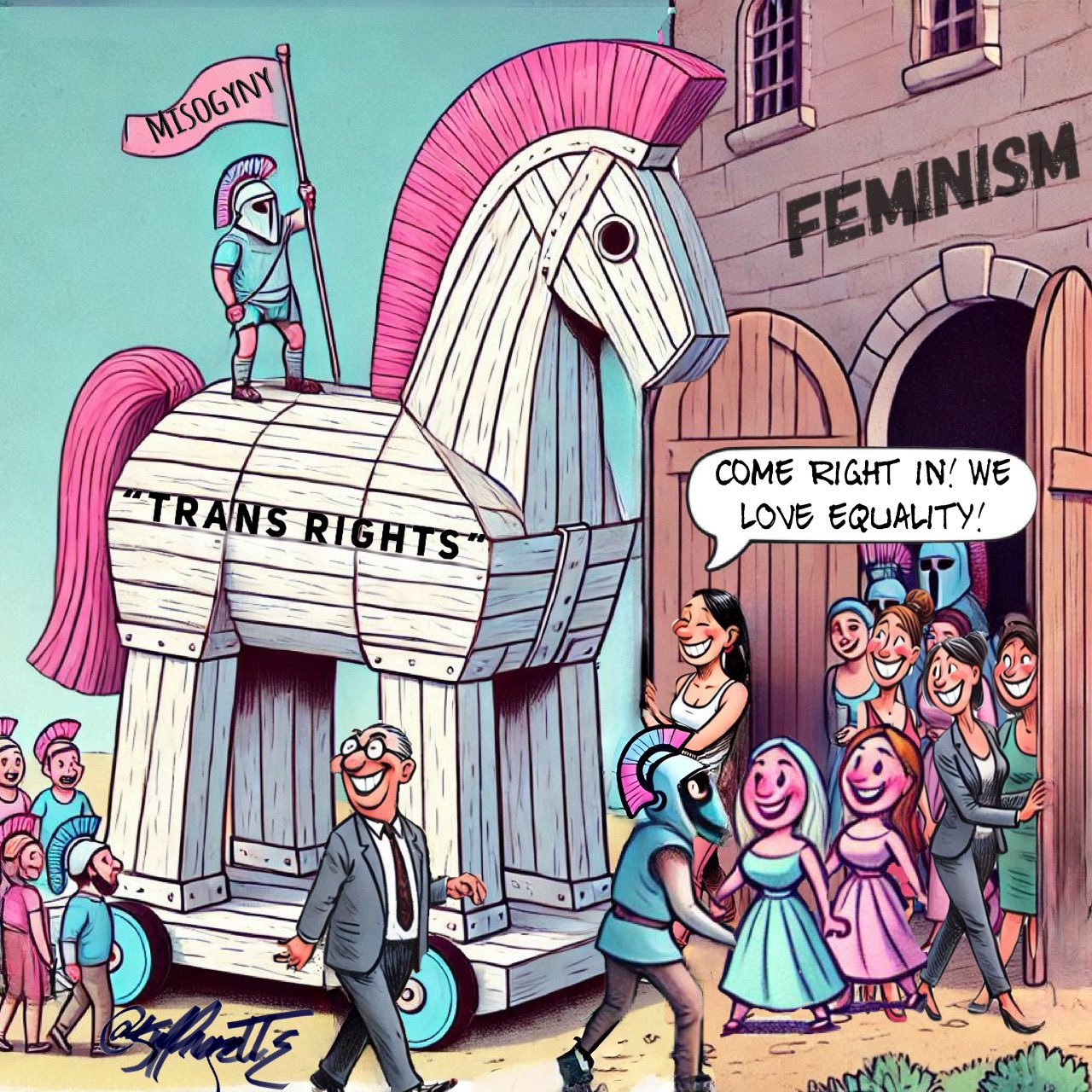
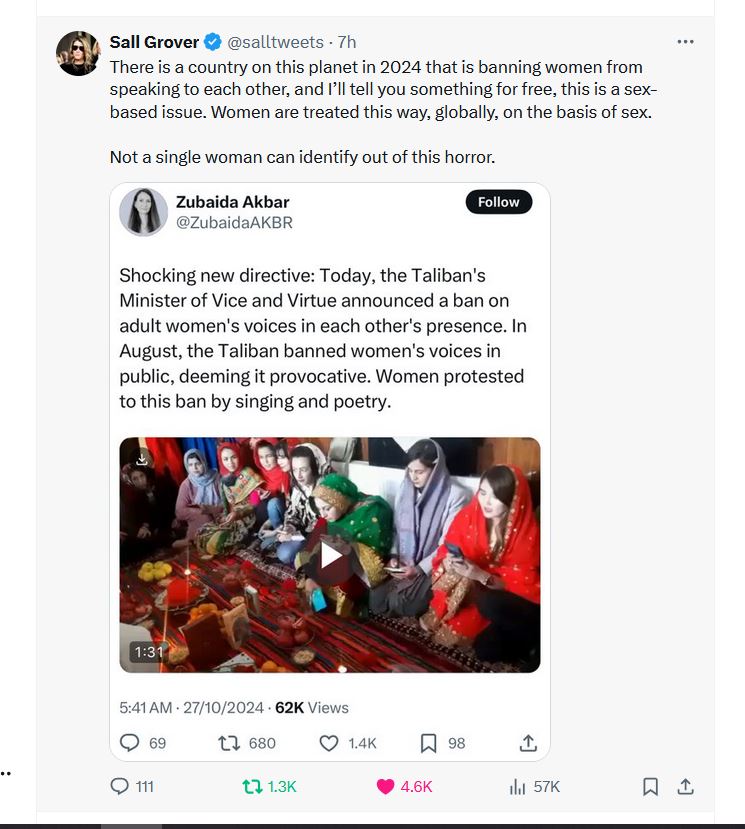
We need to extricate this ideology from the West, we have bigger problems to tackle.
Jasmine began by sharing her harrowing personal experiences: her mother’s conversion to radical Islam, her forced marriage to an Al-Qaeda terrorist, and the traumatic impact these events had on her life. Our discussion covered a wide range of topics, including the Islamic religion, Islamic immigration in Europe, and the specific challenges faced by Muslim immigration in London.











 bleatmop
 Mystro
 The Arbourist


 Dead Wild Roses
Your opinions…