
You are currently browsing the tag archive for the ‘Feminism’ tag.
Back with more insightful analysis is Anita Sarkeesian. The idea of but what about the male in distress plot point is dicusses as well as framing the issues within the bounds of our society.
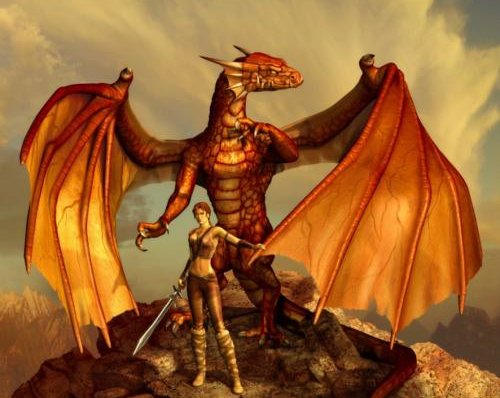
I’m still waiting for Drakken to be redone and released, not only does it start a female protagonist, but it also has Dragons! And I lourve dragons to bits!
“It is because society tells us that women are objects, not subjects, that when society is presented with a case of male violence or sexual abuse, everyone looks at it from his point of view: “Oh, he must have been provoked to have done that,” “He was a nice man who just snapped,” “He must have been confused by her signals,” “Maybe he’s been falsely accused, how terrible to have to go to jail for that.” With every victim-blaming, rape / violence apologist comment, society reveals through whose eyes it looks, and the answer is invariably the man’s. It is because society tells us that women are objects, not subjects, that even good men, when speaking out against violence against women, tell other men to imagine her as “somebody’s wife, somebody’s mother, somebody’s daughter, or somebody’s sister,” it never occurring to them that maybe, just maybe, a woman is also “somebody”.
It is frightening to consider just how deeply entrenched objectification of women really goes. We must certainly combat sexual objectification, but the battle will not end there. Women are objectified in more profound ways than we realise, and we must tear down every entwined shred of the patriarchy, in order to achieve our modest goal of being recognized and treated as human beings.
”
— Source: The Objectification of Women – It Goes Much Further Than Sexy Pictures
It is embarrassing when your hometown makes news on the Internets for having induhviduals who think that rape apologia is a-fucking-okay. These vats of douche have co-opted what was a successful campaign against sexual violence at the University of Alberta and other locations back in 2010. Here is the original poster.

Great poster. Great message promoting the idea that it is sexual assault when there is no consent. Let’s take a look at what our home town misogynists ginned up with their mad photoshop skillz.

How to prove your ‘movement’ is absolute shite.
Yah. They went there. Victim blaming, rape apologia all sung to the insidious drone of “what about the menz!!11!!!1!!!!”. And as with all Men’s Rights Activist content, it is nothing but baseless assertions tinged with whinging about how tough men have it in society. Almost like the Patriarchy didn’t exist. Making shit up is nothing new for MRA’s though, as evinced here:
Karen Straughan, spokesperson for Men’s Rights Edmonton, believes the original “Don’t be that guy” campaign demonized men.
“It frames all men as potential sexual predators,” she said.
Ah yes, because somehow the idea of consent being a necessary part of any sexual encounter demonizes men.
Lise Gotell, chair of women and gender studies at the University of Alberta, worked on the original “Don’t be that guy” campaign. She believes the new posters send the wrong message.
“They’ve perverted the message,” she said. “And they’ve transformed it into a rape apologist message and it’s just very disturbing.”
It is very disturbing because the message being sent reinforces the rape culture women have to deal with every day.
I’m disgusted with these MRA failsauces and their blatant misogyny. Go to rainn.org to get the real deal on what is happening violence and rape with regards to women.
Nothing you shouldn’t already know.


Pop-culture is another avenue through which white/Western imperialism and misogynistic standards are spread. This is how the thin, able-bodied white woman ideal was created and WoC and “third-world”/Global South women and girls were devalued, denigrated and taught to hate their physical appearance, and even take dangerous measures to mimick the thin, able-bodied white woman ideal.

Like it is hard to find patriarchy on the Internets.
It’s easy to think that the misogyny is just a feature of the those who just don’t know better, or who espouse a certain set of values like the dear followers of the GOP in the US. But no, when you live within a patriarchal system, which we do (and I will repeat this fact forever my MRA friends), the misogyny is everywhere and it touches everybody. Go read the entire article on Rumpus.net, but I excerpt a section here that made me cheer. Thank you KMA Sullivan for writing such a great piece.
“It was exhausting. Exhausting to figure out how to respond to the relentless misogyny from men who are otherwise kind and educated, who would never think of themselves as chauvinist assholes. I have heard more than once from this crew, “Most of my favorite poets are women.” If I were to guess, I’d bet that the lot of them vote pro-choice, support the Violence Against Women Act, and consider women well capable of intelligent, complex thought. I certainly don’t assume that all men under 40 would engage in the kind of language and behavior described above; indeed, I know of many who would never do so. And yet, after the past several weeks, its frequency is far beyond what I thought possible.
What is up with all this dehumanizing language? Honestly, I have no idea. But I do know this. If “good guys” feel perfectly at ease using degrading language that objectifies women when talking not only to one another but also to women they purportedly respect, then the bullshit that came out of the GOP this past election cycle (vaginas that can tell the difference between consensual sex and rape, for example) can be explained. A big pile of reasonably aware and well-intentioned people doing thoughtless shit creates a solid set of stairs for unreasonable, ignorant assholes to say and do what most of us (men and women alike) would deem shockingly destructive.”
Today let us look at Science Fiction and examine the experiences of two individuals. Then think about your ‘objective truths’ and notions that ‘good arguments are judged on their merit alone’ and other liberal white dude fappery, and then try and tell me I’m wrong.
You’re fourteen and you’re reading Larry Niven’s “The Protector” because it’s your father’s favorite book and you like your father and you think he has good taste and the creature on the cover of the book looks interesting and you want to know what it’s about. And in it the female character does something better than the male character – because she’s been doing it her whole life and he’s only just learned – and he gets mad that she’s better at it than him. And you don’t understand why he would be mad about that, because, logically, she’d be better at it than him. She’s done it more. And he’s got a picture of a woman painted on the inside of his spacesuit, like a pinup girl, and it bothers you.
But you’re fourteen and you don’t know how to put this into words.
And then you’re fifteen and you’re reading “Orphans of the Sky” because it’s by a famous sci-fi author and it’s about a lost generation ship and how cool is that?!? but the women on the ship aren’t given a name until they’re married and you spend more time wondering what people call those women up until their marriage than you do focusing on the rest of the story. Even though this tidbit of information has nothing to do with the plot line of the story and is only brought up once in passing.
But it’s a random thing to get worked up about in an otherwise all right book.
Then you’re sixteen and you read “Dune” because your brother gave it to you for Christmas and it’s one of those books you have to read to earn your geek card. You spend an entire afternoon arguing over who is the main character – Paul or Jessica. And the more you contend Jessica, the more he says Paul, and you can’t make him see how the real hero is her. And you love Chani cause she’s tough and good with a knife, but at the end of the day, her killing Paul’s challengers is just a way to degrade them because those weenies lost to a girl.
Then you’re seventeen and you don’t want to read “Stranger in a Strange Land” after the first seventy pages because something about it just leaves a bad taste in your mouth. All of this talk of water-brothers. You can’t even pin it down.
And then you’re eighteen and you’ve given up on classic sci-fi, but that doesn’t stop your brother or your father from trying to get you to read more.
Even when you bring them the books and bring them the passages and show them how the authors didn’t treat women like people.
Your brother says, “Well, that was because of the time it was written in.”
You get all worked up because these men couldn’t imagine a world in which women were equal, in which women were empowered and intelligent and literate and capable.
You tell him – this, this is science fiction. This is all about imagining the world that could be and they couldn’t stand back long enough and dare to imagine how, not only technology would grow in time, but society would grow.
But he blows you off because he can’t understand how it feels to be fourteen, fifteen, sixteen, seventeen and desperately wanting to like the books your father likes, because your father has good taste, and being unable to, because most of those books tell you that you’re not a full person in ways that are too subtle to put into words. It’s all cognitive dissonance: a little like a song played a bit out of tempo – enough that you recognize it’s off, but not enough to pin down what exactly is wrong.
And then one day you’re twenty-two and studying sociology and some kind teacher finally gives you the words to explain all those little feelings that built and penned around inside of you for years.
It’s like the world clicking into place.
And that’s something your brother never had to struggle with.











 bleatmop
 Mystro


 Dead Wild Roses
Your opinions…