
You are currently browsing the tag archive for the ‘Gnosticism’ tag.
(TL;DR) Eric Voegelin’s The New Science of Politics remains one of the clearest guides to our modern disorder. It teaches that when politics cuts itself off from transcendent truth, ideology fills the void—and history descends into Gnostic fantasy. Voegelin’s remedy is not new revolution but ancient remembrance: the recovery of the soul’s openness to reality.
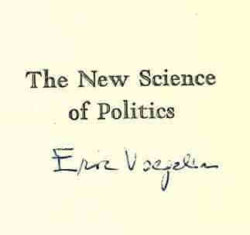
Eric Voegelin (1901–1985) was an Austrian-American political philosopher who sought to diagnose the spiritual derangements of modernity. In his 1952 classic The New Science of Politics—first delivered as the Walgreen Lectures at the University of Chicago—Voegelin proposed that politics cannot be understood as a merely empirical or procedural science. Power, institutions, and law arise from a deeper spiritual ground: humanity’s participation in transcendent order. When societies lose awareness of that participation, they fall into ideological dreams that promise salvation through human effort alone. The book is therefore both a critique of modernity and a call to recover the classical and Christian understanding of political reality (Voegelin 1952, 1–26).
1. The Loss of Representational Truth
Every stable society, Voegelin argued, “represents” its members within a larger order of being. In ancient civilizations and medieval Christendom, political authority symbolized this participation through myth, ritual, and law that acknowledged a reality beyond human control. The ruler was not a god but a mediator between the temporal and the eternal.
Beginning in the twelfth century, however, the monk Joachim of Fiore reimagined history as a self-unfolding divine drama in which humanity itself would bring about the final age of perfection. With this shift, Western consciousness began to “immanentize the eschaton”—to relocate ultimate meaning inside history rather than in its transcendent source. Out of this inversion grew the modern ideologies of progress (Comte, Hegel), revolution (Marx), and race (National Socialism), each promising earthly redemption through planning and will (Voegelin 1952, 107–132).
For Voegelin, the loss of representational truth meant that governments no longer reflected humanity’s place in divine order but instead projected utopian images of what they wished reality to be. Politics ceased to be the articulation of truth and became the engineering of salvation.
2. Gnosticism as the Modern Disease
Voegelin identified the inner structure of these movements as Gnostic. Ancient Gnostics sought hidden knowledge that would liberate the soul from an evil world; their modern successors, he said, sought knowledge that would liberate humanity from history itself. “The essence of modernity,” Voegelin wrote, “is the growth of Gnostic speculation” (1952, 166).
He listed six recurrent traits of the Gnostic attitude:
- Dissatisfaction with the world as it is.
- Conviction that its evils are remediable.
- Belief in salvation through human action.
- Assumption that history follows a knowable course.
- Faith in a vanguard who possess the saving knowledge.
- Readiness to use coercion to realize the dream.
From medieval millenarian sects to twentieth-century totalitarian states, these traits form a single continuum of spiritual rebellion: the attempt to perfect existence by abolishing its limits.
3. The Open Soul and the Pathologies of Closure
Against the Gnostic impulse stands the open soul—the philosophical disposition that accepts the “metaxy,” or the in-between nature of human existence. We live neither wholly in transcendence nor wholly in immanence, but within the tension between them. The philosopher’s task is not to resolve that tension through fantasy or reduction but to dwell within it in faith and reason.
Political science, therefore, must be noetic—concerned with insight into the structure of reality—not merely empirical. A society’s symbols, institutions, and laws can be judged by how faithfully they articulate humanity’s participation in divine order. Disorder, Voegelin warned, begins not with bad policy but with pneumopathology—a sickness of the spirit that refuses reality’s truth. “The order of history,” he wrote, “emerges from the history of order in the soul.”
Empirical data can measure economic growth or electoral results, but it cannot measure spiritual health. That requires awareness of being itself.
4. Liberalism’s Vulnerability and the Way of Recovery
Voegelin saw liberal democracies as historically successful yet spiritually precarious. By reducing political order to procedural legitimacy and rights management, liberalism risks drifting into the nihilism it opposes. When public life forgets its transcendent foundation, freedom degenerates into relativism, and pluralism becomes mere fragmentation.
Still, Voegelin’s outlook was not despairing. His proposed remedy was anamnesis—the recollective recovery of forgotten truth. This is not nostalgia but awakening: the rediscovery that human beings are participants in an order they did not create and cannot abolish. The recovery of the classic (Platonic-Aristotelian) and Christian understanding of existence offers the only durable antidote to ideological apocalypse (Voegelin 1952, 165–190).
To “keep open the soul,” as Voegelin put it, is to resist every movement that promises paradise through force or theory. The alternative is the descent into spiritual closure—an ever-recurring temptation of modernity.
5. Contemporary Resonance
Voegelin’s analysis remains uncannily prescient. Today’s ideological battles—whether framed around identity, technology, or climate—often echo the same Gnostic pattern: discontent with the world as it is, belief that perfection lies just one policy or re-education campaign away, and impatience with reality’s resistance. The post-modern conviction that truth is socially constructed continues the old dream of remaking existence through will and language.
Voegelin’s warning cuts through our century as clearly as it did the last: when politics replaces truth with narrative and transcendence with activism, society repeats the ancient heresy in secular form. The cure, as ever, is humility before what is—the recognition that order is discovered, not invented.
References
Voegelin, Eric. 1952. The New Science of Politics: An Introduction. Chicago: University of Chicago Press.
Hughes, Glenn. 2003. Transcendence and History: The Search for Ultimacy from Ancient Societies to Postmodernity. Columbia: University of Missouri Press.
Sandoz, Ellis. 1981. The Voegelinian Revolution: A Biographical Introduction. Baton Rouge: Louisiana State University Press.
Glossary of Key Terms
Anamnesis – Recollective recovery of forgotten truth about being.
Gnosticism – Revolt against the tension of existence through claims to saving knowledge that masters reality.
Immanentize the eschaton – To locate final meaning and salvation within history rather than beyond it.
Metaxy – The “in-between” condition of human existence, suspended between immanence and transcendence.
Noetic – Pertaining to intellectual or spiritual insight into reality’s order.
Pneumopathology – Spiritual sickness of the soul that closes itself to transcendent reality.
Representation – The symbolic and political articulation of a society’s participation in transcendent order.
This post is inspired by the writing of James Lindsay on X.
The Mechanics of Woke Sociognosticism: A Persuasive Analysis
Contemporary “woke” ideology—focused on systemic injustice, identity-based power dynamics, and cultural transformation—has morphed into a quasi-religious framework that claims exclusive access to sociological truth. Its adherents, wielding an implacable certainty, cast dissent as ignorance or complicity, undermining the pluralism essential to liberal societies. This essay argues that woke ideology operates as sociognosticism: a fusion of critical social theory with gnostic epistemology, where salvation lies in “awakening” to hidden structures of oppression. While its moral aim to address inequities is undeniable, its totalizing worldview risks authoritarianism, stifling dialogue and fracturing society.
I. Defining Sociognosticism
Sociognosticism marries sociological critique with a gnostic belief in hidden, redemptive knowledge. Historically, gnosticism posits that gnosis—secret knowledge—unlocks salvation by revealing a dualistic reality of light versus darkness (Voegelin, 1952). Political theorist Eric Voegelin applied this to ideologies like Marxism, which claim to expose a veiled truth behind social structures. In woke sociognosticism, society is a prison crafted by hegemonic groups (e.g., white, male, capitalist), who maintain power through a “false consciousness” internalized by the masses (Gramsci, 1971). Activists position themselves as enlightened guides, dismantling this illusion. Yet, their framework is often presented not as one perspective but as the sole legitimate lens, dismissing alternative views as inherently flawed.
II. The Elect and the Awakened: Epistemic Elitism
Woke ideology fosters an “elect” class—those “awakened” to systemic oppression—who view their insight as both morally and intellectually unassailable (Lindsay, 2025). This mirrors Herbert Marcuse’s argument in Repressive Tolerance, where dissenting views are deemed intolerable if they perpetuate systemic harm (Marcuse, 1965). Disagreement is recast as evidence of false consciousness, as seen in online campaigns on platforms like X, where critics of woke orthodoxy face accusations of racism or transphobia (e.g., high-profile cancellations of public figures for questioning prevailing narratives, X, 2024–2025). Such epistemic elitism conditions dialogue on ideological conformity, punishing dissent with social ostracism or demands for public “self-education,” effectively silencing pluralistic debate.
III. Struggle, Awakening, and the Maoist Echo
Woke sociognosticism employs rituals of struggle and awakening, echoing Maoist techniques of “self-criticism” and “struggle sessions” (Mao, 1967). Originating during the Chinese Cultural Revolution, these were public rituals of ideological repentance in which individuals were forced to confess alleged wrongthink to reinforce social conformity. Contemporary analogues include institutional diversity training programs that require participants to acknowledge privilege or complicity in systemic bias. For example, several corporate and university DEI (Diversity, Equity, and Inclusion) initiatives between 2023 and 2025 have included exercises in which employees or students must complete “privilege checklists” or write statements of commitment to anti-racism. Refusal to comply is often interpreted as regression or resistance to enlightenment.
The concept of “allyship” reinforces this structure, demanding continuous affirmation of anti-oppression principles, with failure interpreted as betrayal. This creates a narrative of inevitability: crises—social, economic, or personal—are seen as catalysts for “waking up” to the truth. While rooted in a desire to address inequities, these tactics prioritize conformity over dialectic, substituting performative repentance for genuine inquiry.
IV. A Closed Epistemology
The woke worldview is self-sealing, absorbing contradictions into its narrative. Karl Popper’s critique of unfalsifiable theories applies here: counter-evidence is reinterpreted as proof of the system’s pervasive influence (Popper, 1963). For instance, when a woman denies experiencing gender-based oppression, she may be accused of internalized misogyny; when a Black individual critiques critical race theory, they are often labeled as “anti-Black” or as supporting white supremacy. Notably, prominent Black academics who voice heterodox views—such as critiques of DEI bureaucracy—have been targeted with denunciations on platforms like X (2025), reinforcing the idea that dissent is heresy. This totalizing simplicity reduces complex realities to a binary of oppressors versus oppressed, rendering the ideology immune to challenge and hostile to nuance, even when confronting legitimate inequities.
V. The Political Danger
While woke ideology seeks justice—a noble aim—its sociognostic structure threatens pluralism. Hannah Arendt warned that ideologies reducing reality to a single explanatory framework erode judgment and shared political life (Arendt, 1951). Woke influence in institutions like academia and media, where speech codes and DEI policies increasingly frame dissent as harm, raises concerns about encroaching authoritarianism. For example, university speech guidelines updated in 2024 at several U.S. campuses have redefined “harmful speech” to include disagreement with concepts such as gender self-identification or systemic racism, chilling open discourse.
If silence, speech, or disagreement can be deemed oppressive, liberal norms—due process, open debate, individual conscience—are subordinated to a dogmatic moral code. Acknowledging the validity of addressing systemic inequities does not negate the danger: a worldview that pathologizes dissent risks fracturing the very society it aims to redeem.
Conclusion
Woke sociognosticism, while driven by a moral impulse to rectify injustice, operates as a closed belief system that stifles dissent and undermines pluralism. Its adherents’ certainty—rooted in a gnostic claim to hidden truth—casts disagreement as ignorance or sin, fostering division over dialogue. For a liberal society reliant on free inquiry and epistemic humility, this poses a profound challenge. Justice is essential, but it must not sacrifice the principles—open debate, mutual respect—that make justice possible.

References
Arendt, H. (1951). The Origins of Totalitarianism. New York: Harcourt, Brace.
Gramsci, A. (1971). Selections from the Prison Notebooks. New York: International Publishers.
Lindsay, J. (2025). X Post, July 5, 2025. Retrieved from https://x.com/ConceptualJames/status/1941564050707501548
Mao, Z. (1967). Quotations from Chairman Mao Tse-Tung. Peking: Foreign Languages Press.
Marcuse, H. (1965). Repressive Tolerance. In R. P. Wolff, B. Moore Jr., & H. Marcuse, A Critique of Pure Tolerance (pp. 81–123). Boston: Beacon Press.
Popper, K. (1963). Conjectures and Refutations: The Growth of Scientific Knowledge. London: Routledge.
Voegelin, E. (1952). The New Science of Politics: An Introduction. Chicago: University of Chicago Press
The comparison of gender ideology to a Gnostic religious belief hinges on framing it as a worldview with metaphysical claims about identity, reality, and liberation. Here are five examples illustrating this perspective:
- Dualism of Body and Soul: Gnosticism often posits a split between the material body (flawed) and the spiritual soul (true self). Gender ideology can be seen as analogous when it suggests a person’s true gender identity resides in their internal sense of self, distinct from or in conflict with their physical body, which may be viewed as an obstacle to authenticity.
- Secret Knowledge of the Self: Gnosticism emphasizes esoteric knowledge (gnosis) as the path to salvation. Gender ideology sometimes frames self-discovery of one’s gender identity as a profound, personal truth that transcends societal norms or biological reality, accessible only through introspection or affirmation by others.
- Rejection of Material Reality: In Gnostic thought, the material world is illusory or corrupt. Critics argue gender ideology parallels this by prioritizing subjective feelings over objective biological markers (e.g., chromosomes, anatomy), treating physical sex as malleable or irrelevant to one’s true identity.
- Liberation Through Transformation: Gnosticism often seeks liberation from the material world through spiritual awakening. Gender ideology can be interpreted as promoting liberation from societal or biological constraints via social transition, medical interventions, or redefinition of language and norms to align with one’s identity.
- Moral Hierarchy of Believers: Gnostic communities sometimes distinguished between those enlightened by gnosis and outsiders. Gender ideology can create a similar dynamic, where those who affirm certain beliefs about gender are seen as morally superior, while dissenters are labeled as ignorant or harmful, fostering an in-group/out-group divide.
Gender ideology’s proponents might argue it’s grounded in psychological, social, or medical realities rather than metaphysical claims. Still, the Gnostic lens highlights perceived similarities in structure and worldview.











 bleatmop
 Mystro
 The Arbourist


 Dead Wild Roses
Your opinions…