
You are currently browsing the tag archive for the ‘History’ tag.
John Stuart Mill wrote an essay in 1861 (published 1869) called the Subjection of Women. From this brief quote we can see the evidence that even in the 19th century there were people who understood how socialization effects people and how they behave. I’m constantly amazed that here and now in the 21st century I run across people who don’t get basic shit like this. It isn’t rocket science and doesn’t take a keen sociological mind to identify the concepts and start to make the relations and come to the conclusions that Mill was making 150 years ago.
“When we put together three things – first, the natural attraction between the opposite sexes; secondly, the wife’s entire dependence on the husband, every
privilege or pleasure she has being either his gift, or depending entirely on his will; and lastly, that the principal object of human pursuit, consideration, and all objects of social ambition, can in general be sought or obtained by her only through him, it would be a miracle if the object of being attractive to men had not become the polar star of feminine education and formation of character. And, this great means of influence over the minds of women having been acquired, an instinct of selfishness made men avail themselves of it to the utmost as a means of holding women in subjection, by representing to them meekness, submissiveness, and resignation of all individual will into the hands of a man, as an essential part of sexual attractiveness.
Can it be doubted that any of the other yokes which mankind have succeeded in breaking, would have subsisted till now if the same means had existed, and had been so sedulously used, to bow their minds to it?”
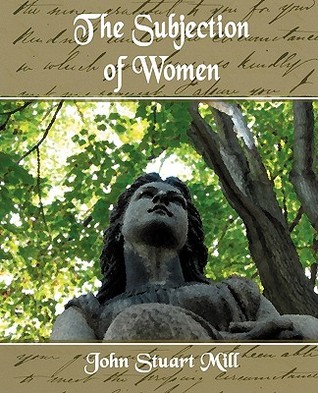
The tl;dr of what is being said – women are raised in a society that glorifies the toxic notion of femininity and the constellation of man pleasing behaviours that femininity entails (patriarchy anyone?). Surprisingly enough(?), this state of affairs is bad for women.
“Wollstonecraft concentrated on describing the state of ignorance and servility to which women were condemned by social custom and training. The passionate feeling with which her book is imbued give it wide social appeal and persuasive power. […] Wollstonecraft’s acute question – “how many generations may be necessary to give vigour to the virtue and talents of the freed posterity of abject slaves?’ – still has pertinence. “

Excerpts from A Vindication of the Rights of Woman –
“And if it be granted that women was not created merely to gratify the appetite of man, or to be the upper servant, who provides his meals and takes care of his linen, it must follow, that the first care of those mothers or fathers, who really attend to the education of females, should be, if not to strengthen the body, at least, not to destroy the constitution by mistaken notions of beauty and female excellence…
To preserve personal beauty, woman’s glory! the limbs and faculties are cramped with worse than Chinese bands, and the sedentary life which they are condemned to live, whilst boys frolic in the open air, weakens the muscles and relaxes the nerves. As for Rousseau’s remarks… that they have naturally, that is from their birth, independent of education, a fondness for dolls, dressing, and talking – they are so puerile as not to merit a serious refutation…
I have, probably, had an opportunity of observing more girls in their infancy that J.J. Rousseau – I can recollect my only feelings, and I have looked steadily around me; yet, so far with coinciding with him in opinion respecting the first dawn of the female character, I will venture to affirm, that a girl, whose spirits have not been damped by inactivity, or innocence tainted by false shame, will always be a romp, and the doll will never excite attention unless confinement allows her no alternative. Girls and boys, in short, would play harmlessly together, if the distinction of sex was not inculcated long before nature makes any difference. I will go further, and affirm, as an indisputable fact, that most of the women, in the circle of my observation, who have acted like rational creatures, or shown any vigour of intellection, have accidentally allowed to run wild… ”
-Ed. Miriam Schneir. Feminism: The Essential Historical Writings. pp 13 – 14.
Let it be known that in the 18th century the processes of female socialization were known to women. Fast forward to the present and we are still presented with arguments about how biology plays an overarching role in determining female social status in society. Of course, admitting that society and the socialization that goes along with it is inherently unjust to women, as opposed to calcified biological fact, would lead us to conclusion that society has been set up for the benefit of one sex, at the expense of the other. Social norms are malleable, biology not so much. I know which case I would rally around if I was trying to justify the inherent injustice that exists.
“In 1776, when the letters reprinted below were exchanged, John Adams was in Philadelphia attending the Continental Congress. Within months of receiving his wife’s request that the “new code of laws” give some consideration “to the ladies,” he was hard at work, with Thomas Jefferson, Benjamin Franklin and others drafting one of the world’s great statements of human liberty – the Declaration of Independence. Yet, for the rights of women, he could summon only a smile. “
(to John Adams)
 31 March, 1776. … in the new code of laws which I suppose it will be necessary for you to make, I desire you would remember the ladies and be more generous and favorable to them than your ancestors. Do not put such unlimited power into the hands of husbands. Remember, all men would be tyrants if they could. If particular care and attention is not paid to the ladies, we are determined to foment a rebellion, and will not hold ourselves bound by any laws in which we have no voice or representation.
That your sex are naturally tyrannical is a truth so thoroughly established as to admit of no dispute; but such of you as wish to be happy willingly give up the harsh title of master for the more tender and endearing one of friend. Why, then, not put it out of the power of the vicious and the lawless to use us with cruelty and indignity and impunity. Men of sense in all ages abhor those customs which treat us only as the vassals of your sex.
***
(to Abigail Adams)
14 April, 1776. As to your extraordinary code of laws, I cannot but laugh. We have been told that our struggle has loosened the bonds of government everywhere; that children and apprentices were disobedient; that schools and colleges were grown turbulent; that Indians slighted their guardians, and Negroes grew insolent to their masters. But your letter was the first intimation that another tribe, more numerous and powerful than all the rest, were grown discontented.
***
(to John Adams)
7 May, 1776. I cannot say that I think that you are very generous to the ladies; for, whilst you are proclaiming peace and good-will to men, emancipating all nations, you insist upon retaining an absolute power over wives. But you must remember that arbitrary power is like most other things which are very hard, very liable to be broken; and, notwithstanding all your wise laws and maxims, we have it in our power, not only to free ourselves, but subdue our masters, and, without violence, throw both your natural and legal authority at our feet; – “Charm by accepting, by submitting away, Yet have our humour most when we obey.”
Ed. Miriam Schneir. Feminism: The Essential Historical Writings. pp 3 – 4.
Well thanks for that John Adams. One might question your dedication to freedom, equality, and other shiny words that were bandied about at the time, considering the hearty F-you delivered to womenfolk. :/
History is awesome! So rich, so vibrant…and mostly so amazingly garbled and riddled with inaccuracies. Here today is a modest start in correcting the damage. :)

In the category of appalling but unsurprising when it comes to the exploitation of labour by capital, we have this “charming” vignette:
“Joy Lynn, who now co-owns the Whipple Company Store and has turned it into a museum, told Kline she has had as many 10 women visit the museum who referred to the third-floor space as “the rape room” because that is how the mine guards forced the women to pay for their shoes. “They would have to keep their mouths shut tight about what had happened to them upstairs,” Lynn said, because the mining companies would threaten to kick them out of their company-owned houses.”
[…]
Consider the time – this is when the free market was actually very close to being free – unhindered by government and all of its nasty regulations. This was also before the time of much of labour organization in the US. Unbridled power in any one segment of society leads to exploitation and abuse of people, yet as we stumble forward in the humble-bumble forced march of neo-liberalism, these are the sorts of conditions that await us.
“Since the publication of his article on Esau in Appalachian Heritage, Kline writes that “numerous accounts of institutionalized forced sexual servitude in the coal fields have surfaced.”
A woman from West Virginia told Harris and Kline a story about her great-grandmother who was “rented” to coal company agents at the age of 12. She would spend four to six months at a time in sexual servitude in coal camps. “And if the girls had babies, the babies would be taken and sold,” the woman said.
The girls and young women who were taken from their homes in West Virginia were called “comfort girls” or “comfort wives” during their time in servitude. The Japanese government followed the same model, forcing Korean and Chinese woman to work as “comfort women” during World War II. Japan has refused to apologize for forcing the women into sexual servitude, claiming the women were voluntary prostitutes. In West Virginia, state officials have never acknowledged the existence of this formal system of sexual servitude.
The West Virginia woman interviewed by Harris and Kline said her great-grandmother felt so desperate at the time that she did not have any qualms about selling her own babies. “I mean, if you’re a woman and the only thing you have to make money with is your body, and you end up pregnant, you can’t afford to feed that baby. So what are you going to do?” she said.
A woman who needed another week’s worth of groceries or needed new shoes would pay with their own bodies, the woman said.
“My sense is they weren’t ashamed,” Harris said about the exploited women. “It wasn’t something they were embarrassed about. It was very much in the same vein as the men going into the coal mine and taking risks they had no business taking. It’s like you do what you have to do to feed your family. They didn’t talk about it, but they certainly weren’t ashamed of it. Why would you be ashamed of feeding your kids?”
This is the sort of exploitation unfettered and unregulated capitalism can bring to people; it should not be a set of conditions that we aspire recreate.
[Quotes from Mark Hands essay: ‘Rape Rooms’: How West Virginia Women Paid Off Coal Company Debts. (via Counterpunch)]
 I’m almost done with Sorrows of Empire so I will stop deluging the blog with quotes, but I cannot forgo Johnson’s explanation of the mutating monster that Neo-liberalism is. I’d like to reproduce the entire chapter because it is that good, but instead we’ll look at how insidious neo-liberalism is when it comes to being critiqued by the intelligentsia residing in centres of Western power.
“It is critically important to understand that the doctrine of globalism is a kind of intellectual sedative that lulls and distracts its Third World victims while rich countries cripple them, ensuring that they will never be able to challenge the imperial powers. It is also designed to persuade the new imperialists that “underdeveloped” countries bring poverty on themselves thanks to “crony capitalism”, corruption, and a failure to take advantage of the splendid opportunities being offered. The claim that free markets lead to prosperity for anyone other than the transnational corporations that lobbied for them and have the clout and resources to manipulate them is simply not borne out by the historical record. As even the Nobel Prize winning economist Joseph Stiglitz, a former director of research at the World Bank, has come to acknowledge, “It is now a commonplace that the international trade agreements about which the United States spoke so proudly only a few years ago were grossly unfair to countries in the Third World… The problem [with globalists is] … their fundamentalist market ideology, a faith in free, unfettered markets that is supported by neither modern theory not historical experience.
[…]
There is no known case in which globalization has led to prosperity in any Third World country, and none of the world’s twenty-four reasonably developed capitalist nations, regardless of their ideological explanations, got where they are by following any of the prescriptions contained in globalization doctrine. What globalization has produced, in the words of de Rivero, is not NICs (newly industrialized countries) but about 130 NNEs (nonviable national economies) or, even worse, UCEs (ungovernable chaotic entities). There is occasional evidence that this result is precisely what the authors of globalization intended.
In 1841, the prominent German political economist Friedrich List (who had immigrated to America) wrote in his masterpiece, The National System of Political Economy, “It is a very common clever device that when anyone has attained the summit of greatness, he kicks away the ladder by which he has climbed up, in order to deprive others of the means of combing up after him.” Much of modern Anglo-American economics and all of the theory of globalization are attempts to disguise this kicking away of the ladder.
-Chalmers Johnson, Sorrows of Empire. p.262.
So really, colonialism by any other name… I’m so glad we’ve progressed so far.
We have truly breached new moral ground, made the world a safer place (for oligarchic capitalism), and ensured the continued well being of right class of people.
For more on ‘ladder kicking’ see Cambridge’s Ha-Joon Chang and his post on this very topic.
It seems like so few people understand the context of empire and how it affects American foreign policy. Let’s take a quick peek at Greece and how we treat fellow democracies when it comes to maintaining ‘interests of state’.
“In the case of Spain there is some plausibility to the argument that the United States had to deal with the leader that it found there, even if he happened to be a fascist. But the story was different in Greece. We helped bring the militarists to power there, and the legacy of our complicity still poisons Greek attitudes toward the United States. There is probably no democratic public anywhere on earth with more deeply entrenched anti-American views than the Greeks. The roots of these attitudes go back to the birth of the Cold War itself, to the Greek civil war of 1946 – 49 and the U.S. decision embodied by the Truman Doctrine to intervene on the neofascist side because the wartime Greek partisan forces had been Communist-dominated. In 1949, the neofascists won and created a brutal right-wing government protected by the Greek secret police, composed of officers trained in the United States by the wartime Office of Strategic Services and its successor, the CIA.
[…]

All you need to know from U.S. President Lyndon Baines Johnston about promoting peace and democracy abroad. – “Fuck your parliament and your constitution. We pay a lot of good American dollars to the Greeks. If your prime minister gives me talk about democracy, parliament, and constitution, he, his parliament, and his constitution may not last very long.”
In February of 1964, George Papandreou was elected prime minister by a huge majority. He tried to remain on friendly terms with the the Americans, but President Lyndon Johnson’s White House was pressuring him to sacrifice Greek interests on the disputed island of Cyprus in favour of Turkey, where the United States was also building military bases. Both Greece and Turkey had been members of NATO since 1952, but by the mid – 1960’s the United States seemed more interested in cultivating Turkey. When the Greek ambassador told President Johnson that his proposed solution to the Cyprus dispute was unacceptable to the Greek parliament, Johnson reportedly responded, “Fuck your parliament and your constitution. We pay a lot of good American dollars to the Greeks. If your prime minister gives me talk about democracy, parliament, and constitution, he, his parliament, and his constitution may not last very long.” And they did not.
The CIA, under its Athens station chief, John Muary, immediately began plotting with Greek military officers they had trained and cultivated for over twenty years. In order to create a sense of crisis, the Greek intelligence service, the KYP, carried out an extensive program of terrorist attacks and bombings that it blamed on the left. Constantin Costa-Gavras’s 1969 film, Z, accurately depicts those days. On April 21, 1967, just before the beginning of an election campaign that would have returned Papandreou as prime minister, the military acted. Claiming they were protecting the country from a communist coup, a five-man junta, four of whom had close connections with either the CIA or the U.S. military in Greece, established one of the most repressive regimes sponsored by either side during the Cold War.
The “Greek colonels”, as they came to be known, opened up the country to American missile launch sites and espionage bases, and they donated some $549,000 to the Nixon-Agnew election campaign.
[…]
The leader of the junta, Colonel George Papadopoulos, was an avowed fascist and admirer of Adolf Hitler. He had been trained in the United States during World War II and had been on the CIA payroll for fifteen years preceding the coup. His regime was noted for it’s brutality. During the colonel’s first month in power some 8,000 professionals, students, and others disliked by the junta were seized and tortured. Many were executed. In 1969, the eighteen member countries of the European Commission of Human Rights threatened to expel Greece – it walked out before the commission could act -but even this had no effect on American policies. “
-The Sorrows of Empire – Chalmers Johnson. pp. 204 – 206
Just in case you were unsure of how realpolitik worked and in need of your levels of depression and ennui topped up.











 bleatmop
 Mystro
 The Arbourist


 Dead Wild Roses
Your opinions…