
You are currently browsing the tag archive for the ‘Idealism’ tag.
Critical theory, as articulated by James Lindsay and rooted in the Frankfurt School’s intellectual project, forms the corrosive core of contemporary “woke” ideology. At its heart, it is not a constructive framework for social improvement but a methodological commitment to negation. Its aim is not to diagnose specific problems and propose reforms, but to discredit existing social arrangements by measuring them against an imagined standard of perfection that its own architects say cannot be positively described.
This orientation traces back to Max Horkheimer’s 1937 essay Traditional and Critical Theory. Traditional theory, he argued—drawing from the natural sciences and classical philosophies—engages with observable reality and grapples with the inevitable trade-offs embedded in human life. Critical theory rejects this approach. It evaluates the real world not against empirical evidence or feasible alternatives, but against a speculative ideal that can never be fully articulated, let alone realized. In 1969, Horkheimer reaffirmed this openly: because the ideal society cannot be conceptualized in existing terms, the only available activity is relentless critique of whatever exists. In effect, the real world is condemned for being real.
This negative idealism weaponizes the gap between the actual and the imaginary. Real societies, by necessity, require trade-offs: freedom of speech permits offensive speech; environmental protection imposes economic and temporal costs; social order requires rules, hierarchies of competence, and constraints on behavior. Critical theory interprets these trade-offs not as inherent features of human life but as intolerable flaws. It provides no functional replacement for what it seeks to dismantle. Instead, it declares that racism, class division, penal systems, borders, gender norms, or any designated “problematic” ought not to exist in the ideal world. Everything short of that unreachable ideal becomes proof of systemic oppression.
By measuring the real against an impossible standard, critical theory does not reform institutions—it erodes their legitimacy. It fosters perpetual grievance while strategically withholding any concrete alternative that could be scrutinized, tested, or judged by the same standards it applies to the world.
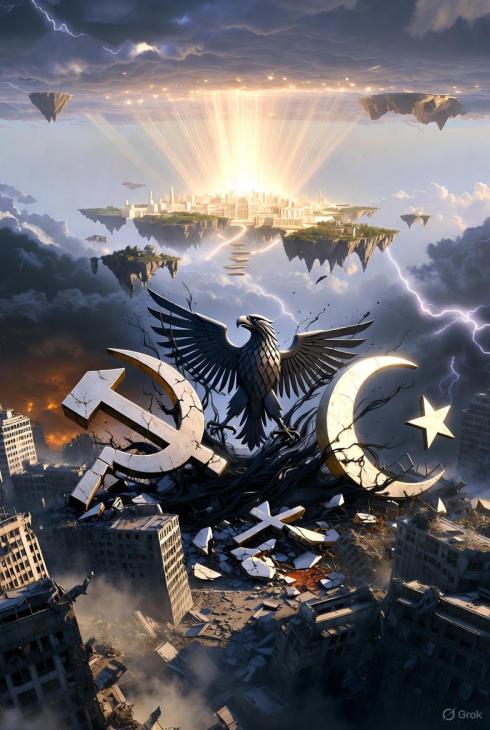
James Lindsay identifies three major historical ideologies that employ this same pattern of negative utopianism: communism, fascism, and political Islam. The claim is not that these movements are identical, but that they exhibit the same critical-theoretical structure:
- Communism imagines a stateless, classless society populated by “socialist man,” a type of human being who does not yet exist. Until such a person emerges, every tradition, institution, and authority is condemned as perpetuating exploitation.¹
- Fascism posits a perfectly ordered national or racial hierarchy unified around the mythic volk. Anything cosmopolitan, liberal, or “degenerate” is denounced as a betrayal of that utopian unity.²
- Political Islam (in its revolutionary form) imagines global submission to divine law. The present age is delegitimized as jahiliyyah—ignorance—and therefore unworthy of loyalty until the ideal community is imposed.³
In each case, the ideal is defined primarily by what it negates: capitalism, decadence, unbelief. And in each case, the historical results were catastrophic: gulags, war, genocide, theocratic oppression. The ideal was literally u-topian—“no place.”
Critical theory operates on precisely the same logic. Its power lies in inflaming resentment, undermining trust in existing institutions, and inducing a permanent revolutionary consciousness. It teaches adherents to view every tradition, norm, and hierarchy as illegitimate simply because it exists. It replaces trade-offs with absolutist moral demands, and flaws with indictments. It offers no blueprint for construction—only a sophisticated toolkit for deconstruction.
This is why contemporary “woke” politics behaves as it does. The endless denunciations of “systems,” “structures,” and “hegemonies”; the refusal to offer workable solutions; the moral absolutism; the perpetual expansion of grievance categories; the inability to articulate what a healthy society would look like—all reflect the same methodological negation that Horkheimer enshrined. It is criticism without end, and without responsibility.
Critical theory, in this sense, is not a path to reform but a program of societal disintegration. By demanding the impossible and attacking the real for failing to produce perfection, it generates only dissatisfaction, conflict, and institutional decay. The historical record is unambiguous: no system built on a negative utopia has ever produced anything but rubble.
To embrace critical theory is to wage war on reality under the banner of a perfection that cannot exist. That is why it must be understood clearly—and rejected root and branch.
Citations
Primary Critical Theory Sources
- Max Horkheimer, Traditional and Critical Theory (1937).
- Max Horkheimer, Critical Theory: Selected Essays (1969).
- Herbert Marcuse, One-Dimensional Man (1964).
- Jürgen Habermas, Knowledge and Human Interests (1968).
- Theodor W. Adorno, Negative Dialectics (1966).
Historical Ideology Sources
6. Karl Marx & Friedrich Engels, The German Ideology (1846); Critique of the Gotha Program (1875).
7. Benito Mussolini & Giovanni Gentile, The Doctrine of Fascism (1932).
8. Sayyid Qutb, Milestones (1964) — foundational for modern political Islam.
9. Ruhollah Khomeini, Islamic Government (1970).
Secondary Sources / Contemporary Analysis
10. James Lindsay, Cynical Theories (with Helen Pluckrose, 2020).
11. James Lindsay, The Marxification of Education (2023).
12. Roger Scruton, Fools, Frauds and Firebrands (2015).
13. Paul Gottfried, The Strange Death of Marxism (2005).
14. Mark Lilla, The Reckless Mind (2016).
15. John Gray, Black Mass: Apocalyptic Religion and the Death of Utopia (2007).
Glossary of Key Terms
Critical Theory – An ideological project originating with the Frankfurt School that critiques society against an impossible ideal rather than proposing practicable reforms.
Negative Idealism – Measuring reality against a utopia that cannot be articulated or realized.
Utopia – Literally “no place”; an imagined perfect society used as a moral weapon against the real world.
Hegemony – Antonio Gramsci’s concept of cultural dominance; used by CT to claim that norms and values are tools of oppression.
Structural Oppression – The assertion that unjust outcomes are produced by hidden systems rather than individual actions.
Standpoint Epistemology – The belief that knowledge is tied to identity; “lived experience” is epistemically privileged.
Praxis – Activism embedded into theory; in CT, the idea that theory must produce political action.
Reification – A Marxist term meaning the naturalization of social constructs; used to claim that institutions disguise power.
Signs You Are Encountering Critical Theory in Real Life
Here are the typical markers:
1. The language of systems and structures
Phrases like:
- “systemic oppression”
- “institutional racism”
- “hegemonic norms”
- “structures of privilege”
These shift blame from individuals to invisible systems.
2. Demands for perfect equity, not equality
If disparities alone are treated as dispositive evidence of injustice, CT is operating.
3. Appeals to lived experience as decisive evidence
Personal narrative is elevated above data or argument.
4. Moral asymmetry between groups
Some identities are framed as inherently oppressive; others as inherently oppressed.
5. Critique without end, without alternatives
If someone deconstructs everything but proposes nothing testable or concrete, it’s CT.
6. Rebranding ordinary conflict as oppression
If disagreement is treated as harm, and harm as violence, CT is at work.
7. The “if it exists, it’s oppressive” rule
Traditions, norms, meritocracy, law, biology—all treated as power structures.
How to Deal With Critical Theory in an Argument
Critical Theory arguments do not operate on normal rules of evidence or rational debate. Here’s how to engage effectively, calmly, and persuasively.
1. Reintroduce Trade-Offs
CT denies trade-offs. Bring them back.
“Every policy choice has costs—what trade-offs are you proposing in exchange for your solution?”
This forces concreteness.
2. Ask for Positive Alternatives
CT collapses when it must define what it wants.
“If the current system is oppressive, what specific system would you replace it with? How would it work in practice?”
Make them articulate the utopia in concrete terms. They rarely can.
3. Reject Claims Based Solely on Disparity
Demand causal reasoning.
“A disparity doesn’t automatically indicate discrimination. What evidence shows a causal link?”
This moves the debate from ideology to empiricism.
4. Expose Moral Asymmetry
Ask:
“Why are only some groups moralized? Do individuals still have agency?”
This undermines the oppressor/oppressed binary.
5. Clarify Definitions
CT thrives on shifting definitions.
Ask:
- “What do you mean by racism?”
- “How are you defining harm?”
- “What counts as violence?”
Pinning down definitions prevents concept-hopping.
6. Refuse Standpoint Epistemology
Challenge the epistemic claim:
“Lived experience matters, but it’s not a substitute for evidence. How can we verify your claim?”
This resets the terms of rational inquiry.
7. Separate Compassion From Ideology
Many people adopt CT-infused ideas because they want to be good.
Tell them:
“Your moral concern is admirable. CT is not the only—or even the best—way to address injustice.”
This opens space for alternatives and lowers defensiveness.
Why do societies slide toward tyranny when they pursue utopia? (TL;DR)
The Scales of Society argues that the real divide in politics isn’t left versus right, but realism versus idealism. When truth yields to belief, coercion follows. From communism and fascism to modern moral crusades, history warns that abandoning objective reality tips civilization toward totalitarianism. The balance must be restored—anchored in realism, humility, and truth.
In the landscape of political philosophy, metaphors serve as intellectual scaffolding—structures that help us grasp dynamics too intricate for direct depiction. The familiar political compass, with its left–right and liberty–authority axes, sketches ideological positions but fails to reveal the deeper fracture driving modern polarization. A more illuminating image is that of a balance scale. Its crossbar represents philosophical realism—the recognition of an objective reality—while the suspended pans embody the idealist extremes of communism and fascism. This model captures not just polarization but the gravitational descent into totalitarianism that occurs when societies abandon reality for utopia.
The Core Divide: Realism vs. Idealism
Realism begins with the premise that reality exists independently of human will or perception. The wall remains whether one believes in it or not, and collision has consequences indifferent to ideology. This external order imposes limits: progress requires trade-offs, and perfection is impossible. The realist accepts these constraints, submitting theories to verification through evidence, reason, law, and experience. Responsibility and competence—not vision or zeal—earn authority.
Idealism inverts this relationship. It treats reality as a projection of consciousness, imperfect but malleable. If perception shapes the world, then changing minds can remake existence. Truth becomes what society collectively affirms. This impulse, when politicized, leads toward social constructivism and, inevitably, coercion: those who refuse to affirm the “truth” must be re-educated or silenced. A contemporary example can be seen in gender ideology, where subjective identity claims are enforced as social fact through compelled speech and institutional conformity. The point is not about gender per se but about the pattern: belief overriding biology through social pressure rather than persuasion.
The Platonic ideal—perfect, transcendent, and abstract—becomes the new absolute. The imperfect, tangible world must be reshaped until it conforms. Once utopia is imagined as possible, coercion becomes inevitable, for someone must ensure that all comply with the ideal.
The Scale and Its Balance
The realist crossbar allows for movement and balance. One may lean left toward egalitarianism, right toward hierarchy and tradition, or find equilibrium between the two. Disputes are adjudicated by verifiable standards: evidence, empirical data, or, for the religious, revelation interpreted through disciplined exegesis. Justice is blind, authority is earned, and failure prompts responsibility rather than revolution.
From that crossbar hang the chains leading to the pans—communism on the left, fascism on the right. Each represents idealism in a different costume. Descent is gradual, a shimmy downward from realism into partial idealism, then freefall into extremism. The pans have no centers: in a world of pure ideals, moderation cannot hold.
Communism imagines a belief-driven utopia—re-educate humanity into “species-being” beyond property or conflict, and paradise will emerge. Fascism demands obedience to a mythic hierarchy—sacrifice self for the community’s glory, and unity will prevail. Both subjugate reality to ideology: when facts resist, facts are crushed. From the perspective of either pan, the realist crossbar appears as the enemy’s support beam. Each seeks to destroy it, believing that only by breaking the balance can truth be realized.
Polarization and the Descent
As tension mounts, the scale begins to swing. Idealists radicalize when realism resists persuasion—utopia seems attainable but for “obstructionist” constraints. In frustration, anti-fascism justifies communism; anti-communism, fascism. The center thins as factions define themselves by opposition rather than truth. The political becomes existential: the other side must be destroyed, not debated. The mechanisms of verification—law, science, journalism, reasoned discourse—collapse under pressure. Force replaces evidence; propaganda replaces persuasion.
History confirms the pattern. The twentieth century saw communism outlast fascism, not because it was less violent but because it sold coercion through promises of emancipation. Fascism, with its naked appeal to dominance, exhausted itself; communism cloaked tyranny in moral idealism. Both ended in mass graves.
Left and Right: The Limits of Tolerance
The realism–idealism axis cuts deeper than the traditional left–right divide. The left tends toward anti-traditionalism and radical egalitarianism, seeking liberation through the dissolution of hierarchy and norm. The right inclines toward tradition and hierarchy, valuing stability and inherited order. Each contains wisdom and danger.
Tradition carries epistemological weight: customs that survive generations have proven utility—Chesterton’s fence stands until one understands why it was built. Yet tradition can ossify, defending arbitrariness or prejudice. Egalitarianism corrects injustice but becomes destructive when it denies the functional necessity of hierarchy. Even lobsters, as Jordan Peterson once observed, form dominance orders; structure is not oppression but biology. When hierarchy is treated as sin and equality as salvation, society drifts from realism into moral mythology.
The Peril of Idealism
Idealism’s danger is not merely its optimism but its refusal to recognize limits. When imagination detaches from reality, coercion rushes in to bridge the gap. The ideal cannot fail; only people can. Those who resist must be “re-educated” or “deprogrammed.” What begins as moral vision ends as total control.
The cure is humility—a willingness to let facts instruct rather than ideology dictate. Repentance, in the philosophical sense, means returning from illusion to reality, subordinating theory to evidence and loving wisdom without claiming omniscience. Realism requires courage: to see, to accept, and to act within the bounds of what is possible.
Lessons from the Twentieth Century and Beyond
The horrors of the last century—gulags, purges, and genocides—were not aberrations but logical conclusions of idealism unmoored from realism. Communism and fascism both promised transcendence from the human condition; both delivered degradation. Today, similar impulses reappear in moralized movements on left and right that treat disagreement as heresy and consciousness as the final battleground. These are not new phenomena but recycled idealisms—different symbols, same metaphysics.
In an era of manufactured crises and moral crusades, the scales remind us: cling to the crossbar. Only realism—anchored in evidence, bounded by humility, and guided by verifiable truth—permits tolerance, adaptation, and progress. When the crossbar breaks, society plunges into the abyss, and one pan’s triumph becomes delusion for all.

References
- Arendt, Hannah. The Origins of Totalitarianism. New York: Harcourt Brace, 1951.
- Burke, Edmund. Reflections on the Revolution in France. London: J. Dodsley, 1790.
- Chesterton, G.K. The Thing: Why I Am a Catholic. London: Sheed & Ward, 1929.
- Lewis, C.S. The Abolition of Man. London: Oxford University Press, 1943.
- Lindsay, James. Left and Right with Society in the Balance. New Discourses Lecture, 2025.
- Peterson, Jordan B. 12 Rules for Life: An Antidote to Chaos. Toronto: Random House, 2018.
- Popper, Karl. The Open Society and Its Enemies. London: Routledge, 1945.
- Voegelin, Eric. The New Science of Politics. Chicago: University of Chicago Press, 1952.
The Western world needs to give its collective head a shake and *not* celebrate terrorism. The conclusion from Benjamin’s essay published on The Free Press.
“How wrong I was. This past week, as over 1,300 Jews were slaughtered, the most murderous attack on Jews since the Holocaust, I saw the true face of Palestinians and their allies. All around the world, they celebrate. They gloat. They mock our tears. They do not protest against Hamas. They embrace pure evil.
And so, to the terrorists I now say:
When you killed my family, I forgave you. When you killed my people, I forgave you. But when you killed my idealism, I had no forgiveness left.
To non-Jewish friends who have reached out, thank you. It is simply the human thing to do. To friends who dare justify what has happened, you are not friends. You are nothing but Nazi supporters dressed up in leftist intellectual language. To the Palestinians: you have lost all moral authority to claim victimhood. I will never advocate for you again. To my family, friends in Israel, and Jews around the world hurting right now, I love you. Stay safe.
In Berlin, where I live today with my German-Ukrainian Jewish wife, Germans love to say “Never Again.” Right now, Never Again is happening again in real time, livestreamed for the whole world to see. I find myself looking up my military number in case the IDF reserves call for me. Unlike our enemy, I feel no joy at the prospect of going to war. But if our people’s existence is at stake, I will do what I must. I will be the world’s favorite villain: the Jew who has the audacity to defend his people.”











 bleatmop
 Mystro


 Dead Wild Roses
Your opinions…