
You are currently browsing the tag archive for the ‘Identity Politics’ tag.
Policing in Canada has historically been grounded in the principle of equality under the law, where all individuals, regardless of identity, are subject to the same legal standards and enforcement practices. However, recent shifts in policy, training, and public discourse suggest that Canadian policing is increasingly adopting a model that applies different standards based on identity categories such as race, ethnicity, gender, and socioeconomic status. This evolution is driven by a combination of social justice movements, government directives, and institutional reforms aimed at addressing systemic inequalities. While intended to rectify historical disparities, this approach raises questions about consistency and impartiality in law enforcement.
One clear indicator of this shift is the implementation of race-based data collection by police services across Canada. Initiated in response to allegations of racial profiling, agencies like the Toronto Police Service and the Ontario Provincial Police began collecting and analyzing data on the race of individuals stopped, questioned, or arrested, starting with pilot projects around 2019 and expanding since then. The stated goal is to identify and address “disproportionate” enforcement patterns, particularly against Black, Indigenous, and other racialized groups. While this data has confirmed higher rates of police interaction for certain communities—such as a 2020 Toronto report showing Black individuals were 2.2 times more likely to be involved in use-of-force incidents—it has also led to tailored policing strategies that adjust scrutiny or leniency based on racial identity rather than uniform application of the law.
Training and policy changes further illustrate this trend toward differential standards. Following high-profile incidents like the 2020 death of Regis Korchinski-Paquet and subsequent Black Lives Matter protests, Canadian police forces have overhauled training to emphasize “de-escalation” and “cultural competency,” often with specific focus on interactions with Indigenous and racialized populations. For instance, the RCMP introduced mandatory “bias-free policing” modules by 2022, which instruct officers to consider historical trauma and systemic factors when engaging with certain groups. While these measures aim to reduce harm, they implicitly encourage officers to alter their approach—sometimes reducing enforcement rigor—based on an individual’s perceived identity, diverging from a strictly neutral standard.
Legal and governmental frameworks also support this shift. In 2023, Bill C-92, an Act respecting First Nations, Inuit, and Métis children, youth, and families, effectively granted Indigenous communities greater autonomy over child welfare, including policing-related interventions, creating a parallel system distinct from mainstream enforcement. Similarly, hate crime laws and sentencing guidelines increasingly factor in identity-based considerations, with offenders targeting “vulnerable” groups facing harsher penalties, while enforcement in marginalized communities is often softened to avoid perceptions of over-policing. This dual-track approach—tougher on some, lighter on others—reflects a deliberate move away from universal standards toward identity-specific policing practices.
Finally, public and institutional pressure continues to reinforce this trajectory. Advocacy groups, such as the Canadian Association of Black Lawyers and Indigenous rights organizations, have successfully lobbied for policies that treat identity as a mitigating factor in policing. Reports like the 2021 Missing and Murdered Indigenous Women and Girls Inquiry explicitly called for reduced police intervention in Indigenous communities, alongside increased accountability for officers dealing with these populations. Meanwhile, urban police forces face scrutiny for “over-policing” racialized neighborhoods, prompting initiatives like Toronto’s 2024 “Community Crisis Support Service,” which diverts mental health calls involving racialized individuals away from police entirely. These developments signal a broader trend: policing in Canada is increasingly calibrated to identity, balancing equity goals against the traditional ethos of equal enforcement. Whether this enhances justice or undermines fairness remains a point of contention.

In Maoist China, the regime employed a rigid system of identity categories to divide and control the population, most notably through the “red” and “black” classifications. The “red” category included those deemed loyal to the Communist Party—workers, peasants, and revolutionary soldiers—while the “black” category encompassed perceived enemies of the state, such as landlords, capitalists, and intellectuals. These labels were not mere descriptors but tools of social engineering, designed to pit groups against one another, justify purges, and dismantle traditional societal bonds. By fostering resentment and mistrust, Mao’s identity politics eroded community cohesion, replacing it with a fractured hierarchy where allegiance to the state superseded all else, ultimately destabilizing Chinese society for decades.
Fast forward to the present, and the “woke” identity categories of today—centered around race, gender, sexuality, and privilege—bear a striking resemblance to Mao’s framework, though cloaked in progressive rhetoric. Instead of “red” and “black,” we have “oppressor” and “oppressed,” with whiteness, maleness, or heterosexuality marking one as inherently guilty, while marginalized identities confer moral superiority. Like their Maoist predecessors, these categories are weaponized to sow division, encouraging individuals to see themselves and others primarily through the lens of grievance or shame. The result is a society obsessed with policing language, canceling dissenters, and dismantling shared cultural norms under the guise of justice, mirroring the Cultural Revolution’s assault on tradition and unity.
The broader point is that identity politics, whether Maoist or woke, are not about liberation but destruction. By reducing individuals to immutable traits or ideological loyalty, they fracture the social fabric, turning neighbors into adversaries and dialogue into denunciation. This corrosion serves those in power—be it a totalitarian regime or a cultural elite—by weakening collective resistance and redirecting energy toward internal conflict. Both systems reveal a timeless truth: when identity becomes the battleground, society itself becomes the casualty, leaving behind a hollowed-out shell ripe for manipulation and control.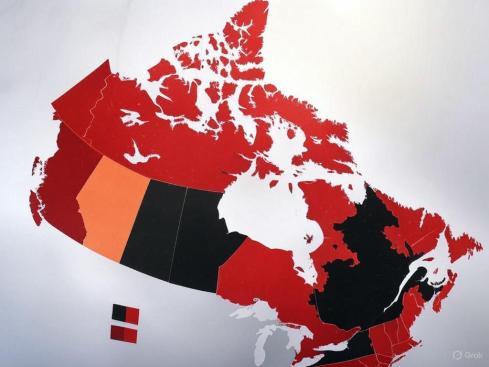
“Soon, I learned about nonbinary identities, and that some people – many people – were literally arguing that sex, not gender, was a social construct. I met people who evangelised a denomination of transgenderism that I had never heard of, one that included people who had never been gender dysphoric and who had no desire to medically transition. I met straight people whose ‘trans / nonbinary’ identities seemed to be defined by their haircuts, outfits and inchoate politics. I met straight women with Grindr accounts, and listened to them complain about the ‘transphobic’ gay men who didn’t want to have sex with women.
All around me, it seemed, straight people were spontaneously identifying into my community and then policing our behaviours and customs. I began to think that this broadening of the ‘trans’ and ‘queer’ umbrella was giving a hell of a lot of people a free pass to express their homophobia.
At Columbia, I took classes on LGBT history, but much of that history was delivered through the lens of queer theory. Queer theorists appropriate French philosopher Michel Foucault’s ideas about the power of language in constructing reality. They argue that homosexuality didn’t exist prior to the late 19th century, when the word ‘homosexual’ first appeared in medical discourse. Queer theorists proselytise a liberation that supposedly results from challenging the concepts of empirical reality and ‘normativity’. But their converts instead often end up adrift in a sea of nihilism. Queer theory, which has become the predominant method of discussing and analysing gender and sexuality in universities, seemed to me to be more ideological than truthful.
In my classes on gender and sexuality in the Muslim world, however, I discovered something else, too. I learned about current medical practices in Iran, where gay sex is illegal and punishable by death, and where medical transition is subsidised by the state to ‘cure’ gays and lesbians who, the theocratic elite insists, are ‘normal’ people ‘trapped in the wrong bodies’. I privately drew parallels between the anti-gay laws and practices of Iran and what I saw developing in the West, but I convinced myself I was just being paranoid.
Then, I learned about what was happening to gender-nonconforming kids – that they were being prescribed off-label drugs to halt their natural development, so that they’d have time to decide if they were really transgender. If so, they would then be more successful at passing as the opposite sex in adulthood. Even worse, I learned that these practices were being touted by LGBT-rights organisations as ‘life-saving medical care’.
It felt like I was living in an episode of The Twilight Zone. How long were these kids supposed to remain on the blockers? And what happens in a few years, if they decide they’re not ‘truly trans’ after all, and all of their peers have surpassed them? Are they seriously supposed to commence puberty at 16 or 17 years of age? These questions rattled my brain for months, until I learned the actual statistics: nearly all children who are prescribed puberty blockers go on to receive cross-sex hormones. Blockers don’t give a kid time to think. They solidify him in a trans identity and sentence him to a lifetime of very expensive, experimental medicalisation.
I wondered how different these so-called trans kids were from the little boy I had been. Obviously, I grew up to be a gay man and not a transwoman. But how could gender clinicians tell the difference between a young boy expressing his homosexuality through gender nonconformity, and someone ‘born in the wrong body’? I decided to dig deeper into the real history of medical transition.”
He draws direct comparisons between the Neo-Marxists of today, to those of yesteryear.
Identity politics serves to corrupt the notions of morality, common sense, and what it means to live in a society under the rule of law. This is a brief examination of a twitter thread I stumbled across about the recent cases of Catholic Churches being burnt down as misguided retaliation for the residential school system that was in place in Canada.
” SASKATOON — A former Polish Roman Catholic church in rural Saskatchewan was destroyed by fire Thursday.
The church was located near Redberry Lake, which is about 80 kilometres northwest of Saskatoon.
Lynn Swystun, who lives about a mile and a half west of the church, says she noticed smoke from her yard around 12:15 p.m. then drove to the area and discovered the church engulfed in flames.”
Now here is where it gets interesting, this is a response to the story.
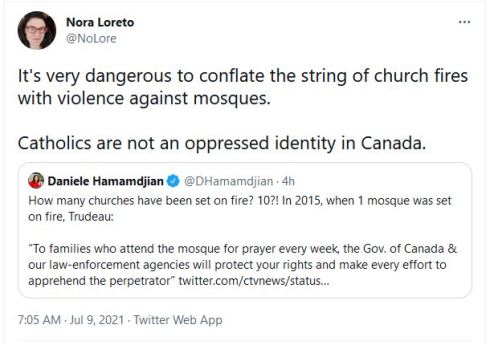
Wait, what? Where exactly is the conflation happening? Damage to places of worship, in my books, is damage to places of worship. But apparently, in Nora’s world, your identity is also somehow a factor that should be used to categorize the level of violence, determining whether the violence is ‘valid’ or not.
If you’ve been with us here DWR you know that I’m not exactly the biggest supporter of organized religion and all the tomfoolery it is responsible for. But, even being the anti-religious soul that I am, I wouldn’t attempt to order and rank attacks on places of worship into ‘worthy’ and ‘less worthy’ categories.
What kind of internal moral compass is Nora going by here?

The hell? It isn’t a hate crime to burn down a place of worship because of a political/ideological motivation? And, yes the actions of the Catholic Church are indeed pretty horrible, but burning down a church is not how we express our displeasure in a nominally civilized society that values the rule of law.

Just in case if you missed it. This is the moral wasteland that much of identity politics leads to. The level of oppression Catholics face in our society is irrelevant the crime that has been committed. Burning down a church is arson. Arson is against the law, for good reason, in our society. There is no “good” or “valid” arson permissible if one wants to live in a reasonable law abiding society.

Do you see it there? The bullshit notion that there are differing levels of ‘arsonability’ based on your identity in society (of course it comes from a pronouns bio *smh*). Err no. There is no fucking way this paradigm can work if we want society as we know it to work. Past oppression does not mean a free pass when you break the law.
Is protest a part of a democratic society, absolutely. It is our civic duty to keep our political class in check and in tune with needs of the people. Arson, however, is not one of those methods that should not be considered acceptable in society as a path to change.
The bullshit has finally start to overflow the gunwales. Lefty dudes that are not directly part of the high trans-inquisition are feeling – all at once – perturbed and miffed that they are not being heard and even villified for believing in what was once considered the ideals of the Left. One can tell when it really bad when it finally starts affecting the men. (???)

Such dark times. And so suddenly, seemingly out of NOWHERE…

Movement toward excising the cancer that is identity politics might start gaining some traction, as the class of people who matter(!) are now being effected.











 bleatmop
 Mystro


 Dead Wild Roses
Your opinions…