
You are currently browsing the tag archive for the ‘JK Rowling’ tag.
The New York Times has a great opinion piece on the wrongful demonization of JK Rowling. Her crime? Standing up for the rights of women.
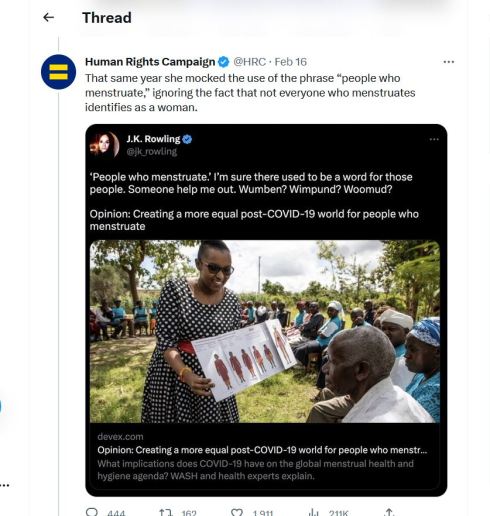
“This campaign against Rowling is as dangerous as it is absurd. The brutal stabbing of Salman Rushdie last summer is a forceful reminder of what can happen when writers are demonized. And in Rowling’s case, the characterization of her as a transphobe doesn’t square with her actual views.So why would anyone accuse her of transphobia? Surely, Rowling must have played some part, you might think.The answer is straightforward: Because she has asserted the right to spaces for biological women only, such as domestic abuse shelters and sex-segregated prisons. Because she has insisted that when it comes to determining a person’s legal gender status, self-declared gender identity is insufficient. Because she has expressed skepticism about phrases like “people who menstruate” in reference to biological women. Because she has defended herself and, far more important, supported others, including detransitioners and feminist scholars, who have come under attack from trans activists. And because she followed on Twitter and praised some of the work of Magdalen Berns, a lesbian feminist who had made incendiary comments about transgender people.
You might disagree — perhaps strongly — with Rowling’s views and actions here. You may believe that the prevalence of violence against transgender people means that airing any views contrary to those of vocal trans activists will aggravate animus toward a vulnerable population.But nothing Rowling has said qualifies as transphobic. She is not disputing the existence of gender dysphoria. She has never voiced opposition to allowing people to transition under evidence-based therapeutic and medical care. She is not denying transgender people equal pay or housing. There is no evidence that she is putting trans people “in danger,” as has been claimed, nor is she denying their right to exist.Take it from one of her former critics. E.J. Rosetta, a journalist who once denounced Rowling for her supposed transphobia, was commissioned last year to write an article called “20 Transphobic J.K. Rowling Quotes We’re Done With.” After 12 weeks of reporting and reading, Rosetta wrote, “I’ve not found a single truly transphobic message.” On Twitter she declared, “You’re burning the wrong witch.”
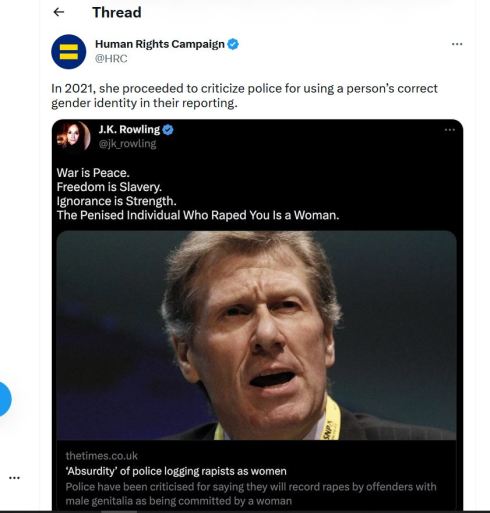
The amazing level of delusion that is present in the the Human Rights Campaign. This is what institutional capture looks like an unhinged denial of reality willing to go to almost any length in an attempt to smear and defame a woman for speaking about the material reality we all share.
If you worry about a rapists ‘correct’ pronouns you really have lost your moral centre and need to seriously reevaluate the so called ‘progressive’ norms you’ve adopted.
See the entire list here.

3 – JK Rowling
JK Rowling is almost certainly the greatest writer of English children’s fiction of her generation, and a remarkable humanitarian. It turns out she writes exhilaratingly powerful prose too.
In a blog about the transgender debate, she offended many people. Offence is the price of free speech. Those offended felt she was questioning their identity and even attacking their human rights, which they argue is a form of discrimination or hate speech.
I take absolutely no view whatsoever on the issues that she raises.
I do take an issue on abuse and trolling, and Rowling has achieved the inglorious honour of topping many a league table for those. The deluge of hatred that she faced before writing this blog made it brave, and it was nothing compared to what came after. Talking about bravery, so too, by the way, was Suzanne Moore’s engrossing, long, personal essay for Unherd on why she left the Guardian.
We should all applaud bravery in writers – even those with whom we disagree. And Rowling’s essay contained moments of both real beauty and piercing honesty, as when she revealed that she is a survivor of domestic abuse and sexual assault.
What the judges – that is, the voices in my head – most admired about the writing was the plain English. It is an interesting fact about rhetoric that if you want people to understand something, plain, mono-syllabic words are usually your best bet: “Ask not what your country can do for you; ask what you can do for your country”.
Or think of the final line from Enoch Powell’s most notorious speech: “All I know is that to see, and not to speak, would be the great betrayal.”
I’m not endorsing the argument; but the rhetorical power of that line comes from the fact that there are 16 words, the first 15 of which have one syllable, and the last of which has three.
Compare it with this line in Rowling’s essay: “So I want trans women to be safe. At the same time, I do not want to make natal girls and women less safe.”
The rhetorical power from those two sentences derives partly from the plainness of the English. Only “women” (twice) and “natal” contain more than one syllable.
If you’re ever editing copy that seems verbose, go through it and think about cutting syllables while conveying the same meaning. Plain English has power. JK Rowling gets that.











 bleatmop
 Mystro
 The Arbourist


 Dead Wild Roses
Your opinions…