
You are currently browsing the tag archive for the ‘Michael Klare’ tag.
Well I’d like to change the channel from the Pandemic Gloom & Doom to the similarly depressing and helplessness inducing topic of climate change. The actors in feel similar in both channels, for instance, the vaccinated can only sit by and watch as the ignorant anti-vax crowd spreads Covid-19 to each other and fills the ICU wards past capacity. Concomitantly we can observe China and the US vie for world dominance economically and militarily while continuing to put stunning amounts of greenhouse gasses into the atmosphere, catastrophically heating the planet.
Micheal Klare sets out the bare-bones minimum guidelines to avert the upcoming climate catastrophe. Unfortunately said guidelines involve China and the US backing down from their military buildups, finding a peaceable solution to Taiwan, and focusing their economies on moving away from using fossil fuels.
Awesome. No problem. We got this…
“Only when China and the United States elevate the threat of climate change above their geopolitical rivalry will it be possible to envision action on a sufficient scale to avert the future incineration of this planet and the collapse of human civilization. This should hardly be an impossible political or intellectual stretch. On January 27th, in an Executive Order on Tackling the Climate Crisis, President Biden did, in fact, decree that “climate considerations shall be an essential element of United States foreign policy and national security.” That same day, Secretary of Defense Lloyd Austin issued a companion statement, saying that his “Department will immediately take appropriate policy actions to prioritize climate change considerations in our activities and risk assessments, to mitigate this driver of insecurity.” (At the moment, however, the thought that Republicans in Congress would support such positions, no less fund them, is beyond imagining.)
In any case, such comments have already been overshadowed by the Biden administration’s fixation on dominating China globally, as have any comparable impulses on the part of the Chinese leadership. Still, the understanding is there: climate change poses an overwhelming existential threat to both American and Chinese “security,” a reality that will only grow fiercer as greenhouse gases continue to pour into our atmosphere. To defend their respective homelands not against each other but against nature, both sides will increasingly be compelled to devote ever more funds and resources to flood protection, disaster relief, fire-fighting, seawall construction, infrastructure replacement, population resettlement, and other staggeringly expensive, climate-related undertakings. At some point, such costs will far exceed the amounts needed to fight a war between us.
Once this reckoning sinks in, perhaps U.S. and Chinese officials will begin forging an alliance aimed at defending their own countries and the world against the coming ravages of climate change. If John Kerry were to return to China and tell its leadership, “We are phasing out all our coal plants, working to eliminate our reliance on petroleum, and are prepared to negotiate a mutual reduction in Pacific naval and missile forces,” then he could also say to his Chinese counterparts, “You need to start phasing out your coal use now — and here’s how we think you can do it.”
Once such an agreement was achieved, Presidents Biden and Xi could turn to Prime Minister Narendra Modi of India, and say, “You must follow in our footsteps and eliminate your dependence on fossil fuels.” And then, the three together could tell the leaders of every other nation: “Do as we’re doing, and we’ll support you. Oppose us, and you’ll be cut off from the world economy and perish.”
That’s how to save this planet from a climate Armageddon. There really is no other way.“

 The concluding paragraphs from Michael Klare’s Essay on the Coming Cold War 2.0.
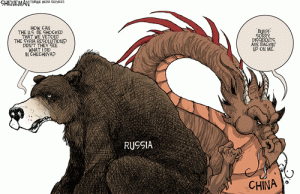
“For those of us residing outside Washington, this choice may appear to have few immediate consequences. The defense budget will rise in either case; troops will, as now, be shuttled desperately around the hot spots of the planet, and so on. Over the long run, however, don’t think for a second that the choice won’t matter.
A stepped-up drive to counter Russia will inevitably produce a grim, unpredictable Cold War-like atmosphere of suspicion, muscle-flexing, and periodic crises. More U.S. troops will be deployed to Europe; American nuclear weapons may return there; and saber rattling, nuclear or otherwise, will increase. (Note that Moscow recently announced a decision to add another 40 intercontinental ballistic missiles to its already impressive nuclear arsenal and recall Senator Cruz’s proposal for deploying U.S. anti-missile batteries in Eastern Europe.) For those of us who can remember the actual Cold War, this is hardly an appealing prospect.
A renewed focus on China would undoubtedly prove no less unnerving. It would involve the deployment of additional U.S. naval and air forces to the Pacific and an attendant risk of armed confrontation over China’s expanded military presence in the East and South China Seas. Cooperation on trade and the climate would be imperiled, along with the health of the global economy, while the flow of ideas and people between East and West would be further constricted. (In a sign of the times, China recently announced new curbs on the operations of foreign nongovernmental organizations.) Although that country possesses far fewer nuclear weapons than Russia, it is modernizing its arsenal and the risk of nuclear confrontation would undoubtedly increase as well.
In short, the options for American global policy, post-2016, might be characterized as either grim and chaotic or even grimmer, if more focused. Most of us will fare equally badly under either of those outcomes, though defense contractors and others in what President Dwight Eisenhower first dubbed the “military-industrial complex” will have a field day. Domestic needs like health, education, infrastructure, and the environment will suffer either way, while prospects for peace and climate stability will recede.
A country without a coherent plan for advancing its national interests is a sorry thing. Worse yet, however, as we may find out in the years to come, would be a country forever on the brink of crisis and conflict with a beleaguered, nuclear-armed rival.”
The geopolitics of the future continue to darken as the interests of the state and corporate elites once again trump the interests of the people of the world. The elephant in the room, of course, is climate change and no one in power seems to care. I imagine, when New York is underwater – action might be considered.











 bleatmop
 Mystro


 Dead Wild Roses
Your opinions…