
You are currently browsing the tag archive for the ‘Oil’ tag.
Here in Alberta I am really enjoying our neoconservative UCP government. They replaced a government that sough to balance economic investment and diversification with support of the public good. The UCP essentially tore up that balanced economic plan and went ‘all-in’ on ramping up the Oil & Gas industry and making building pipelines a major campaign promise.
The UCP budget forcast included oil prices to be well north of $50 a barrel. And here we are speculating that the current oil prices (April/May 2020) may hi the (negative)-40 dollars per barrel figure.
Yep, they were elected on the premise of killing the deficit and now are forecast to run some of the largest deficits in Alberta’s history. But this is nothing new for Alberta under conservative rule. Allegiance to the large business sector and Oil & Gas has always been a fixture. The people of Alberta and the public services they need have always come a distant 10th.
So, the price of Oil has now cratered and is tunneling downward toward the core. What next dear UCP?
“Alberta’s oilpatch history is full of ups and downs, dating back to the province’s first big oil rush more than 100 years ago near Turner Valley. But who would have thought oil would one day be worth less than $0?
On Monday, the price for West Texas Intermediate (WTI), the North American benchmark, fell more than $50 to close at negative $37.63 US.
“It’s certainly not something I ever thought I would witness,” said Matt Murphy, a Calgary-based equity research analyst with Tudor, Pickering, Holt & Co.
“I won’t wager a guess how it may trade [Tuesday]. Could it go worse than negative $40? I don’t know,” he said.
Oil companies in Western Canada and offshore Newfoundland were already drastically reducing costs, slashing payroll and pulling back on oil production in recent weeks with commodity prices hitting multi-year lows. Now, the cuts are being accelerated further with Husky Energy and Crescent Point Energy both on Monday cutting spending more than previously announced.
It was a crazy day on the markets.WTI prices swung wildly as oil traders began to panic as time runs out to get rid of oil contracts for May. The price of oil is determined by investments known as futures contracts, which are agreements to buy and sell a certain amount of oil at a certain time in the future. Typically, the contracts are bought and sold countless times before the oil is actually delivered to the final buyer.
But the May contracts are set to finalize on Tuesday, meaning anyone left holding one will have to physically receive the oil — and storage options are filling up, especially in the U.S. Midwest. No one wants to be stuck with the oil and traders were willing to take heavy losses to ditch the contracts before they come due.”

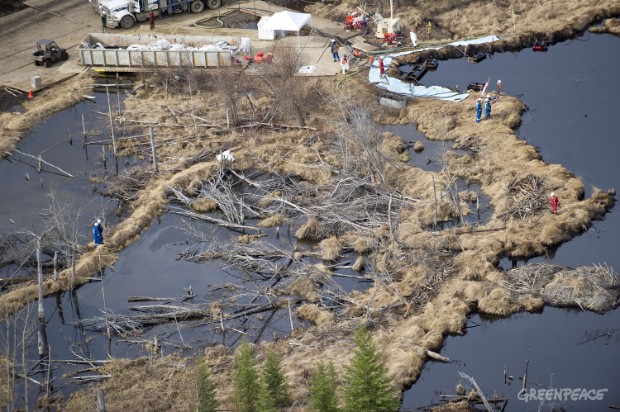
20110505 – Evi, Alberta, Canada – Crews work to clean up at Rainbow Pipeline’s oil spill, the worst Alberta oil spill in 35 years, dumping 28, 000 barrels of oil into a wetland area at Evi, Alberta which is near Little Buffalo, Alberta, Canada.
Progress in the laying of plans for Canada’s build-your-own-envirnomental-disaster have hit a snag. The people’s land that we want to endanger are saying no way, and no how. Pretty rude considering that one of our more outspoken Premier’s comments ,“Let those Eastern bastards freeze in the dark.” Oh Ralph, how we miss those straight talkn’, shoot from hip’in, shod in political clown shoes days of yesteryear (not at all actually).
Now, it seems, Alberta may need the dreaded Easters help in order to get our tar-sands products to market. Strangely enough, they seem to be not acquiescing to our requests. The Mayor of Montreal responds:
“Montreal Mayor Denis Coderre announced the city’s official opposition to proposed Energy East pipeline project Thursday, saying the potential risks outweigh its possible economic benefits to communities including his. Coderre was joined by mayors from neighbouring cities including Laval and Longueuil that make up the Montreal Metropolitan Community.
“We are against it because it still represents significant environmental threats and too few economic benefits for greater Montreal,” said Coderre on behalf of the MMC.”
I imagine it would have been easier to make a case for the pipeline if much of Eastern Canada had not been forced to look elsewhere in the market for oil, because apparently the Dreaded National Energy Program (western Canada selling oil to Eastern Canada for a fair price) was to risky a venture for the Western Canadian oil capitalists. Fast forward to the present and now we in the west are wondering why these bastards are not helping us out.
This state of affairs does not sit will for the political representative of the business sector in the Alberta Legislature. Cue the stolid Brian Jean to microphone:
“In a statement, Brian Jean, leader of Alberta’s Wildrose Party, called Coderre’s position “disgraceful.”
“While Mr. Coderre dumps a billion litres of raw sewage directly into his waterways and benefits from billions in equalization payments, his opposition to the Energy East pipeline is nothing short of hypocritical,” Jean said.
Jean claimed the project would entail economic benefits of $9.2 billion for Quebec, citing numbers provided by TransCanada.”
Well, your claim is only made much more substantial by using the figures provided by the oil company. We shan’t tarry to long with sources though, because this was just the opening salvo in the great West VS East energy pipeline showdown.
Coderre replies:
“”First of all, you have to allow me a moment to laugh at a guy like Brian Jean, when he says he relies on science. These are probably the same people who think the Flintstones is a documentary. But that’s another story.”
Ouch. But our intrepid Wild Rose Leader fires back..
“I had an opportunity to serve with Mr. Coderre in federal politics for many years, and I’m used to watching him float up and down the gutter,” said Jean, who was a Conservative MP for a decade before entering provincial politics in Alberta.”
Oh Brian, politics is hard and nasty eh? We’ll finish with Mr.Coderre:
“The community of metropolitan Montreal isn’t nothing,” he said. “It’s four million residents, it’s 82 municipalities, it’s 50 per cent of the gross domestic product, population and jobs of Quebec.
“We have committees of engineers, so we are working with credible data. We realized that when you build it, you can say it will bring this or that, and it will create so many jobs. But the economic reality is that it’s only 33 jobs and at most $2 million per year of municipal revenue.”
Two million is far cry from 9.2 billion dollars. I’m sure the real number lies *somewhere* between those two extremes, but that isn’t the point. It is Mr.Coderre that we are trying to win over to our side, and calling him a gutter inhabitant is not going to get the pipeline built. This kind of grandstanding might win you the populist vote from rural Alberta (hurrah for the Sticks!), but it doesn’t play very well on the national stage.
On the upside, Brain Jean and band of merry corporatists are doing a lovely PR job, making the Energy East pipeline much less likely to happen. Perhaps the Suzuki Foundation will give them an award or something.
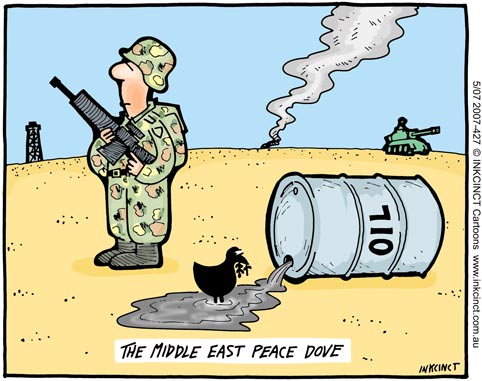 Noam Chomsky is considered a rogue commentator in the United States. His critiques of power illustrates the gross realpolitik that runs the US government and its foreign policy. Traditionally, we tend to think of ourselves as the “good guys”. In reality though, we seldom have that role. A look at the recent history of the Middle East confirms this hypothesis, excerpt from Alter.net.
Q: Does the United States still have the same level of control over the energy resources of the Middle East as it once had?
NC: The major energy-producing countries are still firmly under the control of the Western-backed dictatorships. So, actually, the progress made by the Arab Spring is limited, but it’s not insignificant. The Western-controlled dictatorial system is eroding. In fact, it’s been eroding for some time. So, for example, if you go back 50 years, the energy resources — the main concern of U.S. planners — have been mostly nationalized. There are constantly attempts to reverse that, but they have not succeeded.
Take the U.S. invasion of Iraq, for example. To everyone except a dedicated ideologue, it was pretty obvious that we invaded Iraq not because of our love of democracy but because it’s maybe the second- or third-largest source of oil in the world, and is right in the middle of the major energy-producing region. You’re not supposed to say this. It’s considered a conspiracy theory.
The United States was seriously defeated in Iraq by Iraqi nationalism — mostly by nonviolent resistance. The United States could kill the insurgents, but they couldn’t deal with half a million people demonstrating in the streets. Step by step, Iraq was able to dismantle the controls put in place by the occupying forces. By November 2007, it was becoming pretty clear that it was going to be very hard to reach U.S. goals. And at that point, interestingly, those goals were explicitly stated. So in November 2007 the Bush II administration came out with an official declaration about what any future arrangement with Iraq would have to be. It had two major requirements: one, that the United States must be free to carry out combat operations from its military bases, which it will retain; and two, “encouraging the flow of foreign investments to Iraq, especially American investments.” In January 2008, Bush made this clear in one of his signing statements. A couple of months later, in the face of Iraqi resistance, the United States had to give that up. Control of Iraq is now disappearing before their eyes.
Iraq was an attempt to reinstitute by force something like the old system of control, but it was beaten back. In general, I think, U.S. policies remain constant, going back to the Second World War. But the capacity to implement them is declining.
Curious about the issues surrounding the Tar Sands of Alberta?











 bleatmop
 Mystro
 The Arbourist


 Dead Wild Roses
Your opinions…