
You are currently browsing the tag archive for the ‘Patriarchy’ tag.
“There absolutely is a shared experience universal to all women under patriarchy. No matter what culture or religion or location, we all grow up with the pervasive message that we were made for men. This starts at our birth and ends when we die, and this is the experience every woman has in common.”

Yep, still waiting for the chorus of enraged ‘egalitarian’ voices to protest this (continuing) oversight.
http://tehbewilderness.tumblr.com/post/155051414744/the-future-now-vera-rubin-the-woman-who
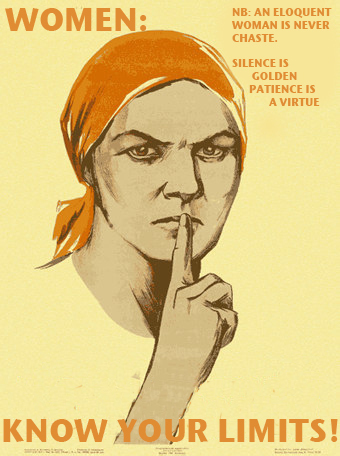 I would like to thank a recent commenter here on DWR for the placement of a tidy swarm of bees squarely in my bonnet. The honour, of course, goes to Godless Cranium for this nugget of wisdom shared on a previous thread:
“And I’m not saying sexism doesn’t exist or doesn’t play a factor sometimes, but I don’t think it’s as pervasive as you think, and I certainly don’t think all men are oppressors like patriarchy theory demands we believe.”
Before you can say “not all men…” check that thread for my response, I have it covered – but I think such a clearly stated denouncement of the patriarchal nature of our society requires a response with a little more… hmm… vibrancy than just a text based reply.
As chance would have it, current political events in my dear home province of Alberta have served up a glorious(?) example of the sexist and patriarchal attitudes that continue to flourish in our society.
The political event that I refer to is the leadership race for the Alberta provincial Progressive Conservative party. As of November 8th, the women who were in the race have both dropped out citing extensive misogynistic threats and physical and social intimidation.
“The only two women vying for the leadership of Alberta’s PC Party have both dropped out of the race.
Sandra Jansen and Donna Kennedy-Glans — socially progressive voices within the party — both gave notice on Tuesday that they were withdrawing.
Jansen, the PC MLA for Calgary-Northwest, cited intimidation and harassment for her decision.”
“In all of that time, I have never before experienced harassment like that which occurred up to and including this past weekend in Red Deer.”
Hmm. What is going on in the upper political echelons of our political class?
“In the release Jansen said she has been harassed online and her social media feeds have been “filled with filth.” The final straw in Red Deer was when “insults were scrawled on my nomination forms.”
“Volunteers from another campaign chased me up and down the hall, attacking me for protecting women’s reproductive rights, and my team was jeered for supporting children’s rights to a safe school environment.”
Hey now, politics is a rough and tumble affair, one should expect to face slings and arrows – it is a part of the process. I mean male politicians get the same calibre of flak, right?
Wrong.
“Sandra should stay in the kitchen where she belongs.”
“What a traitorous bitch.”
“Now you have two blond bimbos in a party that is clueless.”
“Dumb broad, a good place for her to be is with the rest of the queers.”
Let’s listen to what she has to say about the harassment she, like other women, face every day.
“Jansen was highlighting an issue that is bigger than her experience, according to Nancy Peckford of Equal Voice Canada.
“The vast majority of elected women are encountering some sort of misogynistic behaviour, online bullying, or harassment on a fairly regular basis,” she said.
“I think what’s very disturbing for Equal Voice is the misogynistic and sexist undertones and explicit commentary that’s used to diminish women’s contributions to public life and also undermine the confidence and the leadership female elected officials are offering.”
The misogyny she is experiencing is systemic, it happens everywhere all the time. Watch as Ms. Jansen explains her motivations as to why she made her speech. It is a damning look at how patriarchal our society actually is.
“Other women have also spoken out about the sexism they encounter in public life, including Conservative MP Michelle Rempel.
“The everyday sexism I face involves confronting the ‘bitch’ epithet when I don’t automatically comply with someone’s request or capitulate on my position on an issue,” she wrote in a National Post opinion article in April.
“It involves my ass being occasionally grabbed as a way to shock me into submission. It involves tokenism. It involves sometimes being written off as not serious when I’ve clearly proven I am.”
“That combination of the immediacy and the anonymity means that it’s sort of exploded into a new culture of pretty vicious, vitriolic attacks,” she said.
“Unfortunately, the attacks are particularly vicious toward women, and the attacks against women aren’t just violent, they’re sexualized violence. So it’s quite disturbing to see that some people will behave in this way, and it’s a challenge for our political culture to respond effectively to it.
She hopes more and more people will come together to condemn misogyny in politics and said it’s important for party leaders to forcefully and unequivocally reject the attacks.”
Yep. Misogyny needs to be addressed and kept in the spotlight, not only as the struggle for this generation but also the next generation of women and girls to show that having political aspirations (or professional ones) doesn’t mean facing a constant stream of harassment and misogyny.
But wait! There is more! Let’s go to another profession and and listen as Danielle Campbell describes what women have to face if they want to join the Police.
“Danielle Campbell walked into the canine unit 20 years ago as the first female graduate of the Edmonton Police Service dog handler program.
She faced insults, taunts and the reek of urine on her belongings.
“When I was in the unit they drew Xs on my eyes and they drew cocks around my face, a whole bunch of them … they would urinate on my gear.
‘It was ridiculous,” she said, referring to how a picture of her and her dog was defaced. “The sergeant in charge did nothing about it. Nothing.”
Campbell, 51, is no longer a police officer with EPS. She ended her 27-year-career in August 2016 when she resigned as deputy chief of police, the highest rank achieved by a woman within the city’s police force.”
The common saying is that women have to work twice as hard to get half as far ahead in society. Danielle Campbell is the embodiment of this, as her hard work and dedication – her proficiency at the job – eventually fought her way to the level of Deputy Chief of Police.
“A high-ranking officer in the human resources division told her she had to sign a document saying she wouldn’t get pregnant.
She was also told she could never become a dog handler because of her gender due to concerns over her menstrual cycle affecting the dog.
“I burst out laughing. But he didn’t laugh with me, he was dead serious,” she said.
“I just stood up and I said ‘This conversation is over. You have absolutely no empirical data to support that. That is just ridiculous,’ and I walked out. And to be honest with you that’s when I thought I was going to be fired.”
She wasn’t fired and neither was the officer or officers who sent her a Barbie doll in the mail, noose around its neck with the note: “No split tails in the dog unit, take a hint bitch.”
So yeah, I’m thinking there might be something to it when women say there is a culture of harassment and misogyny that makes their careers and lives more difficult than it needs to be.
“I really believe that so much has improved, and there’s so much more support for diversity and inclusivity and gender equality.
“But we’re not fully there yet,” she said, adding what she sees happening in the United States and, closer to home, in Alberta politics, is concerning.”
Please note the sentence – “we’re not there yet”. This is the key right here. Liberal dudes are so very quick to say the need for feminism is over, or sexism isn’t that bad, or that prevalent. Dudes… *you* don’t get to say any of that shit. When we hear it from women, then, and only then, can we declare sexism to be ‘over’ and no need for feminism.
It’s not your call. Stop trying to make it your call, it isn’t always all about you.
Have you considered your patriarchal stereotypes today? Let’s take a peek at a few.
http://tehbewilderness.tumblr.com/post/152784450929/poly-x-jackorino-p0tbarbie-p0tbarbie
“They made it clear from the start that the slightest deviation from the norm would be punished. They turned everything into prisons, even our own bodies.
Wear pink. Play with dolls. Look in the mirror. Go to school. Learn to smile when they abuse you. Diet, wax, apply make-up, and swallow your medication. Follow fashion. Work. Consume. Be silent. Give him a porn star experience. Get married. Shop, cook, wash, iron, dust, vacuum, scrub and polish. Work a 15-hour shift (but don’t call housework ‘work’). Get into debt. Have children. Stay married (or they’ll destroy you and your children). Watch TV. Wear stilettos. Obey their laws. Save for your old age. Now repeat after me: ‘I am free’.Just to make sure I knew who my masters were they spat on m, groped me, pinched me, grabbed me and shoved me at school, in the street, in homes, on buses, in parks, pubs, clubs, everywhere. They shouted at me from cars, building sites, pub windows and doors, everywhere that I was a slut, an ugly bitch, a fat slag, a stupid cow, a skinny cow, a sexy dog, that they would fuck me, hit me, damage me, and destroy me. They made grunting noises and flapped their tongues. They raped me, beat me, pulled the hair out of my head, and kicked me. They threatened to kill me and told me to kill myself. They always wanted to know my weight, size, age and height as though this information was useful for their plans. They harassed me when I studied or worked, they just wouldn’t leave me alone. Then they told me I lacked a sense of humour.
…
They told me to practise positive thinking and to cleanse myself of toxic emotions. They told me to live in the ‘Now’ like a toddler, or a goldfish with a five-second memory. They treated me like a child, demanded that I behave like a child and look like a 15-year-old, and then they told me I was immature and childish.They said, “Consider yourself lucky, this is a democracy and we’ve given women the freedom to choose their own lives and be what they want to be.”
When I mentioned the word ‘misogyny’ they called me a man-hater. When I spoke up against fascist pornography they told me I needed a good fuck. “The answer to your problems,” they said, “is between our legs.” When I spoke about the rise of rape culture they told me I definitely needed a good fuck. But by then I had stopped taking it personally.“Listen,” I said, “what we really need is a vigorous, earth-shaking, relentless, uninhibited, wild, passionate, intoxicating, angry, unapologetic, long-overdue, exciting, luscious revolution.”
Because this was never personal, this was always political.”— Abigail Bray, “The fascism that has no name” in Misogyny Re-Loaded
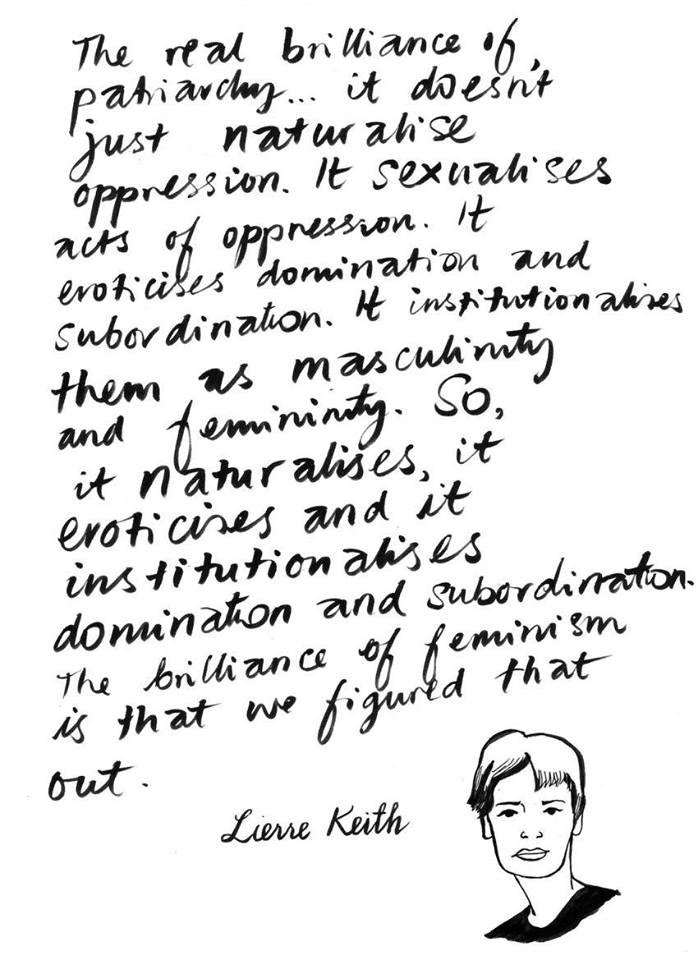
“The real brilliance of patriarchy… it doesn’t just naturalize oppression. It sexualizes acts of oppression. It eroticizes domination and subordination. It institutionalizes them as masculinity and femininity. So it naturalizes, it eroticizes and it institutionalizes domination and subordination. The brilliance of feminism is that we figured that out.
“I could talk about the PE teacher in my town who was asked to resign due to his harassment of female students, who was then hired as a school bus driver for a rural route with both primary and high school students. I could talk about how, from the age of seven, I refused to wear skirts or dresses, and from the time I entered high school at 10 to when I moved at 16 I always wore bike shorts or CCC shorts under my dress, because he was not particularly subtle about the way he looked at us – and those bus steps are high. I could talk about how this was common knowledge and was never denied by any authority figure we ever raised it with, but rather we were just kind of brushed off. I could talk about how, sometimes, I was the last person on my bus in the afternoon and I was never quite sure if something bad would happen to me, even though for a long time I probably couldn’t have articulated what it was that I feared.I could talk about how I spent ten years of my childhood believing it was perfectly normal and acceptable for a seven year old child to stop wearing her favourite clothes because a grown man she relies on to get to and from school from a relatively remote location gets a thrill from looking up her skirt.
I could talk about the art teacher at my high school who used to run his hands up and down our backs, right along the spot where your bra sits. Considering most of us were fairly new to wearing bras in the first place, this was a decidedly uncomfortable experience. I could talk about how he used to get just a little too close for comfort in the supply room. Nothing overt, nothing nameable – just enough to make you drag someone else along with you if you needed a fresh piece of paper or you ran out of ink. I could talk about how the odd comment or complaint that was made was completely handwaved, that we were told to be very careful about what we were saying, that we could get someone in a lot of trouble by “starting those kinds of rumours”, and did we really want to be responsible for that?
I could talk about the first time I was made to feel ashamed of my body, at twelve or thirteen, getting into a water fight with my stepfather and uncle in the height of summer. I could talk about my grandmother completely flipping out, talking about how disgusting it was, how grown men should be ashamed of the way they were behaving with a girl. I could talk about how she then spent the next few hours trying to convince me I was being somehow victimised, while I was mostly confused about what had taken place – it took me a long time to work it out. I could talk about the unvoiced but ever-present fear for months afterwards that my grandma would bring it up again, that she would bring it up in the wrong place or to the wrong people and that my uncle, a schoolteacher, would suffer for it.
I could talk about how that destroyed what had been a fantastic relationship with my uncle, and how, ten years later, he still won’t hug me at Christmas.
I could talk about being called a frigid bitch and a slut in the same breath in high school. I could talk about multiple instances of sitting in a big group of friends, hearing someone trying to get into someone else’s pants, starting off sweet enough but quickly descending into emotional manipulation and thinly veiled abuse. I could talk about the time I went off with someone willingly enough and being followed by someone I considered a friend, someone who would not leave no matter how many times I said “no”, who only went away when the person I was with said that he “didn’t feel like sharing”.
I could talk about the family friend who always made me feel a little bit off for no discernible reason. The one who if I was left alone in the room with him, I would always find an excuse to leave. The one time I expressed this, I was told I was being a drama queen, and that I needed to grow up and stop being so precious, that one day I was going to have to deal with people I didn’t like and I might as well get used to it. I could talk about how he never did anything untoward, never gave me any specific reason to feel unsafe – but years after I last saw him, when he was found guilty of four historical sexual assault charges, one of rape and three of indecent assault on girls under twelve, I was, for reasons I still don’t entirely understand, completely unsurprised.
I could talk about my boyfriend justifying his rape of me with “you could have fought me off if you really wanted you, you slut”. I could talk about how, when I tried to tell people, I was told I was being a nasty, spiteful, vindictive bitch. I could talk about how selfish it was of me to say such things, that he’d overcome such a hard life and was going to go on and make something of himself, who the hell was I to try and stand in his way?
I could talk about how my response to being raped was to sleep with anyone and everyone because I rationalised that if I never said no, then no one could force me. I could talk about how I have been told time and time again, by people who should know better, that this is a sign that I wasn’t really raped at all.
I could talk about how, when I finally worked up the courage to make a formal complaint of sexual harassment against my boss, I was asked why I had let it continue for so long, and what I had done to make him think his behaviour would be welcomed.
I could talk about how when a much later boss got me completely wasted at my leaving party, to the point where I couldn’t walk, and fucked me in a back alley, he waited until I was sober the next morning to tell me that he had a pregnant wife, because he heard through the grapevine that I was very strict about not sleeping with married people or straight women, and he thought I should “learn my place” and realise that I’m “not such a high and mighty bitch with a moral high ground after all”.
I could talk about these things, but I very rarely do. Since I was seven years old, I have been told that my body is not my own, that my consent is not my own, that my feelings of discomfort are not my own. I have taught myself to suppress my gut instinct upon meeting people. I have been taught to smile, to be polite, to suck it up if I feel unsafe. When I complain, I have been told I’m being irrational, oversensitive, and selfish. The underlying message is, how dare I try and ascertain any kind of control over my own body?
I should talk about it. But I don’t actually know whether I can.”











 bleatmop
 Mystro


 Dead Wild Roses
Your opinions…