
You are currently browsing the tag archive for the ‘Piaget’ tag.
Modern psychology has a recurring weakness. It periodically falls in love with stories that feel morally urgent, then struggles to unwind them when the evidence turns out thin. That is not because psychologists are uniquely foolish. It is because the field studies messy human beings with noisy measures, ambiguous constructs, and strong social incentives. In that environment, a persuasive narrative can get promoted into “settled science” long before it is actually settled.
The replication crisis is the clearest public sign of this vulnerability. The Reproducibility Project’s large collaboration tried to replicate 100 psychology studies and found much weaker effects and far fewer statistically significant replications than the original literature suggested. (Science) Methodologists also showed how flexible analysis choices and reporting can inflate false positives unless stricter norms are enforced. (SAGE Journals) Meehl’s older critique still lands for the same reason: in “soft” areas of psychology, theories often fade away rather than being cleanly tested and retired. (Error Statistics Philosophy) The implication is not nihilism. It is epistemic humility, especially for claims that are politically charged and personally consequential.
Psychology’s history offers examples of ideas that persist on social momentum long after the evidence grows cloudy. The “memory wars” around repressed and recovered memories show how a compelling clinical narrative can endure in practice while mechanisms remain disputed, and how suggestion can complicate confident storytelling. (PMC) Lilienfeld and colleagues made the broader point in a different domain: weak measurement, loose constructs, and credulous clinical fashions predict confident claims that later demand painful correction. (Guilford Press) The pattern is simple: psychology is unusually prone to ideas becoming socially protected before they are empirically solid.
That is the right context for the strong activist version of “innate gender identity,” meaning the claim that very young children can reliably know and articulate a fixed inner gender that may mismatch their body, and that this knowledge should be treated as stable guidance for major decisions. Developmentally, this is exactly the kind of adult projection Piaget and Erikson warn against: treating children’s words as if they carry stable adult concepts while the child’s understanding and self-organization remain socially shaped and changeable. Even within clinical samples, trajectories are not uniform; intensity of childhood gender dysphoria is one known factor associated with persistence into adolescence, which is another way of saying early self-labels do not function like a universal diagnostic oracle. (PubMed) Clinically, the major classification systems are more cautious than the slogans: DSM-5-TR defines gender dysphoria around clinically significant distress or impairment, not the mere existence of an identity claim. (American Psychiatric Association) ICD-11 moved gender incongruence out of the mental disorders chapter and into “conditions related to sexual health,” partly to reduce stigma while preserving access to care. (World Health Organization)
The evidence environment around youth gender medicine shows why fad dynamics matter. The Cass Review argued the evidence base for medical interventions in minors is limited and often low certainty, urging caution and better research. (Utah Legislature) Substantial critiques dispute Cass’s methods and interpretation, which itself signals this is not a stable, high-consensus evidentiary domain. (PMC) The adult responsibility is therefore straightforward: treat childhood self-labels as developmentally real but conceptually limited; separate distress from metaphysics; demand the same evidentiary standards you would demand anywhere else in medicine; and resist turning a contested construct into a moral absolute. If psychology keeps rewarding certainty over rigor, the cost will not be merely bad theory. It will be policy and clinical practice that harden too early, then harm real people when the correction finally arrives.

Glossary
- Replication / reproducibility: Whether an independent team can rerun a study and obtain broadly similar results. (Science)
- Researcher degrees of freedom: The many choices researchers can make (when to stop collecting data, which outcomes to report, which analyses to run) that can unintentionally inflate “significant” findings. (SAGE Journals)
- P-hacking: Informal term for exploiting analytic flexibility to chase statistical significance. (SAGE Journals)
- Construct validity: Whether a measure actually captures the concept it claims to measure (not just something correlated with it). (General measurement concern emphasized in clinical-science critiques.) (Guilford Press)
- Gender dysphoria (DSM-5-TR): Clinically significant distress or impairment related to gender incongruence; not all gender-diverse people have dysphoria. (American Psychiatric Association)
- Gender incongruence (ICD-11): ICD-11 category placed under “conditions related to sexual health,” moved out of the mental disorders chapter. (World Health Organization)
- Persistence (in childhood GD research): Continued gender dysphoria into adolescence; research suggests persistence is not uniform, and intensity is one associated factor. (PubMed)
Short endnotes (audit-friendly)
- Replication crisis anchor: Open Science Collaboration (2015), Science; effects in replications notably smaller; fewer significant replications. (Science)
- Analytic flexibility / false positives: Simmons, Nelson & Simonsohn (2011), “False-Positive Psychology.” (SAGE Journals)
- Soft-psychology theory fade-out critique: Meehl (1978), “Theoretical Risks and Tabular Asterisks: Sir Karl, Sir Ronald, and the Slow Progress of Soft Psychology.” (Error Statistics Philosophy)
- Memory wars as an example of contested clinical narratives: Otgaar et al. (2019, PMC) on repression controversy; Loftus (2006) review on recovered/false memories; Loftus (2004) in The Lancet on the continuing dispute. (PMC)
- Clinical-science warning about fads/pseudoscience: Lilienfeld et al., Science and Pseudoscience in Clinical Psychology (Guilford excerpts / volume). (Guilford Press)
- DSM-5-TR framing: APA overview and DSM-related materials emphasize distress/impairment as the diagnostic core. (American Psychiatric Association)
- ICD-11 move and rationale: WHO FAQ; supporting scholarly rationale for moving gender incongruence out of mental disorders while preserving access to care. (World Health Organization)
- Persistence factor (intensity): Steensma et al. (2013) follow-up: intensity of childhood GD associated with persistence. (PubMed)
- Cass Review debate: Cass Review final report PDF (archived copies); published critiques and responses indicating contested interpretation and ongoing debate. (Utah Legislature)
Jean Piaget is still worth reading because he blocks a common adult mistake: treating children’s words as if they carry adult concepts. Children do not merely know fewer facts. They use different cognitive tools at different ages, and those tools change what their categories can mean. That matters whenever adults take a child’s self-label and translate it into a fixed inner essence. Piaget’s basic warning is simple: the same vocabulary can sit on top of a different kind of understanding, and adults are very good at smuggling their own meanings into what a child says. The rest of his theory is an attempt to explain why that translation error is so easy to make.
Piaget’s machinery for explaining the gap is spare and still useful. Children build schemas, mental frameworks for understanding objects, actions, and categories. They update those schemas through assimilation, which fits new experience into an existing framework, and accommodation, which changes the framework when the fit fails. The friction between “make it fit” and “change the model” is not a bug. It is the engine. Piaget calls the longer-term settling of that friction equilibration, the push toward a workable balance where the child’s model of the world holds together and predicts better.
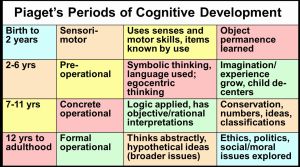
Piaget is best known for his four-stage outline. In the sensorimotor stage (birth to about 2), infants learn through perception and action, and one classic milestone is object permanence, the idea that things still exist when out of sight. In the preoperational stage (about 2 to 7), children gain symbolic thought: language, pretend play, mental imagery. They also show characteristic limits on many tasks, including egocentrism in perspective-taking and failures of conservation (for example, thinking a taller glass has “more” of the same liquid).
Those limits are real, but they are not always as simple as “the child cannot do it.” Modern researchers have shown that the timing can shift when you change the method. Studies using “violation-of-expectation” designs often find signs of earlier object knowledge than Piaget’s original search tasks detected. The clean takeaway is not that Piaget collapses. It is that measurement matters. Some tasks load children with extra demands (motor planning, inhibition, working memory) that can hide understanding that is present in a simpler form. Task demands can mask competence.
In the concrete operational stage (about 7 to 11), children become capable of logical operations tied to tangible situations. Conservation stabilizes, classification becomes more systematic, and seriation appears more reliably, as when a child can order sticks from shortest to tallest without guesswork. In formal operational thought (roughly adolescence onward, and unevenly across people and domains), abstract and hypothetical reasoning becomes more consistent. Even here, performance can be uneven across closely related tasks, a pattern discussed under the label horizontal décalage. That unevenness is a warning against treating stages as rigid ceilings. Read them instead as a map of typical reorganizations in thinking: a useful guide to what changes, and when, without pretending every child hits every milestone on the same schedule. The practical payoff is blunt. When adults treat a child’s words as adult-level commitments, they risk importing meanings the child has not yet built.
Glossary
- Schema: A mental framework for organizing and interpreting experience.
- Assimilation: Fitting new experience into an existing schema.
- Accommodation: Modifying a schema when the old one does not fit.
- Equilibration: The balancing process that restores or maintains cognitive stability through assimilation and accommodation.
- Object permanence: Understanding that objects continue to exist when hidden.
- Conservation: Understanding that quantity stays the same despite changes in appearance if nothing is added or removed.
- Horizontal décalage: Uneven mastery across related tasks; competence does not arrive all at once.
Endnotes
- Encyclopedia Britannica — Piaget overview: stages, age ranges, and constructivist framing.
- APA Dictionary of Psychology — Piagetian terms: schema, assimilation, accommodation.
- APA Dictionary of Psychology — “Equilibration” definition.
- Baillargeon, Spelke & Wasserman (1985) — early object knowledge via violation-of-expectation methods (PubMed record and related materials).
- Lourenço (2016) — stages as conceptual tools/heuristics (ScienceDirect).
- Neo-Piagetian review discussing horizontal décalage and unevenness as a complication for strict stage-uniformity (UCL Press journals).
This quote from@prof_curiosity on X: Piaget: The construction of learning
“Piaget viewed children as “little scientists” who actively construct knowledge by testing and refining mental schemas, most often through play. Through assimilation (fitting new experiences into existing schemas) and accommodation (adjusting schemas when they do not fit), driven by equilibration (resolving confusion), children progress through four stages: sensorimotor, preoperational, concrete operational, and formal operational.Development is a self-motivated process of making sense of the world. Adults naturally introduce their own schemas to children; most are well-meaning and beneficial. However, it is hard to imagine a more destructive schema for young children than that of ‘gender identity.’ Piaget’s theory explains how and why children adopt this adult shortcut to achieve equilibration.Simply it provides easy answers to difficult questions.What transgender ideology offers these playful child scientists is a highly self-destructive, adult schema (construct) wholly unsuitable for their developing, vulnerable minds. This schema, if pushed by significant adults, can easily be assimilated into a child’s learning patterns, providing ready made answers (equilibration) to questions the child would be years away from naturally asking; along with terrible, self-destructive answers to natural self-doubts. Thus, for a toddler girl: “Why do I prefer to play with boys’ things, etc.?” The inserted adult schema answers, “Because you are really a boy.” Of course the correct answer would be, “Because that is who you are” backed up with, “And you are perfect as you are – so carry on playing”.However transgenderism is not interested in children growing into well balanced adults. It targets vulnerable, especially autistic children, with undeveloped schemas who can be convinced that the way to achieve equilibration is to perform “being transgender”. It needs these (trans) children to provide cover for adult autogynephiles.This brilliant application of Piaget’s theory highlights why imposing adult “gender identity” concepts on children short-circuits their natural cognitive development—and why it’s especially harmful for vulnerable groups like autistic kids.”
Evidence backs this up: A 2023 systematic review and meta-analysis found a clear overlap between autism spectrum disorder (ASD) and gender dysphoria/incongruence, with autistic youth far more likely to experience it, likely due to challenges with flexible schemas and social understanding.”
https://pubmed.ncbi.nlm.nih.gov/35596023/The UK’s independent Cass Review (2024) went further: after rigorous systematic evidence reviews, it concluded the evidence for puberty blockers and hormones in minors is weak, with risks (e.g., bone density loss, fertility impacts) outweighing unproven benefits. It recommends extreme caution and holistic care over rapid affirmation.
Full report: https://cass.independent-review.uk/final-report/We must protect children’s natural exploration through play and affirm their bodies as they are. Imposing ideology that locks in confusion isn’t kindness—it’s harm. Prioritize evidence-based therapy and watchful waiting.











 bleatmop
 Mystro
 The Arbourist


 Dead Wild Roses
Your opinions…