
You are currently browsing the tag archive for the ‘Political Framing’ tag.
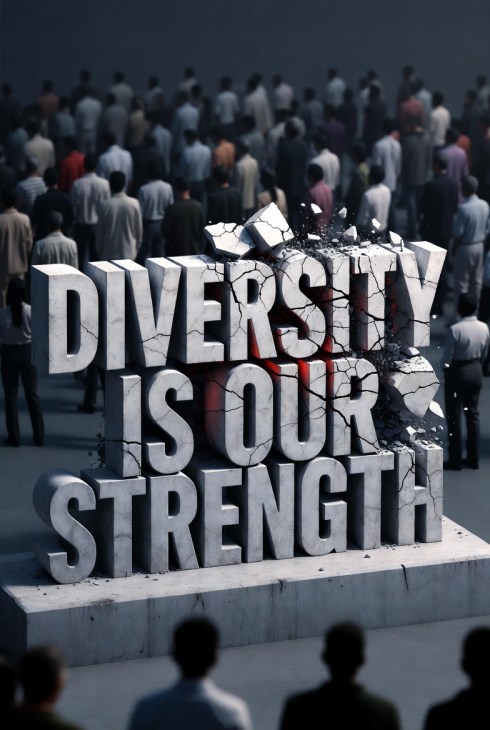
“Diversity is our strength” is one of those phrases that now passes for settled truth. It appears in policy documents, school mandates, and corporate statements, rarely argued and almost never examined. Though it presents itself as an empirical observation, most of the time it functions as moral reassurance.
Since I am not a sociologist, I am not pretending to offer original research here. What I am doing is more modest: reading the best-known work in this area, noting the later reviews, and asking whether the slogan is actually supported by the evidence usually invoked in its defence.
On those terms, the answer is less flattering than the slogan suggests.
When people reach for the empirical case, the best-known starting point is Robert Putnam. In 2007, he published a major study on social capital in American communities built on the Social Capital Community Benchmark Survey, drawing on roughly 30,000 respondents through a national sample and smaller samples from 41 communities across the United States. In the pooled 41-site sample, the estimated effect of diversity on trust was negative in 39 of the 41 communities.
For present purposes, two things matter: the scale was serious, and the pattern was not some one-off local oddity.
Although Putnam is often invoked as if he were a critic of diversity as such, that is not what he was doing. In the same paper, he argued that increased diversity may, in the long run, bring important cultural, economic, fiscal, and developmental benefits, and that successful immigrant societies can build broader identities that overcome fragmentation. Even so, he also concluded that, in the short to medium run, immigration and ethnic diversity “tend to reduce social solidarity and social capital.”
That is the part the slogan politely steps around.
What Putnam found, moreover, was not a simple story of ethnic conflict. His summary remains the clearest: in ethnically diverse neighborhoods, residents of all races tend to “hunker down”; trust, including trust in one’s own race, is lower; altruism and community cooperation are rarer; and people have fewer friends. Contemporary reporting on the study described the pattern less as intergroup hostility than as a general civic malaise.
“The effect isn’t conflict. It’s withdrawal.”
While Putnam’s study is not the last word, neither is it some isolated embarrassment later research quietly buried. A 2020 narrative and meta-analytical review by Peter Thisted Dinesen, Merlin Schaeffer, and Kim Mannemar Sønderskov examined 1,001 estimates from 87 studies and found a statistically significant negative relationship between ethnic diversity and social trust across the literature as a whole. The association was stronger for trust in neighbours and stronger when diversity was measured locally. Adding covariates changed the relationship only slightly.
None of this means every study says the same thing, or that every context behaves the same way. It does mean the slogan cannot honestly be treated as a simple social-scientific fact. At best, the literature points to a more conditional and less comforting conclusion: diversity may bring benefits in some domains while also imposing real costs in trust, cohesion, and civic reciprocity, especially in the short to medium term.
Had public argument stopped there, the conversation would be easier. It does not. One reason progressive arguments on diversity can be so maddening to answer cleanly is that the problem is not just the evidence. It is the rhetorical structure built around it.
What you often get is a classic motte-and-bailey.
In its bailey form, the claim is large and ambitious: diversity makes societies stronger. It enriches institutions, strengthens communities, and should be treated as an obvious good. That is the version used in slogans, public messaging, and moral posturing.
The motte, by contrast, is smaller and safer: people from different backgrounds have equal dignity; plural societies can function; exposure to different people can be valuable; racism is wrong. All true. All defensible. All much easier to protect.
The trick, of course, is that these are not the same argument.
One is a broad empirical claim about what diversity does to trust, cohesion, and institutional life. The other is a narrow moral claim about how people ought to be treated. But when the broader claim comes under pressure, when someone points to evidence of lower trust, weaker civic engagement, or social withdrawal, the argument retreats into the motte. Suddenly the response is not “let’s examine the evidence.” It is “What, are you against diversity? Are you some kind of racist?”
That is the coercive move.
“The harder claim retreats. The safer claim takes its place.”
Once that happens, the moral core is used as a shield for a much larger empirical claim that has not earned that protection.
To say this is not to deny the moral core. It is to point out that it is being made to do dishonest work.
Equal dignity under the law is not the same claim as “diversity strengthens communities.” Opposition to racism is not the same claim as “more heterogeneity reliably produces more trust.” The first set of claims may be moral bedrock. The second set are empirical propositions, and empirical propositions do not become true because disagreement with them is made socially costly.
Nor is the underlying mechanism difficult to imagine. Social trust depends on shared expectations: language, norms, behaviour, obligation. As those expectations become less predictable, the cost of ordinary interaction rises. People become more cautious. Fewer interactions clear the threshold of “worth it.” The result is often not hostility, but distance. That basic picture fits both Putnam’s “hunkering down” formulation and the later finding that the negative association is strongest in neighbour trust and local contexts.
Less talking. Less joining. Less trusting.
None of that requires malice. It requires friction.
“The long run is not the short run.”
As Putnam himself argued, successful immigrant societies can, over time, construct broader identities and new forms of solidarity. Fine. Maybe. But that long-run possibility does not erase the short-run trade-off he reported, and the later review literature does not erase it either.
Here, “may” is doing a lot of work.
That outcome is conditional. It depends on institutions, norms, shared language, and successful integration over time. It is not an automatic by-product of demographic change, still less a magic formula that turns heterogeneity into cohesion by moral declaration. Putnam’s own formulation was that the central challenge for diversifying societies is to create a new, broader sense of “we.”
Possibility is not inevitability.
What raises the stakes is that the costs of lower trust do not fall evenly. They hit hardest where social capital is already thin: poorer neighborhoods, fragile communities, institutions with less slack, places where informal cooperation matters most. When trust declines there, the result is weaker networks, less mutual aid, and more pressure on systems already under strain. Social capital is not a decorative extra. It is part of what makes communities safer, healthier, and more governable.
Ignoring that does not make a society humane. It makes it less prepared.
“A slogan that cannot admit costs cannot guide policy.”
A serious discussion of diversity would start there. It would admit trade-offs. It would separate moral claims from empirical ones. It would stop pretending every objection is a moral stain and start asking the harder question: under what conditions can diversity be made compatible with trust, reciprocity, and shared civic life?
That is the real task. Not chanting the slogan more loudly. Not treating doubt as heresy. Not hiding a contested empirical claim inside a morally untouchable one.
In the end, societies that do that are not being honest. They are buying social peace on credit and hoping the bill never comes due.
References
- Robert D. Putnam, “E Pluribus Unum: Diversity and Community in the Twenty-first Century,” Scandinavian Political Studies 30, no. 2 (2007).
- Peter Thisted Dinesen, Merlin Schaeffer, and Kim Mannemar Sønderskov, “Ethnic Diversity and Social Trust: A Narrative and Meta-Analytical Review,” Annual Review of Political Science 23 (2020).
- Michael Jonas, “The Downside of Diversity,” Boston Globe, August 5, 2007.











 bleatmop
 Mystro
 The Arbourist


 Dead Wild Roses
Your opinions…