
You are currently browsing the tag archive for the ‘Politics’ tag.
Modern North American politics is increasingly conducted as if the other side is not an opponent but a threat. Not “wrong,” but illegitimate. Not “mistaken,” but dangerous. Once that framing takes hold, everything downstream gets harder: legislating, compromising, trusting institutions, even sharing a country.
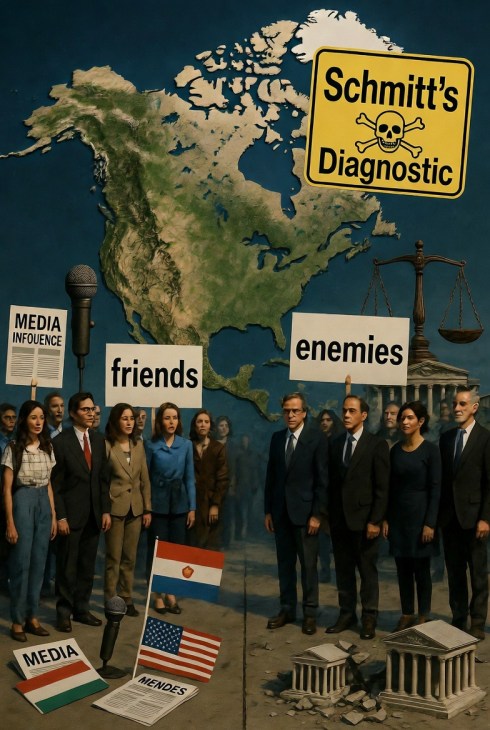
There’s a name for this move, and it’s older than social media: the friend–enemy distinction associated with the German jurist Carl Schmitt. Use it carefully. Attribute it correctly. Treat it as a warning label, not a blueprint.
The Schmitt paragraph (correct attribution without laundering)
In The Concept of the Political (first as an essay in 1927; expanded as a book in 1932), Carl Schmitt argued that what is distinctively political is not morality, economics, or aesthetics, but the capacity to sort human beings into friends and enemies—public groupings that can reach the highest intensity and, in the extreme case, make violence thinkable. (Stanford Encyclopedia of Philosophy) Schmitt is a morally compromised figure: he joined the Nazi Party in 1933 and wrote in support of the regime, which makes him “radioactive” as an authority. (Wikipedia) That’s precisely why the concept should be handled as a diagnostic for a recurring political pattern—not as an endorsement of Schmitt’s politics, and not as a permission slip to treat fellow citizens as foes.
That’s the frame. Now the point: you can reject Schmitt’s politics and still find his definition useful for recognizing when a society is sliding from politics-as-bargaining into politics-as-threat-management.
1) What the friend–enemy distinction is (and isn’t)
Schmitt’s core claim is often quoted badly. The clean version is this:
- It’s public, not personal. “Enemy” is not your private dislike. It’s a public adversary, a category applied at the level of groups. (Stanford Encyclopedia of Philosophy)
- It’s about intensity and stakes. The distinction becomes political when disagreement is framed as a contest over a community’s existence or way of life—when coercion becomes not just imaginable but morally narratable. (Stanford Encyclopedia of Philosophy)
- It’s not reducible to morality. In Schmitt’s framing, you can judge an enemy morally good and still treat them as an enemy; the political is not the same thing as ethics. (Stanford Encyclopedia of Philosophy)
So the friend–enemy distinction is less a philosophy lesson than a switch. When it flips on, political disagreement stops being about what we should do and becomes about who is allowed to be “us.”
2) The observable move: how to spot it in the wild
You’re watching friend–enemy politics when rhetoric shifts from:
- “Their plan won’t work” → “They cannot be permitted to govern.”
- “We’ll reverse this policy later” → “If they win, the country is finished.”
- “We can bargain on X” → “Any compromise is betrayal.”
- “Institutions are imperfect” → “Institutions are legitimate only when they deliver our outcomes.”
Here’s the part that matters: this is not just “heated language.” It’s a legitimacy test. The argument isn’t “our side has better ideas.” It’s “the other side is outside the moral community.”
What it sounds like now (no special villains required)
Over the last decade, ordinary campaign language has absorbed a new register: catastrophe certainty. You hear it when routine electoral competition is narrated as a point of no return not “we’ll reverse their policy,” but “if they win, the country is over.” You hear it when every institution that fails to deliver your preferred outcome becomes not merely flawed but captured—courts, schools, public health bodies, legacy media, election administration. Once those are recast as enemy infrastructure, the next step is predictable: treating compromise as collaboration.
That’s the Schmittian escalator: it turns normal democratic rivalry into a kind of internal cold war.
3) Why this maps onto polarization in the U.S. (with verifiable anchors)
American public opinion data increasingly fits the emotional profile you would expect in a friend–enemy environment: high frustration, high anger, low confidence, and pervasive negativity toward the opposing party.
Pew Research Center (survey fielded Sept. 22–28, 2025) reports that roughly half of U.S. adults say each party makes them feel angry (Democratic Party 50%, Republican Party 49%), and large majorities say each makes them feel frustrated (Democratic Party 75%, Republican Party 64%). (Pew Research Center) Pew also reports that majorities view both parties as too extreme (GOP 61%, Democrats 57%). (Pew Research Center)
That doesn’t “prove Schmitt.” It shows a climate where it’s easy for elites and activists to plausibly say: “The other side isn’t just wrong; they’re dangerous.”
Political science has a name for the emotional side of this: affective polarization which is the tendency for partisans to dislike and distrust the out-party as a social group. Iyengar, Sood, and Lelkes argue that affect increasingly operates through social identity dynamics rather than ideological distance alone. (Political Communication Lab)
Affective polarization supplies the fuel. Friend–enemy rhetoric supplies the spark.
4) Why Canada is not “the same,” but not immune
Canada has its own stresses: regional tensions, institutional distrust, culture-war imports, and an online ecosystem shared with the U.S. but it is still a mistake to claim Canada is simply America north.
A careful comparative point looks like this: research summarized by UBC Magazine reports Canadians show moderate affective polarization and lower levels of deeper hostility (political sectarianism) than Americans; divisions exist, but they are less intense, and fewer people treat the other side as morally beyond the pale. (UBC Alumni Magazine)
A note on insulation (not immunity) 🧯
Canada also has some built-in insulation: parliamentary governance can make politics feel less like a single, winner-take-all presidency; multi-party dynamics can prevent a total two-tribe monopoly; party discipline can concentrate bargaining inside caucuses rather than turning every vote into a public loyalty test. None of that makes Canada immune especially in a shared online ecosystem with American media incentives but it helps explain why Canadian polarization can be real without being identical.
5) Why identity politics dovetails so easily (even when it starts as justice) 🧩
“Identity politics” is a term that gets used as a slur, so define it cleanly. The Stanford Encyclopedia of Philosophy describes identity politics as political activity and theorizing rooted in shared experiences of injustice among members of particular social groups, often aiming to secure political freedom for a marginalized constituency. (Stanford Encyclopedia of Philosophy)
That definition is not inherently friend–enemy. You can organize around group experiences without treating dissenters as enemies.
So why the dovetail?
Because identity politics—left and right—naturally foregrounds group boundaries: who counts, who belongs, who’s harmed, who threatens, who is owed what. Schmitt’s point is that any distinction ethnic, cultural, religious, linguistic, and ideological can become politically decisive if it becomes a marker of collective identity with enough intensity. (Stanford Encyclopedia of Philosophy)
Now add moralization. Finkel and colleagues define political sectarianism as “the tendency to adopt a moralized identification with one political group and against another.” (Political Communication Lab) Once politics is moralized at the identity level, compromise starts to look like apostasy: you don’t bargain with evil; you resist it.
Here’s the dovetail in one line:
Identity makes the boundary salient; moralization makes it sacred; friend–enemy logic makes it coercive.
The accelerant: attention economics
The friend–enemy move also fits the modern information economy. Outrage travels; nuance doesn’t. Platforms and partisan media ecosystems reward content that converts complexity into moral clarity so we get villains, victims, emergencies, and betrayal. That incentive structure doesn’t invent the friend–enemy distinction, but it mass-produces it, because existential framing is the most reliable way to keep attention and discipline the in-group.
6) The cost: why friend–enemy politics jams the machinery of governance
When politics is friend–enemy:
- Compromise becomes betrayal.
Not merely “a bad deal,” but disloyalty to the tribe. - Institutions become contested terrain.
Courts, legislatures, bureaucracies, and media are judged not by process but by whether they serve “us.” Legitimacy becomes outcome-dependent. - Policy friction skyrockets.
Even mutually beneficial reforms become hard because the other side’s win is treated as loss of status or existential risk. - Moderation gets punished.
The moderate’s basic civic move—“I’ll grant you partial legitimacy and bargain” gets rebranded as weakness or collaboration.
The social cost (quiet, cumulative, real)
The damage isn’t confined to legislatures. Friend–enemy framing erodes social trust: people self-censor at work, avoid neighbours, and retreat into curated friend-only spaces. Institutions become identity badges your media, your university, your charities, your professional associations until public life resembles a network of gated communities with competing moral jurisdictions.
7) The steelman (and the answer)
Steelman: sometimes the other side really is dangerous. Sometimes a movement is openly anti-democratic, violent, or committed to permanent domination. In those cases, “enemy” language can feel like moral clarity.
Answer: danger exists. But friend–enemy framing is cheap to claim and expensive to live under. The burden of proof has to be high, because once you normalize existential threat talk, you train citizens to treat routine democratic alternation as intolerable. You also incentivize mirroring: nobody wants to be the only player insisting it’s “just politics” while being branded a threat.
Friend–enemy politics is a ratchet. It rarely turns only one way.
8) A short field guide: “know it when you see it”
You’re in friend–enemy territory when you hear:
- “They’re illegitimate.”
- “If they win, the country is over.”
- “Neutrality is complicity.”
- “Compromise is betrayal.”
- “The system is rigged—unless we win.”
- “Your neighbour’s vote is violence / treason / conquest.”
And you’re watching it spread when those claims expand outward to tag neutral institutions and ordinary citizens: not just the party but anyone who isn’t for us is with them.
9) The exit ramp: moderation without naïveté
This is not a call for civility theatre. It’s a call for civic hygiene.
A workable politics of moderation has one core rule:
Treat opponents as lawful rivals unless and until they clearly demonstrate otherwise and even then, be precise.
Practically, that means:
- Argue policy in terms of tradeoffs, constraints, second-order effects (the language of governing, not excommunication).
- Reserve “enemy” language for genuinely exceptional cases, and specify evidence and predictions that could, in principle, be falsified.
- Defend institutional legitimacy as a process, not a scoreboard.
If you can’t do that, you don’t just intensify conflict you corrode the shared premise that makes democratic disagreement possible: that losing an election is not losing the country.
Closing: the consequence if we don’t name it
Schmitt’s concept is dangerous partly because it’s accurate as a description of how politics can harden. Once a society trains itself to see politics as friend versus enemy, it will eventually demand enemy-handling tools: purges, blacklists, emergency powers, legitimacy tests, permanent distrust. The policy state becomes brittle; the civic culture becomes suspicious; moderation becomes a vice.
The friend–enemy distinction is not merely an idea. It’s a habit of mind. And habits, unlike ideologies, don’t require formal assent. They spread by imitation.
The minimum defensive act is to recognize the move when it’s being done to you, and when you’re tempted to do it back. 🧭
Glossary
Affective polarization — Dislike, distrust, and social hostility toward supporters of the opposing party, treated as a group identity rather than merely a set of policy positions. (Political Communication Lab)
Catastrophe register / no-return framing — A rhetorical mode that describes ordinary electoral competition as an existential point of no return (“if they win, the country is over”).
Friend–enemy distinction (Schmitt) — The claim that the political is defined by the capacity to distinguish friend from enemy in a public sense, with sufficient intensity that coercion or violence becomes thinkable in extreme cases. (Stanford Encyclopedia of Philosophy)
Identity politics — Political activity and theorizing grounded in shared experiences of injustice among members of particular social groups, typically aimed at securing political freedom for a marginalized constituency. (Stanford Encyclopedia of Philosophy)
Legitimacy denial — Treating the opposing side as outside the set of lawful rivals who may govern; shifting from “they’re wrong” to “they must not rule.”
Political sectarianism — “The tendency to adopt a moralized identification with one political group and against another,” borrowing the metaphor of religious sects rather than mere teams. (Political Communication Lab)
Process legitimacy — The idea that institutions are legitimate because procedures are lawful, stable, and fairly applied—not because they produce outcomes you like.
Citations (Sources)
- Carl Schmitt (Stanford Encyclopedia of Philosophy), overview of Schmitt and the friend–enemy distinction. (Stanford Encyclopedia of Philosophy)
- Background note on The Concept of the Political and Schmitt’s Nazi Party membership (reference context). (Wikipedia)
- Pew Research Center (Oct 30, 2025), party feelings: anger/frustration measures. (Pew Research Center)
- Pew Research Center (Oct 30, 2025), views of both parties: “too extreme” findings. (Pew Research Center)
- UBC Magazine (Dec 2, 2025), summary of Canadian polarization research and comparative claims. (UBC Alumni Magazine)
- Iyengar, Sood, & Lelkes (2012), “Affect, Not Ideology,” on affective polarization as social identity. (Political Communication Lab)
- Finkel et al. (Science, 2020), “Political sectarianism in America,” definition and framework. (Political Communication Lab)
- Identity Politics (Stanford Encyclopedia of Philosophy), definition and scope. (Stanford Encyclopedia of Philosophy)
If a government’s job is to steward the conditions for ordinary people to build, trade, invest, and plan a life, then our federal leadership has been doing that job badly.
Not because Canadians are lazy. Not because the world is easy. But because the governing reflex is wrong: when something breaks, Ottawa reaches for a new program, a new credit, a new rebate, a new subsidy, a new “strategy.” It treats the economy like a patient that can be stabilized indefinitely with IV drips.
That approach can buy headlines. It cannot buy prosperity.
The best indicator is per-person performance. We can argue about which yardstick matters most, but the story is consistent: Canadians are producing less per person than we should be, relative to peers and especially relative to the United States. When per-capita output stagnates, everything gets harder at once: housing feels unaffordable, healthcare feels strained, wages feel thin, and every problem becomes a fight over slices instead of a discussion about baking more bread.
The policy style matters because it shapes incentives. When governments patch symptoms with cash transfers while leaving the cost structure and the approval structure untouched, they teach the country the wrong lesson: don’t fix the machine; keep bribing the machine not to squeal.
The mechanism: why “more programs” keeps failing
Here’s the basic mechanism, stripped of moral drama:
- High costs and slow approvals choke supply.
Housing, energy, infrastructure, major projects, even small-business expansions: Canada is a country that says “no” and “later” far more often than it says “yes” and “go.” Every delay is a tax. Every duplicated review is a tax. Every veto point is a tax. - Government then tries to “help” people pay the tax it created.
Rebates, credits, subsidies, targeted relief. It’s a strange kind of compassion that insists on first inflating the cost of living and then offering a coupon to survive it. - Those programs don’t increase productivity.
They redistribute purchasing power. Sometimes that’s justified in emergencies. But as a governing model it becomes a treadmill: you need ever-larger transfers to offset the same underlying frictions. - Meanwhile investment goes elsewhere.
Capital avoids uncertainty, delays, and politicized approvals. If the return on effort is higher across the border, it doesn’t matter how many committees we convene about “competitiveness.” The money leaves. So do the high-productivity jobs.
That’s the loop.
Steelman: “But the government is trying to protect people”
Yes. There are real hardships and real shocks: pandemic aftershocks, energy volatility, inflation waves. A modern state can’t pretend none of that exists.
But a serious government distinguishes relief from policy habit.
Relief is temporary and humble. It treats symptoms while it removes the causes.
Policy habit is permanent and proud. It treats symptoms and declares victory.
Canada’s problem is not that government ever helps. It’s that government too often helps in a way that replaces fixing the constraints. Then it wonders why the constraints keep biting.
The verdict
If your economic model is “make life expensive, then subsidize the expense,” you don’t get abundance. You get dependency, resentment, and a widening gap with jurisdictions that still know how to build.
You also get a politics where every election becomes a bidding war over who will mail the bigger cheque, because structural reform has been quietly taken off the table.
That’s not leadership. It’s managed decline with better graphics.
Three solutions that trust Canadians
These aren’t “one weird trick” fixes. They’re principles that put choice back in the hands of households and entrepreneurs rather than bureaucracies.
1) Let people keep more of what they earn, especially on essentials
If Ottawa wants to help with affordability, it should stop pretending price pressures are solved by “targeted” programs. The cleanest help is broad, simple tax relief that lets people choose.
- Cut taxes that hit basics hardest (and stop layering cost-pushers into the production chain).
- Prefer lower rates and fewer carve-outs over boutique credits that require a rulebook and a caseworker to access.
- If a policy goal requires a price signal, keep it simple and transparent, not buried across permits, compliance, and pass-through.
This trusts Canadians because it doesn’t tell them what to buy. It stops taking their money and then re-selling it back to them with a government logo.
2) Slash approval times and regulatory duplication so builders can build
Canada does not have a “housing feelings” problem. It has a permission structure problem.
- Set hard timelines for approvals and treat missed deadlines as automatic escalation or approval, not “we’ll get back to you.”
- Collapse overlapping reviews and require agencies to coordinate rather than serially veto.
- Align incentives so provinces and municipalities that approve homes and infrastructure fast aren’t punished for growth.
This trusts Canadians because it assumes the default answer to a lawful project is “yes,” and it lets builders, trades, and communities respond to demand without waiting years for permission.
3) Open the country internally: real competition, real mobility, real choice
A country shouldn’t feel like 10 small markets with paperwork toll booths between them.
- Remove internal trade barriers so goods, services, and workers can move freely across provinces.
- Make credential recognition faster for skilled trades and professionals so talent isn’t trapped behind provincial gatekeeping.
- Reduce the habit of picking “future sectors” by subsidy and instead create conditions where any sector can win if it serves customers.
This trusts Canadians because it relies on competition and mobility, not bureaucratic selection. It lets consumers choose, lets workers move, and lets businesses scale without needing a lobbyist.
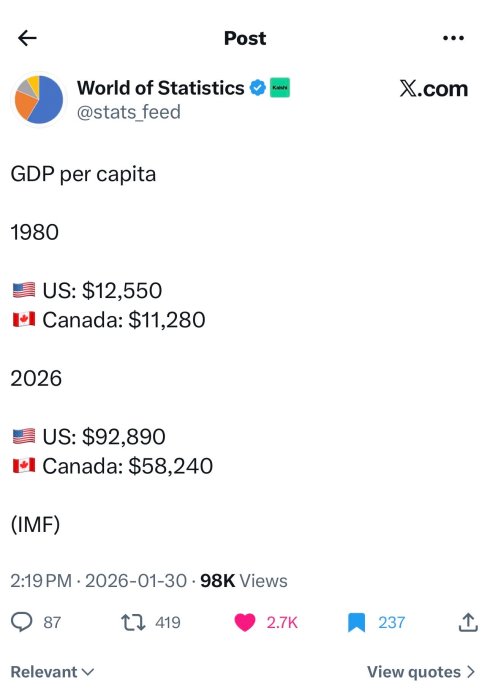
If Ottawa keeps governing by bandage, the next few years will look like the last: higher spending, louder announcements, thinner per-person results, and a country that feels like it’s working harder for less. The gap won’t close by intention. It will close only when we stop confusing “more government activity” with “more national competence.”
On January 3, 2026, the United States carried out a large-scale operation in Venezuela that resulted in the capture of Nicolás Maduro and his wife, Cilia Flores, and their transfer into U.S. custody. [1] Within hours, the story stopped being only about Maduro. It became a stress test of the West’s default assumptions about how global order actually works.
The reaction split fast and predictably: condemnation framed in the language of sovereignty and the UN Charter; applause framed in the language of liberation and justice; and, underneath both, a quieter argument about whether “international law” is a meaningful constraint—or primarily a vocabulary used to legitimize outcomes power already permits.
Two languages for one event
When a great power uses force to remove a sitting head of state and relocate him for prosecution, states and commentators typically reach for one of two languages.
The first is legal-institutional: Was this lawful? Was it authorized? What does the UN Charter permit? What precedent does it set?
The second is strategic-realist: What will it cost? Who can impose consequences? What does it deter? What does it invite?
These languages often coexist, but Venezuela forced a choice because it exposed the tension between *the claim* of a rules-governed international order and *the mechanism* by which order actually persists.
The enforceability problem
The measured point is not that international law is “fake” in every domain. A great deal of international life runs on rules that are real in practice: treaties, trade arrangements, financial compliance, aviation coordination, maritime norms, and sanctions enforcement. In those domains, rules can be highly consequential because they are tied to access, markets, and institutional membership.
But in the domain that states care about most—hard security and regime survival—international law runs into a structural limitation: there is no global sovereign with a monopoly on force. The question is not whether rules exist, but whether they bind the actors most able to ignore them.
That isn’t a rhetorical flourish. It’s the structural fact everything else sits on.
The UN can convene, condemn, and deliberate. But it cannot consistently coerce major powers into compliance. In the wake of the Maduro operation, the UN Security Council moved to meet and the UN Secretary-General warned the action set a “dangerous precedent.” [2] That may shape legitimacy and alliances. It may raise political costs. But it does not function like law inside a state, because law inside a state ultimately rests on enforceable authority.
This is why the phrase “international law” so often behaves less like binding law and more like legitimacy currency—something states spend, something rivals contest, and something that matters most when it is backed by power.
The reaction spectrum makes more sense as philosophy, not partisanship
The political reactions were not merely partisan reflexes; they were expressions of competing world-models.
Institutionalists treated the precedent as the core danger: once unilateral force becomes normalized, the world becomes easier for worse actors to imitate.
Sovereignty-first critics (especially in regions with long memories of intervention) treated it as a return to imperial patterns—regardless of Maduro’s character.
Results-first supporters treated it as overdue action against an entrenched authoritarian regime and criminal networks.
Realists treated it as a reminder that rules do not restrain actors who cannot be credibly punished.
It is possible to disagree with the operation and still accept the realist diagnosis. “This was reckless” and “this reveals how order works” are not contradictions—they’re often the same conclusion stated in different registers.
A small but telling detail: systems moved, not just speeches
One detail worth noting is that the event had immediate operational spillover beyond diplomacy: temporary Caribbean airspace restrictions and widespread flight cancellations followed, with U.S. authorities later lifting curbs. [3] That’s not a moral argument either way. It’s simply a reminder that great-power action produces real-world system effects instantly—while multilateral processes operate on a different clock.
Meanwhile, Venezuela’s internal institutions scrambled to project continuity. On January 4, 2026, reporting described Venezuela’s Supreme Court ordering Vice President Delcy Rodríguez to assume the interim presidency following Maduro’s detention. [4] Again, one can read this in legal terms or strategic terms. But it underscores the same point: the decisive moves were being made through power, institutional control, and logistics—not through international adjudication.
What Venezuela is really teaching
The strongest measured conclusion is this:
1. International law can matter as coordination and legitimacy.
2. But in hard-security conflicts, it does not function like ordinary law because enforcement is selective, especially against great powers.
3. Therefore, when Western leaders speak as though “international law” itself will constrain outcomes, they are often describing the world they want—or the world they remember—more than the world that exists.
This is the wake-up Venezuela delivers: not that rules are worthless, but that rules don’t become rules until they are paired with credible consequences. If the West wants a world that is safer for liberal societies, it must stop mistaking procedural vocabulary for strategic capacity.
What Western leaders should do differently
If “international law” is often a language of legitimacy rather than a source of enforcement, then the task for Western leaders is not to abandon norms—but to rebuild the conditions under which norms can actually hold. That requires a change in posture that is both external and internal.
First: speak honestly about interests and tradeoffs.
A rules vocabulary can be morally sincere and still strategically evasive. Western publics deserve leaders who can say, without euphemism, what outcomes matter, why they matter, and what costs we are willing to pay to secure them.
Second: re-embody Western values in our institutions, not merely our slogans.
The West is not “a place that sometimes gets things right.” It is the most successful civilizational experiment yet produced: freedom under law, pluralism, scientific dynamism, broad prosperity, and the moral insight that the individual matters. If leaders treat this as an embarrassment rather than an inheritance, they will govern as caretakers of decline.
Third: restore civic confidence by repairing the narrative infrastructure.
A civilization that teaches its own children that it is uniquely evil will not defend itself—or even understand why it should. The “mono-focused West-is-bad” story has become a kind of institutional reflex across parts of education, culture, and bureaucracy. You can reject naïve triumphalism while still insisting on civilizational honesty: that the West has flaws, committed crimes, and still produced the best lived human outcomes at scale to date.
Fourth: build capacity again—material, strategic, and moral.
Norms without capacity do not preserve peace; they invite tests. This means defense industrial readiness, energy resilience, border and migration competence, counterintelligence seriousness, and the willingness to impose costs where deterrence requires it.
Finally: treat multilateralism as a tool, not a substitute for power.
Institutions can amplify strength; they cannot conjure it. A West that wants a stable order must stop acting as though process is the engine. Process is the dashboard.
Afterword: the more polemical take
Western elites keep reaching for “international law” the way a sleepwalker reaches for the bedside table—by habit, not by sight. They speak as if naming the norm substitutes for enforcing it. But there is no authority behind it for the actors that matter most.
So the scandal isn’t disagreement about Venezuela. The scandal is that so many of our leadership classes still talk like we live in a world where legitimacy language can replace power, unity, and competence. That was a comfortable posture in a more unipolar era. It is a dangerous posture now.
In a multipolar environment, moral declarations without strength don’t preserve order. They advertise weakness. And weakness is not neutral: it invites tests.

Footnotes
[1] Reuters (Jan 3–4, 2026): reporting on the U.S. operation capturing Nicolás Maduro and Cilia Flores and transferring them to U.S. custody.
[2] Reuters (Jan 3, 2026): UN Security Council to meet over U.S. action; UN Secretary-General calls it a “dangerous precedent”; meeting requested with backing from Russia/China.
[3] Reuters (Jan 3, 2026): Caribbean airspace restrictions and flight cancellations following the operation; later lifted.
[4] Reuters (Jan 4, 2026): Venezuela’s Supreme Court orders Delcy Rodríguez to assume interim presidency after Maduro’s detention.
Direct Reference Links
[1] Reuters — “Mock house, CIA source and Special Forces: The US operation to capture Maduro”
https://www.reuters.com/business/aerospace-defense/mock-house-cia-source-special-forces-us-operation-capture-maduro-2026-01-03/
[2] Reuters — “UN Security Council to meet Monday over US action in Venezuela”
https://www.reuters.com/world/americas/un-chief-venezuela-us-action-sets-dangerous-precedent-2026-01-03/
[3] Reuters — “US lifts Caribbean airspace curbs after attack on Venezuela”
https://www.reuters.com/world/americas/us-airlines-cancel-flights-after-caribbean-airspace-closure-2026-01-03/
[4] Reuters — “Venezuela’s Supreme Court orders Delcy Rodriguez become interim president”
https://www.reuters.com/world/americas/venezuelas-supreme-court-orders-delcy-rodriguez-become-interim-president-2026-01-04/
For most of my adult life, I identified as left-of-centre. I supported progressive policies on social issues, the environment, and equality. But over the past few years—especially now, at 51—I’ve found myself increasingly out of step with parts of the contemporary left. Not because my values changed, but because many of the policies being pushed today feel more disruptive than constructive. They often reshape core institutions, family structures, or economic systems without clear evidence that the changes will work long-term.
This isn’t a turn toward extremism. I still care deeply about compassion, fairness, and progress. What has changed is my tolerance for sweeping experimentation without rigorous testing. I want policy that is incremental, evidence-based, and willing to adjust when data shows something isn’t working. That’s not ideology—it’s responsibility.Seeking evidence-driven solutions isn’t inherently “right-wing.” Both sides claim to follow the data, but in practice, good policy should transcend labels. Historically, Canadian conservatism has often embodied this approach: balanced budgets, stable institutions, and pragmatic reforms that build on what already works rather than tearing systems down in pursuit of unproven theories.
Yet critics are quick to slap on labels like “Maple MAGA”—a term meant to equate any Canadian centre-right view with the most polarizing elements of U.S. Trumpism. It’s a lazy shortcut, designed to shut down conversation rather than understand it. Not every conservative is a populist firebrand. Many people—myself included—are simply tired of rapid, ideologically driven changes that risk destabilizing society without demonstrating clear benefits.
I’m not closed off. If strong evidence emerges showing that bold progressive policies genuinely improve stability, opportunity, and quality of life, I’m willing to reconsider. But right now, I see more promise in cautious, proven approaches that respect the complexity of the systems we’re trying to improve.
What about you? Have your views shifted as you’ve gained more life experience? I’m interested in real dialogue: no smears, no lazy labels, and no assumptions that a shift in perspective means abandoning core values.

For Canadians observing American politics from across the border, the U.S. conservative movement can look unusually volatile—especially after Donald Trump’s 2024 victory reinforced his influence over the Republican Party. If the Canadian Conservative Party is a “big tent,” the GOP is a sprawling, louder, and more internally divided version of the same idea. Its factions share broad goals but clash over identity, strategy, and the future of the movement.
In a recent public commentary, writer James Lindsay outlined five distinct factions competing for influence on the American right. His taxonomy is one interpretation among many, but it captures real ideological and generational tensions. For Canadians trying to understand how these divisions might shape U.S. policy, it’s a useful map.
1. Establishment Republicans: The Institutional Conservatives
These are the traditional, business-oriented conservatives—what Lindsay calls the “stodgy suit-wearing” wing. They emphasize:
• limited government
• free trade
• predictable governance
• strong national defense
For Canadians, this group resembles the Mulroney-era blue Tories: polished, institutionally minded, and cautious about populist disruption.
2. “RINO” Moderates: The Centrist Republicans
“RINO” (Republican In Name Only) is a pejorative label used by hardliners to describe moderates they see as too conciliatory or ideologically soft. Think of figures who prioritize bipartisan cooperation or resist populist rhetoric.
The Canadian parallel would be how some conservatives dismiss “Red Tories” as insufficiently committed to conservative principles. The term reflects internal policing rather than a neutral category, but it marks a real divide between ideological purists and pragmatic centrists.
3. Middle MAGA: The Populist-Pragmatic Core
Lindsay identifies Middle MAGA as the current center of gravity within the GOP. This faction emphasizes:
• patriotism
• common-sense governance
• America First policies
• civic engagement
• skepticism of foreign wars
It is largely Gen X–led and blends populist energy with practical governance. For Canadians, the closest analogue is Pierre Poilievre’s populist-but-practical conservatism: anti-elite, affordability-focused, and oriented toward achievable reforms rather than sweeping ideological overhauls.
4. The Woke Right / Post-Liberal Radicals
This faction—also described as post-liberal, paleoconservative, or national conservative—rejects classical liberalism’s emphasis on individual rights and free markets. Instead, they advocate:
• a more interventionist state
• protectionist economics
• government enforcement of cultural or religious norms
• a strong national identity
Lindsay criticizes this group for adopting tactics he associates with left-wing activism, such as purity tests and identity-based rhetoric. For Canadians, this resembles fringe nationalist or sovereigntist currents—loud, ideological, and disruptive, but not representative of mainstream conservative policy.
5. Pragmatic Neo-Establishment Republicans (e.g., DeSantis-aligned)
This faction overlaps with Middle MAGA but is distinct in its technocratic, results-oriented approach. These conservatives:
• embrace populist themes
• maintain classical liberal commitments
• prioritize policy execution and administrative competence
Lindsay uses Ron DeSantis as an example of this style: populist in tone, managerial in practice. For Canadians, this resembles the Harper-era blend of populist messaging with disciplined governance.
Where the Movement Is Heading
Lindsay predicts that the most likely future for the American right is a fusion between Middle MAGA (3) and the pragmatic neo-establishment (5). This coalition would combine populist energy with administrative competence, pulling many traditional establishment conservatives (1) along with it.
By contrast, he expects the RINO moderates (2) and the Woke Right/post-liberal radicals (4) to resist this consolidation—“kicking and screaming,” as he puts it—and potentially causing disruption from the fringes.
Why This Matters for Canada
These internal American debates have direct implications for Canadians. U.S. conservative politics influence:
• trade policy and tariffs
• energy infrastructure, including pipelines and cross-border projects
• border security and immigration coordination
• NATO and continental defense
As Trump’s second term unfolds, the balance of power among these five factions could shape everything from tariff structures to foreign aid priorities. For Canada, understanding these divisions is essential. Our closest ally and largest trading partner is navigating a period of ideological realignment—one that echoes our own debates, but on a larger, louder, and more consequential scale.

When the extremes meet, the center collapses. (TL;DR)
When the Horseshoe Hangs from the Scales explains why the far left and far right increasingly resemble each other—not in ideas, but in methods. Drawing on the metaphors of the scale and the horseshoe, this essay argues that both totalitarian idealism and populist reaction stem from the same metaphysical error: the rejection of objective reality. Only realism—humility before truth—can keep Western society from closing into a circle of coercion.
Political language often obscures more than it reveals. The familiar left–right spectrum suggests linear opposition—progressives facing conservatives across a straight divide. Yet history and experience show something stranger: as ideologies radicalize, their behavior begins to mirror one another. The further the extremes move from reality, the closer they become in method, rhetoric, and moral psychology.
In The Scales of Society (published yesterday), realism anchored the crossbar, and idealism dragged the pans downward into totalitarianism. The horseshoe adds a complementary image. Viewed from above, the scale’s pans curve toward each other like the ends of a bent spectrum. The metaphysical collapse becomes social convergence. Both metaphors describe a single process: when realism breaks, the poles of idealism meet in coercive symmetry.
The Geometry of Political Collapse
The horseshoe theory proposes that the political spectrum bends upon itself, bringing the far left and far right into proximity. Communism and fascism, though ideologically opposed, resemble one another in practice: one abolishes private property, the other subordinates it to the state; both demand absolute obedience. Each claims to redeem humanity through purity—of class or of nation—and each regards dissent as treason.
The scale explains why this happens: both extremes spring from idealism detached from reality. The horseshoe shows how it manifests: through behavioral and institutional mimicry. One describes the metaphysical axis, the other the social. Together they form a complete model of ideological deformation. The vertical collapse of realism generates the horizontal convergence of fanaticism.
From Difference to Sameness
Political polarization masquerades as difference, but when stripped of surface content, the ends often converge in identical impulses:
- Moral totalism. Each side claims moral monopoly—an absolute vision of justice or order that sanctifies any means.
- Friend–enemy logic. Politics becomes warfare. Dialogue is betrayal; neutrality, complicity.
- Collectivist ethics. The individual dissolves into the movement, valuable only as a vehicle for ideological ends.
- Epistemic closure. Truth is no longer discovered but declared; narrative replaces verification.
Arendt observed that totalitarian movements, regardless of ideology, replace empirical reality with “a fictitious world” sustained by propaganda. Popper saw the same pattern: the closed society begins when ideas become sacred and unfalsifiable. Whether draped in red flags or eagles, the architecture is the same.
What begins as opposition ends as resemblance. The revolutionary who abolishes hierarchy and the reactionary who enforces it both deny human limitation. Each demands transformation rather than reform, purity rather than compromise. The further they stray from realism, the more they mirror one another’s methods—purges, censorship, mythmaking, and ritual denunciation.
Convergence in the Contemporary West
The horseshoe is no relic of the twentieth century; its shape defines the present. In the West, the rhetoric of liberation and the rhetoric of restoration increasingly share an authoritarian grammar.
Cultural absolutism. On the progressive extreme, morality is redefined as the enforcement of inclusivity. Dissenting speech becomes “harm,” and linguistic deviation, “violence.” On the reactionary extreme, purity is national or moral rather than social, but the logic is the same: deviation equals corruption. Each side builds orthodoxy around identity.
Information control. The progressive insists on regulating “disinformation,” policing language for moral safety. The populist right responds with its own echo chambers, treating factual correction as conspiracy. Both distrust open discourse, substituting propaganda for persuasion. Truth is no longer common ground but a weapon.
Purity politics. Cancel culture and culture-war purges are functional twins. One excommunicates for heresy against equality, the other for heresy against tradition. Each side frames punishment as virtue, enforcing conformity by shame or exclusion. In both cases, moral capital accrues not from good deeds but from the public destruction of sinners.
The psychological mechanism is identical: belonging through denunciation. The horseshoe’s curve tightens as participants draw moral comfort from collective outrage. When opposing extremisms adopt the same tactics, the distance between them is illusion.
The Horseshoe Meets the Scale
The two metaphors illuminate one another. The scale shows the metaphysical error: idealism’s detachment from realism. The horseshoe shows the social consequence: the return of opposites through behavioral convergence. The result is not diversity of belief but monoculture of method.
Imagine the scales viewed from above: the crossbar of realism forms the straight backbone, but as the pans descend into idealism, they bend toward one another, forming the curve of the horseshoe. The more society abandons truth, the closer its extremes approach in both temperament and technique.
When realism—objective verification, moral humility, and factual accountability—fails, politics becomes a contest of myths. The question is no longer “what is true?” but “whose truth will rule?” In that struggle, the difference between revolutionary and reactionary becomes decorative. Both invoke moral crisis to justify compulsion; both see coercion as salvation.
Why the Center Cannot Hold Without Realism
Critics often lament the “vanishing center,” as if centrism itself could rescue political sanity. But moderation is not a position; it is a discipline—an adherence to external reality over internal fervor. The true counterweight to the horseshoe’s closure is not neutrality but realism.
Realism anchors discourse in verifiable truth: data, evidence, experience, and the acknowledgment of limits. It permits disagreement without dehumanization because it recognizes a shared world beyond ideology. Realism turns enemies into interlocutors by subjecting both to the same facts.
Idealism, by contrast, makes conflict existential. When truth depends on belief, contradiction becomes evil. The desire to perfect the world leads to the compulsion to perfect others, and the moral imagination becomes the tool of tyranny. Only realism—accepting that the world corrects us—keeps the curve of politics open rather than collapsing into a circle of extremism.
The Moral Psychology of the Horseshoe
The convergence of extremes is not merely institutional; it is psychological. Both sides attract personalities drawn to certainty, purity, and moral theater.
The late political theorist Eric Voegelin described this as “gnostic revolt”—the refusal to accept human limitation and the longing to recreate the world in one’s own image. Arendt called it “world alienation.” Each formulation captures the same impulse: the substitution of idea for reality. The horseshoe is the social geometry of that spiritual rebellion.
When entire populations internalize this mindset, societies lose the ability to distinguish moral conviction from metaphysical arrogance. Activists and autocrats alike begin to speak in the same register—of awakening, purity, and necessary sacrifice. The vocabulary of utopia is universal; only its symbols differ.
The Path Back to Reality
Escaping the horseshoe requires reattaching it to the scales—recovering realism as the crossbar that holds political difference in balance. This means restoring institutions that mediate between belief and fact: open science, free inquiry, due process, and honest journalism. It means accepting that error, not heresy, is the normal state of human reason.
Humility, not ideology, is the civic virtue realism demands. The realist admits uncertainty, revises judgment, and learns from failure. Such modesty is not weakness but strength—the discipline that prevents conviction from hardening into cruelty.
Conclusion: The Shape of Sanity
The geometry of political life reflects our metaphysics. When truth stands above us, the scales stay level and the horseshoe remains open. When truth becomes a tool of power, the scales tilt, and the horseshoe closes into a circle—opposites united in coercion.
The West’s present turbulence is not a clash of left and right but a crisis of realism. Both sides, in their extremes, are tempted by the same illusion: that belief can replace being, that will can dictate truth.
If freedom is to endure, it will not be because one ideology triumphs but because reality reasserts itself—quietly, stubbornly, as the only ground capable of bearing the weight of difference.

References
- Arendt, Hannah. The Origins of Totalitarianism. New York: Harcourt Brace, 1951.
- Burke, Edmund. Reflections on the Revolution in France. London: J. Dodsley, 1790.
- Haidt, Jonathan. The Righteous Mind: Why Good People Are Divided by Politics and Religion. New York: Vintage, 2012.
- Lukianoff, Greg & Haidt, Jonathan. The Coddling of the American Mind. New York: Penguin, 2018.
- Popper, Karl. The Open Society and Its Enemies. London: Routledge, 1945.
- Voegelin, Eric. The New Science of Politics. Chicago: University of Chicago Press, 1952.
- Ortega y Gasset, José. The Revolt of the Masses. New York: W.W. Norton, 1932.
(TL;DR) Eric Voegelin’s The New Science of Politics remains one of the clearest guides to our modern disorder. It teaches that when politics cuts itself off from transcendent truth, ideology fills the void—and history descends into Gnostic fantasy. Voegelin’s remedy is not new revolution but ancient remembrance: the recovery of the soul’s openness to reality.
Eric Voegelin (1901–1985) was an Austrian-American political philosopher who sought to diagnose the spiritual derangements of modernity. In his 1952 classic The New Science of Politics—first delivered as the Walgreen Lectures at the University of Chicago—Voegelin proposed that politics cannot be understood as a merely empirical or procedural science. Power, institutions, and law arise from a deeper spiritual ground: humanity’s participation in transcendent order. When societies lose awareness of that participation, they fall into ideological dreams that promise salvation through human effort alone. The book is therefore both a critique of modernity and a call to recover the classical and Christian understanding of political reality (Voegelin 1952, 1–26).
1. The Loss of Representational Truth
Every stable society, Voegelin argued, “represents” its members within a larger order of being. In ancient civilizations and medieval Christendom, political authority symbolized this participation through myth, ritual, and law that acknowledged a reality beyond human control. The ruler was not a god but a mediator between the temporal and the eternal.
Beginning in the twelfth century, however, the monk Joachim of Fiore reimagined history as a self-unfolding divine drama in which humanity itself would bring about the final age of perfection. With this shift, Western consciousness began to “immanentize the eschaton”—to relocate ultimate meaning inside history rather than in its transcendent source. Out of this inversion grew the modern ideologies of progress (Comte, Hegel), revolution (Marx), and race (National Socialism), each promising earthly redemption through planning and will (Voegelin 1952, 107–132).
For Voegelin, the loss of representational truth meant that governments no longer reflected humanity’s place in divine order but instead projected utopian images of what they wished reality to be. Politics ceased to be the articulation of truth and became the engineering of salvation.
2. Gnosticism as the Modern Disease
Voegelin identified the inner structure of these movements as Gnostic. Ancient Gnostics sought hidden knowledge that would liberate the soul from an evil world; their modern successors, he said, sought knowledge that would liberate humanity from history itself. “The essence of modernity,” Voegelin wrote, “is the growth of Gnostic speculation” (1952, 166).
He listed six recurrent traits of the Gnostic attitude:
- Dissatisfaction with the world as it is.
- Conviction that its evils are remediable.
- Belief in salvation through human action.
- Assumption that history follows a knowable course.
- Faith in a vanguard who possess the saving knowledge.
- Readiness to use coercion to realize the dream.
From medieval millenarian sects to twentieth-century totalitarian states, these traits form a single continuum of spiritual rebellion: the attempt to perfect existence by abolishing its limits.
3. The Open Soul and the Pathologies of Closure
Against the Gnostic impulse stands the open soul—the philosophical disposition that accepts the “metaxy,” or the in-between nature of human existence. We live neither wholly in transcendence nor wholly in immanence, but within the tension between them. The philosopher’s task is not to resolve that tension through fantasy or reduction but to dwell within it in faith and reason.
Political science, therefore, must be noetic—concerned with insight into the structure of reality—not merely empirical. A society’s symbols, institutions, and laws can be judged by how faithfully they articulate humanity’s participation in divine order. Disorder, Voegelin warned, begins not with bad policy but with pneumopathology—a sickness of the spirit that refuses reality’s truth. “The order of history,” he wrote, “emerges from the history of order in the soul.”
Empirical data can measure economic growth or electoral results, but it cannot measure spiritual health. That requires awareness of being itself.
4. Liberalism’s Vulnerability and the Way of Recovery
Voegelin saw liberal democracies as historically successful yet spiritually precarious. By reducing political order to procedural legitimacy and rights management, liberalism risks drifting into the nihilism it opposes. When public life forgets its transcendent foundation, freedom degenerates into relativism, and pluralism becomes mere fragmentation.
Still, Voegelin’s outlook was not despairing. His proposed remedy was anamnesis—the recollective recovery of forgotten truth. This is not nostalgia but awakening: the rediscovery that human beings are participants in an order they did not create and cannot abolish. The recovery of the classic (Platonic-Aristotelian) and Christian understanding of existence offers the only durable antidote to ideological apocalypse (Voegelin 1952, 165–190).
To “keep open the soul,” as Voegelin put it, is to resist every movement that promises paradise through force or theory. The alternative is the descent into spiritual closure—an ever-recurring temptation of modernity.
5. Contemporary Resonance
Voegelin’s analysis remains uncannily prescient. Today’s ideological battles—whether framed around identity, technology, or climate—often echo the same Gnostic pattern: discontent with the world as it is, belief that perfection lies just one policy or re-education campaign away, and impatience with reality’s resistance. The post-modern conviction that truth is socially constructed continues the old dream of remaking existence through will and language.
Voegelin’s warning cuts through our century as clearly as it did the last: when politics replaces truth with narrative and transcendence with activism, society repeats the ancient heresy in secular form. The cure, as ever, is humility before what is—the recognition that order is discovered, not invented.
References
Voegelin, Eric. 1952. The New Science of Politics: An Introduction. Chicago: University of Chicago Press.
Hughes, Glenn. 2003. Transcendence and History: The Search for Ultimacy from Ancient Societies to Postmodernity. Columbia: University of Missouri Press.
Sandoz, Ellis. 1981. The Voegelinian Revolution: A Biographical Introduction. Baton Rouge: Louisiana State University Press.
Glossary of Key Terms
Anamnesis – Recollective recovery of forgotten truth about being.
Gnosticism – Revolt against the tension of existence through claims to saving knowledge that masters reality.
Immanentize the eschaton – To locate final meaning and salvation within history rather than beyond it.
Metaxy – The “in-between” condition of human existence, suspended between immanence and transcendence.
Noetic – Pertaining to intellectual or spiritual insight into reality’s order.
Pneumopathology – Spiritual sickness of the soul that closes itself to transcendent reality.
Representation – The symbolic and political articulation of a society’s participation in transcendent order.











 bleatmop
 Mystro
 The Arbourist


 Dead Wild Roses
Your opinions…