
You are currently browsing the tag archive for the ‘Polysemy’ tag.

Philosophy Professor Letitia Meynell in this portion of an essay postulates how we need to deal with ‘woke’ in our society. I read the essay and found that it misses one of the key aspects of ‘woke’ and that is the use of polysemy to confuse the meanings of words and terms. Let’s read her essay together and then propose a some counters to her arguments. A long read, but it is necessary to see how ‘woke’ works in the wild and what you can do to counter it.
“A few years ago, there was considerable anxiety in some quarters about “political correctness,” particularly at universities. Now it’s known as wokeness, and even though the terminology has changed, the concerns are much the same.
Some years ago, I offered an analysis of political correctness that equally pertains to wokeness today. What interests me are ways to think about and discuss political correctness/wokeness so as to avoid polarizing polemics and increase mutual understanding.
The goal is to help us all envision and create a more just and peaceful society by talking with each other rather than talking past each other.
‘Woke interventions’
Typically, “wokeness” and “woke ideology” are terms of abuse, used against a variety of practices that, despite their diversity, have a similar character. Often, what is dismissed as “woke” is a new practice that is recommended, requested, enacted or enforced as a replacement for an old one.
These practices range from changing the names of streets, institutions and buildings to determining who reads to pre-school children in libraries and altering the words we use in polite conversation.
When a practice is identified as “woke,” there is an implication that the non-woke practice is better or at least equally good. Thus the dismissal of something as “woke” is an endorsement of some alternative.
If we stop there, all we will see is a power struggle between progressive and conservative values. To dig deeper, I am going to share a particular case of calling out, or language policing, as an example of wokeness.
This incident happened to a Jewish friend of mine when we were students. She was directing a play about the Holocaust and, during auditions, a young woman casually used the word “Jew” to mean cheat. When my friend challenged this, the young woman asserted that it wasn’t offensive; it was just the way people from her town talked.
In the wrong
I use this example because I think it’s clear this young woman was in the wrong. My friend wasn’t being overly sensitive and was right to call her out.
But this example is also useful because it’s fairly typical of cases where someone attempts a “woke intervention” and it’s rejected — someone follows a practice that is common in their community, a “woke” intervenor calls it out, and the person responds not with an apology or even a question, but with outright dismissal.
Often, such responses come with an explicit criticism that the “woke” intervenor is over-sensitive, irrational or controlling. Sometimes, the original speaker claims victimization at being targeted, ironically displaying the hypersensitivity often attributed to people described as woke.
Three claims
In thinking about this and similar situations, it strikes me that woke interventions tend to share the same kinds of motivations. They boil down to the following three claims about the targeted practice that justify the woke intervention:
- The practice is offensive to the members of a group to which it pertains;
- The practice implies something that is false about this group and reflects and reinforces this inaccuracy;
- The practice implicitly endorses or maintains unjust or otherwise pernicious attitudes about the group that facilitate discrimination and various other harms against them.
So, in my friend’s case, she was right to call out this young woman, who had insulted her to her face and implied something about the Jewish community that is not only false but dangerously and perniciously antisemitic.
Now, in any particular instance, it is an open question whether, in fact, a specific term or practice is offensive, inaccurate or facilitates discrimination. This is where the difficult work starts.
Real effort is required to learn to see injustices that are embedded in our ordinary language and everyday practices.
Social psychological work on implicit biases suggests that good intentions and heartfelt commitments are not enough. It takes integrity and courage to critically examine our own behaviour and engage in honest conversations with people who claim we have hurt them.
However, once we recognize what’s at stake, to dismiss something as woke is a refusal to even consider the possibility that the targeted practice might be offensive, premised on false or inaccurate claims or discriminatory or harmful.
Defensiveness
Often such refusals are grounded in defensiveness and embarrassment. I suspect many of us can recognize the young woman’s sense of shock, hurt and denial at being called out for her behaviour.
But for those who disagree with a woke intervention, the right response is not glib dismissal or bombastic accusations of “being cancelled.”
Rather — after a sincere attempt to understand the woke intervenor’s perspective and consider the relevant facts — the right response is a respectful, tempered explanation of why they believe their remarks or actions were neither premised on false claims nor discriminatory. An apology may be in order. After all, at the very least, one has inadvertently insulted someone.
If my analysis is correct, we can now see why the knee-jerk dismissal of something as “woke” is so nasty; it amounts to a self-righteous choice not only to insult or denigrate others but to protect one’s ignorance and support injustice.
Unless we learn to talk with each other rather than past each other, it’s difficult to see how we can ever achieve peace on Earth or truly show our good will to each other.”
Refuting Wokeness: Clarity Over Obfuscation
Introduction: The Polysemy Trap
Philosophy Professor Letitia Meynell, in her essay on navigating “wokeness,” seeks to foster dialogue about contentious social practices. Yet her analysis falters by overlooking a critical feature of “woke”: its polysemy, which obscures meaning and confounds discourse. The activist Left often deploys poorly defined terms, resisting crystallization into cohesive arguments. This ambiguity is deliberate, enabling the Motte and Bailey strategy—where “woke” advocates defend controversial policies under the guise of innocuous ideals. For supporters, “woke” connotes kindness, empathy, and social awareness; in practice, it can manifest as discrimination against perceived “oppressor” groups. Meynell’s failure to grapple with this duality undermines her vision of mutual understanding, necessitating a sharper critique.
Engaging Meynell’s Core Claims
Meynell posits that “woke interventions” target practices deemed offensive, false, or discriminatory, citing an antisemitic slur used casually during a play audition as a clear case of harm. Her framework, at its strongest, is not a dogmatic defense of all interventions but a call to assess practices critically: might they offend a group, misrepresent them, or perpetuate unjust attitudes? She urges critics to engage intervenors’ perspectives before dismissing their concerns, a reasonable plea for open-mindedness rooted in social psychological research on implicit biases.
Yet this approach stumbles on two counts. First, it ignores the polysemy of “woke,” which allows advocates to glide between benign ideals and coercive measures. A call for inclusive language (the motte) can escalate into punitive actions (the bailey), as seen in the 2018 case of a University of Michigan professor disciplined for refusing to use preferred pronouns, despite no evidence of discriminatory intent. Meynell’s essay elides this slippage, presenting interventions as primarily corrective. Second, her reliance on subjective offense risks overreach. While the antisemitic slur is unequivocally harmful, many “woke” targets—debates over cultural appropriation or microaggressions—hinge on context and interpretation. Absent clear criteria for harm, interventions can stifle discourse, a tension Meynell underestimates.
The Unproven Premise of Systemic Harm
Meynell’s most compelling claim is that “woke interventions” address practices that “implicitly endorse or maintain unjust attitudes,” facilitating discrimination. She invokes implicit bias research to argue that good intentions cannot preclude harm—a point with merit, as biases can operate unconsciously. Yet she assumes systemic harm as axiomatic, demanding critics disprove it rather than requiring proponents to prove it. Research on implicit bias, like the Implicit Association Test (IAT), faces scrutiny for weak predictive validity in real-world behavior (Oswald et al., 2013). Correlation is not causation; asserting that everyday practices inherently perpetuate discrimination requires evidence—say, data linking specific language to measurable disparities. By sidestepping this rigor, Meynell inverts rational inquiry, undermining her call for “honest conversations.”
The Motte and Bailey’s Polarizing Effect
The polysemy of “woke” fuels a rhetorical sleight-of-hand: the Motte and Bailey strategy. In the motte, “woke” is empathy—uplifting the marginalized, fostering inclusion. In the bailey, it justifies policies that alienate or vilify, often without substantiating harm. Consider the 2020 backlash against J.K. Rowling, labeled “transphobic” for questioning gender ideology, despite her nuanced arguments. Such interventions, cloaked in moral righteousness, suppress debate. Meynell’s essay endorses the motte, ignoring the bailey’s divisive impact. A 2021 Cato Institute survey found 66% of Americans fear expressing political views due to social repercussions, suggesting “woke” practices can fracture rather than unite. Polysemy exacerbates this: without shared definitions, dialogue devolves into mutual incomprehension—a debacle Meynell’s framework fails to address.
A Path to True Dialogue
Meynell’s vision of dialogue is laudable but lopsided. She rightly urges critics to consider intervenors’ perspectives, yet spares advocates the same scrutiny. True dialogue demands reciprocity: proponents must substantiate harm with evidence—statistical impacts, not anecdotal offense—while critics must articulate principled objections, such as free speech or empirical skepticism. Meynell’s call for critics to offer “tempered explanations” or apologies assumes intervenors’ claims are prima facie valid, tilting the scales. Dismissing dissent as “nasty” or “self-righteous” poisons discourse, as does the polysemic dodge that shields “woke” policies from critique. A just society requires evidence-based debate: terms defined, assumptions tested, ambiguity exposed.
Conclusion
Meynell’s essay, at its core, aspires to bridge divides through reflection on social practices. Yet it falters by ignoring the polysemy of “woke” and presuming systemic harm without proof. Her prescriptive tone—demanding critics justify dissent while excusing advocates’ vagueness—corrodes the mutual understanding she champions. By dismantling the Motte and Bailey tactic and grounding discourse in evidence, we can forge a society that is both just and cohesive. Clarity, not obfuscation, is the path forward.
References
- Oswald, F. L., Mitchell, G., Blanton, H., Jaccard, J., & Tetlock, P. E. (2013). Predicting ethnic and racial discrimination: A meta-analysis of IAT criterion studies. Journal of Personality and Social Psychology, 105(2), 171–192.
- Cato Institute. (2021). National Survey: Americans’ Free Speech Concerns. Retrieved from cato.org.

it’s fun-fact woke learning time! First a new vocabulary word!
Polysemy – Having a word or concept that has multiple meanings. What it does is allow the activists to say one thing, while meaning something completely different.
Employed skillfully, the woke can flit between the reasonable definition and the one they really intend.

The “woke mind virus” is a dogmatic, control-seeking ideology, not the benign traits listed. These 10 points misfire by assigning warped meanings to common virtues, fueling confusion and division.
- “Reading books, not burning them” sounds noble, but woke ideology often curates what’s “acceptable” to read, banning dissent subtly.
- “Embracing science” shifts to cherry-picking studies that fit narratives, not raw inquiry.
- “Changing your mind” becomes abandoning principles for trending dogma, not reasoned flexibility.
- “Issues aren’t black and white” morphs into relativism that dodges accountability.
- “True equality” redefines as forced sameness, not equal opportunity.
- “Liking to share” turns into mandating redistribution, not generosity.
- “Embracing cooperation” means silencing disagreement for fake unity.
- “Respecting rights” flips to prioritizing select groups’ feelings over universal freedoms.
- “Valuing culture and arts” becomes worshipping approved expressions, not creativity.
- “Caring for the planet” slides into eco-orthodoxy, shaming nonconformists.
By cloaking coercion in virtuous terms without admitting the shift, these points don’t expose the virus—they spread it, eroding clarity and free thought under a moral mask.
So much of the discussion around DEI is people arguing about two or more very different ideas of what DEI is. Let’s investigate that problem – like many of the situations we face as a society today much of the furor is being caused by have multiple definitions of the same idea.
Polysemy—the fact that words or concepts like DEI (Diversity, Equity, and Inclusion) can have multiple meanings—does indeed complicate discussions about it. Supporters might define DEI as a noble effort to ensure fairness and opportunity for all, as seen in your earlier examples (e.g., accommodations for disabled neighbors or pregnant friends). Critics, however, might interpret it differently, focusing on its implementation or unintended consequences. Below is a 5-point breakdown of why DEI, as commonly applied, might not be a good thing for society, while acknowledging this definitional divide and approaching the critique thoughtfully.
1. It Can Prioritize Group Identity Over Individual Merit
-
Critics’ View: DEI often emphasizes categories like race, gender, or disability status, which can shift focus away from a person’s skills or qualifications. For example, hiring quotas (real or perceived) might lead to someone being chosen to “check a box” rather than based on their ability.
-
Supporters’ Definition Clash: Supporters might say DEI is about removing barriers, not enforcing quotas—like ensuring the autistic barista gets a fair shot. But when DEI translates into policies that seem to favor group outcomes over individual effort, it risks alienating those who value meritocracy, creating resentment instead of unity.
2. It May Undermine Equal Treatment Under the Guise of Equity
-
Critics’ View: Equity, a core DEI pillar, seeks equal outcomes rather than equal opportunities. This can lead to unequal treatment—e.g., giving extra resources to one group while others receive less, even if their circumstances differ due to personal choices or chance. Critics argue this contradicts the principle of fairness it claims to uphold.
-
Supporters’ Definition Clash: Supporters might frame equity as leveling the playing field (e.g., accommodations for a pregnant friend via FMLA). Yet when DEI pushes beyond legal protections into preferential policies, it can feel like reverse discrimination to those outside the targeted groups, fueling social division.
3. It Risks Oversimplifying Complex Social Issues
-
Critics’ View: DEI often reduces multifaceted problems—like poverty, education gaps, or workplace struggles—to identity-based solutions. For instance, a veteran’s employment challenges might stem from PTSD or lack of training, not just their veteran status. DEI’s broad brush can miss these nuances, offering symbolic fixes rather than addressing root causes.
-
Supporters’ Definition Clash: Supporters might argue DEI raises awareness of systemic barriers (e.g., for the Down syndrome bagger). But critics contend that awareness alone, without tailored solutions, can become performative, leaving deeper issues unresolved while claiming progress.
4. It Can Foster Resentment and Polarization
-
Critics’ View: When DEI initiatives spotlight certain groups for special attention, others may feel excluded or unfairly judged. For example, a non-disabled worker might resent extra accommodations for a colleague who works fewer hours, even if those accommodations are fair. This breeds a “zero-sum” mindset where one group’s gain feels like another’s loss.
-
Supporters’ Definition Clash: Supporters might see DEI as uplifting everyone (e.g., ensuring the disabled neighbor thrives). Yet if the messaging or execution seems to pit groups against each other, it can erode trust and cohesion—counter to the inclusive society supporters envision.
5. It May Encourage Dependency on Institutional Fixes Over Personal Agency
-
Critics’ View: By framing systemic change as the solution, DEI can unintentionally discourage individual initiative. If people expect workplaces to adapt to every need (beyond reasonable accommodations), it might weaken resilience or accountability—like assuming a job should mold to you rather than you rising to meet its demands.
-
Supporters’ Definition Clash: Supporters might say DEI empowers people (e.g., giving the autistic barista tools to succeed). Critics, though, worry that over-reliance on DEI frameworks could shift responsibility from individuals to institutions, reducing self-reliance and long-term societal strength.
Closing Thought:
The polysemy of DEI is key here. Supporters often define it as a compassionate, inclusive ideal—helping the marginalized shine, as in your examples. Critics, however, see it as a bureaucratic or ideological tool that, in practice, can distort fairness, divide people, and oversimplify reality. The tension lies in how it’s applied: a supporter’s vision of DEI as “opportunity for all” might not match the critic’s experience of it as “preference for some.” This gap suggests society might benefit more from targeted, practical solutions (like existing laws or community efforts) than a catch-all framework that means different things to different people.
Activists use polysemy to make their corrosive ideas sound palatable to people not versed in their conversational inanity. The play is usually a cloak and dagger affair where they use the commonly accepted definition of a particular word, in this case ‘Diversity’ and use it in a dishonest setup that is really about pushing their specialist meanings into society and society’s institutions.
Here is great example.
Diversity (M1): Generally refers to the presence of variety within an organizational workforce, encompassing differences in identity, such as race, gender, sexual orientation, disability, age, culture, class, religion, or opinion. It’s about having a mix of different people.
Diversity(M2): Some critics argue that in “woke” contexts, diversity might be seen more as a means to an end rather than an end in itself, potentially focusing on increasing representation of certain politically aligned marginalized groups. This view suggests that diversity is less about broad inclusion and more about specific group representation.
The woke will push M1 and be morally outraged if you speak against Diversty(M1). How could you oppose having a different mix of people involved in a situation/task?
How could one indeed? But the pushback isn’t against Diversity(M1) it is pushback against Diversity(M2) which is infused with identity politics and the oppressor/oppressed narrative. It is the Diversity(M2) narrative that calls for a diversity of group identities with the proviso that they share the same ideological beliefs. This idea is illustrated by the fact that, for example, Black Conservatives are not considered to be a ‘diverse choice’ since they often opposed the oppressor/oppressed narrative.
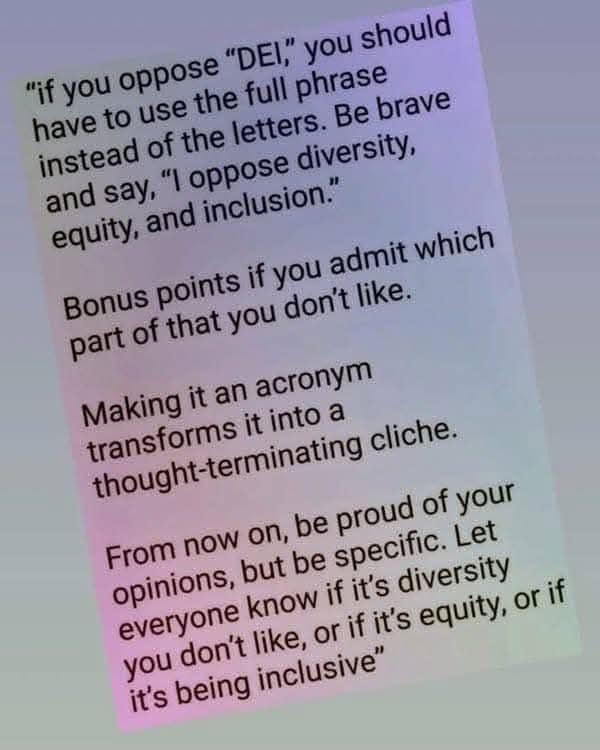
How deep does the polysemic rabbit hole go? Well…
The term “diversity” in the context of social justice advocacy often exhibits polysemy, where the word has multiple related or unrelated meanings. Here are three examples of how the term “diversity” is used:
Diversity as Representation: Meaning: This refers to the inclusion of different racial, ethnic, gender, and sexual orientation groups within organizations, institutions, or media.
Usage: In this context, “diversity” is often used to describe efforts to ensure that various demographic groups are represented in workplaces, schools, and public life. For example, a company might strive for diversity in its hiring practices to reflect the broader community’s composition.
Diversity as Ideological Uniformity:
Meaning: Some critics argue, as seen in posts on X, that “diversity” in certain circles is used to mean a variety of backgrounds but with a uniform set of political or social views, particularly those aligned with progressive or “woke” ideologies.
Usage: This interpretation suggests that while there might be diversity in appearance or demographic markers, there’s an expectation of conformity in thought, especially in terms of social justice issues. This usage is often highlighted in debates over free speech and ideological diversity.
Diversity as a Tool for Inclusion vs. Exclusion:
Meaning: “Diversity” can sometimes be perceived as inclusive when it pertains to groups historically underrepresented or marginalized, but it can also be seen as exclusive if it’s interpreted as excluding certain groups (like straight white males) from consideration for diversity initiatives.
Usage: This dual interpretation can lead to confusion or contention, where diversity initiatives are praised for broadening perspectives but criticized by others for being exclusionary based on identity rather than merit or broader inclusivity.
These examples show how “diversity” can be a multifaceted term within social justice discourse, with its meaning shaped by context, intent, and perspective. The web results and posts on X suggest that while the term is generally used positively to advocate for broader representation, there’s a significant debate around its implications and actual practice.
This is how the activist Left abuses polysemy. Polysemy is defined as follows:

So, this is their game. To make their radical propositions seem reasonable they purposefully use words that have a generally accepted meaning, but then at the same time a special transformative meaning for them. The woke activist left does this so they can move the political/social football in a radical direction all the while sounding like they are saying normal, reasonable things.
Let’s take an easy obvious example, let’s look at the word “inclusion”.
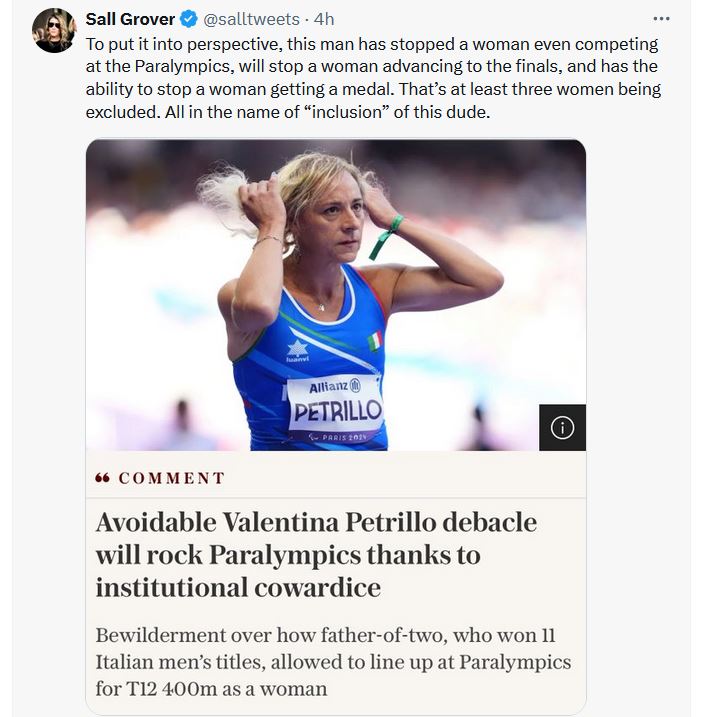
“Inclusion” in this case is doing a great deal of work under the hood. The argument from the activists is this – we should include all types of women in female sports that includes “cis-women”¹ and of course “trans – women”.
The mechanism at work here is “inclusion” means accepting the notion that there are more that one type of females in society that play sports. This is the truth married to a lie in action – the woke argument for inclusion inserts the notion that males who call themselves women are actually women and thus in ‘woke reality’ we should include deluded males in the female category.
This is how they wedge their bullshit into society because when confronted by people who comport with reality woke activists can then smear and attack their reality abiding opponents for not being “inclusive”. To low information people seeing the argument taking place they see one side coming out for inclusion and one side being against inclusion (the bigots, the transphobes, insert your preferred vehicle of social coercion…) – but the definition of inclusion the low information people have in their heads is not the same as the one the activists are implicitly following.
So the low information people working on the non activist definition of inclusion are bamboozled into going along with the activists (and the poison pill contained within) thinking that they are supporting a just, more inclusive society.
Obviously, the exact opposite is true. By including men in female sports female athletes are excluded from participating, winning medals, and getting funding to further their excellence in their own category.
This is dichotomy of terms (dialectical even) is not a mistake, because if they led with a clear unambiguous statement of their inane version of ‘inclusion (including males in the female sport categories)’ they would get zero social traction/support for their society corrosive radical views.











 bleatmop
 Mystro
 The Arbourist


 Dead Wild Roses
Your opinions…