
You are currently browsing the tag archive for the ‘Rachmaninoff’ tag.
I love this piece and in my deepest and darkest piano dreams I’d be able to play it. :)
The prelude is organized into three main parts and a coda:
- The piece opens with a three note motif at fortissimo which introduces the grim C-sharp minor tonality that dominates the piece. The cadential motif repeats throughout. In the third bar, the volume changes to a piano pianissimo for the exposition of the theme.
- The second part is propulsive and marked Agitato (agitated), beginning with highly chromatic triplets. This passionately builds to interlocking chordal triplets that descend into a climactic recapitulation of the main theme, this time in four staves to accommodate the volume of notes. Certain chords in the section are marked with quadruple sforzando.
- The piece closes with a brief seven-bar coda which ends quietly.
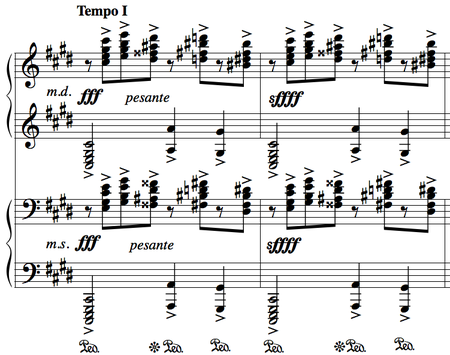
4 staves? Jesus…
Prelude in G minor, Op. 23, No. 5, is a music piece by Sergei Rachmaninoff, completed in 1901. It was included in his Opus 23 set of ten preludes, despite having been written two years earlier than the other nine. Rachmaninoff himself premiered the piece in Moscow on February 10, 1903, along with Preludes No. 1 and 2 from Op. 23.
The Prelude’s taut structure is in ternary form, consisting of an opening “A” section with punctuated sixteenth-note chords (marked Alla marcia), a more lyrical and melancholy “B” section with sweeping arpeggios in the left hand (marked Poco meno mosso), a transition into the original tempo, and a recapitulation of the initial march.
Prelude in C-sharp minor (Russian: Прелюдия), Op. 3, No. 2, is one of Sergei Rachmaninoff’s most famous compositions. It is a ternary (ABA) prelude for piano in C-sharp minor, 62 bars long, and part of a set of five pieces entitled Morceaux de fantaisie.[1]
Its first performance was by the composer on September 20, 1892,[2] at a festival called the Moscow Electrical Exhibition,[3] which Rachmaninoff considered his debut as a pianist.[2] After this première, a review of the concert singled out the Prelude, noting that it had “aroused enthusiasm”.[4] From this point on, its popularity grew.
Rachmaninoff later published 23 more preludes to complete a set of 24 preludes covering all the major and minor keys, to emulate earlier sets by Bach, Chopin, Alkan, Scriabin and others.
The prelude is organized into three main parts and a coda:
- The piece opens with a three note motif at fortissimo which introduces the grim C-sharp minor tonality that dominates the piece. The cadential motif repeats throughout. In the third bar, the volume changes to a piano pianissimo for the exposition of the theme.
- The second part is propulsive and marked Agitato (agitated), beginning with highly chromatic triplets. This passionately builds to interlocking chordal triplets that descend into a climactic recapitulation of the main theme, this time in four staves to accommodate the volume of notes. Certain chords in the section are marked with quadruple sforzando.
- The piece closes with a brief seven-bar coda which ends quietly.
[Source]











 bleatmop
 Mystro


 Dead Wild Roses
Your opinions…