
You are currently browsing the tag archive for the ‘Radical Feminism’ tag.
Another super-peachy-keen aspect of being female in our society – saying “no” to men can get you killed.

Thank you wing-women of the world. :) On a much more sombre note, to stop the clueless dudes from cluttering my comment section a small sample of what can happen when women say no…
- A woman says no, I don’t want to go to prom with you, and gets stabbed to death.
- A woman says no, I will not sleep with you, and a man go on a shooting spree.
- A woman says no, I will not give you my number, and is shot outside the club.
- A woman says no, I don’t want you to buy me a drink, and a man shattered a glass across her face.
- A woman say no, I’m a lesbian, and a man shoots both her and her girlfriend while they slept in their home.
- A woman says no, I don’t want to be with you any more, and a man stabs her to death and murders her dog.
- A woman says no, stop harassing these teenagers, and a group of men beat her to death with stones and bats, smashing her skull on the pavement.
- A woman says no, we aren’t married any more, leave me alone, and a man shoots her to death.
- A woman says no, we work together but I’m not interested in you romantically, and a man shoots her to death whilst she’s working.
- A woman says no, I don’t want to sleep with you, and a man rapes, murders and then hangs her from a tree.
- A woman says no, I’m not interested, and a man slashes her neck open.
- A woman says no, I never cheated on you, and a man beats her.
- A woman says no, I want a divorce, and a man cuts her neck open and stabs her multiple times.
So dudes, yes you with the hangy-bits – You want women to start telling you no? You don’t want women to play games? Teach your fellow men to stop murdering women for doing so.
Radical feminism starts with naming the problem – male violence – and working on solutions based on the material conditions of the situation.
It is a comparison that is floating around more and more as the po-mo authoritarian left is stifling debate and silencing criticisms of people who happen to be against their unique vision of reality. We have here a helpful chart to compare and contrast the positions of the two parties in question.

Glad we could clear that up. Thus endeth the lesson. :)
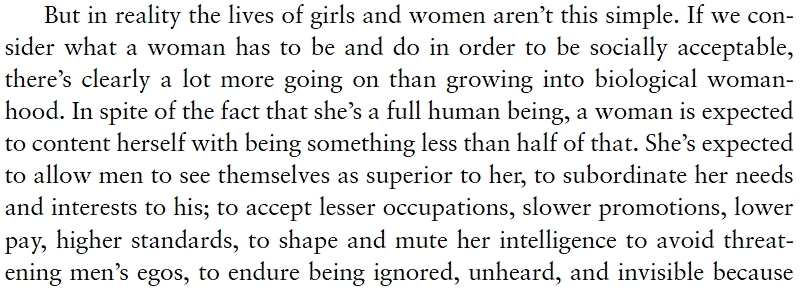


-Allan Johnson on compulsory femininity
(the systematic expectations and goals of female socialization)
The choice of which battles to fight reflects on how one views society and how it is constructed. Here is what going to the root of problem and starting one’s analysis looks like.
“Radical feminists have never denied the agency of women under conditions of oppression. But radical feminists have located women’s agency, women’s making of choices, in resistance to those oppressive institutions, not in women’s assimilation to them. Nowhere in the more “nuanced” feminist liberal literature on choice is women’s resistance to pornography and surrogacy stressed as a sign of women’s agency. What about the agency of women who have testified about their abuse in pornography, risking exposure and ridicule, and often getting it? What about the ex-surrogates who choose to fight for themselves and their children in court, against the far greater economic, legal, and psychological advantages of the sperm donor? If we want to stress women’s agency, let’s look in the right places.”
-Janice G. Raymond. “Sexual and Reproductive Liberalism.”
The Sexual Liberals and the Attack on Feminism. Ed. Dorchen Leidholdt and Janice G. Raymond.
Teachers College Press, 1990. 103-111.
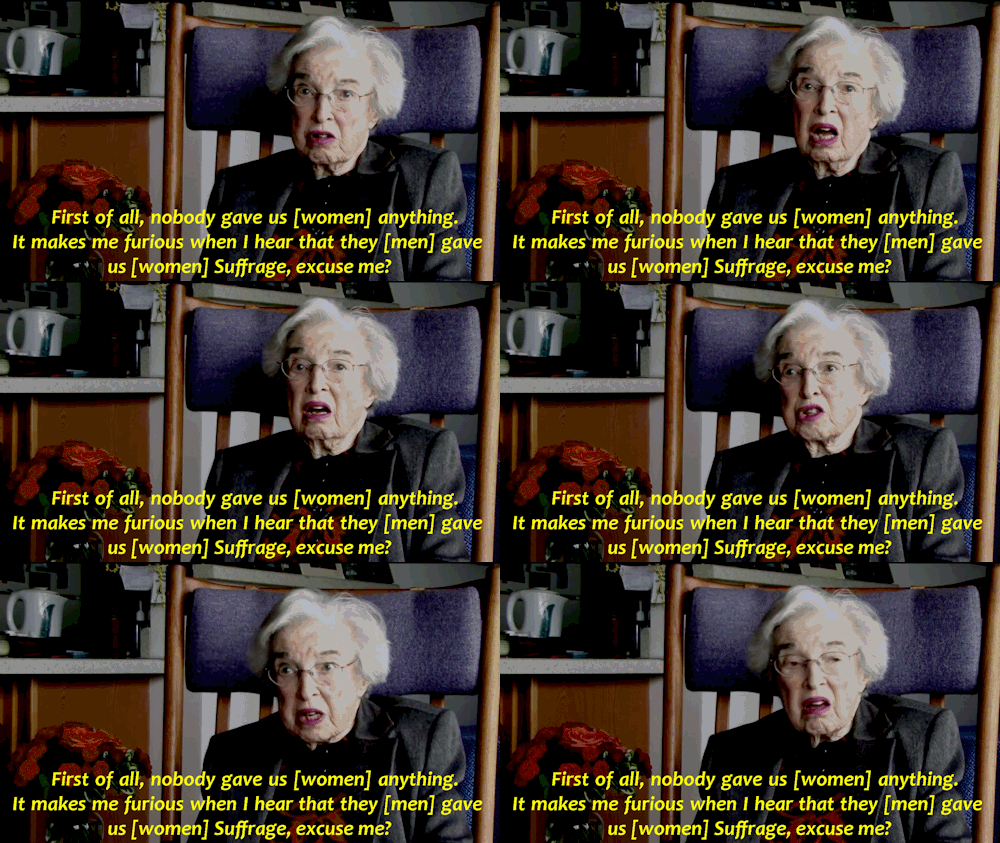


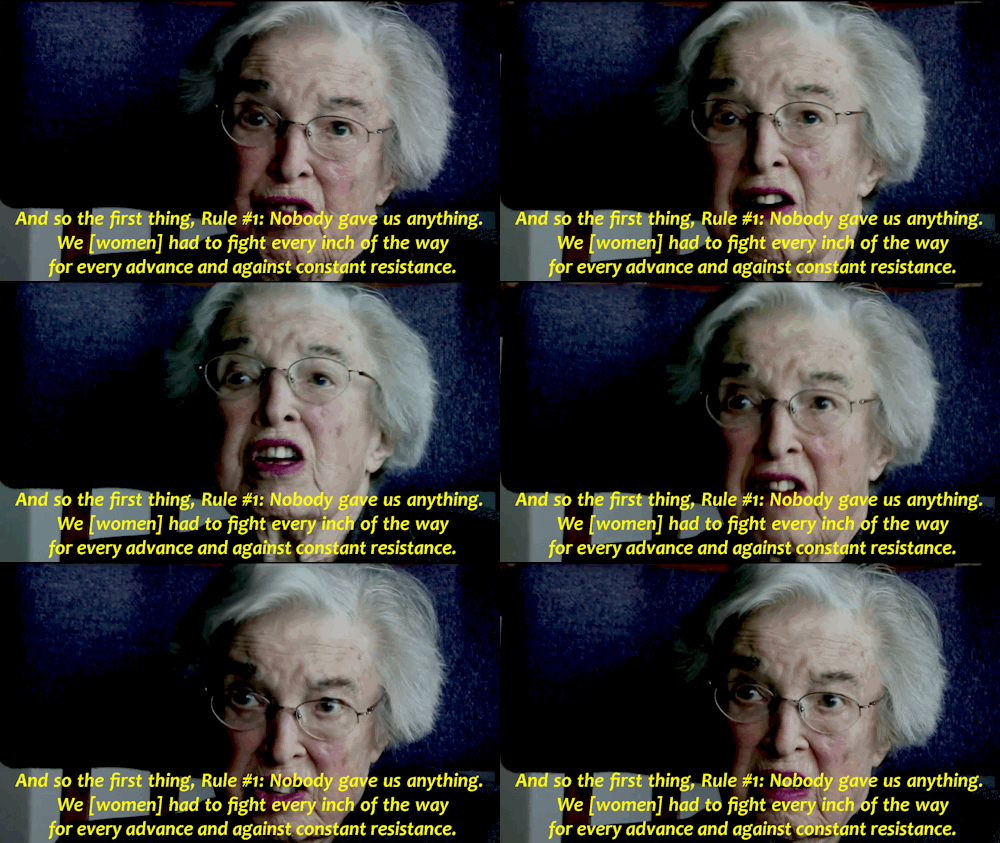
Seventy two years (+) of struggle just to get right to vote, and an uphill battle *all* of the way. Now who exactly was creating such resistance to positive social change? Hmm… now that is quite the puzzle now isn’t it.
Those in power will never willingly concede their power. Not ever. What it takes – organizing, resistance, community are the factors that feminism built up until roughly the end of the Second wave. With the influx of po-mo theory and men – the feminist root manifesto i.e. the liberation of women from the oppressive structures of society – has been all but lost.
So much time has been lost to endless debates over empowerment and identity politics, the entire project steadfastly nonthreatening to the status quo. The radical feminist message is starting to get out again, despite the best efforts of the establishment to silence women who look to the root causes of the oppression of women. The task ahead is, as always, daunting but community is being formed, women are organizing and of course the status quo – is to be questioned, analyzed and ultimately rejected.
Women under patriarchy often are told that the choices they make will differentiate themselves from those “other” women. That the choices they make as an individual will empower them to overcome the obstacles they face. Granted, in some individual cases this can happen, but for the vast majority of women the choices they make individually in society does not alter society’s or men’s impressions and evaluations of them. Hence, the resultant series of catch 22’s that define the female experience – Virgin/Whore, Push-Over/B*tch, Motherly/Control Freak et cetera.
The common factor that is missing from much of liberal feminist analysis is the idea that misogyny is the backdrop (canvas, background radiation, insert meaningful metaphor here)to the stage of how society operates. Men will hate women in whichever role they choose, thus negating much if not all of the progress claimed by individual women.
Let us thank tumblr user Sazquatch (original post unavailable) as she provides perspective into the finer points of how misogyny works in society.
It’s not really as simple as saying “Men treat you badly when you do x, therefore men hate x, and so you doing x is empowering yourself and standing up to them!!” because men treat us badly no matter what we do, even if what we are doing materially benefits them. That’s what misogyny is – the hatred of women.
Men treat women who engage in sex with them badly, talking about how they’re worthless sluts if they send nudes etc., and you’re not gonna convince me that men’s goal in life is to ensure no woman ever has sex with them. Men want you to engage in sex with them, but they treat you badly afterwards because they hate women.
It’s like how men want women to be subservient house-servants who cook and clean without complaint, and then they turn around and slam those same women for being dependent, boring, or doormats. It doesn’t mean they want us to stop performing domestic labour for them, it just means they hate us.
Nothing we are doing in relation to men is standing up and doing things they hate to empower ourselves, unless we’re actively avoiding them and not centring them in our lives.”
Still not convinced? But wait there’s more! Did you want to see how quickly the shift happens in dudely behaviour from ‘possible happy sex times’ to let’s see how fast we can pile on the misogynistic insults. The bullshit dudes pull really turns a dime. Don’t believe me? Go see for yourself.
This is just a small sliver background of misogyny that we exist in and yes Dudebro’s it applies to you, because you let it go on around you. Your part in the equation is to stop the misogyny when your friends start in on, if you don’t then welcome to being part of the problem.
Ms. Reilly-Cooper has done some fantastic foundational work describing what sex and gender is and, more importantly, how many radical feminists approach the topic.
This will be a long post and a feature here at DWR as it is a resource too good not to replicate.
“Sex
1. Humans, like the vast majority of species, reproduce sexually. This means that the reproduction of our species is achieved through the fusion of a female gamete with a male gamete to produce a new organism. In normal cases, each organism produced will be unambiguously either female or male, and will produce the appropriate gametes for the purposes of sexual reproduction.
2. The categories of female and male are thus general biological categories that apply to all species that reproduce sexually. Humans are not special in this regard. While the language we use to describe these biological facts, and the values we attach to these facts, will be shaped by culture, the facts themselves exist independently of culture or our social understandings of them. Whether or not we have the language with which to describe it, females will continue to produce large, non-motile gametes (ova), and males will continue to produce small, motile gametes (spermatozoa).
3. Humans, like the majority of species and like all mammals, are sexually dimorphic. This means that female and male organisms of the same species are distinguishable from one another, due to differences in their anatomy and physiology: their primary and secondary sex characteristics. In female humans, relatively higher levels of oestrogen will lead to the development of a vulva, vagina, ovaries, uterus, breasts, and a range of other physiological markers. In male humans, relatively higher levels of testosterone will lead to the development of a penis and testes, deepening of the voice and growth of facial hair at puberty, and a range of other physiological markers. Again, humans are not special in this regard. While the language we use to describe these biological facts and the values we attach to them will vary with culture, the facts themselves exist independently of culture or our social understandings of them. Whether or not we have the language with which to describe it, at puberty female humans will begin to develop breasts and to menstruate.
4. As mentioned in point 1, in normal cases, the child that is born as a result of human reproduction is unambiguously female or male and easily recognised as such, as a result of the visible sex organs that develop in utero. In a small percentage of cases, the child is intersex. This means that the sexual characteristics the child displays are such that it is not possible to make a simple classification of female or male. While it is difficult to make a clear determination on the prevalence of intersex conditions, due to the range of different biological factors that may cause it, it is estimated that around one in 2,000 children will be born visibly intersex. The fact that some humans are intersex in no way diminishes the truth of sexual dimorphism, any more than the fact that some humans are born missing lower limbs diminishes the truth of the statement that humans are bipedal.
5. In all of those cases where the child is unambiguously female or male, the biological sex of the child is recognised at birth: female children are called girls, male children are called boys. Correctly identifying the genitals that a child possesses and therefore the biological sex to which they belong is not a matter of assigning gender to the child; it is simply to recognise the biological facts and to give them the correct biological label. Whether or not we have the language with which to describe it, male and female humans will exist. Children with vulvas will continue to be born, and children with penis and testes will continue to be born, whether or not we call them girls and boys (and whether or not we call those organs by those labels. A penis is anatomically a different organ from a clitoris, no matter what name you give it).
6. To summarise points 1-5: despite the existence of some unusual cases that deviate from the norm, the vast majority of humans possess the anatomical characteristics of either one sex or the other. These characteristics determine the reproductive function the individual can go on to perform. Biologists use the labels female and male to refer to these sex classes. Whether we retain these labels to refer to these sex classes, or whether we allow those labels to be co-opted to mean other things and thereby lose our language to describe these basic biological facts, these basic biological facts will remain. Every human being that has ever existed was created through this mechanism, and it took a lot of arduous and dangerous reproductive labour on the part of their mothers to get them here.
7. There is nothing remotely oppressive or unjust about correctly labelling a child’s biological sex on the basis of their genitals, and therefore correctly identifying their potential reproductive role. Neither is there anything essentialist or determinist about this classification. To acknowledge that on the basis of their biology, only one half of our species is potentially capable of conceiving and gestating live young, neither reduces female persons to that reproductive function, nor prescribes it as necessary for them. However, to deny this basic biological fact renders female biology unspeakable, which in turn makes it impossible to describe and analyse the oppression that accompanies living in a female body (such as rape and sexual violence, lack of access to contraception and abortion, provision of maternity healthcare and maternity employment rights, lack of investment and research into female illnesses and diseases…)
8. Women’s oppression has its historical roots and its ostensible justification in female biology and the exploitation of female reproductive labour. Altering the definition of the word ‘female’ so that it now means ‘any person who believes themselves to be female’ is not only conceptually incoherent (more on this in a later post); it also removes the possibility of analysing the structural oppression of female persons as a class, by eradicating the terminology we use to describe the material conditions of their existence. (Bookmark that link for later if you must, but do read it. Read it more than once, ideally. It’s worth it.)
9. Furthermore, for those who feel strongly that they should have been born female but were not, changing the definition of the word female so that it also applies to them will bring only a temporary alleviation of their suffering. It is not the existence of the words ‘female’ and ‘male’ that persons with dysphoria find distressing. It is the underlying biological facts to which they refer, as well as the socially constructed gender roles that are associated with being a member of that sex class, that they find intolerable. Neither of these sources of pain will be remedied by changing the label we use to refer to them. The words female and male are neutral descriptors, and there is nothing pejorative about being classified as male. Any negative connotations the words female and male bring to mind are caused by the social construction of gender norms associated with the sexes, in the form of femininity and masculinity; this will be the subject of the next post.”











 bleatmop
 Mystro
 The Arbourist


 Dead Wild Roses

Your opinions…