“Redesigning democracy for the digital age is far beyond my abilities, but I can suggest three categories of reforms––three goals that must be achieved if democracy is to remain viable in the post-Babel era. We must harden democratic institutions so that they can withstand chronic anger and mistrust, reform social media so that it becomes less socially corrosive, and better prepare the next generation for democratic citizenship in this new age.
Harden Democratic Institutions
Political polarization is likely to increase for the foreseeable future. Thus, whatever else we do, we must reform key institutions so that they can continue to function even if levels of anger, misinformation, and violence increase far above those we have today.
For instance, the legislative branch was designed to require compromise, yet Congress, social media, and partisan cable news channels have co-evolved such that any legislator who reaches across the aisle may face outrage within hours from the extreme wing of her party, damaging her fundraising prospects and raising her risk of being primaried in the next election cycle.
Reforms should reduce the outsize influence of angry extremists and make legislators more responsive to the average voter in their district. One example of such a reform is to end closed party primaries, replacing them with a single, nonpartisan, open primary from which the top several candidates advance to a general election that also uses ranked-choice voting. A version of this voting system has already been implemented in Alaska, and it seems to have given Senator Lisa Murkowski more latitude to oppose former President Trump, whose favored candidate would be a threat to Murkowski in a closed Republican primary but is not in an open one.
A second way to harden democratic institutions is to reduce the power of either political party to game the system in its favor, for example by drawing its preferred electoral districts or selecting the officials who will supervise elections. These jobs should all be done in a nonpartisan way. Research on procedural justice shows that when people perceive that a process is fair, they are more likely to accept the legitimacy of a decision that goes against their interests. Just think of the damage already done to the Supreme Court’s legitimacy by the Senate’s Republican leadership when it blocked consideration of Merrick Garland for a seat that opened up nine months before the 2016 election, and then rushed through the appointment of Amy Coney Barrett in 2020. A widely discussed reform would end this political gamesmanship by having justices serve staggered 18-year terms so that each president makes one appointment every two years.
Reform Social Media
A democracy cannot survive if its public squares are places where people fear speaking up and where no stable consensus can be reached. Social media’s empowerment of the far left, the far right, domestic trolls, and foreign agents is creating a system that looks less like democracy and more like rule by the most aggressive.
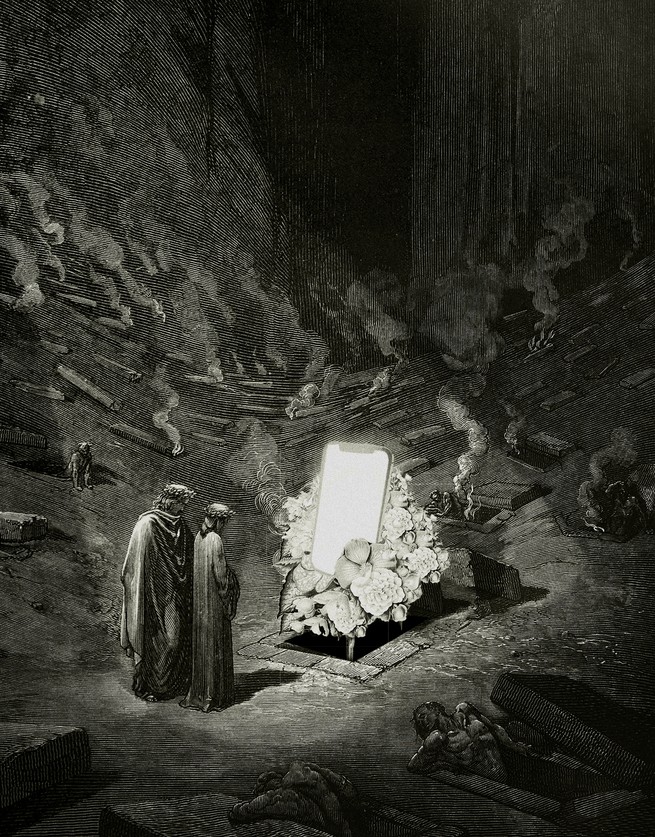
Illustration by Nicolás Ortega. Source: The Arch Heretics, Gustave Doré, c. 1861.
But it is within our power to reduce social media’s ability to dissolve trust and foment structural stupidity. Reforms should limit the platforms’ amplification of the aggressive fringes while giving more voice to what More in Common calls “the exhausted majority.”
Those who oppose regulation of social media generally focus on the legitimate concern that government-mandated content restrictions will, in practice, devolve into censorship. But the main problem with social media is not that some people post fake or toxic stuff; it’s that fake and outrage-inducing content can now attain a level of reach and influence that was not possible before 2009. The Facebook whistleblower Frances Haugen advocates for simple changes to the architecture of the platforms, rather than for massive and ultimately futile efforts to police all content. For example, she has suggested modifying the “Share” function on Facebook so that after any content has been shared twice, the third person in the chain must take the time to copy and paste the content into a new post. Reforms like this are not censorship; they are viewpoint-neutral and content-neutral, and they work equally well in all languages. They don’t stop anyone from saying anything; they just slow the spread of content that is, on average, less likely to be true.
Perhaps the biggest single change that would reduce the toxicity of existing platforms would be user verification as a precondition for gaining the algorithmic amplification that social media offers.
Banks and other industries have “know your customer” rules so that they can’t do business with anonymous clients laundering money from criminal enterprises. Large social-media platforms should be required to do the same. That does not mean users would have to post under their real names; they could still use a pseudonym. It just means that before a platform spreads your words to millions of people, it has an obligation to verify (perhaps through a third party or nonprofit) that you are a real human being, in a particular country, and are old enough to be using the platform. This one change would wipe out most of the hundreds of millions of bots and fake accounts that currently pollute the major platforms. It would also likely reduce the frequency of death threats, rape threats, racist nastiness, and trolling more generally. Research shows that antisocial behavior becomes more common online when people feel that their identity is unknown and untraceable.
In any case, the growing evidence that social media is damaging democracy is sufficient to warrant greater oversight by a regulatory body, such as the Federal Communications Commission or the Federal Trade Commission. One of the first orders of business should be compelling the platforms to share their data and their algorithms with academic researchers.
Prepare the Next Generation
The members of Gen Z––those born in and after 1997––bear none of the blame for the mess we are in, but they are going to inherit it, and the preliminary signs are that older generations have prevented them from learning how to handle it.
Childhood has become more tightly circumscribed in recent generations––with less opportunity for free, unstructured play; less unsupervised time outside; more time online. Whatever else the effects of these shifts, they have likely impeded the development of abilities needed for effective self-governance for many young adults. Unsupervised free play is nature’s way of teaching young mammals the skills they’ll need as adults, which for humans include the ability to cooperate, make and enforce rules, compromise, adjudicate conflicts, and accept defeat. A brilliant 2015 essay by the economist Steven Horwitz argued that free play prepares children for the “art of association” that Alexis de Tocqueville said was the key to the vibrancy of American democracy; he also argued that its loss posed “a serious threat to liberal societies.” A generation prevented from learning these social skills, Horwitz warned, would habitually appeal to authorities to resolve disputes and would suffer from a “coarsening of social interaction” that would “create a world of more conflict and violence.”
Depression makes people less likely to want to engage with new people, ideas, and experiences. Anxiety makes new things seem more threatening. As these conditions have risen and as the lessons on nuanced social behavior learned through free play have been delayed, tolerance for diverse viewpoints and the ability to work out disputes have diminished among many young people. For example, university communities that could tolerate a range of speakers as recently as 2010 arguably began to lose that ability in subsequent years, as Gen Z began to arrive on campus. Attempts to disinvite visiting speakers rose. Students did not just say that they disagreed with visiting speakers; some said that those lectures would be dangerous, emotionally devastating, a form of violence. Because rates of teen depression and anxiety have continued to rise into the 2020s, we should expect these views to continue in the generations to follow, and indeed to become more severe.
The most important change we can make to reduce the damaging effects of social media on children is to delay entry until they have passed through puberty. Congress should update the Children’s Online Privacy Protection Act, which unwisely set the age of so-called internet adulthood (the age at which companies can collect personal information from children without parental consent) at 13 back in 1998, while making little provision for effective enforcement. The age should be raised to at least 16, and companies should be held responsible for enforcing it.
More generally, to prepare the members of the next generation for post-Babel democracy, perhaps the most important thing we can do is let them out to play. Stop starving children of the experiences they most need to become good citizens: free play in mixed-age groups of children with minimal adult supervision. Every state should follow the lead of Utah, Oklahoma, and Texas and pass a version of the Free-Range Parenting Law that helps assure parents that they will not be investigated for neglect if their 8- or 9-year-old children are spotted playing in a park. With such laws in place, schools, educators, and public-health authorities should then encourage parents to let their kids walk to school and play in groups outside, just as more kids used to do.”
“How We Reached the Point Where We Can’t Hear Each Other” is a article on Counterpunch by Joseph Natoli. I’ve excerpted some of the beginning bits for context, but the best is when he focuses on what is happening in Education and how people are taught to think these days. I’m also a fan of his borrowing of radical feminist methodology that focuses on the the material reality of the situation and the naming of the problem. I heartily recommend you read the full article, as it suggests reasons why we are becoming less social despite ‘social’ media and the corrosive effect that identity politics, one of the crown jewels of post-modern theory, is having on our society.
[…]
“The intent of a past analog world to put us all on the same page so we could all direct ourselves in common to our common, societal problems is something now disseminated into an infinitude of self-designed enclaves. We have connectivity between the like-minded, or opinionated, but not conjunction which Bifo Berardi defines “as a way of becoming other.” (And: Phenomenology of the End, 2015)
If you want to reflect beyond the entrapment of your own personal experiences and the personal opinions derived from such, you are desiring something that has been superseded.
If you want not to be the blind man who feels the tail of an elephant and pronounces the elephant to be shaped like a snake, you are hoping for a door that leads out of the room of your own limited experience.
Unfortunately, there is no longer any need to leave that room because cyberspace has designed the whole world to be your room. You can blog, tweet, text. Video, emoji your reflections online without any intent to augment social knowledge or understanding or to encounter a counter-punch that will cause you to adjust your views.”
[…]
“We exist now within narratives, not impeccable logics and sound proofs, air-tight arguments or binding adjudications. For reasons too elaborate to condense, we have accepted Nietzsche’s view of reason as a pawn of power and have retreated to our own personal reasoning.
This retreat to personal arbitration of all matters is expressed in the politics of identity, a politics concerned with the full emancipation of the individual not as defined within any cultural, religious, historical, or anthropological notion of the individual, but defined by each and every variety of individual. It is as if the individual is a knowledge within itself.”
[…]
Education is also in a special dilemma considering the mission here is get a student to put his or her personal opinions and preferences and different experiences out of sight and attend to a rationally validated collective representation of a subject.
Nathan Heller points out that elite colleges find that the cultivation of the individual is not an easy matter when students will not leave their personal “experiential authority” at the door. (“The Big Easy,” The New Yorker May 30, 2016) One is not reading to extract eternal verities, the Enlightenment dream, or to deconstruct the pretenses of those same verities. In the climate that Heller describes, no content can be permitted to transgress the personally defined identity of the reader or listener.
An Oberlin student who Heller describes as “a trans man …educated in Mexico, walks with crutches, and suffers from A.D.H.D. and bipolar disorder …lately on suicide watch” objected to a discussion of Antigone without a trigger warning, i.e., characters in the play committed suicide. Identity-based oppression is responded to with a theory of intersectionality, which contends, “who knows what it means to live at an intersection better than the person there?” Thus, personal experiential authority now contends with a pedagogic tradition of minimizing the effects of personal experiential authority on objective, rational reflection.
Education attempts to respect individual arrangements of the results of critical thinking but not allow those arrangements to taint the process of critical thinking. This long standing agreement is no longer in effect. We have reached the point where we cannot engage in any way what may “trigger” our personal dislike or what may upset a private space we have self-designed. Long standing notions of both education and society are dissolving.
We now listen to our own voices and our clones in “social” media, a pathological condition that undermines much needed social and political communication and interrelationships. The way out, as with all pathologies, is to first recognize the condition, observe the point we have reached and reorient our compass.”
Teaching critical thinking in public education has always been a revolutionary activity, as this article confirms, it looks like it shall continue to be in the revolutionary category for quite some time.
Wow. What brilliant article by Ms.Fowles recently published by the Walrus. I’m gonna put the whole thing up here because it sheds light on so many of the issues that face women today in the online world. Consider this example #2348239487 of how woman’s experiences in society are dramatically different than those of men.
“Every so often, someone (always a man) sends me a casual tweet asking why he can’t retweet me. Of course, the obvious answer is that my account is locked—a tiny optional blessing of Twitter’s functionality that means I’m not searchable to the world outside. The more complex answer relates to why my account is locked in the first place, why I would choose to keep people from reading my brilliant musings on ’90s’ teen movies, Rihanna’s latest video, or the myriad virtues of Magic Mike XXL. There are easy, palatable answers I have given to those that ask; I value my privacy, or I like to keep my circle small and manageable, or I prefer to keep the personal aspects of my life away from my employers and ex-boyfriends.
But the most important (and truest) answer is this: I am afraid of men on the Internet.
There’s good reason for this fear, and it’s likely one you’ll empathize with if you’re a woman who has ever dared to have an opinion in the techno-public realm. In fact, women have never once asked me why my account is locked—and unlike some of my male editors, they’ve never recommended opening it up. They understand that the online world has become a horror show, and that men largely drive that horror. Men are usually the ones who post nude pictures of their exes, release the home addresses of the women they dislike, and run the vileness that is Gamergate. (I’m even reluctant to type the word Gamergate, as if doing so conjures the hoards like some kind of Internet Candyman.) Of course, Not All Men, but unless a new Twitter follower has “I hate women” or some variation thereof in his bio, there’s no good way to predict which one will decide to take offence at you merely existing. And there’s no way to know whether that person who is offended will be the one to threaten to end your life.
Online technology has allowed a stranger to tell me he’d like to penetrate me with a broken light bulb because I’d “probably like it.” It has let a commenter inform me that women shouldn’t act the “way they do” if they don’t want men to commit crimes against them. I’ve been the subject of mockery and derision on men’s-rights-activist websites and right-wing blogs. On a good day, the Internet helps people let me know I’m stupid, and on a bad one it helps them threaten me with bodily harm. It’s facilitated me being called a man hater, a feminazi, a libtard, a hack, an attention whore, or just a plain old whore. It’s brought me patronizing questions, profanity-laden emails, and abuse masquerading as “criticism.”
It has also been a great way for people to tell me that I should ignore all this, that I should get a thicker skin, and if I don’t like it maybe I should get offline altogether.”
Catch the rest at the Walrus, as apparently they need their ad revenue – tracking down hole in the wall blogs for copyright violations is an expensive business.
We can lump this video in with the others that attempt to shed light on issues in society that matter while discreetly hawking their wares in the background. The best form of advertising? I’m not sure, but the commercial makes space for some thinking about how generational experiences are becoming increasingly stratified and foreign to one another.
Are today’s youth doomed to be nothing but cloistered vid-heads who only know nature through what they have seen on the screens of their tablets? Possibly but I’m thinking that much of the fuss we see about losing out youth to technology is a direct result of our societies ruthless quest for economic productivity, seemingly at all costs.
Productivity has ever increased, but at what social cost? Remember when only one bread-winner was required to live a reasonable life and raise children? Successive generations have had to work harder for less money, just to stay in place. Community life has taken a back seat to the lifestyle focused the individual and consumption – social technology directly feeds into our atomization and separation from others.
The leaders of our society have learned the lessons of the past. All that New Deal/Civil Rights/ Second Wave Feminist scared them shitless and having witnessed what an organized community of like minded people can accomplish are doing their best to ensure that it (social change benefiting the masses) does not happen again. People with common interests, common community and commitment to bettering their own interests change society. Isolated lone-wolves mired in consumptive practices do not. Hence witness the trajectory of our society in which the ‘tailored-experience’ is all the rage; the idea that making choices (ones that are carefully circumscribed mind you) is empowering; and sadly the idea that social power resides in competition and being ‘unique’. These are all hallmarks of society geared toward preserving a status-quo that benefits a particular segment of society.
The video is playing up the same fears every generation has about the next. Are some of the concerns valid? I think so, but nothing that cannot be overcome with realization that social media friends are not the same as having friends in real life. Sharing (not the facebook variety) your life with others is a necessary part of healthily existing in society and cannot be replaced by social media. Can social media/technology be used to enhance and facilitate our social interactions? Of course, but it is not a replacement for the attachment and community humans need to be healthy and happy.
Societal analysis aside,I for one am glad that video games have come as far as they have. Video games are an immersive experience for me that allow me to spend some time outside of the real-world. At the same time I do realize that video gaming is just one aspect of life and must be balanced with other pursuits/activities/interests.
Admittedly, one must be careful in allocating time to video gaming as hours seem to disappear, especially when playing with your friends . It is very easy to lose yourself in the experience and come out bleary-eyed on the other-side wondering why the hell it is 2am and why you’re not sleeping. :)
One retired general’s opinion on why ISIS such a force in the world. A quick yet still interesting interview tagging social media and the media cycle as contributors to the success of ISIL.
What is ad block? It is an application that, at your discretion blocks out advertising so you can browse the internet for content as opposed to ads. If you do not have it, get it here so you can enjoy my blog without the insidious advertising.

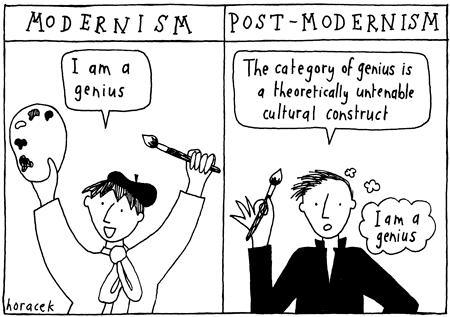 “How We Reached the Point Where We Can’t Hear Each Other” is a article on Counterpunch by Joseph Natoli. I’ve excerpted some of the beginning bits for context, but the best is when he focuses on what is happening in Education and how people are taught to think these days. I’m also a fan of his borrowing of radical feminist methodology that focuses on the the material reality of the situation and the naming of the problem. I heartily recommend you read the full article, as it suggests reasons why we are becoming less social despite ‘social’ media and the corrosive effect that identity politics, one of the crown jewels of post-modern theory, is having on our society.
“Every so often, someone (always a man) sends me a casual tweet asking why he can’t retweet me. Of course, the obvious answer is that my account is locked—a tiny optional blessing of Twitter’s functionality that means I’m not searchable to the world outside. The more complex answer relates to why my account is locked in the first place, why I would choose to keep people from reading my brilliant musings on ’90s’ teen movies, Rihanna’s latest video, or the myriad virtues of Magic Mike XXL. There are easy, palatable answers I have given to those that ask; I value my privacy, or I like to keep my circle small and manageable, or I prefer to keep the personal aspects of my life away from my employers and ex-boyfriends.













 bleatmop
 Mystro
 The Arbourist


 Dead Wild Roses
Your opinions…