You are currently browsing the tag archive for the ‘Socialism’ tag.
Tag Archive
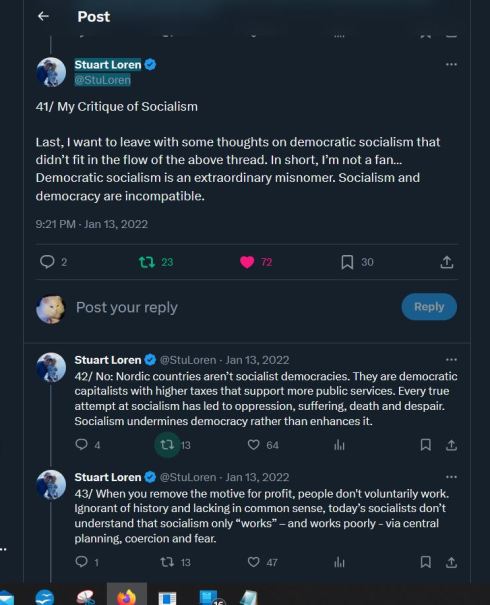
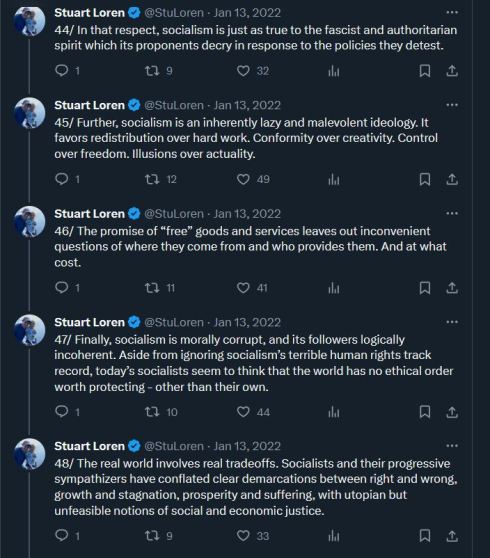
A Critique of Socialism – Stuart Loren
December 18, 2023 in Culture, Economy, Politics | Tags: Critique, Socialism, Stuart Loren | by The Arbourist | 1 comment


Share this:
A Case for Transitioning Toward Socialism – Chris Wright
September 7, 2019 in Culture, Politics | Tags: Capitalism, Chris Wright, Politics, Socialism | by The Arbourist | 10 comments
I do like me some socialism, as I do believe it is the tonic that will address some of the societal problems we are currently experiencing. I think tackling the inherent problems socialism bring with it might be good for a change. It’s like changing the government every so often, clear out the old graft and corruption and make way for a fresher, newer array of graft and corruption, perhaps even doing some positive governance things before bought off by the powers that be. Chris Wright makes some good points by focusing on the alienation that people can experience in a capitalist society.
“The case for socialism is usually made, rightly, from the perspective of its justice. It would be just to have economic and social democracy, for one thing because it is intrinsically right that people not be forced to rent themselves to a business owner who exploits them for profit but instead that they collectively control economic activities and distribute rewards as they see fit. Moreover, economic democracy, whether in the form of worker cooperatives or democratic government control, would essentially make impossible the extreme income inequality that corrodes political democracy and ultimately unravels the social fabric.
But it’s also worth broadcasting the message that even from an existentialist point of view, our only hope is socialism. Certain types of conservatives (usually religious) like to complain about the demise of the family, the community, non-hedonistic interpersonal ties, and the sense of meaning in our lives, a demise for which they blame such nebulous phenomena as secularism, “humanism,” communism, and liberalism. That is, everything except what really matters: capitalism, the reduction of multifaceted life to the monomaniacal pursuit of profit, property, and power. So these conservatives end up in the realm of fascism or neofascism, which promises only to complete the destruction of family and community.
The truth is that only socialism, or an economically democratic society in which there is no capitalist class, could possibly usher in a world in which the existentialist howl of Camus and Sartre didn’t have universal resonance. Mass loneliness, “homelessness,” and the gnawing sense of meaninglessness are not timeless conditions; they’re predictable expressions of a commoditized, privatized, bureaucratized civilization. Do away with the agent of enforced commoditization, privatization, and hyper-bureaucratization-for-the-sake-of-social-control—i.e., the capitalist class—and you’ll do away with the despair that arises from these things.”
Share this:
Divided and Conquered – Social Movements in the US
May 4, 2019 in History, Politics | Tags: Divide and Conquer, Left Populism, Socialism, The Politiy in the US, US Poltics | by The Arbourist | Comments closed
Interesting question. The US is home to some of the largest social movements in the Western World, yet the US is also the farthest behind in terms of actual gains for the working class, women, and minorities. How does this work? Vincent Navarro describes the situation in the US and proposes that one of the key concepts missing from the American polity is a party, or even a politic that can bring people of the lower classes together to bargain for their interests collectively. In other words, there is no real socialist option or ideological umbrella to foment behind in the political arena. Most certainly there are groups and popular movements, each with individual muscle, but more strikingly evident, a lack of sinew and connective tissue to bind these various groups together in the polity.
This situation in which the progressive forces in the US are atomized is no mere accident. The ruling classes have made it their project to remove socialist language and though from political discourse precisely because of how powerful class consciousness and solidarity are. The success of the ruling classes venture is evident and brought to light by Navarro:
Moreover, the American business and conservative class, aware that the division of victims favors the victimizer, supports such division, hindering and impeding the transversality of such movements and showing great hostility toward the socialist project, which uses the concept of social class as the starting point of such transversality. This project—the alliance of the popular classes against the ruling class—is the most feared, since transversality would allow a union of actions that would weaken the ruling classes’ ability to exploit the rest of society. When the 1984 presidential candidate Jesse Jackson (whom I had the honor to advise) presented himself as the candidate of the black minorities, the New York Times (the voice of the political and media establishment) wrote an extremely laudatory editorial. Four years later in 1988, when he presented himself as the working-class candidate in the Rainbow Coalition, which united all races and genders of the working class, the same newspaper wrote an editorial accusing him of “wanting to destroy the USA.” When, in the last primaries of 1988, journalists asked Jesse Jackson how he was going to win the vote of the white worker from Baltimore (an industrial city), he answered: “by making him see that he has more in common with the black worker, for being workers, than with the owner and manager of the company, for being white.” Jesse Jackson won the primary of the Democratic Party in Baltimore and almost won nationwide, despite the enormous opposition and hostility of the political and media establishments, including the apparatus of the Democratic Party. More recently, during the 2016 U.S. presidential elections, the socialist candidate Bernie Sanders emphasized the need to unite the “working American families” in a coalition that cuts across identity differences. He almost won the primaries, despite the opposition of the Democratic Party apparatus (including the opposition of the feminist movement NOW, which supported Hilary Clinton as its favored candidate).
Following the rise of so-called populism based on identity causes, it is important to underline this point. Promoting populism with its great diversity of anti-establishment movements, celebrating such diversity without any criteria in terms of transversality that can unite such movements, is to reproduce what has happened in the United States, the country of social movements (except for the socialist movement) where the left (and women and the minorities) is enormously weak.
Share this:
On Capitalist Democracy – Daniel Tayor
January 13, 2018 in Economy, Politics | Tags: Capitalist Democracy, Politics, Socialism | by The Arbourist | 3 comments
Daniel Taylor writing in Red Flag, addresses some of the systemic problems with the economic system we currently have.
“When the system is under strain, the “democratic deficit” of capitalism becomes obvious. No matter how many elections take place, the things we want don’t happen; the things we don’t want, do happen; and the people we despise are in charge.
But the roots of the problem are deeper than the political process: the lack of democracy is built into the fundamental structures of a capitalist economy.
Democracy means “the rule of the people”. Capitalism means the rule of the market. Between those two concepts lies a gulf that can’t be bridged by any number of patriotic songs and firework displays.
A capitalist economy, based on private property, divides society into those who own and those who don’t: those who decide and those who obey. The first, most fundamental decisions that can be made in society – what to do with the tremendous wealth and technology that exists in the world – are made with no democratic oversight at all.
Will factories be used to assemble medical equipment or machine guns? Will cranes be set to work building schools and hospitals or luxury apartments for the rich? Will the printing presses make textbooks or newspapers full of racist fear-mongering?
These key decisions, which determine the shape of the society we live in, are made every day in secret, with no democratic oversight, by the tiny minority of the population that owns society’s productive wealth. They are not made in parliaments, but boardrooms. And they are made in the interests of the capitalist class, to increase its profits and strengthen its rule over society.
In capitalist “democracy”, “the people” have no say whatsoever over the most important decisions in the world: the economy is the private concern of the bosses, and we have to live with their decisions. And the state – supposedly the democratic influence on society, in which all citizens, rich and poor alike, have an equal say – merely reflects and reinforces this tyranny.”
I think it is time we give democratic socialism a fair shake.
Share this:
Eugene Debs – The American Politician We Don’t Hear Much About
June 9, 2016 in History | Tags: History, Socialism, USA, War | by The Arbourist | 1 comment
From Wikipedia:
“Eugene Victor “Gene” Debs (November 5, 1855 – October 20, 1926) was an American union leader, one of the founding members of the Industrial Workers of the World (IWW or the Wobblies), and five times the candidate of the Socialist Party of America for President of the United States.[1] Through his presidential candidacies, as well as his work with labor movements, Debs eventually became one of the best-known socialists living in the United States.
Early in his political career, Debs was a member of the Democratic Party. He was elected as a Democrat to the Indiana General Assembly in 1884. After working with several smaller unions, including the Brotherhood of Locomotive Firemen, Debs was instrumental in the founding of the American Railway Union (ARU), one of the nation’s first industrial unions. After workers at the Pullman Palace Car Company organized a wildcat strike over pay cuts in the summer of 1894, Debs signed many into the ARU. He called a boycott of the ARU against handling trains with Pullman cars, in what became the nationwide Pullman Strike, affecting most lines west of Detroit, and more than 250,000 workers in 27 states. To keep the mail running, President Grover Cleveland used the United States Army to break the strike. As a leader of the ARU, Debs was convicted of federal charges for defying a court injunction against the strike and served six months in prison.
In jail, Debs read various works of socialist theory and emerged six months later as a committed adherent of the international socialist movement. Debs was a founding member of the Social Democracy of America (1897), the Social Democratic Party of America (1898), and the Socialist Party of America (1901).
Debs ran as a Socialist candidate for President of the United States five times, including 1900 (earning 0.63% of the popular vote), 1904 (2.98%), 1908 (2.83%), 1912 (5.99%), and 1920 (3.41%), the last time from a prison cell. He was also a candidate for United States Congress from his native Indiana in 1916.
Debs was noted for his oratory, and his speech denouncing American participation in World War I led to his second arrest in 1918. He was convicted under the Sedition Act of 1918 and sentenced to a term of 10 years. President Warren G. Harding commuted his sentence in December 1921. Debs died in 1926, not long after being admitted to a sanatorium due to cardiovascular problems that developed during his time in prison. He has since been cited as the inspiration for numerous politicians.”
Share this:
Thanks Onion – Socialism vs Capitalism
December 8, 2015 in Humour | Tags: Capitalism, Humour, Socialism, The Onion | by The Arbourist | 5 comments
Share this:
Trumpeting the Nordic Model – How Socialism Wins the Day
November 20, 2014 in Education, International Affairs, Politics | Tags: Neo-Liberal Troll Bait., Nordic Countries, Socialism, Welfare State | by The Arbourist | 9 comments
Damn, Ólafur Grímsson, President of Iceland, is getting cocky. For good reason of course. Keeping the people that run your country and businesses educated and healthy = productivity and innovation.
Shocked I am. Positively aghast. :)


Your opinions…