Tyler Cowen once tried to name the biggest “revolutions” he’s lived through—moon landing, collapse of communism, the internet, and now AI. In the middle of that list he drops one that most people still don’t treat like a revolution at all: “Feminization.” (Marginal REVOLUTION)
That word isn’t a complaint. It’s a category. It says: a long-run compositional change is underway, and it matters.
Helen Andrews’ “Great Feminization” thesis—popularized in a talk and elaborated in her Compact essay—takes the next step: as women become a larger share of institutions, institutions don’t merely “include” women; they become substantively feminized, and what we call “wokeness” is basically the cultural exhaust of that process. (Compact)
Here’s my position up front: the demographic shift is real and measurable in Canada; the “feminization = wokeness” equation is an overconfident master key.
It explains too much, too easily, by psychologizing demographics instead of interrogating incentives.
Canadian anchors: the shift is measurable (not vibes)
Start with a handful of Canadian facts you can actually point to.
Parliament: the House of Commons sits at 104 women out of 343 MPs (30.3%). (IPU Parline)
Judiciary: the share of federally appointed judges who are women rose from 43.8% (2021) to 46.7% (2023), per Statistics Canada. (Statistics Canada)
Universities: women are 43.7% of full-time teaching staff in 2024/2025, up from 15.9% in 1984/1985. (Statistics Canada)
Management: women are 51.9% of public-sector managers but 35.2% of private-sector managers (2023), and hold 42.7% of middle management vs 30.8% of senior management (2021). (Statistics Canada)
Psychology (Alberta snapshot): Job Bank puts psychologists at 81% women / 19% men in Alberta. (Job Bank)
You don’t need to think any of this is good or bad to recognize the basic point: elite and semi-elite Canadian pipelines have changed composition in living memory. The “Great Feminization,” at minimum, names something real.
Why composition changes institutions (and why noticing this isn’t misogyny)
Here’s the move that poisons discussion: someone observes a demographic shift and asks what it does to norms; the response is to treat the question itself as hatred.
That’s not an argument; it’s a veto.
Institutions aren’t just rulebooks. They are reward systems: what gets you promoted, what gets you ostracized, what gets you hauled into a meeting, what everyone learns not to say out loud. When composition changes, the informal equilibrium can change too—sometimes for the better, sometimes not.
Before anyone reaches for the “misogyny” stamp, three obvious distinctions:
Descriptive claims aren’t moral verdicts. Saying “X is now 47% female” is not saying “women ruined X.”
Group averages aren’t destinies. Even if differences exist on average, overlap is huge. Plenty of women are rule-first and combative; plenty of men are harmony-first and censorious.
The target is incentives, not women. If a system rewards reputational risk-avoidance and punishes open conflict, it will drift toward soft enforcement and speech management—regardless of who staffs it.
Those distinctions don’t sanitize the topic. They make it discussable.
Where Andrews helps—and where her thesis becomes a master key
Steelman Andrews first: she’s right that the shift is large, and she’s right that institutions can be remade through changes in who occupies them. If you pretend otherwise, you’re pretending humans don’t do social enforcement.
Where she overreaches is the claim (often treated as self-evident) that “feminization = wokeness.” (Compact)
Two problems.
1) One variable can’t carry a multi-cause phenomenon
The rise of “woke” managerial dynamics tracks at least four forces that are not reducible to gender composition:
social media: instant reputational escalation; permanent records of mistakes; a public audience for internal disputes
liability culture: institutions optimizing to avoid lawsuits, complaints, and scandal
bureaucratic expansion: more compliance, more policy, more internal language policing
credential sorting: ideological clustering in certain professional strata
In Canada, you can see the basic direction without naming villains: risk management becomes a career track; “process” becomes protection; disputes become “incidents”; leaders learn to value quiet over truth because quiet is legible as safety.
You can believe feminization is one contributor. But treating it as the engine is an interpretive leap, not an established causal law.
2) It tempts essentialism even when it gestures at nuance
If “wokeness” is “women’s morality,” you’ve turned a complex institutional pathology into a personality profile of half the species. That’s analytically brittle and politically stupid: it hands critics the easiest rebuttal (“you’re essentializing women”) and it blinds you to male-led versions of the same pathologies (purges, conformity spirals, status policing), which history supplies in bulk.
If you want to criticize a norm regime, criticize the regime. Don’t smuggle in contempt.
What the evidence can support—more modestly
A defensible claim, one that doesn’t require you to psychologize women as a class, looks like this:
Some sex-linked preference gaps show up in some contexts, especially around speech, conflict, and social sanction. For example, a Knight Foundation/College Pulse study reports large gender differences among U.S. college students: 41% of college women prioritized protecting free speech versus 71% of college men, while women were more likely to prioritize promoting an inclusive society.
Institutions are sensitive to preference distributions because norms are enforced socially, not just formally.
Incentives decide which preferences become “policy.” Liability, reputation, and managerial bureaucracy amplify harm-avoidance.
And this is the part Andrews gestures at, but doesn’t fully own: if you want to understand modern speech policing, HR creep, and the new professional fearfulness, start with incentives. The incentives turn every controversy into a corporate emergency; then people behave accordingly.
On that view, feminization isn’t the whole story. It’s a relevant input—and its effects depend on the system it enters.
The real Canadian question: can we preserve hard virtues mid-transition?
Canada is useful here because we’re visibly mid-shift rather than at some imagined endpoint. Parliament is at 30% women, not parity. (IPU Parline) The federal judiciary is closing on parity. (Statistics Canada) Universities have moved dramatically since the 1980s, but remain below parity in full-time teaching staff. (Statistics Canada) Management splits sharply by public vs private sector, and senior leadership remains male-skewed. (Statistics Canada)
So the live question isn’t “should women be here?” They are here, and they belong here.
The question is narrower and more urgent:
As composition changes, what norms do we want to protect because they are fragile?
A short list:
due process and evidence standards (law)
viewpoint tolerance and intellectual risk-taking (academia)
candid disagreement and non-performative conflict (organizations)
the capacity to make decisions that feel “unkind” but are necessary (policy)
If you think those virtues are real and fragile, you don’t need to scapegoat women. You need to design institutions that reward truth-telling and competence more than “harm management” and reputational prophylaxis. That means fewer performative “values” rituals and more procedural backbone: clear standards, clearer speech norms, and leaders who can say “no” without laundering it through therapy language.
Verdict and prediction
The Great Feminization is real in Canada. The numbers are not subtle. (IPU Parline)
But “feminization = wokeness” is a bad master key. It explains too much, too easily, by psychologizing demographics rather than interrogating incentives. (Compact)
My bet is that the next decade won’t be settled by shouting “misogyny” or shouting “women did this.” It will be settled by whether our institutions relearn a difficult skill: distinguishing “this feels harmful” from “this is false,” and building cultures where adults can endure disagreement without turning every conflict into a moral emergency.
Glossary
Confounders — other factors that could be the real cause, making cause-and-effect hard to prove.
Essentialism / essentialize — treating a group as if it has one fixed “essence” (“women are X”), ignoring variation.
Epiphenomenon — a byproduct; something that looks important but is really “exhaust” from a deeper cause.
Monocausal — blaming one cause for a complex outcome.
Pathology (institutional pathology) — a recurring dysfunctional pattern inside an institution.
The future of queer theory in public life will be defined by tension — between liberation and dissolution, between critique and nihilism. As the concept of queer migrates from academic theory into social activism, its anti-normative roots have begun to destabilize not only rigid hierarchies but also the shared frameworks that hold civil society together. Recognizing this dynamic is essential if we hope to preserve the moral and cultural balance that allows both freedom and order to coexist.
At its core, queer theory began as a revolt against imposed boundaries: gender binaries, heteronormative expectations, and cultural assumptions about propriety. But when “resistance to norms” becomes the sole moral compass, society loses its capacity to define virtue, responsibility, or even truth. The queer ethos—“whatever is at odds with the normal”—risks transforming from an emancipatory critique into a perpetual revolution against coherence itself.
Radical activists now extend this logic beyond sexuality, framing any attempt to establish limits or standards—biological, moral, or linguistic—as acts of “hegemonic oppression.” Efforts to balance queer aspirations with reasonable critique are thus recast as betrayal. This rhetorical maneuver shields the ideology from correction: dissent becomes proof of guilt.
Yet a healthy society requires shared reference points. Boundaries around meaning, family, education, and biology are not inherently oppressive—they are stabilizing norms that protect continuity while still allowing reform. To restore equilibrium, we must distinguish between compassionate inclusion and ideological dissolution. Supporting human dignity does not require denying human nature.
The road ahead will be difficult. Reintroducing critical engagement into discussions of gender and identity will be framed as reactionary or “anti-queer.” But clarity is not cruelty. The challenge is to defend open debate and the material basis of truth while affirming genuine freedom for individuals to live authentically. A future where queerness and normalcy coexist in mutual respect, rather than mutual negation, is possible—but only if the conversation itself remains open.
Closing Summary & Series Links
To help readers navigate the series and access each part easily.
Part 1 — What Does “Queer” Mean?
Introduces David Halperin’s foundational definition of “queer” as opposition to societal norms and explores what it means to have an “identity without an essence.”
Part 2 — Insights from Judith Butler and Eve Kosofsky Sedgwick
Examines how Butler and Sedgwick expanded queer theory by deconstructing gender and sexuality, framing queer as a disruptor of cultural meaning.
Part 3 — The Unraveling of Society and the Quest for Balance
Analyzes how queer politics, when detached from social reality, can erode shared meaning, and proposes a framework for restoring balance between critique and stability.
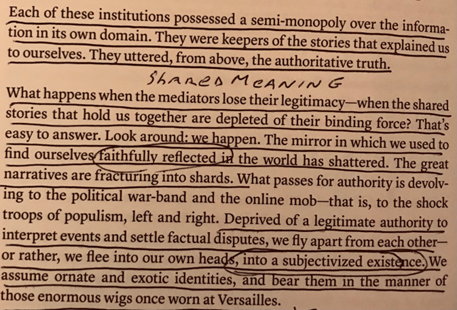
Society must progress, but not at the cost of the ideas and values that brought it together in the first place. The balance between progress and conserving has been off for awhile. The values that hold society together and the institutions that uphold them are in decline as people are distrusting what is coming out of our institutions.
We need to be able to put our trust in the institutions that represent us and should work toward restoring their place in society.
“Increasingly, Western societies – especially the English-speaking countries – are becoming two different peoples speaking two very different languages and believing in two modes of living. One camp believes in some form of objective truth and labels humans as either male or female. They acknowledge there are endless variations in the ways humans express themselves, but they are certain there are only two sexes. The concept of two sexes is so ancient and fundamental to our makeup as a species, we’re still wrapping our heads around having to verbalize what was always common sense. Defending the obvious is exhausting.
Clash of two camps: If universal truths are no longer recognized and everything is a “construct,” writes the author, society becomes increasingly divided even at the level of basic understanding and language. Shown are: (top) the 2023 Drag Up Fight Back protest, San Francisco, CA; (bottom) the meeting against minor children transgender policies, Vancouver, B.C. (Sources of photos: (top) Sheila Fitzgerald/Shutterstock; (bottom) EJ Nickerson/Shutterstock)
The other camp believes in a post-modernist version of constructed truth in which there are dozens of “fluid” genders that negate sex and biology. They also believe that anyone who does not subscribe to this belief is a heretic and as evil as a Nazi. They have the news and entertainment media, most of academia, much of the corporate world, and more and more of the state apparatus (from educational bureaucracies to human rights commissions) on their side.
How do these two camps speak to one another? The two belief systems require very different laws and social norms. If there are only two sexes, the man in my mother’s story is not allowed in the women’s changeroom. If sex is a social construct and can change through self-declaration or self-perception, that man can be a woman and is therefore allowed in the women’s changeroom. Right now, it seems the latter camp is winning and that we no longer share a common understanding of basic truths or even of language. Words like “man” or “woman” that were once universal are no longer.
A society that does not have a shared language cannot share thoughts. A society that is divided on whether or not there is objective truth, outside of personal feelings and emotions, cannot set laws or policies that work for the broadest range of people. A society where women and girls are cowed into silence when a crime is perpetrated against them for fear of being labelled the enemy is a shaky society indeed.”
What is ad block? It is an application that, at your discretion blocks out advertising so you can browse the internet for content as opposed to ads. If you do not have it, get it here so you can enjoy my blog without the insidious advertising.
















 bleatmop
 Mystro


 Dead Wild Roses
Your opinions…