
You are currently browsing the tag archive for the ‘Society’ tag.
The notion we have a fair playing field, a balance, whatever you’d like to call it is quite patently false. We have not all just fallen out of some sort of Rawlsian simulator into a just society. Injustice and anti-egalitarian ideals are normative in society, they are the water we swim in, the air we breathe. Otherwise interactions like the below just wouldn’t happen.


 The recent terrorist shooting in South Carolina have brought the issue of racism back to the top of the heap in the mainstream media. I’m sure there will be deep introspective think pieces in all of the major dailies and magazines. Then, like any story the media deigns “having being milked enough”, the racist terrorist attack will be quietly shunted to the side while the next tragedy is cued up for consumption.
Consumption of news these days seems to be the problem though. We are expected to keep track of the world, hell even personalize our ‘news experience’, but that is not what being an educated, engaged member of society is all about. The 5th Estate is (should) there to monitor the centres of power in society and report their activities for the citizens of democratic countries can engage with and evaluate said activities. With so much of media today being focused on infotainment rather than critical analysis of important events how the the average citizen get the information she needs?
There are a couple of threads to pull apart with the questions being raised. Firstly, the idea that personalized news is good idea for democratic societies, secondly the role of infotainment media and lastly the effect of the professional media colluding with the centers of power in society. All three of these aspects work against the creation of active, informed democratic participation in society.
“Society” is the watchword here – the ludicrous amount of personalization options presented to us in North America society gives us choice – and we all know (or should know by now the neo-liberal taint associated with that concept) that the choice presented to us is really a form of atomization that keeps our fingers firmly off the pulse of society and rather, firmly on our own as we sail alone through society.
What comes to mind is an captioned black and white image (pro-tip:if you want to every reuse something save it the first time you see it) of people on a train all
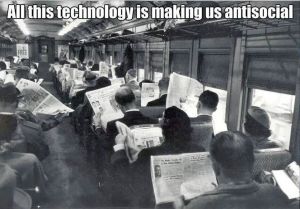
A big tip of the hat to Bleatmop for tracking down this picture.
reading the paper. The witty caption was something like this – smartphones and technology have changed society darn much… You can see the obvious parallel being made; every buried in a newspaper vs. everyone buried in their smart phones. On the surface this is correct but I remember pausing then thinking that something wasn’t quite right.
That “something” was that reading the daily newspaper was a still a shared experience in society. You could talk to someone about an article, even a complete stranger, and it was likely that they would have read the same article and then you could start a conversation about it. How neat is is that? Today though, that is a much taller order as many people have tailored their consumption of news to their tastes and sphere of interests making finding a common ground with people that much more difficult. Talking to people about important issues is what community is about, especially when they have different views on what is the correct course of action. Hashing things out, being charitable, accepting an well reasoned argument are all part of living in a democratic society.
Democracy is not a streamlined affair, nor should it be, because our personal freedom and ethical concerns are at stake. When governments act unilaterally and secretly it doesn’t matter what personal choices you make, it is the society around you that is going to shit and your choosy-choices and personal experiences will also be circling the drain since you are part of said society(see Canadian bill C-51, NAFTA, Trans-Pacific-Partnership). So having a reliable, accessible, common base of public knowledge is important to democratic society.
Democratic society has given us many media choices but, coupled with the capitalist infrastructure that actually runs the show our media sources have conglomerated and become ensconced within the power structures of society. See Fox and Faux News for the most shining example of the marriage between news and corporate propaganda. The focus of much of our news media today is to sell advertising, while educating/informing the public on crucial issues facing society is quite far down the list. I shudder when I see how much of the professional media now resembles Entertainment Tonight rather than the venerable Front Page Challenge (The Fifth Estate, Marketplace, et cetera). It now takes a great deal of time just to filter out the dross to get to the important news that people should know about their society and even then one must take into account the bias and elite influence present within ‘serious news’. The importance of public broadcasters cannot be overstated here – public institutions such as the CBC, NPR, and BBC are more free from the elite consensus and can more accurately report on the issues without the elite’s point of view being considered the default (This is a relative judgment – see Media Lens for an annotated listing of how awesomely independent Auntie Beebs is becoming).
Public broadcasting, with all of its problems aside, is one avenue to escape ‘the preferred message’ being broadcast to society by the corporate media with their vested interests of the status-quo. This isn’t a wild conspiracy theory – the way the world currently works benefits a certain class of people and it is their best interests to maintain the current system because it keeps them at the top of the heap. No mystery present. This system also provides the answers to why certain problems keep cropping up again and again within society – inequality, institutionalized racism and sexism for example. There structures within society serve their purpose; the ‘right people’ profit from their existence and thus are maintained. Just look at the perspectives surrounding mass murders:

The evidence, but then put through the media filters and the very different result…

The NYT’s nails it, for once, and lays down a view into the systemic racism that permeates North American society. This is the story that needs constant repetition. Yet, watch how soon the white racial violence dissipates into the ether. This is not a fluke, not a statistical aberration, this is policy. And thus, because of the collusion of much of the media with the current centres of power, the problems that face our society are not adequately dealt with nor are they given the proper amount of time or analysis that would help the people of the nation understand these problems and what can be done about them.
For those in power though it wise to note that only so much tamping down of these systemic problems can be done. Eventually, these issues take a life of their own and people will take radical action to resolve these seemingly ‘intractable’ problems and not in the way that the nestled elite likes.

Another great strip from Tatsusya Ishida.

This is taken from the interview titled: Does Capitalism Cause Drug Addiction? The piece that I am going to excerpt is about how we view addiction in society. If we are to believe Hari, it isn’t about a failure in moral rectitude or falling into a drug laden trap of compulsion; but rather it is the atomization and rampant consumerism in society that causes the addictions we see today.
“Drugs are not what we think they are. Addiction is not what we think it is. The drug war is certainly not what we’ve been told it is. And the alternatives aren’t what we think they are.
And there were two people here in Canada who really helped me to think about this. One is guy called Bruce Alexander. He’s someone you will know the work of. If you had said to me four years ago, say, “What causes heroin addiction?” right, I would have—I would have looked at you like you were a little bit simpleminded. I would have said, “Well, heroin causes heroin addiction, right?” There’s a story we’ve been told about addiction, how it works, for a hundred years now, that’s so deeply ingrained in our consciousness that it seems like our common sense, right? We think if the first 20 people on the rows here, if we all used heroin together for, say, 20 days, there are chemical hooks in heroin that our body would start to physically need, right? So, on day 21, we would need that heroin. We would physically crave it. And that’s what addiction is; that’s how we think it works.
And the first kind of chink in my doubt about that was explained to me by another great Canadian, Gabor Maté in Vancouver, who some of you will know the work of, amazing man. And he pointed out to me, if any of us step out of here today and we’re hit by a bus, right, God forbid, and we break our hip, we’ll be taken to hospital. It’s very likely we’ll be given a lot of diamorphine. Diamorphine is heroin. It’s much better heroin than you’ll score on the streets, because it’s medically pure, right? It’s really potent heroin. You’ll be given it for quite a long period of time. Every hospital in the developed world, that’s happening, right? If what we think about addiction is right, what should—I mean, those people should leave as addicts. That never happens, virtually never happens. You will have noticed your grandmother was not turned into a junkie by her hip replacement operation, right?
I didn’t really know what to do with it. When Gabor first explained that to me, I didn’t really know how to process that, until I met Bruce Alexander. Bruce is a professor in Vancouver, and Bruce explained something to me. The idea of addiction we have, the one that we all implicitly believe—I certainly did—comes from a series of experiments that were done earlier in the 20th century. They’re really simple experiments. You can do them yourself at home if you’re feeling a little bit sadistic. Get a rat and put it in a cage and give it two water bottles. One is just water, and one is water laced with either heroin or cocaine. If you do that, the rat will almost always prefer the drugged water and almost always kill itself very quickly, right, within a couple of weeks. So there you go. It’s our theory of addiction.
Bruce comes along in the ’70s and said, “Well, hang on a minute. We’re putting the rat in an empty cage. It’s got nothing to do. Let’s try this a little bit differently.” So Bruce built Rat Park, and Rat Park is like heaven for rats. Everything your rat about town could want, it’s got in Rat Park. It’s got lovely food. It’s got sex. It’s got loads of other rats to be friends with. It’s got loads of colored balls. Everything your rat could want. And they’ve got both the water bottles. They’ve got the drugged water and the normal water. But here’s the fascinating thing. In Rat Park, they don’t like the drugged water. They hardly use any of it. None of them ever overdose. None of them ever use in a way that looks like compulsion or addiction. There’s a really interesting human example I’ll tell you about in a minute, but what Bruce says is that shows that both the right-wing and left-wing theories of addiction are wrong. So the right-wing theory is it’s a moral failing, you’re a hedonist, you party too hard. The left-wing theory is it takes you over, your brain is hijacked. Bruce says it’s not your morality, it’s not your brain; it’s your cage. Addiction is largely an adaptation to your environment.
There was a really interesting human experiment going on at the same time as Rat Park, which kind of demonstrates this really interestingly. It was called the Vietnam War, right? Twenty percent of American troops in Vietnam were using heroin a lot, right? And if you look at the reports from the time, they were really worried. They thought—because they believed the old theory of addiction. They were like, “My god, these guys are all going to come home, and we’re going to have loads of heroin addicts on the streets of the United States.” What happened? They came home, and virtually all of them just stopped, because if you’re taken out of a hellish, pestilential jungle, where you don’t want to be, you can die at any moment, and you go back to a nice life in Wichita, Kansas, you can bear to be present in your life. We could all be drunk now. Forget the drug laws. We could all be drunk now, right? None of you look very drunk. I’m guessing you’re not, right? That’s because we’ve got something we want to do. We’ve got things we want to be present for in our lives.
So, I think this has—Bruce taught us about how this has huge implications, obviously, for the drug war. The drug war is based on the idea that the chemicals cause the addiction, and we need to physically eradicate these chemicals from the face of the Earth. If in fact it’s not the chemicals, if in fact it’s isolation and pain that cause the addiction, then it suddenly throws into sharp contrast the idea that we need to impose more isolation and pain on addicts in order to make them stop, which is what we currently do.
But it actually has much deeper implications that I think really relate to what Naomi writes about in This Changes Everything, and indeed before. We’ve created a society where significant numbers of our fellow citizens cannot bear to be present in their lives without being drugged, right? We’ve created a hyperconsumerist, hyperindividualist, isolated world that is, for a lot of people, much more like that first cage than it is like the bonded, connected cages that we need. The opposite of addiction is not sobriety. The opposite of addiction is connection. And our whole society, the engine of our society, is geared towards making us connect with things. If you are not a good consumer capitalist citizen, if you’re spending your time bonding with the people around you and not buying stuff—in fact, we are trained from a very young age to focus our hopes and our dreams and our ambitions on things we can buy and consume. And drug addiction is really a subset of that.”
I’m very happy to see that some places in Canada are starting to turn on to this sort of thinking – Medicine Hat Alberta for instance where they are working toward eradicating homelessness – by giving people homes to live in – because it is cheaper to do so that the current methods.
**update** John Hari speaking on a TED talk about addiction.
Wow, kick back and let Ms.Moran guide you though the problems of liberal feminism with regards to prostitution and the changes that are necessary to make in society.
First of all I’d like to talk a little bit about what Radical Feminism means to me in the context of my work as an abolitionist activist, and also in an emotional sense, as a sex-trade survivor. Three years ago, when I began writing anonymous newspaper articles and blogging under the pseudonym FreeIrishWoman, I noticed pretty quickly that my words were shared amongst and disseminated by a particular group of feminists: Radical Feminists. Given that the recollections I described were the experiences of a homeless, socially-disowned, prostituted fifteen-year-old girl, I would have expected support from the feminist community, of all places. Just as well I wasn’t completely politically ignorant with regard to the divisions between those who describe themselves as feminists, otherwise it would have been a shock to discover that while my words and experiences were honoured and shared by Radical Feminists, they were widely ridiculed and had their authenticity relentlessly challenged by some of those who referred to themselves as Liberal Feminists.
Liberal feminism – which holds that anything a woman does can be empowering as long as she does it without a gun pointed to her head – had always sounded like a crock of crap to me anyway, so I cannot say I was terribly disappointed. I was wounded though; and above all, I was galled. It is both wounding and galling for me to know that there is a whole army of twenty-something, white, socially-privileged young women out there talking of prostitution as the very epitome of female empowerment. That they’ve made this assessment about an experience they’ve never had, while having spent years being educated in an effort to keep themselves out of the social class of women who most commonly have to experience it, and have decided it’s harmless, in spite of the tsunami of evidence that attests to its harm, is, to me, the most repulsive sort of hypocrisy.
Sometimes we who speak the truth about the global sex-trade find ourselves close to despair, crushed beneath the weight of the prevailing public view, steeped as it is in ignorance; both wilful and malignant, and in obliviousness, sometimes innocent in its nature, and when it is, all the more frustrating for it. We know the interests of patriarchy are served by the very existence of the global sex-trade and by the annihilation of the innumerable female lives snuffed out of existence within it. It is galling therefore, for all of us to listen to the Liberal Feminists toe the patriarchal line with the lie they buy for themselves and try to sell on to us that black is white, up is down, and imprisonment is liberating. Conflating consent with liberation is the business of those who do not know that oppression cannot operate without it. But the consent of oppression, consent under duress, is not true consent. The duress itself has morphed consent into a different shape and moved it away from its own nature. True sexual consent is not possible here. Sexual consent is beyond the laws of commerce; it is beyond sale and it is beyond purchase. Sexual abuse however, often has a price tag, and when it does, we call it prostitution.
I am tired of the ignorance of women who do not understand this, but is it surprising to anyone, really, that most of these women are, as I’ve said, young, white and privileged? I doubt that any of the women gathered here today are surprised by that, because, that the socially privileged are removed from the realities of the socially dispossessed is simply not surprising to any woman with a whit of political savvy.
But yes, I’ll own that we are tired and frustrated and pissed off, and with good reason. Each time we speak out, they do their best to shut us down. We’ve seen examples of this in recent weeks, as we do in all weeks. As I speak, there are fools running petitions against this conference from Edinburgh to Brighton and back again. The most genteel advice I could give these women would be to consult their dictionaries, and turn to the word feminist. Of course, unfortunately, I’d have to also advise them, in many cases, to disregard what they had found, since so many dictionaries frame feminism as a matter of sexual equality, which rather puts the cart before the horse. A woman who believes in the social, economic and political equality of the sexes is not a feminist, but a fantasist. We don’t live in that world; we don’t have equality, and, as Radical Feminists know, a prerequisite of equality is the dismantling of male supremacy. First, we must be liberated from it. Then, and only then, might we live our lives as equals.
The simple cruelty of the Liberal Feminist stance is something that also, apparently, escapes them. Their stance tells us sex-trade survivors that every rape we endured did not matter, that every sexual assault of every manner and variety were just occupational hazards, and that our gang-rapes would not have been gang-rapes had legislation just forced those men to use us one at a time. Well, I have news for them: flat rate brothels and gang-bang packages are all the rage in Germany now. For anyone who hasn’t heard these terms, a flat rate brothel is prostitution’s answer to an all you can eat buffet. Men pay a one-off fee, a ‘flat rate’, and for this fee they can use the body, or bodies, of women for as long as they are humanly able, climaxing as many times as they want, or can. These are sometimes combined with gang-bang packages, whereby five or six or seven men arrive at the brothel together, pay their ‘flat rate’ and use the body of a woman until she can barely stand. I have had photographs forwarded to me from one such a scene from a German brothel. The girl being used by a half dozen men was nineteen years old, and seven months pregnant. This is the true face of the regulated sex-trade that Liberal Feminists fight for.
It has been claimed, in the midst of the campaigns against this conference, that I am endangering the lives of women in prostitution. It is telling how the depths of their incomprehension is revealed by the very charges they level against me. There was only one group of people who were ever responsible for endangering my life when I was in prostitution, and they most certainly were not abolitionists; they were sex-buying men; the same sex-buying men whose dicks will never be sucked by the Liberal Feminists who defend and uphold the rights of those men, to have their dicks sucked by other women; economically disenfranchised, educationally disadvantaged, socially deprived and racially marginalised women.
So where do we go, with our frustrations? And what do we do, with the anger that is so inevitable here, such an intrinsic human reaction to the injustice of telling the truth and being called a liar. The first thing I would say is take heart: this situation will not last forever. It is precisely the hypocrisy of the Liberal Feminist stance which will be its undoing. The doctrine that says ‘empowerment can be found in these experiences (which we will fight tooth and nail to avoid for ourselves)’ has a shelf life. That type of nonsense has a sell-by date. However popular it might be, for however long, such doctrine is doomed to exposure – Emperor’s New Clothes style.
I have been profoundly comforted these last years (and especially this last eighteen months, since my book, Paid For, was published) not only by the truths that were accepted from me, but by the truths that were told by so many other women, most of whom did not have to have lived these realities to acknowledge them. I have been comforted to see, in country after country, abolitionist movements spring up where none had existed before, or become strengthened where they had been floundering, and everywhere I have seen the strengthening of abolitionism I have seen a strong overlap between the abolitionist movement and the Radical Feminist movement, or, at the very least, a strong adherence in abolitionism to Radical Feminist principles.
The reality is that Radical Feminists are on the right side of history here, and they are the only feminists who get the full picture, and the reasons why it exists. Socialist Feminists have my respect, but they don’t have the whole picture here. Prostitution does not exist as a consequence of women’s economic disenfranchisement. Poverty is a supporting factor. Not a reason. Supporting factors are not reasons. They are simply supporting factors. Prostitution exists for only one reason; that reason is male demand. No amount of poverty would be capable of creating prostitution if it were not for male demand.
I have come here today to ask for the support of every woman in this room in fighting this scourge that weighs almost exclusively on girls and women. We need to fight this, not by ripping at the leaves, nor hacking at the branches, nor even cutting this off at the trunk; we need to rip it up by the roots. As daunting as this task seems, we already have the tools to do it. We are not, thankfully, totally bamboozled like the liberals, nor are we hobbled in our understanding like the socialists. We know that prostitution is both a consequence and good evidence of the subordination of women, and it is from the standpoint of this understanding that we can dismantle it. It is very important that we never give an inch in this fight. We must never concede to the tactics of the pro-prostitution lobby, the first of which is to pretend that prostitution is not a moral issue. Let me say in front of you and in front of the world: You can be damn sure that prostitution is a moral issue, as human rights always are.
Abolitionists, the pro-prostitution lobby contend, are engaged in a ‘moral crusade’ to rid the world of prostitution. Crusade, here, is a pejorative term, and it is linked with morality in order that some of its contemptuous derision will rub off. Morality itself, we are told, is negative, ill-founded and, well, wrong. The straight-up foolishness of asserting that discerning between right and wrong is itself wrong apparently escapes some people.
I am tired of hearing people frame abolitionist arguments by beginning ‘I am not a moralist, but…’ We are all moralists, unless we are psychopaths, and since when was morality a dirty word? Here’s the answer to that: morality has been a dirty word since it suited certain people that we look the other way and pretend that morality is null and void here; and you will find, time and again, that people who espouse that position are defending something which is very plainly wrong, hence their absolute insistence that morality shouldn’t get a look in.
There is also the nonsense claim that those who oppose prostitution do so necessarily from a religious standpoint, as though there were any shortage of ethical atheists in the world. The moral principles that govern or influence conduct often have no basis other than our own innate sense of what is or is not harmful human behaviour. Prostitution is damaging to the human psyche on every conceivable level; it is exactly its harmful, degrading nature that gives rise to the instant sense of objection we feel when we imagine prostitution as a feature in the lives of the women we love.
So let us stand firm on these points: That prostitution exists because of the male demand for it, and that we know damn well and will not be shaken in our assertion that it is flat-out wrong. There is a reason we are fought so consistently on these points; the reason is our opponents know we can win on them.
Let me repeat that I have come here today to ask for the support of every woman in this room in fighting prostitution. Please hear this as a call to action. Across Europe, our politicians are beginning to discuss prostitution more frequently, and just this February the European Parliament voted by an overwhelming majority to adopt the Honeyball report, which calls for a Europe wide adoption of the Nordic Model. When your politicians speak out, please support them by letters both public and private. When they do not, please encourage them to do so. When you see abolitionist campaigns spring up – and you will see more of them; the abolitionist movement is growing – please lend your time and your energy and your voice.
I am working with a group called SPACE International. SPACE stands for ‘Survivors of Prostitution-Abuse Calling for Enlightenment’. Our membership spans seven countries now and all of us have made the deeply painful sacrifice of speaking out publicly about our abuse in the sex-trade. We have friends and allies in several international organisations and we are gaining ground, but we cannot do this without the support of women in the general public. I encourage you to join RadFemUK and other groups like them, and to support their actions by sharing and disseminating their campaigns and materials. We need a groundswell of support from women, but maybe before that happens, we need to remind women that the bodies of their daughters would be just as welcome in the brothels and the red-light zones as ours ever were, should the circumstances of their lives ever happen to place them there.
 Religion doesn’t just happen in the 21st century in the West. Religion must be instilled into children, magic and fable must be taught to be revered and most darkly, the fear of eternal punishment must be enshrined in young minds.
Hell for children is a very real fear – it torments their thoughts and causes a great deal of unnecessary anxiety. My question to the religious is simply this:
Why make your children fearful?
Isn’t there enough to worry about life with regards to food, shelter, and security to add another imaginary layer of anxiety to the mix? Is that a responsible action to take as a parent?
Of course it isn’t.
Being afraid for yourself is not a great motivator for ethical action, and yet that is the implicit lesson that resonates through so much of religious teaching. Consider also how the fallacy inducing mode of binary thinking is encouraged and reinforced. You are good with Jebus and bad the the Devil… etc. Serious ethical actions and thoughts require moving past that first easy binary of good and evil because almost every encounter we have as individuals in society is a mixed bag of ethical and unethical choices and behaviours.
Stating moral relativism here always leads to the conclusion that somewhere down the line – anything and everything will be permissible. Given that the last 1700 hundred years or so of religious dominance in the field of ethical behaviour I would have to say that absolute morality path isn’t exactly a slam dunk either, as far as worthwhile moral systems are concerned.
I’m always here on Sundays giving both barrels to religion and its antiquated notions of how the world is – seldom do I offer what I would like to see happen instead of the religious tomfoolery so easily demarcated and dispatched.
The vision I have is one that requires a society that understands how ill equipped our species is for rational, logical thought. Bearing that in mind no expense must be spared to raise children in a safe, welcoming, and stimulating environment in which the only worry they will have is what new thing they will learn after lunch.
How far off is this goal?
Too damn far away. Every time I’ve been called to a kindergarten or pre-k class some of the children there have come to school hungry. Nothing defeats curiosity and learning like an empty belly. Too many times I’ve been empty handed at lunch, because I’d already distributed my lunch to other children, yet there was yet another to feed. (Don’t worry we always find something).
I need my society to realize how important it is for all children to have the basics of life taken care before I can start helping them explore and comprehend the world around them.
Bringing this back to religion and the insecurity it supposed to soothe – how about some more focus on doing ‘good works’ rather than all the political nonsense currently dominating the religious sphere. How awesome would it be to have another volunteer (religious or not) in every classroom there to support learning and socialization?
There are so many ways to help children. The problem being that the outlay of time and emotional investment (for both the secular and religious) is prohibitive; and that, sadly, is structural feature of society.
A big thank you to Neural Notes for posting this video to recent discussion thread over at the Superstitious Naked Ape. It is a grand example of establishment vs revolutionary representatives talking past each other.











 bleatmop
 Mystro


 Dead Wild Roses
Your opinions…