
You are currently browsing the tag archive for the ‘Sociological Images’ tag.
From Sociological Images Micheal Lozano –
[…] Japanese fast-food has found a way to bypass the cultural stigmas that impede their profits. One food chain noticed many women would not buy their biggest-sized burgers. The culprit was ochobo, a Japanese custom that prevents women from opening their mouth widely in public. Small mouths are considered beautiful and opening them widely is considered “ugly” and “rude.” The restaurant concluded that it would get into the business of “freeing women from the spell of ‘ochobo.’”

Face Veil, so liberating! much burger! noms tasty!
Of course, the irony is that the burger chain’s “solution” isn’t actually liberating women. By hiding the deviation behind a paper mask, it is actually reinforcing Ochobo. After all, the social reality remains — it is not acceptable for Japanese women to display an open mouth in public.
*sigh* Like the gender binary needs more reinforcement…

Thanks to Dr. Lisa Wade over at Sociological Images for the pic and commentary.
“Dieting is for women.
I mean we all know that dieting and women go together like peas and carrots. We know this — collectively and together, even if we don’t agree that it should be this way – not because it’s inevitable or natural, but because we constantly get reminded that women should be on diets and dieting is a feminine activity.”
I keep telling myself, “Arbourist, you need to post more stuff you write as opposed to other things gleaned from the net”. The problem is that the net has a lot of awesome on it that does it better than I. Consider Sociological Images. They present a concept, concisely explain said concept and then reinforce the learning with a spot-on video. SI, you do are doing it right. From SI:
“Microaggressions are “brief and commonplace daily verbal, behavioral, or environmental indignities, whether intentional or unintentional, that communicate hostile, derogatory, or negative… slights and insults” (source). These are often subtle. So the recipient feels badly, but it can be difficult to explain exactly why, especially to someone who isn’t sympathetic to issues of bias. The Microaggressions Project has hundreds, maybe thousands, of examples.
In this video, Franchesca Leigh poses as a “White girl” and says many of the things that she and other “Black girls” hear routinely. To Leigh, these are microaggressions. They variously trivialize and show insensitivity towards race and racism, remind the listener that she is considered different and strange, homogenize and stereotype Black people, and more…
As usual Sociological Images is chock-full of interesting articles. I was intrigued by the title of this post and decided to reproduce it in part here for the benefit of my readership. While you are there, check out the article on how cheerleading outfits are shrinking over time.
“You might be surprised to learn that at its inception in the mid-1800s cheerleading was an all-male sport. Characterized by gymnastics, stunts, and crowd leadership, cheerleading was considered equivalent in prestige to an American flagship of masculinity, football. As the editors of Nation saw it in 1911:
…the reputation of having been a valiant “cheer-leader” is one of the most valuable things a boy can take away from college. As a title to promotion in professional or public life, it ranks hardly second to that of having been a quarterback.*
Indeed, cheerleading helped launch the political careers of three U.S. Presidents. Dwight D. Eisenhower, Franklin Roosevelt, and Ronald Reagan were cheerleaders. Actor Jimmy Stewart was head cheerleader at Princeton. Republican leader Tom DeLay was a noted cheerleader at the University of Mississippi.”

Head over to SI and read the whole thing.
More than anything, this is just a post as to have another handy reference when it comes to arguing with MRA’s and other assorted people about ‘equality’ and ‘parity’ in the work environment. A big thanks to Sociological Images for compiling the information in the post titled “Explaining Gender Inequalities in Salary Expectations”.
The following chart featured at The Economist illustrates that women in Europe expect to earn significantly less than men after graduating from university. (Of course, women’s expectations are represented in pink, and men’s in blue.) According to the study, European women attending the most prestigious universities expect to earn an average of 21 per cent less than their male counterparts.
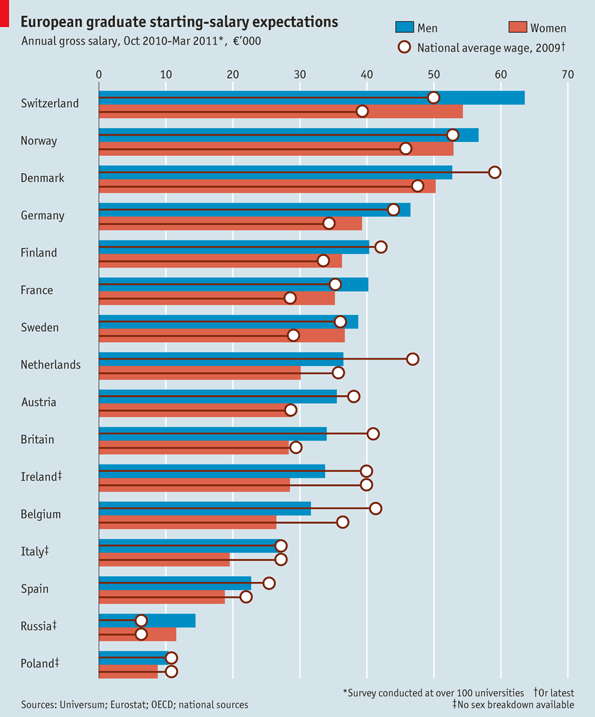
Given that women actually do earn an average of 17.5 per cent less than men in the European Union, this difference in salary expectations might not seem shocking. What’s interesting, though, is the accompanying text that attempts to explain these disparities:
Women and men seem to differ in workplace and career aspirations, which may explain why salary expectations differ. Men generally placed more importance on being a leader or manager than women (34% of men versus 22% of women), and want jobs with high levels of responsibility (25% v 17%). Women, however want to work for a company with high corporate social responsibility and ethical standards; men are more interested in prestige (31% v 24%).
By neglecting to address how our social environment can contribute to reported differences in career aspirations, statements like these risk reinforcing gender stereotypes and naturalizing salary inequalities. Can we really assume that gendered salary disparities are due to women’s innately lower inclination to pursue high-paying career paths?
Research says: no, we can’t. [Go to Sociological Images for the rest of the story].
As a proponent of progressive taxation and egalitarian society I still hear about benefits “trickling down” from the top of society to the bottom. This of course is still horsepucky but as a meme still shows a great amount of resiliency as it continues to crop up again and again. Another sticking point is all the doom and gloom being written about the economy, despite a rebound of corporate earnings. Sociological images provides a graph and analysis about the economy.
“Using Bureau of Economic Analysis data, he looked at total U.S. domestic profits, as well as the proportion of all domestic profits earned by the financial sector, between 2001 and the end of 2010. And what we see is that both overall corporate profits, and the finance sector so central to the economic crisis, have bounced back quite well, returning to the levels we saw just before the peak of the boom period:
:
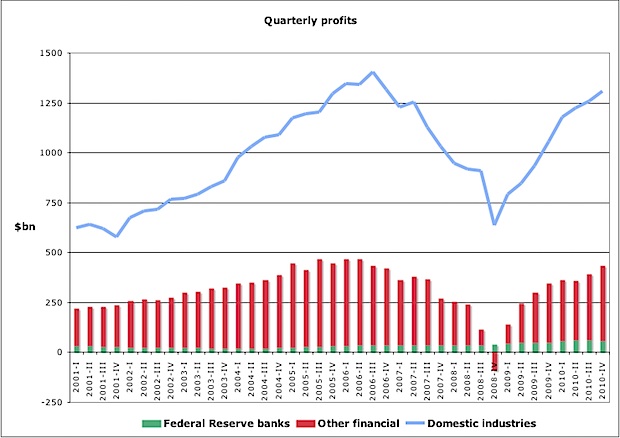
“Point is, it complicates the general perception we might get from news reports that everything in the economy is awful and there are no profits to be made. Ongoing job stagnation and media focus on the negative economic news doesn’t mean all parts of the economy are suffering equally, or that as soon as corporate earnings rebound, the benefits would quickly reach workers in the form of new job opportunities.”
I’m thinking that the workers are not seeing the rebound as quickly or at all if one is to believe the graph. In a country with more redistributive policies in place I would predict that more people would be on the rebound instead of just the corporate elite.
Raiding Sociological Images is a pastime of mine as SI manages to succinctly highlight important issues in our society. One issue is gender inequality and how prevalent it remains in our society. The neat graph, along with some of their interpretation:

“First, notice that women with more education (the lighter bars in each age bracket) do worse compared to men than women with less education. That is, the gender inequity is worse in the upper classes than it is in the lower classes. Why? Well, people tend to marry other with similar class and education backgrounds. Accordingly, women with more education may be married to men with higher earning potential than women with less education. Those women are more able to make work-related choices that don’t foreground economics, since their income is less central to the financial health of the couple. They are also more likely to take substantial amounts of time out of the workforce when they have kids (working class women can’t afford to do so as easily), and we know that doing so makes a real dent in career advancement. So, perhaps ironically, women who are “richer” educationally may marry economically richer men who then allow them to deprioritize their careers.”











 bleatmop
 Mystro
 The Arbourist


 Dead Wild Roses
Your opinions…