
You are currently browsing the tag archive for the ‘The Field Guide to Woke’ tag.
A pocket field guide to the tells, the vibes, and the escape hatches 🧭
This one is deliberately not an essay. It’s a field guide. If “The Woke Machine” was the engine diagram and “The Woke Machine in the Wild” was the road test, this is the laminated card you keep in your purse/wallet so you can recognize the pattern in real time.
Rule of thumb: you’re not looking for left or right. You’re looking for a script. The woke script, as used in this series, shows up when a conversation shifts from “what’s true?” to “who gets to speak?” to “if you disagree, you’re guilty.”
The three-check test (10 seconds)
If you hear these three moves stacked together, you’ve found it:
- Identity first: “This is about who we are and what’s been done to us.”
- Standing first: “Some people speak; other people defer.”
- Sealed loop: “Disagreement proves the harm.”
One of these is normal politics. All three together is the machine.
The Field Guide Cards 📇
Each card has: vibe → what it’s doing → escape hatch
Card 1: The Credential Swap
Vibe: “It’s not my job to educate you.”
What it’s doing: Turns your question into an offense so the claim never has to be defended.
Escape hatch: “Fair. Point me to the best source you trust. I’ll read it, then we can discuss the claim and the remedy.”
Card 2: The Motive Trap
Vibe: “Intent doesn’t matter. Only impact matters.”
What it’s doing: Makes every mistake equally condemnable. Eliminates proportionality.
Escape hatch: “Impact matters. Intent matters for what response is fair. What change would satisfy you, and what would be excessive?”
Card 3: The Moral Draft Notice
Vibe: “Silence is violence.”
What it’s doing: Forces instant alignment. Neutrality becomes guilt.
Escape hatch: “I’m open to discussion. I don’t do coerced declarations.”
Card 4: The Sacred Testimony Upgrade
Vibe: “Listen to marginalized voices.”
What it’s doing: Sometimes an honest corrective. Sometimes a command to treat testimony as unquestionable.
Escape hatch: “I’m listening. After listening, are we allowed to test general claims with shared evidence standards?”
Card 5: Harm as a Veto
Vibe: “That’s harm.” / “That’s violence.”
What it’s doing: Replaces argument with a stop sign.
Escape hatch: “Let’s specify. What concrete harm, to whom, at what threshold, and what rule follows from it?”
Card 6: The Implementation Shaming
Vibe: “You’re centering yourself.”
What it’s doing: Turns practical questions into moral failure.
Escape hatch: “Implementation questions protect people from unintended damage. Let’s talk tradeoffs.”
Card 7: The Purity Shortcut
Vibe: “If you were a good person, you’d already agree.”
What it’s doing: Makes moral worth depend on agreement.
Escape hatch: “Good people disagree. Let’s talk reasons, evidence, and costs.”
Card 8: The Story-to-System Leap
Vibe: “My lived experience proves the system is X.”
What it’s doing: Jumps from testimony to total causation without the hard middle step.
Escape hatch: “I accept the experience. Now show how we know the cause. What alternative explanations did we check?”
Card 9: The Sealed Loop
Vibe: “Your disagreement is proof.”
What it’s doing: Objections become confirmation. Nothing can be corrected.
Escape hatch: “If disagreement counts as proof, we’ve left reasoning. What would count as disconfirming evidence?”
Card 10: The Reality Sabotage
Vibe: “Objectivity is a tool of oppression.”
What it’s doing: Undermines common standards so the frame can’t lose.
Escape hatch: “If we can’t share standards, we can’t make fair rules. What standards apply to everyone equally?”
Card 11: The Venue Laundering Move
Vibe: “Deplatforming isn’t censorship.”
What it’s doing: Uses technicalities to deny coercion while doing coercion.
Escape hatch: “Maybe it isn’t state censorship. It’s still a power move. What principle makes this consistent?”
Card 12: The Totalizing Story
Vibe: “The whole system is rigged.”
What it’s doing: Converts a hypothesis into a worldview. Every counterexample becomes cover-up.
Escape hatch: “Maybe. What evidence would make you revise that, and what would count as a genuine counterexample?”
The “Woke in the Wild” Bingo Strip 🎯
If you hear three of these in one conversation, slow down:
- “Do the work.”
- “That’s not up for debate.”
- “I don’t feel safe.” (used as policy veto)
- “Platforming equals harm.”
- “Your questions are violence.”
- “You’re asking for emotional labor.”
- “We can’t center comfort.”
- “The data is racist.”
- “That’s tone policing.”
- “You’re on the wrong side of history.”
Some of these are sometimes fair complaints. The tell is when they function as argument substitutes.
Three calm moves that work in almost any room 😌
- Falsifiability: “What would change your mind?”
- Symmetry: “Does this rule apply to your side too?”
- Category check: “Are we discussing evidence, or are we assigning moral status?”
You’re not trying to dunk. You’re trying to keep the conversation inside reality.
Mini-glossary (translation for normal humans) 📘
- Standing: who is treated as allowed to speak and be believed.
- Self-sealing: a belief that treats objections as confirmation.
- Moral sorting: dividing people into good/bad based on frame acceptance.
- Harm (as used here): sometimes real injury; sometimes a rhetorical stop sign.
- Deplatforming: removing access to a venue; not always illegal, often still coercive.
Endnote
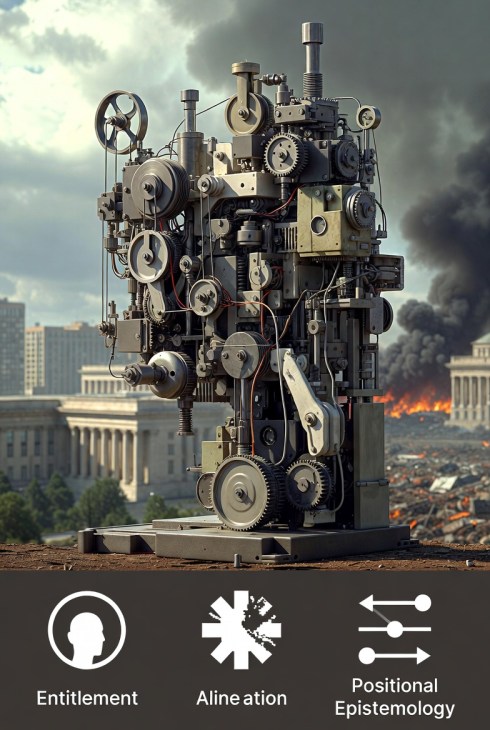
This field guide simplifies the framework outlined in “The Woke Machine” and “The Woke Machine in the Wild” prompted by James Lindsay’s New Discourses discussion of “woke” as an identity-and-epistemology posture rather than a simple political label.











 bleatmop
 Mystro
 The Arbourist


 Dead Wild Roses
Your opinions…