
You are currently browsing the tag archive for the ‘Tribal Politics’ tag.
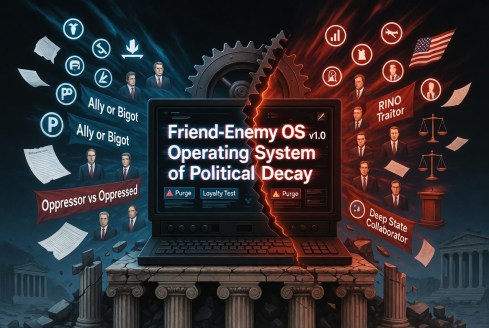
One of the most destructive temptations in politics is the urge to turn disagreement into moralized tribal war. Not argument. Not persuasion. Not the hard, frustrating work of governing a society full of competing interests and imperfect people. War. Friends and enemies. Allies and traitors. The pure and the contaminated. Once that frame takes hold, politics stops being about order, restraint, and judgment. It becomes a loyalty machine. Carl Schmitt gave this instinct its most famous formulation in The Concept of the Political, where he argued that the essence of politics lies in the distinction between public friend and public enemy. He was right to see that real political life can descend to existential conflict. He was wrong to treat that descent as the essence of politics rather than one of the permanent dangers civilized politics is supposed to contain. The friend-enemy distinction is not the foundation of healthy politics. It is the logic of political decay.
The danger is not only that the framework is harsh. Politics can be harsh. The danger is that it installs enmity at the center of public life and pushes everything else to the margins. Institutions, laws, debate, compromise, constitutional limits, due process, even ordinary factual disagreement all become secondary. What matters is identifying the enemy, consolidating the team, and punishing hesitation. That is why this logic travels so easily across ideologies. It can appear in revolutionary Marxism, in Maoist “enemies of the people,” in Islamist loyalty-and-disavowal frameworks, in activist binaries like ally versus bigot or oppressor versus oppressed, and in right-wing scripts about traitors, regime collaborators, and weak conservatives who supposedly enable the left. The vocabulary changes. The mechanism does not. A public enemy is named, and then a moral test is imposed: how fully will you align against him?
“The ratchet always turns one way: toward greater fanaticism, greater purification, greater moral ugliness. Truth is subordinated to solidarity. Principle is subordinated to faction.”
What makes this logic totalitarian is that it abolishes the space for dissent. Once the enemy has been declared, neutrality is no longer allowed. You either join the mobilization or you are suspected of serving the enemy’s cause. Hesitation becomes complicity. Refusal becomes betrayal. Moderation becomes guilt. That is how political movements become purge machines. You can either be anti-racist or you are helping racism. You can either be a trans ally or you are enabling bigotry. You can either fight the deep state, resist the regime, and oppose the left without reservation, or you are a RINO, a coward, a collaborator. This is the structure that matters. Not the tribe wearing it. Once politics is moralized into friend and enemy, the pressure falls hardest not only on official opponents, but on the insufficiently zealous within one’s own camp.
That is why factions organized around “no enemies to the left” or “no enemies to the right” almost always radicalize inward. The outer edge of the movement becomes untouchable because criticizing it risks helping the enemy. So the only safe targets are moderates, doubters, and fellow travelers who fail the loyalty test. The left protects its most extreme activists and attacks liberals who cannot keep up. The right protects its own hardliners and attacks conservatives who still think prudence, constitutional restraint, or factual discipline matter. In both cases, the center is hollowed out first. The ratchet always turns one way: toward greater fanaticism, greater purification, greater moral ugliness. Truth is subordinated to solidarity. Principle is subordinated to faction. Politics ceases to be the art of living together under conditions of disagreement and becomes a permanent sorting mechanism for friends, enemies, and suspects.
A civilized society cannot survive on those terms. That does not mean pretending enemies never exist. They do. Free societies are not obliged to indulge movements openly hostile to liberty, law, and peaceful coexistence. But the achievement of constitutional civilization is precisely that it refuses to make enmity the organizing principle of normal public life. It channels conflict through law, opposition, procedure, restraint, and rights. It leaves room for disagreement without turning every disagreement into proof of treason. That is the line Schmitt blurred and totalitarian movements erase completely. The mistake is not in noticing that politics can become existential. The mistake is in treating that possibility as the deepest truth of politics and then building public life around it. Once you do that, purges are no longer an accident. They are the destination. Friend-enemy politics is not realism. It is the operating system of political decay.











 bleatmop
 Mystro


 Dead Wild Roses
Your opinions…