
You are currently browsing the tag archive for the ‘Trucker Convoy’ tag.
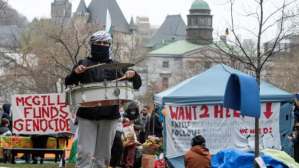 The protests at McGill University in April 2025 and the Trucker Convoy of 2022, while distinct in their scale, context, and authority, offer a compelling lens through which to examine accountability and lawbreaking in Canada. The McGill protests, driven by anti-Israel activists, involved physically blocking lecture halls and disrupting classes, as reported by B’nai Brith Canada, thereby denying students their right to education. In contrast, the Trucker Convoy, a nationwide movement against COVID-19 mandates, paralyzed critical infrastructure like the Ambassador Bridge, causing billions in economic losses and prompting the federal government to invoke the Emergencies Act. The scale of the Trucker Convoy’s impact was far greater, affecting national and international trade, while McGill’s disruptions were localized to a university campus. Additionally, the authority responding differed—McGill’s administration, a private institution, managed the campus protests, whereas the federal government, with its broader legal powers, tackled the Trucker Convoy. These differences in scope and jurisdiction naturally shaped the responses, but they also highlight a shared challenge: ensuring accountability when laws or rules are broken.
Acknowledging the protesters’ perspectives strengthens the case for consistent accountability. At McGill, the activists likely saw their actions as a moral imperative, aiming to pressure the university into divesting from companies linked to Israel’s actions in Gaza, which they framed as complicity in genocide. Similarly, the Trucker Convoy participants believed they were defending personal freedoms against government overreach, with some public support reflecting sympathy for their cause, as noted in historical polling data. Both groups may argue that their lawbreaking was justified by higher ethical goals—whether social justice or individual rights. However, this justification does not negate the harm caused: McGill students were intimidated and denied education, while the Trucker Convoy’s blockades disrupted livelihoods and public safety, with reports of harassment like defecating on lawns, as documented in news coverage from the time. The principle of free expression, a cornerstone of Canadian democracy, does not extend to actions that violate others’ rights or break laws, whether on a university campus or a national border. Recognizing the protesters’ motivations does not absolve them of responsibility; rather, it underscores the need for equitable enforcement to maintain social order and trust in institutions.
 The disparity in official responses to these events reveals a troubling inconsistency in addressing lawbreaking in Canada, fueling perceptions of a two-tier justice system. The Trucker Convoy faced severe consequences—hundreds of arrests, vehicle seizures, and frozen bank accounts under the Emergencies Act, as reported by Globalnews.ca—reflecting the government’s prioritization of economic and public safety. In contrast, McGill’s response was tepid, with the university implementing ID-based access controls only after days of disruption, and no immediate legal consequences like arrests or suspensions for the protesters, despite calls from advocacy groups for decisive action. While the federal government’s authority and the national stakes justified a stronger response to the Trucker Convoy, McGill’s leniency raises questions about institutional accountability on Canadian campuses. This inconsistency—where one group faces significant repercussions while another does not—erodes public confidence in the rule of law, suggesting that the consequences of lawbreaking may depend on the cause, context, or authority involved. Canada must strive for a balanced approach, ensuring that all acts of lawbreaking, regardless of scale or motivation, are met with fair and proportionate accountability to uphold the principles of justice and equality that define the nation.
 Herbert Marcuse’s 1965 essay *Repressive Tolerance* argues that tolerance in liberal societies isn’t neutral—it props up power while smothering real dissent. He saw it as a rigged game: the system tolerates ideas that fit its frame and represses those that don’t. Marcuse’s fix? “Liberating tolerance”—coddling radical change, even lawbreaking, if it’s “progressive,” while crushing “regressive” resistance. Fast-forward to today: police and courts often give left-leaning lawbreakers a pass when their cause aligns with elite vibes, but hammer right-leaning groups like Canada’s Trucker Convoy. Let’s break this down with real cases through Marcuse’s eyes.
Marcuse’s Core Idea
Marcuse claimed tolerance in capitalist democracies—like free speech or legal fairness—shields the status quo. It’s not about justice; it’s about control. He pushed for intolerance toward oppressive ideas (think war or exploitation) and leniency for acts challenging them, even if illegal. The hitch: who picks the winners? Today’s justice system seems to—favoring leftist breaches while pummeling right-wing ones. Two real examples show it plain.
The Left’s Light Touch
Look at the 2020 Portland protests after George Floyd’s death. Night after night, activists clashed with police, torched a federal courthouse, and smashed storefronts. Over 1,000 arrests happened across months, per Portland Police data, but Multnomah County DA Mike Schmidt dropped charges for most non-violent cases—hundreds walked free. Rioting and property damage? Illegal, sure. But Schmidt called it “proportional” to focus on “serious” crimes, nodding to the protests’ racial justice aim.
Marcuse might nod too. He’d see this as “liberating”—lawbreaking to dismantle systemic racism, a cause he’d back. The state’s leniency fits his playbook: tolerate disruption if it’s “just.” But context matters. Media framed it as moral outrage, and cultural elites cheered. Tolerance here wasn’t blind—it leaned on a narrative Portland’s leaders could stomach.
The Trucker Convoy: Heavy Hand
Now flip to Canada’s 2022 Trucker Convoy. Truckers rolled into Ottawa, protesting vaccine mandates. They parked rigs, honked horns, and gridlocked downtown—illegal blockades, no question. No firebombs, though; it was loud, not violent. Ottawa’s response? A state of emergency. Police arrested 191 people, per the Ottawa Police Service, and the feds invoked the Emergencies Act—first time since 1988. Bank accounts got frozen, crowdfunding cash was seized, and leaders like Tamara Lich faced charges carrying up to 10 years. Courts still grind on some as of 2025.
Marcuse might call this “regressive”—truckers resisting public health for personal freedom, not his revolutionary vibe. His theory would greenlight repression here. But step back: these were blue-collar workers, not suits, pushing against centralized control. The state didn’t just enforce law—it flexed hard, with banks and media tagging them “extremists.” Tolerance? Out the window when the script flipped.
Side by Side
Portland versus Ottawa lays it bare. In Portland, sustained lawbreaking—arson, vandalism—drew arrests, but prosecutors waved off most penalties. The cause? Racial justice, a darling of progressive elites. The truckers broke laws too—blockades, noise—but got hit with emergency powers, asset freezes, and jail time. Their cause? Individual liberty, a sore spot for the same elites. Both disrupted public order. One got a shrug; the other got shackles.
Marcuse’s lens tracks this. He’d argue Portland’s activists deserved slack—their fight aligned with his anti-oppression stance. The truckers? Too “backward” to tolerate. Yet the truckers’ working-class roots and anti-mandate gripes echo his underdog ideal more than Portland’s curated chaos. The difference? Cultural clout. Left-leaning causes get a halo; right-leaning ones get a boot.
Steel-Manning the Divide
To be fair, the state’s not a monolith. Portland’s leniency could reflect local politics—progressive DAs like Schmidt prioritize “equity” over punishment. Ottawa’s crackdown? Public safety after weeks of gridlock, not just ideology. Law’s messy, not a conspiracy. Still, the gap’s real. A 2021 DOJ report showed 93% of Portland riot cases got dismissed or deferred; contrast that with the Convoy’s 70+ convictions by 2023, per Canadian court records. Police logged 1,000+ hours on Portland protests with kid gloves; Ottawa saw 2,000+ officers deployed in days, batons out. Numbers don’t lie—tolerance tilts.
Marcuse didn’t see this coming. He figured the repressed were leftists battling a right-wing Goliath. Now? Power’s cultural, not just economic, and it leans left—media, tech, academia. The truckers, not the rioters, look more like his outcasts. Yet “repressive tolerance” still flows his way—toward causes that sound noble, not ones that clash with the zeitgeist.
The Takeaway
Marcuse’s *Repressive Tolerance* nails today’s double standard. Portland’s rioters broke laws and walked; Ottawa’s truckers did the same and sank. It’s not random—tolerance tracks power’s favorites. Marcuse wanted it for revolution, but it’s become a perk for the loudest voices. Scroll X, pick a protest, and test it: who gets the pass? The answer’s in the outcomes, not the excuses.”
Credit to Grok AI, for the legwork with regards to statistics and editing for clarity.











 bleatmop
 Mystro


 Dead Wild Roses
Your opinions…