
You are currently browsing the tag archive for the ‘Weak Evidence’ tag.
The public case for pediatric gender medicine is simple enough. Medical intervention is supposed to reduce distress and improve mental-health outcomes.
That claim matters because the interventions are not minor. Puberty blockers, cross-sex hormones, and related medical pathways are presented to parents, policymakers, and the public as serious treatments for serious suffering. Their case does not rest on compassion alone. It rests on the claim that they work.
The trouble is that the strongest population-level data now available does not show that happening.
A new Finnish nationwide register study reports severe psychiatric morbidity before referral, continued severe psychiatric morbidity after referral, and no sign that psychiatric need subsides after medical gender reassignment. The study does not prove that treatment caused worsening. It does, however, cut directly against confident claims that these interventions reliably resolve the underlying distress in young people.
Terms fixed in advance
This subject is saturated with semantic drift, so a few terms need fixing at the outset.
By pediatric gender medicine, I mean the medical management of gender-distressed minors and young people through interventions such as puberty blockers, cross-sex hormones, and, where applicable, surgical pathways. By psychiatric morbidity, I mean the study’s outcome measure: need for specialist psychiatric treatment, whether inpatient or outpatient. By improvement, I mean a measurable reduction in psychiatric morbidity relative to baseline or to relevant controls.
That is a demanding definition. It is also the clinically serious one. If an intervention is being justified as a mental-health measure, then some observable improvement in hard psychiatric outcomes is the least one should expect.
What the Finnish study is
The Finnish paper is not a survey, and it is not a self-report exercise. It is a nationwide register study of all 2,083 individuals under age 23 who contacted Finland’s centralized gender identity services between 1996 and 2019, compared with 16,643 matched controls. Follow-up extended to June 2022. The outcome was specialist-level psychiatric treatment recorded in national health registers.
That matters. Register data has limits, but it is still harder than the small, uncontrolled, self-reported studies so often used to manufacture confidence in this field.
What it found
Before referral, 45.7% of the gender-referred cohort had already received specialist psychiatric treatment, compared with 15.0% of controls. Two years or more after referral, 61.7% of the gender-referred cohort required specialist psychiatric care, compared with 14.6% of controls. The first fact that has to be faced squarely is that psychiatric burden in this population is not only high at baseline. It remains very high afterward.
The post-2010 cohort matters as well, because defenders of the current model often imply that older data says little about the newer referral population. In this study, referrals after 2010 were in markedly worse psychiatric shape before referral than the earlier cohort. Among referrals before 2010, pre-referral psychiatric morbidity was 23.7%, versus 11.8% among controls. Among referrals after 2010, it was 47.9%, versus 15.3% among controls. So the recent referral surge did not simply bring in more of the same patients. It brought in a population with substantially heavier psychiatric burden.
The most striking figures concern the medically treated subgroups. Among those proceeding down the feminizing pathway, pre-referral psychiatric treatment was 9.8%; at least two years after referral it was 60.7%. Among those proceeding down the masculinizing pathway, the figures were 21.6% before referral and 54.5% after. Those are not small fluctuations. They are large increases in specialist psychiatric treatment after entry into the care pathway.
The adjusted-risk figures are no less serious. After adjustment for prior psychiatric treatment, hazard ratios remained approximately 3.0 to 3.7 times higher than female controls and 4.7 to 6.1 times higher than male controls. In plain English, the excess psychiatric burden did not wash away once prior history was accounted for.
The authors’ own conclusion is worth quoting in fuller form than the clipped line now circulating online: “Severe psychiatric morbidity is common among gender-referred adolescents and appears to be more prevalent in those referred after the recent surge in referrals. Psychiatric needs do not subside after medical gender reassignment.” That is not activist spin. It is the paper’s conclusion.
“Psychiatric needs do not subside after medical gender reassignment.”
What this study does not claim
This part matters because opponents will often try to smuggle in a claim you did not make and then congratulate themselves for refuting it.
This study does not prove that medical transition caused worsening in every case. It does not isolate a single causal mechanism. It does not show that no individual patient experienced subjective relief. It does not establish that specialist psychiatric treatment is a perfect one-to-one proxy for every dimension of psychological distress.
Those are real limits. They should be stated plainly.
But none of them rescues the stronger public claim that pediatric medical transition is clearly supported by solid evidence showing reliable mental-health benefit.
The strongest counterargument
The strongest counterargument is easy enough to state. Patients who go on to medical treatment may differ in important ways from those who do not. There may be unmeasured confounding. Some young people selected for treatment may have had more severe, more persistent, or more complex underlying psychiatric problems than the registers fully capture.
This is plausible.
Even if granted in full, however, it concedes the central problem.
If these interventions are working as claimed at the population level, then some clear signal of mental-health improvement should appear in the aggregate outcomes. Instead, psychiatric burden remains extremely high, does not converge toward control levels, and in key medically treated subgroups rises sharply. Increased specialist psychiatric treatment does not by itself prove worsening in every individual. What it does show is substantial psychiatric need persisting at levels incompatible with confident claims of broad psychiatric resolution.
That is the point critics keep trying to dodge. The question is not whether every confounder has been abolished. The question is whether the real-world outcome pattern supports the certainty with which these treatments have been promoted. This study says no.
Absence of demonstrated benefit is not a trivial problem
A common dodge here is to pretend that unless one has a perfect randomized trial proving direct harm, no serious concern exists. That is not how responsible pediatric medicine works.
Lack of demonstrated benefit is not identical to proof of harm. But weak evidence plus invasive intervention is not a neutral combination, especially in minors. When the evidence base is low quality and the strongest real-world data still fails to show the promised mental-health improvement, caution is not reactionary. It is simply what evidence-based medicine looks like once ideology is removed from the room.
“If an intervention works, population data should eventually show it. This does not.”
The larger evidence context
The Finnish register study matters on its own, but it lands in a broader evidentiary landscape that has already shifted under activists’ feet.
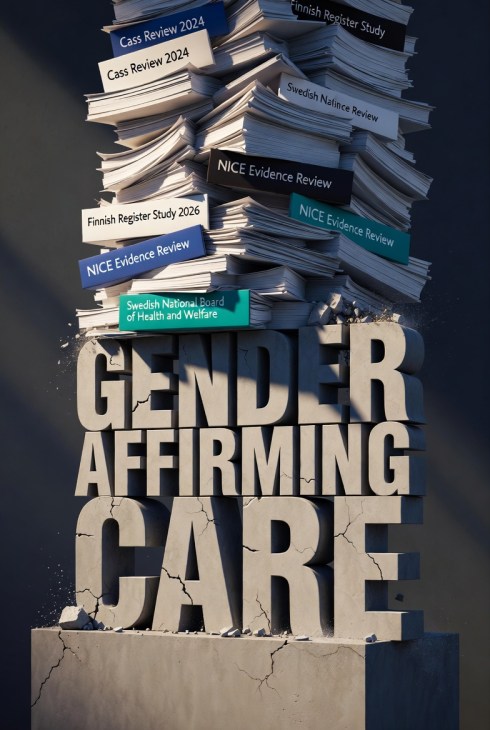
The independent Cass Review in England concluded that the evidence base for medical intervention in children and young people with gender-related distress is weak, that studies are generally small and uncontrolled, and that the field has been marked by overconfidence unsupported by good evidence. The review also incorporated earlier evidence reviews commissioned from NICE on puberty blockers and hormones.
Those NICE evidence reviews found the evidence for both puberty blockers and cross-sex hormones in this population to be of very low certainty. They remain among the most cited formal evaluations of the literature in this area.
Sweden’s National Board of Health and Welfare likewise revised its national guidance, concluding that for minors the risks of puberty blockers and hormone treatment currently outweigh the expected benefits, and that such treatment should be offered only in exceptional cases within structured specialist settings.
That pattern is not accidental. It reflects a broader recognition across evidence reviews and national reassessments: the confidence of the clinical rhetoric has run ahead of the quality of the evidence.
What can actually be concluded
Several conclusions can be made safely.
First, the psychiatric burden in this population is real and often severe. Nothing in this argument denies that.
Second, the new Finnish register data does not show psychiatric need subsiding after medical gender reassignment. On the contrary, the burden remains high, and in some medically treated subgroups the observed specialist psychiatric treatment rates rise sharply.
Third, the broader review literature and policy reassessments from major health authorities do not justify the level of certainty with which pediatric medical transition has often been promoted. The evidence is not robust enough for that.
Fourth, this study does not by itself prove a simple causal story of treatment-induced worsening in every case. Anyone claiming that from this paper alone is saying more than the evidence can bear. But anyone claiming that the strongest available population-level data clearly supports a confident mental-health benefit is also saying more than the evidence can bear.
The policy problem
That mismatch is the real issue.
This is not a case in which critics are denying a clearly established medical benefit. It is a case in which weak evidence, ambiguous long-term outcomes, and very serious interventions have too often been wrapped in the language of settled science.
They are not settled.
The evidence base is weak. The psychiatric burden remains high. The strongest register data now available does not show the promised relief in hard mental-health outcomes. That should force a lower-confidence, higher-caution clinical posture than the activist narrative has allowed.
Verdict
No honest reading of this literature permits the triumphant line that pediatric gender medicine is clearly evidence-based and reliably improves youth mental health.
The better reading is harsher and simpler.
The evidence is weak. The certainty has been inflated. And the strongest real-world data now available does not show psychiatric needs subsiding after medical gender reassignment.
When the evidence does not show improvement, escalation is not caution.
It is risk.
References
Ruuska, S.-M., Tuisku, K., Holttinen, T., & Kaltiala, R. (2026). Psychiatric morbidity among adolescents and young adults who contacted specialised gender identity services in Finland in 1996–2019: A register study. Acta Paediatrica. Advance online publication. https://doi.org/10.1111/apa.70533
Cass, H. (2024). Independent review of gender identity services for children and young people: Final report. https://cass.independent-review.uk/home/publications/final-report/
NICE / NHS England. (2020). Evidence review: Gonadotrophin releasing hormone analogues for children and adolescents with gender dysphoria. https://www.engage.england.nhs.uk/consultation/puberty-suppressing-hormones/user_uploads/nice-evidence-review-gnrh-analogues-for-children-and-adolescents-with-gender-dysphoria-october-2020.pdf
NICE / Cass Review. (2020). Evidence review: Gender-affirming hormones for children and adolescents with gender dysphoria. https://cass.independent-review.uk/wp-content/uploads/2022/09/20220726_Evidence-review_Gender-affirming-hormones_For-upload_Final.pdf
Socialstyrelsen. (2022). Care of children and adolescents with gender dysphoria – Summary of national guidelines – December 2022. https://www.socialstyrelsen.se/publikationer/care-of-children-and-adolescents-with-gender-dysphoria–summary-of-national-guidelines–december-2022-2023-1-8330/
Socialstyrelsen. (2022, December 16). Updated knowledge support for care in gender dysphoria among young people. https://www.socialstyrelsen.se/om-socialstyrelsen/pressrum/press/uppdaterat-kunskapsstod-for-vard-vid-konsdysfori-hos-unga/
Hostile Reader FAQ
“You’re claiming gender-affirming care causes harm.”
No. This piece does not claim causation. It shows that the strongest population-level data does not demonstrate the expected mental-health improvement. Absence of demonstrated benefit is not the same as proof of harm—but it is not neutral either.
“Psychiatric service use isn’t the same as worse mental health.”
Correct. It is not a perfect proxy for subjective distress. It is, however, a hard clinical outcome and a strong indicator of ongoing psychiatric need. Persistent high rates of specialist care are not consistent with claims of broad resolution.
“These patients were already more distressed.”
Yes. The study shows elevated psychiatric burden before referral. The question is whether that burden improves. At the population level, it does not converge toward control levels, and in some subgroups increases substantially.
“This is just one study.”
It is one of the largest and longest nationwide register studies to date. More importantly, its findings align with multiple systematic reviews and policy reassessments that rate the evidence base as low quality and uncertain.
“Other studies show benefits.”
Some smaller or short-term studies report improvements, often based on self-report and without strong controls. Systematic reviews consistently find these studies to be low certainty and at high risk of bias. That is why several national health authorities have revised their guidance.
“You’re ignoring patient experiences.”
Individual experiences vary, and some patients report relief. Clinical policy, however, is not built on anecdote. It is built on aggregate outcomes and evidence quality. Those are the focus here.











 bleatmop
 Mystro


 Dead Wild Roses
Your opinions…