
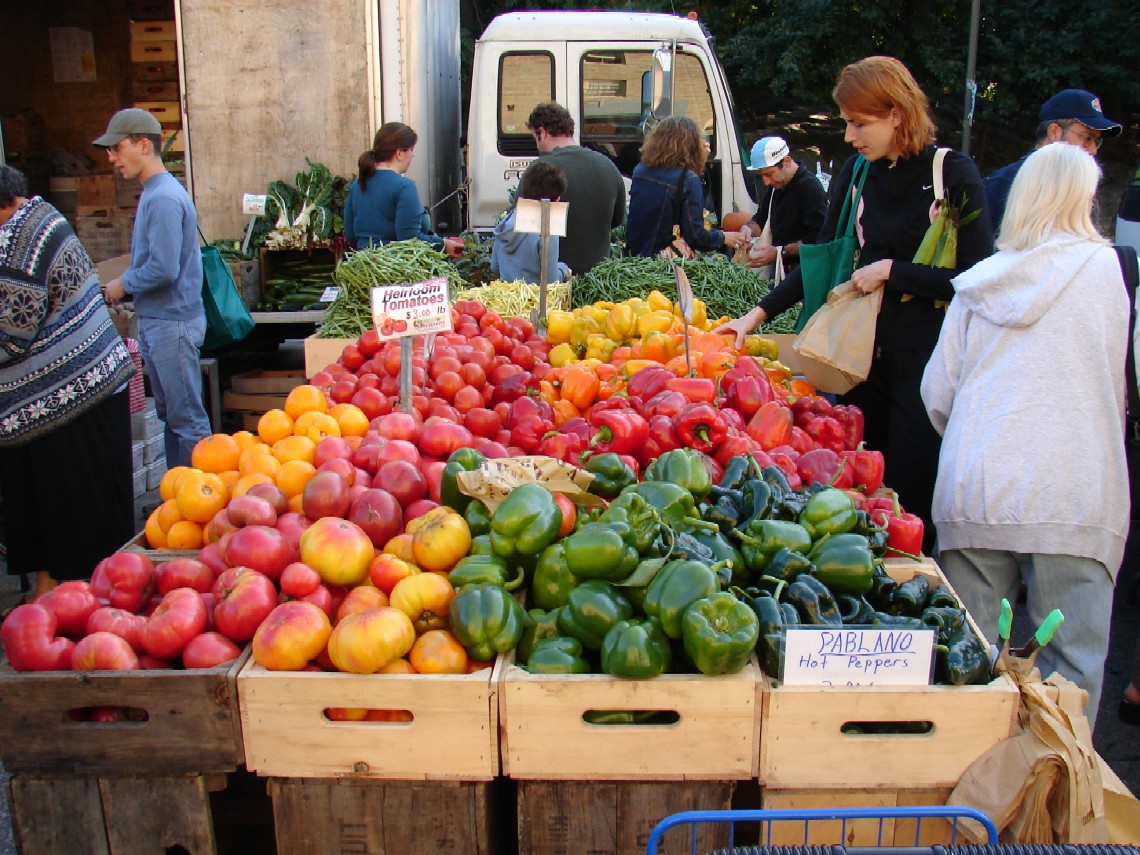
 Going down to haggle at the local Farmer’s market is a weekly ritual for many urban dwellers. A recent study also indicates that the markets could be a contributing factor do our sense of fairness and altruism.
“They found that even sharing of money with a stranger in a psychological experiment was more common in societies were people got most of their food from markets, rather than growing it themselves, and in societies that embrace world religions.
In all there were 2,100 participants in the experiments, from communities ranging in size from 20 to 10,000 people, including hunter-gatherers, farmers and people who work for a wage.”
It is nice to see finally, that religions might actually be of some good in the overall picture. Here at DWR the opinion is the sooner they go away the better. However, the findings of the study seem to indicate that subscribing to a “world religion” could be a positive factor when deciding how fair to be to strangers. I guess, the buring the heretics and apostates comes later. :)
“Natural selection would never favour it in these large contexts, but it might work anyway,” Henrick said. “If that’s true, then hunter-gatherers and people in the smaller-scale societies should behave like people in large-scale societies” in the anonymous interactions modeled in the economic games.
Their study showed the opposite, Henrick said.
“In our view, it’s actually pretty tough to get people to co-operate in large-scale societies, and it took a lot of cultural evolution over millennia, probably, to get the right set of norms and institutions to internalize the notions of fairness and mutually beneficial exchange,” Henrick said.”
Sharing is never an easy thing as this study points out. I’m glad I live now and there is a modicum of altruism in people these days, as I suspect my career as a hunter-gatherer would be nasty, brutish and short.











 bleatmop
 Mystro


 Dead Wild Roses
Your opinions…