
You are currently browsing the monthly archive for March 2011.
The current state of most of our social intercourse is focused on the wrong issues, consider the “what if…” that Subnormality brings to the table.

 Going to the hospital is usually bad news. Catching C.Difficile is worse considering that most hospitals in Canada have this nasty bug roaming around, not to mention the stuff already resides in most of our colons. When things get ugly is when antibiotics have killed all the helpful bacteria in our guts allowing C.diff to throwdown and start raising the roof causing fecal mayhem for all those involved. However, all is not lost.
“A unique antibody from a llama could prove to be a key weapon against C. difficile, a nasty infection that is a growing problem in many hospitals throughout North America.
Clostridium difficile is a common cause of infectious diarrhea in nursing homes and hospitals and usually occurs in patients who have been taking regular antibiotics for an infection.”
The one of the usual treatments is fecal bacteriotherapy which is finding compatable donor feces and repopulating  your intestinal gut-flora so the C.diff house party can stop. Of course, having a reverse enema with someone else’s poop somehow seems a little disquieting to most…
“New research from the University of Calgary and the National Research Council in Ottawa suggests that simple antibodies from the llama can interfere with the disease-causing toxins from the infection.
U of C professor Dr. Kenneth Ng said that discovery moves them a step closer to understanding how to neutralize the toxins and create novel treatments for the disease.”
Thank you our lovely, albeit smelly, Llama friends; for possibly preventing reverse-poop enemas in a hospital near you in the future.
One cannot always write about the evil that is religion or what amazing new low conservative politicians have brought public discourse to. So this Monday I share with my loyal readers my most favourite foods in the whole wide world.

Of course, the crown jewel and most exalted must be the princely Perogy. I’m game on almost any filling but would have to put classic potato, cheese and bacon and sauerkraut as my top 3 choices. With a liberal application of sour cream (or cottage cheese), bacon bits and onion I quickly reach a heavenly food nirvana in which all becomes good with the world and I crave only a nap to digest all the carbohydrates I just consumed.
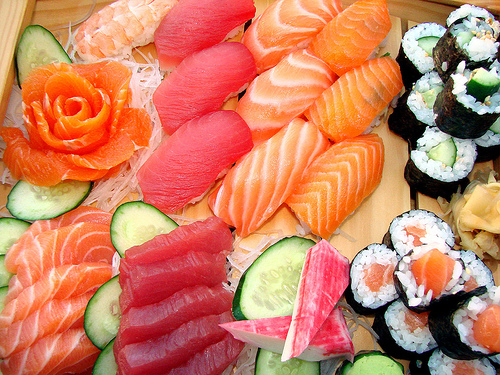
Another indulgence that I less often satisfy is the wonderful taste universe of Sushi, the melting of delicately cut tuna on my tongue followed by the blistering heat of the wasabi leaves everything to be desired as only more can make my sushi-lust abate.

What better to combat a cold winter’s day than a steaming bowl of Pho? Combining just the right amount of lime, hot peppers, sprouts and Hoisen sauce to create a symphony of savoury sweet, meaty soupful bliss makes for a warm happy ending and brief reprise from the overall misery of winter.
Please share your favourites in the comments section as I am always willing to expand my list of favourite foods. :)
 It has been a hectic pre-report card week and therefore I am behind in my postings, as I still have to schedule in the upcoming weeks batch of posts( meh! :( ). Today’s post though is an exercise in empathy and understanding as perhaps the persecuted majority might get a view of how silly some of their arguments about genetics actually are.
Yes, it actually sounds that silly coming from the other direction as well.
Rough around the edges, viewer discretion advised (but funny!).
Beethoven’s 9th, the fourth movement is not out yet, so we’ll kick it back a bit to the late baroque era, please enjoy and learn about Domenico Scarlatti.
Giuseppe Domenico Scarlatti (Naples, 26 October 1685 – Madrid, 23 July 1757) was an Italian composer who spent much of his life in the service of the Portuguese and Spanish royal families. He is classified as a Baroque composer chronologically, although his music was influential in the development of the Classical style. Like his renowned father Alessandro Scarlatti he composed in a variety of musical forms although today he is known almost exclusively for his 555 keyboard sonatas.
Only a small fraction of Scarlatti’s compositions were published during his lifetime; Scarlatti himself seems to have overseen the publication in 1738 of the most famous collection, his 30 Essercizi (“Exercises”). These were rapturously received throughout Europe, and were championed by the foremost English writer on music of the eighteenth century, Dr. Charles Burney.
The many sonatas which were unpublished during Scarlatti’s lifetime have appeared in print irregularly in the two and a half centuries since. Scarlatti has, however, attracted notable admirers, including Frédéric Chopin, Johannes Brahms, Béla Bartók, Dmitri Shostakovich, Heinrich Schenker, Vladimir Horowitz, Emil Gilels, Arturo Benedetti Michelangeli, and Marc-André Hamelin.
Frédéric Chopin, as a piano teacher, notably wrote:
“Those of my dear colleagues who teach the piano are unhappy that I make my own pupils work on Scarlatti. But I am surprised that they are so blinkered. His music contains finger-exercises aplenty and more than a touch of the most elevated spirituality. Sometimes he is even a match for Mozart. If I were not afraid of incurring the disapprobation of numerous fools, I would play Scarlatti at my concerts. I maintain that the day will come when Scarlatti’s music will often be played at concerts and that audiences will appreciate and enjoy it”.[1]
Scarlatti’s 555 keyboard sonatas are single movements, mostly in binary form, and mostly written for the harpsichord or the earliest pianofortes. (There are four for organ, and a few for small instrumental group). Some of them display harmonic audacity in their use of discords, and also unconventional modulations to remote keys.
Other distinctive attributes of Scarlatti’s style are the following:
- The influence of Iberian (Portuguese and Spanish) folk music. An example is Scarlatti’s use of the Phrygian mode and other tonal inflections more or less alien to European art music. Many of Scarlatti’s figurations and dissonances are suggestive of the guitar.
- A formal device in which each half of a sonata leads to a pivotal point, which the Scarlatti scholar Ralph Kirkpatrick termed “the crux”, and which is sometimes underlined by a pause or fermata. Before the crux, Scarlatti sonatas often contain their main thematic variety, and after the crux the music makes more use of repetitive figurations as it modulates away from the home key (in the first half) or back to the home key (in the second half).
The harpsichordist Ralph Kirkpatrick produced an edition of the sonatas in 1953, and the numbering from this edition is now nearly always used – the Kk. or K. number. Previously, the numbering commonly used was from the 1906 edition compiled by the Neapolitan pianist Alessandro Longo (L. numbers). Kirkpatrick’s numbering is chronological, while Longo’s ordering is a result of his grouping the sonatas into “suites”. In 1967 the Italian musicologist Giorgio Pestelli published a revised catalogue (using P. numbers), which corrected what he considered to be some anachronisms. See [1] for a list converting Longo, Kirkpatrick and Pestelli numbers of Scarlatti’s sonatas.
Aside from his many sonatas he composed a quantity of operas and cantatas, symphonias, and liturgical pieces. Well known works include the Stabat Mater of 1715 and the Salve Regina of 1757 that is thought to be his last composition.
 Gender is a feature of society that is becoming the focus of more and more research and experimentation. One idea that fascinates me is the idea of psychological priming for gender and gender related activities and careers. I’m working my way through Delusions of Gender by Cordelia Fine, but this article caught my eye from Jonah Lehrer and dovetails nicely with what I am currently reading.
“One last point: I think the power of seeing a female calculus professor is magnified by the absence of similar figures in mass culture. In a 2002 study led by the psychologist Paul Davies, two groups of male and female undergrads were shown three minutes of television commercials. Students in the first group were shown a variety of “gender stereotyping” ads, such as a woman gleefully touting the benefits of a skin product, or a “slender female” talking about the deliciousness of diet soda. (All of the ads were real.) Students in the second group, in contrast, were shown a mix of gender-neutral ads, such as a pitch for an insurance company and a commercial about cell-phones. Then, the women were quizzed about their interest in pursuing a career in math or science.
Once again, the results were depressingly clear: Women exposed to the gender stereotyping ads were far less interested in anything quantitative. Instead, they were more than twice as likely to choose careers in the verbal and service industry, such as retail, sales and communication.
The pattern was reversed, however, in the women who saw neutral ads. They were actually more interested in pursuing quantitative careers. All it took was the absence of a blatant stereotype to increase their interest in math. While I don’t expect television commercials to get better anytime soon – pop culture is full of persistent tropes – it turns out that we’ve got a fix for the negative effects of these stereotypes. The cure is female math teachers.”











 bleatmop
 Mystro
 The Arbourist


 Dead Wild Roses
Your opinions…