
You are currently browsing the monthly archive for August 2011.
You would think by now we could progress past the idea that scary storms are tantrums of the gods and that tsunami are not any godheads’ perverted act of ‘retribution’ or similar horsepucky. One would think that, but just listen to the small snippits of christian talk radio Thunderf00t talks about and let the batshite insanity abuse your neurons. I need to start a Unicorn cult and get in on this delusional action in the US, cause at least unicorns are pretty and are probably relatively safe to worship.
Now it got Jack Layton. He was a good man. Someone in politics for what seemed to be the right reasons. A politician who passed the “would I have a beer with him” test with flying colours – I did have a beer with him and we had a lovely time. He was one of those people who could make you feel like the most important person in the world the way he listened to you. And now just like that he’s gone.
I’ve really had a problem with the discourse (or really, lack thereof) that’s surrounded his fight with cancer. The dogged optimism. The refusal to come out and say, when you’ve had prostate cancer and it’s back, and on top of that you’ve now got another kind of cancer as well, you’re pretty much fucked. And also, things like what Edmonton Strathcona MP Linda Duncan said on CBC this morning: “If anybody could beat cancer, it would be Jack.” I understand the sentiment. I really do. If cancer was something that could be fought with the will, who better than Jack, the perpetual underdog who never gave up. If cancer was something you could fight with hard work and determination, who better than Jack, who lead the NDP from near-demise to official opposition status. Except that cancer doesn’t care how hard you fight. If it did, we’d still have Jack. And a whole lot of other people too.
Pushing the limits of our knowledge is what science is all about. Consider what NASA is learning about thunderstorms and their possible role in creating anti-matter. Fascinating stuff!
 The idea that religion is harmless and that it is good for people, is patently false.
The raging torrent of evil shit that religion is responsible for claims more victims every second we allow magical thinking to be acceptable and “OK” in our society. It is a double header today, two videos for the price of one post.
Magical thinking kills children. Belief in god kills children. Christianity when insulated far enough away from the light of reason, kills children. Here is one instance, this child died surrounded by adults who were praying to god to restore her to health. She fracking had diabetes. Diabetes is a treatable condition with access to medical treatment.
But no. That is a little too sane. A little too rational.
The father testified in court that he thought “God would heal his daughter…”
The mother, a good ‘christian’ woman was also convicted and could face up to 25 years for her ignorance along with her husband. Send them away for 100 years, it does not matter as the damage is already done. The child is dead because her parents were mired in wilful religious ignorance. They were living in a foolish bronze age delusion that encourages belief in magic and myth at the expense of the real and the rational.
Our tour de force of religious stupidity limps onward. First on the agenda the book called “To Train up a Child” by Michael and Debi Pearl(their website has ‘mysteriously gone 404, since their book was instrumental in the death and torture of children, go figure). This ‘child rearing book’ prescription for the torture and abuse of children is an absolute travesty and prima facie evidence for how religion cloaks itself in morality while advocating the exact opposite.
Want to see evil in action? Let’s grab a review from Christianbook.com. (TW for ignorance and sadism)
“I recommend this book to everyone who has children! (Obviously, because child abuse is not rampant enough, let’s get those numbers going through the roof! This manual advocates beating your child until they comply. Not a little ‘swat’ but laying into your child until they are crying and cowering so they know you mean ‘business’. The second video in this post is about two fine christians who adopted children and then proceeded to beat one of them to death using the tried and true “biblical methods” described in this book.)
We lost the true understanding of discipline, and became so weak minded and selfish that we’ve produced spoiled, winning, uncontrolled “adults.” “Guiding” a child isn’t enough; and you don’t guild a child, you guild an adult. (Ah, so apparently torturing and beatings are will cure behavioural problems straight up. This gets even more atrocious as this religious fuck-wit cites verse to perversely back up her child abusing ways.)
“The rod is to guide, not hit” is strictly unbiblical. (Feeling the mercy and compassion of the bible already, I know I am. )
If your a christain the bible clearly instructs us to use the rod, ” Withhold not correction from the child; for if thou BEATEST him with the ROD, he shall not die. Thou shalt beat him with the ROD, and shalt deliver his soul from hell (Prov 23:13-14).” “He that spareth his rod hateth his son: but he that loveth him chastenth him betimes (Prov. 13.24).” “The rod and reproof give wisdom: but a child let to himself bringeth his mother to shame(Prov. 29:15).” “Foolishness is bound in the heart of a child: but the rod of correction shall drive it far from him (Prov 22:15).” How can you misinterpet that? (Jesus-fuck, how indeed could you misinterpret that? I mean other than using your rationality and moral instincts to identify that the abuse and torture of children is wrong, how could you?)
It’s mind boggling how children act these days.. so unruly, so disrespectful to parents. We need to go back to the old time discipline, (biblical) and STOP listening to people with “degrees.”(Because careful study and observation of behaviour has been a complete write-off. Yes, let us stop looking to science for answers because the bible knows better, let us get back to beating our kids so they fear us.)
Obviously, how they “think” our child should be raised isn’t working too well. (Back in the real world, the lessons children learn from violence are evident: fear of authority, blind obedience, might makes right. Definite boons to society no? ) People need to have more children ( you need to have less, you ignorant fool), then they’ll understand. Our children is our future ( Not the ones, trained like yours, to use violence to obtain their goals ).
I am from a family of 9 children. I have 4 children 6years old and under. We read and applied “To Train up a Child” and it worked marvelously ( Violence, coercion and intimidation are always effective in the short term. I’m sure the psychological scarring won’t be too too bad, maybe all of your children won’t turn out to be as abusive as you.) People always commit on how well our children behave! ( As they comment on your ability to write, reflecting your tenious grasp on reality ) They are HAPPY scared shitless and so fun to be around, and we are planning to have more ( Once you get the torture-a-go-go rockn’ you just can’t stop!)!

I will be ordering multi copies because people are always asking where they can get a copy. It’s a short, easy read and straight to the point. (Child abuse is good) This book helps you to understand and apply what the bible teaches. ( how to abuse people and scar them for life, religion the gift that keeps on giving. ) If you want to produce responsible, respectful, obedient, happy, loving children this book is defiently a must!!!” (…)
Written by a true believer… But hey who am I to comment on this? I am an avowed atheist and perhaps my treatment of this issue has not been charitable. Lets see this book in action:
They only beat her for 7 hours before she died.
Read that again. If you’re not feeling a little (or a lot) sick to your stomach by now, you have a problem, because you’re not grasping the enormity of the evil being perpetrated here. These people, backed by their particular religious nonsense, tortured to death an innocent child. There is no morality to be found in religion.
I point to QualiaSoup’s assertion on what morality actually is: “Empathy, Experience, Reason and Knowledge – When we KNOW better, we can DO better. It does not get any more straightforward than this. Religion is a barrier to knowing better and therefore has no place in any rational system of morals. How many more grievous examples do we need before we can finally say that religion is an (ongoing) atrocity and a putrid stain on humankind that needs to be banished for the good of the species?
The youtube atheist community is being unusually productive and insightful as of late. DarkMatter2525 take the idea of rejection in relationships and makes a fairly sound analogy to how people view themselves and their belief in god. Furthermore, he details why atheists get some hate directed their way because of their skepticism and general lack of belief in magic.
That James Cameron, he so funny…
I cannot believe that this is the only recording of this particular song. I apologize for the poor video quality, but then again, the sound is fairly good, as well as the choir and soloist. This piece was also performed in Kaslo, and I have the intention to learn the solo and perform it with a choir. :)
**update** – Found a better version, now with harp. :)
For music geeks, the choir tenor part is actually signs higher notes than the soloist, going to all the way to a “A” while the soloist goes as high as “G”. As I’ll probably get the honour singing both parts, I’m doubly lucky…
A little of Gabriel Fauré’s history and his music, thank you Wikipedia.
Gabriel Urbain Fauré (pronounced: [ɡabʁiɛl yʁbɛ̃ fɔʁe]; 12 May 1845[n 1]– 4 November 1924) was a French composer, organist, pianist and teacher. He was one of the foremost French composers of his generation, and his musical style influenced many 20th century composers. Among his best-known works are his Nocturnes for piano, the songs “Après un rêve” and “Clair de lune”, his Pavane and his Requiem.
Born into a cultured but not unusually musical family, Fauré revealed his talent when he was a small boy. He was sent to a music college in Paris, where he was trained to be a church organist and choirmaster. Among his teachers was Camille Saint-Saëns, who became a lifelong friend. In his early years, Fauré earned a modest living as an organist and teacher, leaving him little time for composition. When he became successful, holding the important posts of organist of the Église de la Madeleine and head of the Paris Conservatoire, he still lacked time for composing, retreating to the countryside in the summer holidays to concentrate on composition.
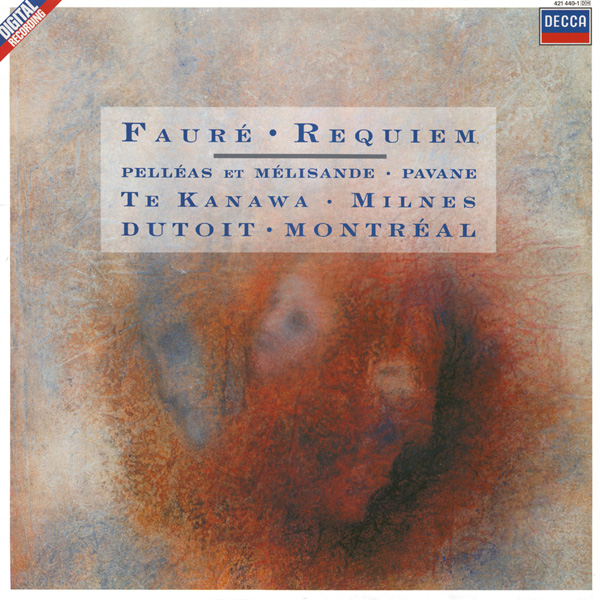 By his last years, Fauré was recognised in France as the leading French composer of his day. An unprecedented national musical tribute was held for him in Paris in 1922 headed by the President of the Republic. Fauré had many admirers in England, but his music, though known in other countries, took decades more to become widely accepted. His music has been described as linking the end of Romanticism with the modernism of the second quarter of the 20th century. When he was born, Chopin was still composing, and by the time of his death the atonal music of the Second Viennese School was being heard. The Grove Dictionary of Music and Musicians, which describes him as the most advanced composer of his generation in France, notes that his harmonic and melodic innovations affected the teaching of harmony for later generations. In contrast with the charm of his earlier music, his last works, written when increasing deafness had struck him, are elusive and withdrawn in character.
Vocal music
Fauré is regarded as one of the masters of the French art song, or mélodie.[1] In Copland’s view, the early songs were written under the influence of Gounod, and except for isolated songs such as “Après un rêve” or “Au bord de l’eau” there is little sign of the artist to come. With the second volume of the sixty collected songs, Copland judged, came the first mature examples of “the real Fauré”. He instanced “Les berceaux”, “Les roses d’Ispahan” and especially “Clair de lune” as “so beautiful, so perfect, that they have even penetrated to America”, and drew attention to less well known mélodies such as “Le secret”, “Nocturne”, and “Les présents”.[5] Fauré also composed a number of song cycles. Cinq mélodies “de Venise”, Op. 58, was described by Fauré as a novel kind of song suite, in its use of musical themes recurring over the cycle. For the later cycle La bonne chanson, Op. 61, there were five such themes, according to Fauré.[62] He also wrote that La bonne chanson was his most spontaneous composition, with Emma Bardac singing back to him each day’s newly written material.[63]
The Requiem, Op. 48, was not composed to the memory of a specific person but, in Fauré’s words, “for the pleasure of it.” It was first performed in 1888. It has been described as “a lullaby of death” because of its predominantly gentle tone.[64] Fauré omitted the Dies Irae, though reference to the day of judgment appears in the Libera me, which, like Verdi, he added to the normal liturgical text.[65] Fauré revised the Requiem over the years, and a number of different performing versions are now in use, from the earliest, for small forces, to the final revision with full orchestra.[66]Fauré’s operas have not found a place in the regular repertoire. Copland called Pénélope a fascinating work, and one of the best operas written since Wagner. He noted, however, that the music is, as a whole, “distinctly non-theatrical.”[5] The work uses leitmotifs, and the two main roles call for voices of heroic quality, but these are the only ways in which the work is Wagnerian. In Fauré’s late style, “tonality is stretched hard, without breaking.”[67]











 bleatmop
 Mystro


 Dead Wild Roses
Your opinions…