
You are currently browsing the monthly archive for March 2012.
Fantastic. Our cracked conservative government is floating yet another trial balloon on its anti-empirical evidence “tough” on reality crime bill. Listen to all the surreal talking points from the interview on CBC’s The Current Podcast.
Civilized states do not put people to death. We should remain counted as a civilized state.

The Piano Quintet in F minor, opus 34, by Johannes Brahms was completed during the summer of 1864[1] and published in 1865.[2]It was dedicated to Her Royal Highness the Princess Anne of Hesse. Like most piano quintets, it is written for piano and string quartet (two violins, viola and cello).
The piece is in four movements:
- Allegro non troppo (F Minor)
- Andante, un poco adagio (A♭ Major)
- Scherzo: Allegro (C Minor – C Major)
- Finale: Poco sostenuto – Allegro non troppo – Presto, non troppo (F Minor)
The work began life as a string quintet (completed in 1862 and scored for two violins, viola and two cellos). Brahms transcribed the quintet into a sonata for two pianos (in which form Brahms and Carl Tausig performed it) before taking its final form. Brahms destroyed the original version for string quintet, but published the Sonata as opus 34 bis. The outer movements are more adventurous than usual in terms of harmony and are unsettling in effect. The introduction to the finale, with its rising figure in semitones, is especially remarkable. Both piano and strings play an equally important role throughout this work.
Because of strong unionization and higher regard for education in Canada teachers make a better living than those in the United States. However, the points GI brings up still apply to Canadian educators and should apply to Canadian politicians as well.
I’m thinking we may need to investigate the MPAA’s claims about piracy and copyright…
:)
Oh and we get redefine terms as well:

 A double-quick quiz to see if need to read this article or not – Is the following statement true? – Egalitarian societies are in general are more economically, socially and politically sound than those where inequality more pronounced.
If you answered false go here and evaluate the evidence for yourself. If you answered true, then the following will make sense. :)
“Washington, DC – As evidence mounts that income inequality is increasing in many parts of the world, the problem has received growing attention from academics and policymakers. In the United States, for example, the income share of the top one per cent of the population has more than doubled since the late 1970s, from about eight per cent of annual GDP to more than 20 per cent recently, a level not reached since the 1920s.
While there are ethical and social reasons to worry about inequality, they do not have much to do with macroeconomic policy per se. But such a link was seen in the early part of the twentieth century: Capitalism, some argued, tends to generate chronic weakness in effective demand due to growing concentration of income, leading to a “savings glut”, because the very rich save a lot. This would spur “trade wars”, as countries tried to find more demand abroad.
From the late 1930’s onward, however, this argument faded as the market economies of the West grew rapidly in the post-World War II period and income distributions became more equal. While there was a business cycle, no perceptible tendency toward chronic demand weakness appeared. Short-term interest rates, most macroeconomists would say, could always be set low enough to generate reasonable rates of employment and demand.
Now, however, with inequality on the rise once more, arguments linking income concentration to macroeconomic problems have returned. The University of Chicago’s Raghuram Rajan, a former chief economist at the International Monetary Fund, tells a plausible story in his recent award-winning book Fault Lines about the connection between income inequality and the financial crisis of 2008.”
This is not about “socialism” or “communism” or any of the other words the business press has corrupted. This is about what has happened and what is happening now.
“Rajan argues that huge income concentration at the top in the US led to policies aimed at encouraging unsustainable borrowing by lower – and middle-income groups, through subsidies and loan guarantees in the housing sector and loose monetary policy. There was also an explosion of credit-card debt. These groups protected the growth in consumption to which they had become accustomed by going more deeply into debt. Indirectly, the very rich, some of them outside the US, lent to the other income groups, with the financial sector intermediating in aggressive ways. This unsustainable process came to a crashing halt in 2008.
Joseph Stiglitz in his book Freefall and Robert Reich in his Aftershock have told similar stories, while economists Michael Kumhof and Romain Ranciere have devised a formal mathematical version of the possible link between income concentration and financial crisis. While the underlying models differ, the Keynesian versions emphasise that if the super-rich save a lot, ever-increasing income concentration can be expected to lead to a chronic excess of planned savings over investment.
Macroeconomic policy can try to compensate through deficit spending and very low interest rates. Or an undervalued exchange rate can help to export the lack of domestic demand. But if the share of the highest income groups keeps rising, the problem will remain chronic. And, at some point, when public debt has become too large to allow continued deficit spending, or when interest rates are close to their zero lower bound, the system runs out of solutions.”
So, consider the implications of a monetary policy that encourages people not to hold onto gratuitous wealth. The 90% tax rate on 3 million and above seems a little less unseemly if it can spurn economic growth and development.
“This story has a counterintuitive dimension. Is it not the case that the problem in the US has been too little savings, rather than too much? Doesn’t the country’s persistent current-account deficit reflect excessive consumption, rather than weak effective demand?
The recent work by Rajan, Stiglitz, Kumhof, Ranciere and others explains the apparent paradox: Those at the very top financed the demand of everyone else, which enabled both high employment levels and large current-account deficits. When the crash came in 2008, massive fiscal and monetary expansion prevented US consumption from collapsing. But did it cure the underlying problem?
Although the dynamics leading to increased income concentration have not changed, it is no longer easy to borrow and in that sense another boom-and-bust cycle is unlikely. But that raises another difficulty. When asked why they do not invest more, most firms cite insufficient demand. But how can domestic demand be strong if income continues to flow to the top?
Consumption demand for luxury goods is unlikely to solve the problem. Moreover, interest rates cannot become negative in nominal terms and rising public debt may increasingly disable fiscal policy.
So, if the dynamics fuelling income concentration cannot be reversed, the super-rich save a large fraction of their income, luxury goods cannot fuel sufficient demand, lower-income groups can no longer borrow, fiscal and monetary policies have reached their limits, and unemployment cannot be exported, an economy may become stuck.”
Is this a hate the rich tract? No, it is not. It is an article merely identifying a probable framework behind what is going on in the US economy.
“The early 2012 upturn in US economic activity still owes a lot to extraordinarily expansionary monetary policy and unsustainable fiscal deficits. If income concentration could be reduced as the budget deficit was reduced, demand could be financed by sustainable, broad-based private incomes. Public debt could be reduced without fear of recession, because private demand would be stronger. Investment would increase as demand prospects improved.
This line of reasoning is particularly relevant to the US, given the extent of income concentration and the fiscal challenges that lie ahead. But the broad trend toward larger income shares at the top is global and the difficulties that it may create for macroeconomic policy should no longer be ignored.”
This article supports the idea that a more egalitarian society is a more healthy economic society. I just wonder if the US policy makers have enough political will to enact this possible solution to some of the economic problems facing the US.

I have a great many weaknesses, but one of the more prominent lies in the area of cooperative gaming.
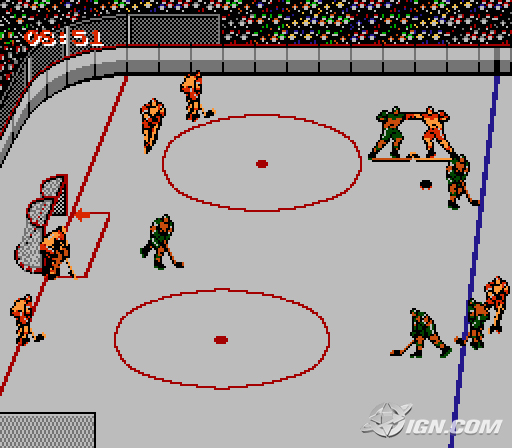
Oh, how I miss the blocky good times.
I remember, back in the day, that occasionally Blades of Steel (hockey) on the 8-bit NES, a glitch would occur and somehow you and your friend could both control players on the same team. It was chaos as the controls mirrored each other so the defence guy had to be careful not to interfere once he passed the puck out his area of responsibility. It was often traumatically funny, with our pixelated little hockey avatars swooping around seemly at random, the game confused by two sets of input, while the computer went in and scored on us. Oh the angst and thrills of victory (especially over the pink tinged Montreal Canadians). In the same vein, Contra, another 8-bit classic we played to death as it was one of the first legitimate two player co-op games on the home console market. Life was good, but things were poised to become great back in the summer of 1991.
Nineteen years ago, Electronic Arts (back when EA was just another good budding developer) released NHL Hockey. My best friend and I had been waiting for this game to be released for the Sega Megadrive/Genesis for about a year. I can still remember coming home from school and seeing the large cardboard box wedged in the mailbox. My pulse still quickens at the memory.
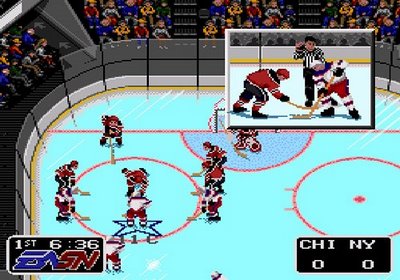
Co-Op + Playoffs = Awesome!
You see, EA Hockey was not available in Canada(!) when it was first released, I sent away for it, buying directly from EA via snail mail. We got our copy an entire delicious month before the rest of Canada had retail access to the game. EA Hockey was innovative for its time, the first game featuring a top down vertical play action, but more importantly, you could choose to both play on the same team.
Sweet Mother of Jebus, but was it fun! The Edmonton Oilers, back in the 1990 still featured amazing talent and my best friend and I relished making the one timer players, and those oh so sweet cross ice passes from Messier to Kurri, not to mention those wacky breakaways with the speedy Petr Klima. EA did not get the license from the NHLPA so the avatars only had numbers, but that was fine, back then we knew all the numbers for the Oilers.

Oh, Mega Drive, with the crappy homemade s-video to RCA converter.
I’m sure, if I found my school records, I could track the dip in my academics when that first game was released. I’d do it again though, in a heart-beat as those were some great times for me on the video game front. Yes gentle reader we’re getting to War in the North, but know that the road getting from there to here passed through many a classic co-op title – Streets of Rage 1,2 (especially 2), 3, Double Dragon (sega master system), Contra, of course the EA NHL and NFL games, Altered Beast, GOLDEN AXE 1,2 (Oh how I miss you sweet barbarian princess),oh don’t forget NBA Jam (boomshakalaka!!).
After about 2003ish, gaming companies finally got the idea that people like playing on the same team together and titles began to pour out – Soldier of Fortune 1,2, Serious Sam, Team Fortress, SW Battle Front, Counter-Strike, Diablo 2, and of course the current pinnacle of co-op shooter gaming Left for Dead 1 and 2. (I realize this is far from comprehensive list, add your favs in the comments). The number games now that feature co-op gaming are simply too numerous to list here, however it is nice to have your particular gaming addictions properly fed. :)
Having played the Lord of the Rings games for the original xbox (and being a Tolkien fan, pre-movies) the idea of entering realms from the fantasy series has always been particular appealing. As a side note, I always wonder why developers try and take a game based around a successful and wildly popular co-op mechanic and make it into a turd-a-rific single player experience; yes I’m looking at you Golden Axe: Beast Rider.
Back to the LoTR though, on the PC-gaming front not much has been done (well) with regards to cooperative play until now. The Lord of the Rings: The War in the North fills out the cooperative role nicely so far (I’ve only played 2 of the 8 chapter of the game). Like its Mega-Drive predecessor LotR:WiN is based around the singular concept of finding neat new ways to put the pointy end of your sword into nearest Orc baddie. I was leery of purchasing the game reviews were mixed at best. What won me over was the price drop from $50down to $20 dollars. Twenty dollars is the sweet spot for purchasing most computer games, as they tend to disappear from shelves and not return until a “new and improved” gold edition (for more $$) is released later in the year. Anyhow, for forty dollars, even lacklustre hack and slash is fairly good deal.
Economics aside, I did feel a certain amount of trepidation due because this was one of those “gut-purchases” more than my usual “brain-purchases”. Hmm…how does it look?

Yah, okay…I’m sold. It is as fun as it looks (so far). Seeing that this is already some eight hundred words, I’ll continue this nostalgia/anecdata/game review in another post when I have more of the game under my belt. :)
The amazing juxtaposition of reality and “american reality” never fails to amaze me. The onslaught of liberal values on TV is just horrible, and the mouthpieces of the Liberal conspiracy are Elmo and Big Bird. The American right is like a crazy guy with scissors in a rubber life raft who keeps on cutting holes in the raft and then complaining/blaming the others that he’s getting ever closer to drowning. It boggles the mind.
So watch how they spin the usual persecuted majority bullshite all over the airwaves and pine over the loss of direction and morality in the conservative America of today.











 bleatmop
 Mystro


 Dead Wild Roses

Your opinions…