
You are currently browsing the monthly archive for January 2013.
I think Fox News sometimes tries really hard to be of use to the American public, but that urge, once realized, is quickly woven into partisan propaganda. Liberal Viewer brings to light what the ALCU is doing against the unlawful surveillance of its citizenry.
As a Canadian, I realize we are just a couple of months behind the legislative cycle, thus this sort of Big Brother stuff is slated for Canada as well.
Allow me to expand on how the religious abuse, fold, spindle, and mutilate science as seen by Potholer54.
These people are in desperate need reality. The god-goggles need to go, the portcullis of faith needs to be lifted, the cathedral needs repurposing into a useful fixture of society.
If there is one constant in religion it would be that it contradicts itself on a regular basis.

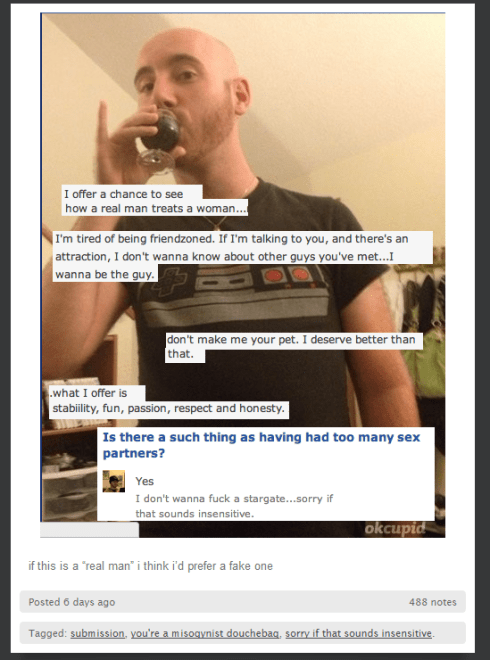
But gosh and wow, all at once. There is a sociology paper to be written about this phenomena, the great mystery of why… oh why… ‘nice guys’ cannot get with women. Actually wait, it needs to be feminist paper…or actually a feminist sentence.
If women aren’t into you it is because they see something they don’t like about you.
There is nothing after that. No friend zone BS, no nice guys finish last BS, no projecting of insecurities BS. If you’re having problems with forming a relationship with women it is most likely because you are a douche-cake and have not taken steps to rectify the situation. The Tumblr called “nice guys of Okcupid” [ed. The tumblr was shutdown, I have no idea when or if it will back up// Online with new ownership] provides evidence of this phenomena. Pay special attention to the misogyny, racism and homophobia (no idea why these gems of people are not being snapped up, gals lets get in there!).




The sonata was originally dedicated to the violinist George Bridgetower (1778–1860), who performed it with Beethoven at the premiere on 24 May 1803 at the Augarten Theatre at a concert that started at the unusually early hour of 8:00 am. Bridgetower sight-read the sonata; he had never seen the work before, and there had been no time for any rehearsal. However, research indicates that after the performance, while the two were drinking, Bridgetower insulted the morals of a woman whom Beethoven cherished. Enraged, Beethoven removed the dedication of the piece, dedicating it instead to Rodolphe Kreutzer, who was considered the finest violinist of the day.[1] However, Kreutzer never performed it, considering it “outrageously unintelligible”. He did not particularly care for any of Beethoven’s music, and they only ever met once, briefly.[2]
Sources suggest the work was originally titled “Sonata mulattica composta per il mulatto Brischdauer [Bridgetower], gran pazzo e compositore mulattico” (Mulatto Sonata composed for the mulatto Brischdauer, big wild mulatto composer), and in the composer’s 1803 sketchbook, as a “Sonata per il Pianoforte ed uno violino obligato in uno stile molto concertante come d’un concerto”.[3]
Structure
The piece is in three movements, and takes approximately 43 minutes to perform:
Adagio sostenuto – Presto – Adagio (about 15 minutes in length)
Andante con variazioni (about 18 minutes)
Presto (about 10 minutes)
The sonata opens with a slow 18-bar introduction, of which only the first four bars of the solo violin are in the A-Major-key. The piano enters, and the harmony begins to turn darker towards the minor key, until the main body of the movement — an angry A-minor Presto— begins. Here, the piano part matches the violin’s in terms of difficulty. Near the end, Beethoven brings back part of the opening Adagio, before closing the movement in an anguished coda.
There could hardly be a greater contrast with the second movement, a placid tune in F major followed by five distinctive variations. The first variation transliterates the theme into a lively triple meter while embellishing it with trills, while in the second the violin steals the melody and enlivens it even further. The third variation, in the minor, returns to a darker and more meditative state. The fourth recalls the first and second variations with its light, ornamental, and airy feel. The fifth and final variation, the longest, caps the movement with a slower and more dramatic feel, nevertheless ending in carefree F major.
The calm is broken by a crashing A major chord in the piano, ushering in the virtuosic and exuberant third movement, a 6/8 tarantella in rondo form. After moving through a series of slightly contrasting episodes, the theme returns for the last time, and the work ends jubilantly in a rush of A major.
This finale was originally composed for another, earlier, sonata for violin and piano by Beethoven, the Op. 30, no. 1, in A major.[4]
 I’m finishing Brownmiller’s book, Against our Will. Funny how the arguments really have not changed and are still regularly trotted out by ‘feminist allies’ and critics here in 2012. As Brownmilla concludes, she thoroughly brings the noise and lays it all down on the table with bon mots like this:
“Critics of the women’s movement, when they are not faulting us for being slovenly, straggly-haired, construction booted, whiny sore losers who refuse to accept our female responsibilities, often profess to see a certain inexplicable Victorian primness and anti-sexual prudery in our attitudes and responses. “Come on, gals,” they say in essence, “don’t you know that your battle for female liberation is part of our larger battle for sexual liberation? Free yourselves from all your old hang-ups! Stop pretending that you are actually offended by those four-letter words and animal noise we grunt in your direction on the street in appreciation of your womanly charms. When we plaster your faceless naked body on the cover our slick magazines, which sell millions of copies, we do it in sensual obeisance to your timeless beauty – which, by our estimation, ceases to be timeless at age twenty or thereabouts. If we feel the need for a little fun and go out and rent the body of a prostitute for half and hour or so, we are merely engaging in a mutual act between two consenting adults, and what’s it got to do with you? When we turn our movie theatres into showcase for pornographic films and covert our bookstores to outlets for mass produced obscene smut, not only should you marvel at the wonders of our free-enterprise system, but you should applaud us for pushing back the barriers of repressive middle class morality, and for our strenuous defense of all the civil liberties you hold so dear, because we have made obscenity the new frontier in defense of freedom of speech, that noble tradition. And surely you’re not against civil liberties and freedom of speech, now, are you?”
The case against pornography and the case against toleration of prostitution are central to the fight against rape, and if it angers a large part of the liberal population to be so informed, then I would question in turn the political understanding of such liberals and their true concern for the rights of women.”
[…]
Once we accept as basic truth that rape is not a crime of irrational,impulsive, uncontrollable lust, but is a deliberate, hostile, violent act of degradation and possession on the part of the would be conqueror, designed to intimidate and inspire fear, we must look toward those elements in our culture that promote and propagandize these attitudes, which offer men, and in particular impressionable, adolescent males, who form the potential raping population, the ideology and psychologic encouragement to commit their acts of aggression without awareness, for the most part, that they have committed a punishable crime, let alone a moral wrong. ”
-Susan Brownmiller quoted from her book Against our Will p.389-390.
Hey you, yes you…lighten up, Lawrence Krauss is in the house. :)











 bleatmop
 Mystro
 The Arbourist


 Dead Wild Roses
Your opinions…