
You are currently browsing the monthly archive for September 2015.
I love this piece and in my deepest and darkest piano dreams I’d be able to play it. :)
The prelude is organized into three main parts and a coda:
- The piece opens with a three note motif at fortissimo which introduces the grim C-sharp minor tonality that dominates the piece. The cadential motif repeats throughout. In the third bar, the volume changes to a piano pianissimo for the exposition of the theme.
- The second part is propulsive and marked Agitato (agitated), beginning with highly chromatic triplets. This passionately builds to interlocking chordal triplets that descend into a climactic recapitulation of the main theme, this time in four staves to accommodate the volume of notes. Certain chords in the section are marked with quadruple sforzando.
- The piece closes with a brief seven-bar coda which ends quietly.
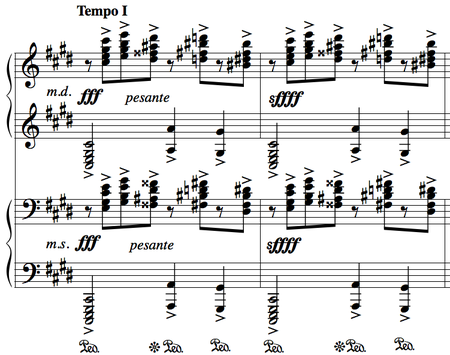
4 staves? Jesus…
“Male propagation of the idea that men, too, are feminine – particularly through feminine behaviour by males – distracts attention from the fact that femininity is a man-made construct, having essentially nothing to do with femaleness.”
-“Gyn/Ecology” Mary Daly p.49


It seems like so few people understand the context of empire and how it affects American foreign policy. Let’s take a quick peek at Greece and how we treat fellow democracies when it comes to maintaining ‘interests of state’.
“In the case of Spain there is some plausibility to the argument that the United States had to deal with the leader that it found there, even if he happened to be a fascist. But the story was different in Greece. We helped bring the militarists to power there, and the legacy of our complicity still poisons Greek attitudes toward the United States. There is probably no democratic public anywhere on earth with more deeply entrenched anti-American views than the Greeks. The roots of these attitudes go back to the birth of the Cold War itself, to the Greek civil war of 1946 – 49 and the U.S. decision embodied by the Truman Doctrine to intervene on the neofascist side because the wartime Greek partisan forces had been Communist-dominated. In 1949, the neofascists won and created a brutal right-wing government protected by the Greek secret police, composed of officers trained in the United States by the wartime Office of Strategic Services and its successor, the CIA.
[…]
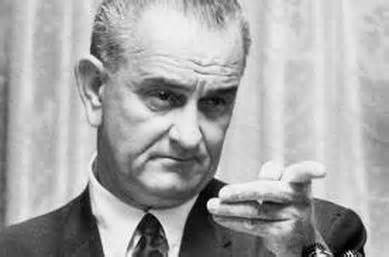
All you need to know from U.S. President Lyndon Baines Johnston about promoting peace and democracy abroad. – “Fuck your parliament and your constitution. We pay a lot of good American dollars to the Greeks. If your prime minister gives me talk about democracy, parliament, and constitution, he, his parliament, and his constitution may not last very long.”
In February of 1964, George Papandreou was elected prime minister by a huge majority. He tried to remain on friendly terms with the the Americans, but President Lyndon Johnson’s White House was pressuring him to sacrifice Greek interests on the disputed island of Cyprus in favour of Turkey, where the United States was also building military bases. Both Greece and Turkey had been members of NATO since 1952, but by the mid – 1960’s the United States seemed more interested in cultivating Turkey. When the Greek ambassador told President Johnson that his proposed solution to the Cyprus dispute was unacceptable to the Greek parliament, Johnson reportedly responded, “Fuck your parliament and your constitution. We pay a lot of good American dollars to the Greeks. If your prime minister gives me talk about democracy, parliament, and constitution, he, his parliament, and his constitution may not last very long.” And they did not.
The CIA, under its Athens station chief, John Muary, immediately began plotting with Greek military officers they had trained and cultivated for over twenty years. In order to create a sense of crisis, the Greek intelligence service, the KYP, carried out an extensive program of terrorist attacks and bombings that it blamed on the left. Constantin Costa-Gavras’s 1969 film, Z, accurately depicts those days. On April 21, 1967, just before the beginning of an election campaign that would have returned Papandreou as prime minister, the military acted. Claiming they were protecting the country from a communist coup, a five-man junta, four of whom had close connections with either the CIA or the U.S. military in Greece, established one of the most repressive regimes sponsored by either side during the Cold War.
The “Greek colonels”, as they came to be known, opened up the country to American missile launch sites and espionage bases, and they donated some $549,000 to the Nixon-Agnew election campaign.
[…]
The leader of the junta, Colonel George Papadopoulos, was an avowed fascist and admirer of Adolf Hitler. He had been trained in the United States during World War II and had been on the CIA payroll for fifteen years preceding the coup. His regime was noted for it’s brutality. During the colonel’s first month in power some 8,000 professionals, students, and others disliked by the junta were seized and tortured. Many were executed. In 1969, the eighteen member countries of the European Commission of Human Rights threatened to expel Greece – it walked out before the commission could act -but even this had no effect on American policies. “
-The Sorrows of Empire – Chalmers Johnson. pp. 204 – 206
Just in case you were unsure of how realpolitik worked and in need of your levels of depression and ennui topped up.
Well let’s file this under practical and useful tips for the ladies…
Of course, as you can see in the video, even dressing in a a garbage bag is no guarantee that you won’t be harassed.
“The effect of chivalry then is to reinforce sex roles, a system geared to the creation of dominant males and submissive females. Students in our “Psychology of Women” classes have routinely argued that the act of a man opening a door for a woman has nothing to do with sexism it’s simply one person being polite to another. If they are right, then men should feel complimented when women (and men) open doors for them. To test this presumption, we ask the women in the class to open doors for men and the men to wait at doors until a woman opens the door for them. We also ask them to record the responses they receive. (we also ask that you the reader do the same). The women learn that there is a sizable minority of men that refuses to go through a door held open for them by a woman, becoming irate if the woman insist on “just being polite.” Even more insulting to men is when a man opens a door for another man. We have to ask ourselves then, why are men insulted when women and/or men open doors for him? The conclusion can only be that the man that is allowing the door to be opened for him is then forced into the role of being passive and thereby forcing him in the role as “female” and this is perceived by the man as demeaning.
Once we turn the tables and women do “chivalrous” acts for men, we find out quickly that “chivalry” is a social norm that is invisible until you violate it.“ – Dee. L. Graham, Loving to Survive

Accept this innocuous challenge ladies? Report back in the comments section, if you dare… :)
I can’t say I disagree with the little man from Shawinigan.
“In 2003, to the dismay of our American and British allies, we refused to go to war in Iraq because the UN refused its consent to what is now universally acknowledged as a big mistake. Canada was noticed and respected for this decision.
However, since then something has happened to Canada’s international reputation. I fear it has been altered and damaged for a long time. In 2010, for the first time, Canada’s bid for a seat on the Security Council of the United Nations was defeated. The next year we sent our planes to bomb Libya, and we are now participating militarily in Iraq and Syria.
After the campaign in Libya – which we now know had disastrous consequences in the region – the Harper government trumpeted Canada’s bombing role with a flyover above Parliament Hill to celebrate our “victory.” This is a ritual normally characteristic of conquering and warlike countries.
Today, with great sadness and shame, I am watching Mr. Harper’s cold-hearted reaction to the tragedy of refugees from Syria and Iraq. German Chancellor Angela Merkel has stepped up to the plate, and the world looks upon the generosity of her country with admiration. The same goes for Norway, Sweden and Finland, which have welcomed refugees and do not erect roadblocks to taking them in. Instead they get rid of roadblocks. But not Mr. Harper. He has shamed Canada in the eyes of Canadians and of the international community.
In my travels around the globe, I am regularly asked: What has happened to Canada? What has happened to the advanced, peace-seeking, progressive country Canada once was? What has happened to the country that was a model for peace and stability in a tumultuous world? These questions evoke great sadness in me.
I am sad to see that in fewer than 10 years, the Harper government has tarnished almost 60 years of Canada’s reputation as a builder of peace and progress. During all these years, government leaders, whether Liberal or Progressive Conservative, have sought to understand, engage and influence their international peers, including those with whom they disagreed. They did not try to embarrass or give other countries lessons in good behaviour. Rather, they patiently sought to convince others of the universal values that make our global community a better and safer place to live.”

Oh if we had the handshake now to deal with the Harper foolishness…*pines*
[Source]











 bleatmop
 Mystro


 Dead Wild Roses
Your opinions…