
You are currently browsing the monthly archive for May 2016.
Do not cross paths with this seething pile of birb-rage, if you know what is good for you. :)

The choice of which battles to fight reflects on how one views society and how it is constructed. Here is what going to the root of problem and starting one’s analysis looks like.
“Radical feminists have never denied the agency of women under conditions of oppression. But radical feminists have located women’s agency, women’s making of choices, in resistance to those oppressive institutions, not in women’s assimilation to them. Nowhere in the more “nuanced” feminist liberal literature on choice is women’s resistance to pornography and surrogacy stressed as a sign of women’s agency. What about the agency of women who have testified about their abuse in pornography, risking exposure and ridicule, and often getting it? What about the ex-surrogates who choose to fight for themselves and their children in court, against the far greater economic, legal, and psychological advantages of the sperm donor? If we want to stress women’s agency, let’s look in the right places.”
-Janice G. Raymond. “Sexual and Reproductive Liberalism.”
The Sexual Liberals and the Attack on Feminism. Ed. Dorchen Leidholdt and Janice G. Raymond.
Teachers College Press, 1990. 103-111.
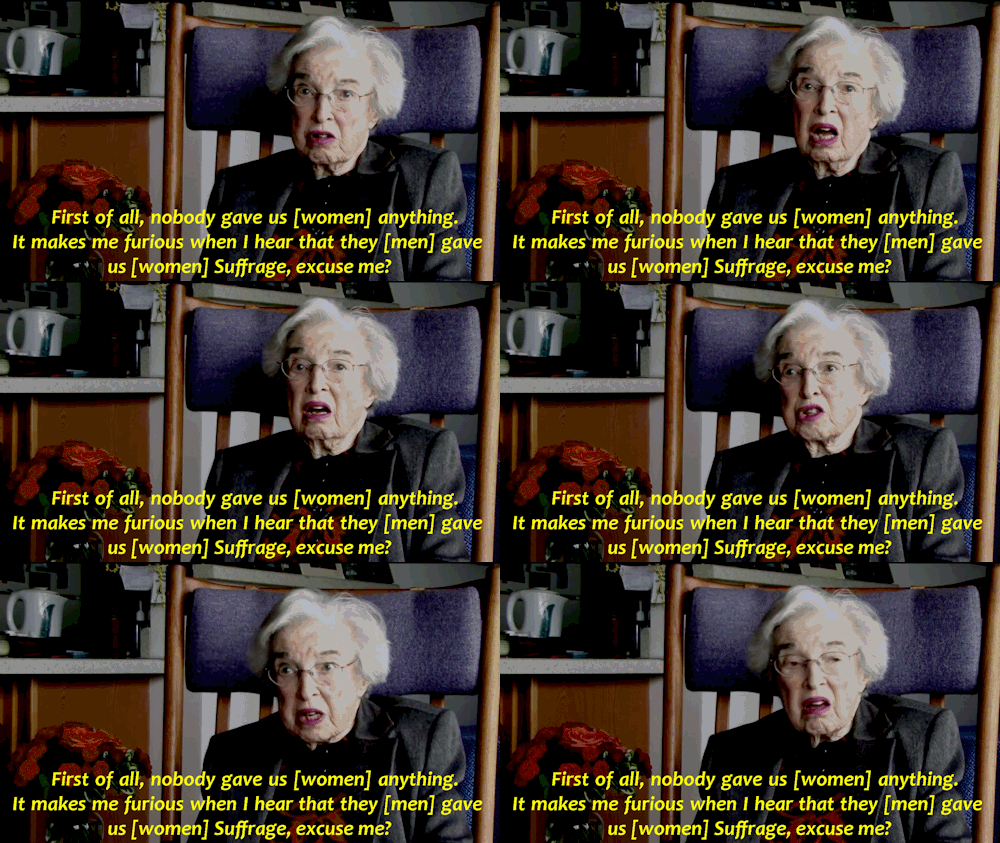


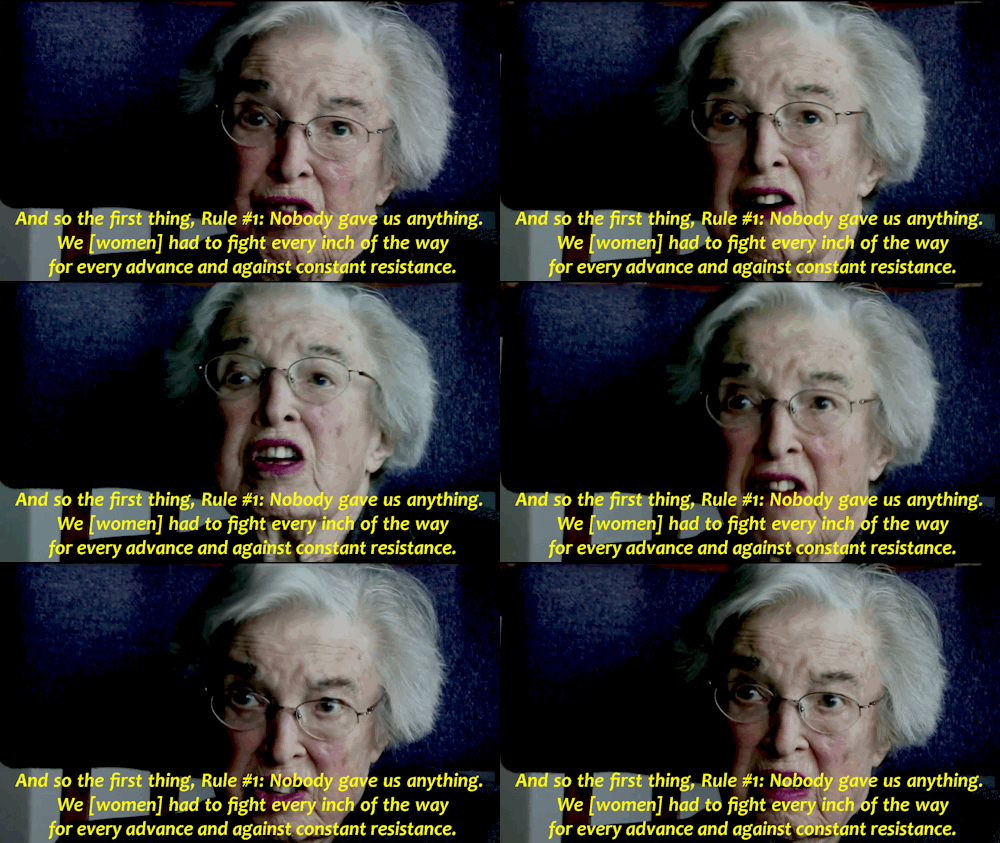
Seventy two years (+) of struggle just to get right to vote, and an uphill battle *all* of the way. Now who exactly was creating such resistance to positive social change? Hmm… now that is quite the puzzle now isn’t it.
Those in power will never willingly concede their power. Not ever. What it takes – organizing, resistance, community are the factors that feminism built up until roughly the end of the Second wave. With the influx of po-mo theory and men – the feminist root manifesto i.e. the liberation of women from the oppressive structures of society – has been all but lost.
So much time has been lost to endless debates over empowerment and identity politics, the entire project steadfastly nonthreatening to the status quo. The radical feminist message is starting to get out again, despite the best efforts of the establishment to silence women who look to the root causes of the oppression of women. The task ahead is, as always, daunting but community is being formed, women are organizing and of course the status quo – is to be questioned, analyzed and ultimately rejected.
Racism isn’t that easy to define. There are two competing meanings and the new, more specific one, is quite controversial once examined.
The Pedagogy of the Meaning of Racism: Reconciling a Discordant Discourse Carlos Hoyt Jr.
“We do our students (white and not white) a disservice by indoctrinating them into a belief system that charges white people with being de facto racists (by virtue of being the beneficiaries of historic and present institutional race-based oppression) while providing an exemption to black people from being held accountable for racist beliefs (racism) or practices (race-based oppression). One of our basic charges as social workers is to affirm that discrimination and oppression based on the accident of one’s condition (whether the condition is one’s appearance (lookism), physical ability (ableism), sex (sexism), sexual orientation (heterosexism), place of origin (xenophobia/ethnocentrism), or socioeconomic status (classism) are patently and intolerably unjust.
In defining and describing the types of social bias and injustice we confront and aim to dispel, we are obliged to observe nuance when it is relevant to a thorough understanding of a phenomenon under consideration. The minute that one human being is treated unequally by another, without legitimate basis for the unequal treatment, there is injustice, but until the motivation for that unjust treatment is determined to be a belief in the superiority or inferiority of races, the mistreatment cannot reasonably be labeled as racist.
There are, unfortunately, many factors that can derail reason and lead to irrational unjust behavior (personal enmity, fear of the unfamiliar, the perception of threat, social conditioning, any of the isms listed earlier). When the flaw is a belief in race as a legitimate reason to discriminate, it is racism. When racism is enacted to subjugate or disenfranchise others, it is oppression; when the source of the power is systemic, structural, or institutional, it is race-based institutional oppression.”
I highly recommend reading the paper in its entirety as Hoyt Jr lays out the arguments for the redefinition versus the original meaning of racism.

As the fire continues to rage around Fort McMurray, Alberta, it’s natural to want to help, and Albertans – and Canadians, and others around the world, are stepping up in a heart-opening outpouring of generosity. Over and over again, authorities have emphasized, the best thing you can do is donate to the Red Cross or other NGO involved in the effort. Donating goods, or showing up uninvited to volunteer, can often cause more trouble to those on the ground, than your heartfelt contribution can ever be worth to them. Edward McIntyre, who was involved in disaster relief efforts in the Slave Lake fire in 2011, and the Calgary floods in 2013, explains why, in his piece, When Helping Hurts: Why you should never donate physical goods during a disaster:
[…]why more organizations don’t accept physical goods. Here are a few reasons why:
- Warehouseing and sorting donated goods is a logistical nightmare
- Individuals affected often don’t have anywhere to store donated items
- The majority of donated items are not fit for redistribution for health and safety concerns
- Costs for shipping & storing donated items often outweigh the cost of buying new
- Donations rarely fill the actual need at the moment
- NGO’s such as the Red Cross have pre-existing agreements in place to fulfill the basic needs of food, shelter & clothing
- The collective buying power of an NGO can stretch your dollar further
In Slave Lake, for example, many generously and sincerely donated items ended up having to go to the landfill for these reasons.
Volunteering without a clear plan can also cause problems, especially when conditions are life-threatening: rather than helping, unsolicited volunteers can take trained workers’ attention off the job at hand, and onto wrangling people. And if conditions turn dire, it can just mean more people to rescue.
So what can you do that will actually help? McIntyre suggests:
1. Make a financial donation to an NGO involved in the relief effort
We always have a hard time with when it comes to giving financially to an organization but this is the absolute best thing you can do. The Canadian Red Cross does need assessments on every individual and endeavors to provide for their specific needs. This includes getting them back to work by providing items like work boots and specially items such as prescription eyewear or medical aids. Their support often stretches out for years and when you donate to an financial appeal the money is earmarked for that and only that.
2. Help others on an individual basis
If you see a direct ask or need from a family or individual and you have the means to provide it, please do so. Just be cautious about spreading the word and collecting more then they need.
3. Volunteer
This can be tricky as everyone wants to help but in these times skilled and highly trained individuals are required. Keep an eye our for calls for volunteers from reputable organizations and remember that volunteers will be needed for months to come.
4. Thank the Volunteers
I can tell you from personal experience that volunteering during a disaster is extremely taxing. You work long hours, get very little sleep and being there for people effected means you also carry their emotional burden. Volunteers may not always be willing to talk about their experiences but taking the time to thank them for their service can provide much needed energy and prevent burnout. During the Slave Lake fires comedian Tracy Morgan invited volunteers to attend his show free of charge and it gave me the mental break I needed to push through another week.
One doubt people often express about donating cash to charitable organizations is that these organizations will use some of their donation for administration and/or fundraising, rather than their money going to those in need. It’s a valid concern; relying as it does on the goodness of people’s hearts, the charitable sector is ripe for exploitation by the greedy and unscrupulous. But, having examined the audited financial statements of literally hundreds of charitable organizations as part of my work in a previous job, I can tell you that while it does happen, it’s exceedingly rare. And between that broad exposure, and my specific experience volunteering for a variety of charitable organizations from tiny to very large, I can also tell you, that having some of your donation go to administration and fundraising expenses, is actually a Very Good Thing.
Some charitable organizations are very small, and have no, or almost no, administration and fundraising costs, because they’re basically just a handful of passionate, dedicated volunteers. Never underestimate the good these small organizations can do – it can be amazing! But as an organization grows and develops, and becomes capable of bigger things, it needs more and more time from skilled people to keep it running, both at its charitable purpose and also behind the scenes. And if you want significant, ongoing contributions of time from people with specialized skills, you eventually have to start paying them.
Probably the first paid position you’ll have is an office person. Somebody to answer the phone, handle the mail, manage the financials and the website, coordinate the volunteers – and that person is fundamentally necessary to growing your organization and keeping it running smoothly, but because she’s not involved directly in doing the organization’s actual charitable work, you have to count her pay as an administrative expense.
Or maybe you have some paid staff who do specialized work towards the organizations’ charitable purpose. That’s great, you can count their pay as a program expense. But who handles their payroll and human resource needs? Do you take them away from their specialized work, and make them double as HR and payroll, or do you get a HR person? Guess what, she’s an administrative expense too, even though without her, nobody would get paid, and so nobody who needs money to eat would be coming to work for very long.
As your organization grows further, your one office person is going to get progressively overworked, and if you don’t get her some help, she’ll quit. So maybe now you have an admin support person, and a web person, and a volunteer coordinator, and a HR person, and a financial person – and at this point you’ve got enough people that you probably need a manager or a director. All administrative expenses. Grow enough, and those individuals eventually become teams, all of which need team leads, who in turn need somebody to coordinate them. And whether it’s helping homeless animals or running a symphony orchestra, even though none of these people may ever touch a dog or a violin, and have to be counted as administrative expenses, without them the organization wouldn’t be able to function at its present level of scope and complexity. Paying for specialized people to invisibly support the visible work of the charitable organization, is not a misdirection of your donation, or the charity “keeping” some of your money; it’s an investment in the organization’s continued effectiveness.
Pithy definitions for us today folks. :)

Sooooooo… I need someone to tell me how morality springs from said book again, I seem to have forgotten how that works, given the source material.











 bleatmop
 Mystro


 Dead Wild Roses
Your opinions…